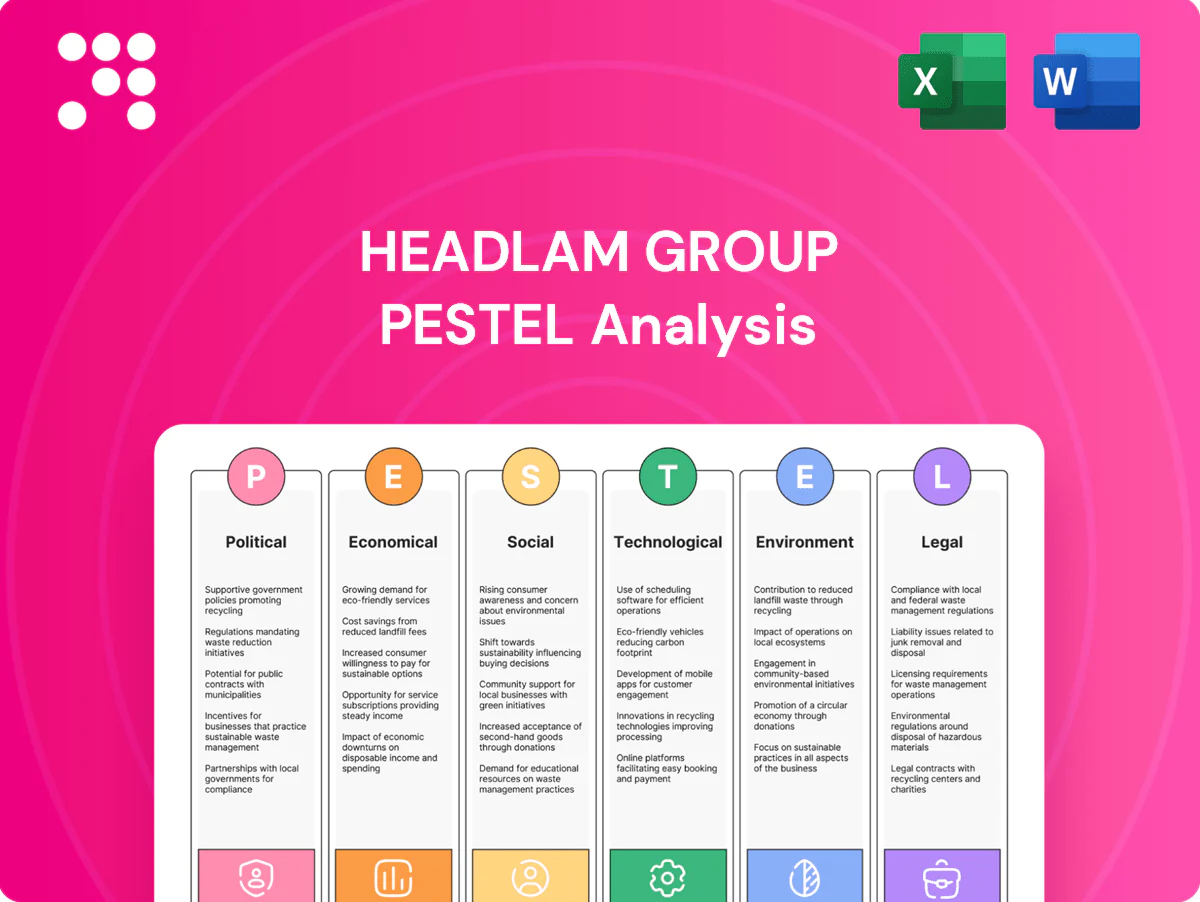
Headlam Group PESTLE Analysis

Make Smarter Strategic Decisions with a Complete PESTEL View
Unlock strategic clarity with our PESTLE Analysis of Headlam Group—three concise sections reveal how political shifts, economic cycles, and environmental trends affect margins and growth. Ideal for investors and strategists, this ready-to-use report pinpoints risks and opportunities. Purchase the full analysis to get actionable insights and editable files for immediate use.
Political factors

UK trade and customs post-Brexit
Since new UK–EU customs declarations and rules of origin came into force on 1 January 2021 and full import controls were phased in by 2023, Headlam faces higher paperwork and potential duty exposure that can raise import costs and lead times. The group must manage customs compliance across UK and Continental hubs to avoid delays. Delays risk breaching service-level commitments to retailers and contractors. Active brokerage partnerships and inventory buffering mitigate disruption.
Public spending on housing and infrastructure
Government stimulus or austerity in housing, schools and healthcare—driven by EU NextGenerationEU funds of €806.9bn and UK levelling-up allocations (approx £4.8bn rounds)—shifts commercial flooring demand between refurbishment and new-build segments. Public procurement frameworks increasingly mandate sustainability standards such as BREEAM and Level(s), favouring specific product specs and EPDs. Headlam should align ranges, achieve relevant certifications and price for public-tender rules. Regional funding asymmetry across UK devolved nations and EU member states creates uneven demand patterns.

Trade policy and tariffs on materials
Policy shifts on tariffs for timber, vinyl and chemical inputs (tariff changes of 10% or more in past trade disputes) directly squeeze Headlam’s margins by raising input costs and passing volatility to selling prices. Geopolitical tensions and sanctions have rerouted EU/UK timber and PVC shipments, lengthening lead times and raising logistics costs. Hedging contracts and multi-sourcing reduced exposure to sudden spikes, while industry advocacy (via BMF and FIS) seeks favorable tariff outcomes.

Regional political stability in supplier countries
Political risk in sourcing nations for wood, resins and textiles can sharply disrupt availability through export restrictions, industrial action and border delays; strikes and sudden licensing controls have repeatedly delayed shipments to UK distributors. Headlam's diversified supplier network across Europe and Asia increases resilience, while scenario planning and dual-sourcing support continuity of service.
- Supply disruption: export controls/strikes
- Diversification: Europe + Asia suppliers
- Mitigation: scenario planning & dual sourcing
Local planning and building standards policy
Local planning and building-standards policy directly gates renovation and commercial fit-out timing via planning approvals and conditions, affecting Headlam Group order pipelines and logistics. Policy incentives for energy-efficient retrofits, through schemes such as HUG and ECO, have driven demand toward resilient, low-VOC and thermal-performance flooring. Headlam can align product lines and bids to retrofit grant criteria and must have sales teams tracking regional policy calendars and grant rounds.
- Track local planning approvals to anticipate project flow
- Target HUG/ECO-aligned products for retrofit demand
- Focus on low-VOC, insulated flooring specs
- Monitor regional grant calendars and procurement windows
Customs frictions raise lead times; public funds €806.9bn boost low-VOC demand
Post-2021/2023 UK–EU customs and import controls raise paperwork, duties and lead times, risking SLAs; Headlam uses brokers and inventory buffers. Public funding (NextGenerationEU €806.9bn; UK levelling-up ~£4.8bn) plus HUG/ECO shift demand to low-VOC/BREEAM products. Tariff swings (~10%) and sourcing restrictions increase cost volatility; hedging and multi-sourcing mitigate.
| Metric | Value |
|---|---|
| NextGenerationEU | €806.9bn |
| UK levelling-up | £4.8bn |
| Tariff swing (historical) | ~10% |
What is included in the product
 Detailed Word Document
Explores how Political, Economic, Social, Technological, Environmental and Legal forces uniquely affect Headlam Group’s flooring distribution and retail operations, with data-backed trends, forward-looking scenarios and specific sub-points to inform strategy, risk mitigation and investor-facing materials.

 Customizable Excel Spreadsheet
A concise, visually segmented PESTLE summary for Headlam Group that quickly highlights external risks and opportunities, easing meeting prep and strategic alignment across teams.
Economic factors

Construction and housing cycle sensitivity
Residential transactions near 1.0m in 2023 (HMRC) and England new-build completions around 244k in 2023/24 (DLUHC) drive Headlam volumes; slowdowns cut discretionary upgrades such as LVT and engineered wood, while counter-cyclical repair works and social housing contracts partly offset declines, and flexible cost structures have helped protect margins in recent downturns.
Inflation, interest rates, and consumer confidence
Rising input and borrowing costs—Bank of England Bank Rate at 5.25%—squeeze Headlam’s margins and working capital while also pressuring trade customers. Higher rates and weak consumer confidence (GfK UK index around -20) dampen big-ticket home improvements, driving trade-down to value ranges. Headlam’s price architecture and good-better-best assortments mitigate churn, while dynamic pricing and faster inventory turns are critical in volatile periods.

FX exposure (GBP/EUR and USD-linked inputs)
Imports priced in EUR and USD expose Headlam’s COGS to currency swings given 2024 average FX levels (GBP/EUR ~1.17, GBP/USD ~1.27), increasing margin volatility. Natural hedging from euro-denominated revenues and active financial hedges (forwards/options) can stabilise gross margins. Transparent surcharges allow partial pass-through to trade customers. Contract terms should include FX adjustment clauses where viable.

Energy and transport costs
Warehousing, distribution and supplier manufacturing are energy intensive; UK industrial electricity averaged ≈£0.18/kWh in 2024 and European TTF gas eased to ≈€35/MWh in 2024.
- Fuel/freight volatility: global container rates fell ~80% from 2022 peaks to 2024 (Drewry)
- UK diesel ~£1.63/L (2024)
- Route optimization and fleet efficiency protect service levels
- Supplier energy surcharges require controlled pass-through
Consolidation among retailers and contractors
Customer consolidation raises buyer bargaining power and rebate demands; Headlam reported revenue of £624.9m in FY2024, highlighting exposure to large-account negotiating leverage.
Large accounts increasingly require bespoke logistics and EDI integration, raising fixed-cost servicing requirements and IT investment.
Long-tail independents still need credit, training and delivery support; maintaining a balanced mix keeps customer concentration risk lower.
- Top-customer risk: diversification reduces revenue concentration
- EDI/logistics: higher fixed servicing costs
- Independents: margin and credit support needed
Customs frictions raise lead times; public funds €806.9bn boost low-VOC demand
Residential transactions ~1.0m (2023) and 244k new-builds (2023/24) drive volumes; weak confidence and BoE rate 5.25% curb upgrades while repair/social housing partly offset. FX (GBP/EUR ~1.17, GBP/USD ~1.27) and input inflation pressure margins; energy £0.18/kWh, diesel £1.63/L. Customer consolidation raises rebate/EDI demands; FY2024 revenue £624.9m highlights account exposure.
| Metric | Value |
|---|---|
| Residential transactions (2023) | ~1.0m |
| New-builds (2023/24) | 244k |
| Bank Rate | 5.25% |
| FY2024 Revenue | £624.9m |
| GBP/EUR | ~1.17 |
| GBP/USD | ~1.27 |
| UK industrial electricity (2024) | £0.18/kWh |
| UK diesel (2024) | £1.63/L |
| Container rates change | ~-80% vs 2022 |
Same Document Delivered
Headlam Group PESTLE Analysis
The preview shown here is the exact Headlam Group PESTLE Analysis you’ll receive after purchase—fully formatted and ready to use. The content, structure and layout are identical to the downloadable file. No placeholders or surprises; this is the final, professional document you’ll own immediately after checkout.

Original: $10.00
-65%$10.00
$3.50Product Information
Product Information
Shipping & Returns
Shipping & Returns
Description
Make Smarter Strategic Decisions with a Complete PESTEL View
Unlock strategic clarity with our PESTLE Analysis of Headlam Group—three concise sections reveal how political shifts, economic cycles, and environmental trends affect margins and growth. Ideal for investors and strategists, this ready-to-use report pinpoints risks and opportunities. Purchase the full analysis to get actionable insights and editable files for immediate use.
Political factors
UK trade and customs post-Brexit
Since new UK–EU customs declarations and rules of origin came into force on 1 January 2021 and full import controls were phased in by 2023, Headlam faces higher paperwork and potential duty exposure that can raise import costs and lead times. The group must manage customs compliance across UK and Continental hubs to avoid delays. Delays risk breaching service-level commitments to retailers and contractors. Active brokerage partnerships and inventory buffering mitigate disruption.
Public spending on housing and infrastructure
Government stimulus or austerity in housing, schools and healthcare—driven by EU NextGenerationEU funds of €806.9bn and UK levelling-up allocations (approx £4.8bn rounds)—shifts commercial flooring demand between refurbishment and new-build segments. Public procurement frameworks increasingly mandate sustainability standards such as BREEAM and Level(s), favouring specific product specs and EPDs. Headlam should align ranges, achieve relevant certifications and price for public-tender rules. Regional funding asymmetry across UK devolved nations and EU member states creates uneven demand patterns.
Trade policy and tariffs on materials
Policy shifts on tariffs for timber, vinyl and chemical inputs (tariff changes of 10% or more in past trade disputes) directly squeeze Headlam’s margins by raising input costs and passing volatility to selling prices. Geopolitical tensions and sanctions have rerouted EU/UK timber and PVC shipments, lengthening lead times and raising logistics costs. Hedging contracts and multi-sourcing reduced exposure to sudden spikes, while industry advocacy (via BMF and FIS) seeks favorable tariff outcomes.
Regional political stability in supplier countries
Political risk in sourcing nations for wood, resins and textiles can sharply disrupt availability through export restrictions, industrial action and border delays; strikes and sudden licensing controls have repeatedly delayed shipments to UK distributors. Headlam's diversified supplier network across Europe and Asia increases resilience, while scenario planning and dual-sourcing support continuity of service.
- Supply disruption: export controls/strikes
- Diversification: Europe + Asia suppliers
- Mitigation: scenario planning & dual sourcing
Local planning and building standards policy
Local planning and building-standards policy directly gates renovation and commercial fit-out timing via planning approvals and conditions, affecting Headlam Group order pipelines and logistics. Policy incentives for energy-efficient retrofits, through schemes such as HUG and ECO, have driven demand toward resilient, low-VOC and thermal-performance flooring. Headlam can align product lines and bids to retrofit grant criteria and must have sales teams tracking regional policy calendars and grant rounds.
- Track local planning approvals to anticipate project flow
- Target HUG/ECO-aligned products for retrofit demand
- Focus on low-VOC, insulated flooring specs
- Monitor regional grant calendars and procurement windows
Customs frictions raise lead times; public funds €806.9bn boost low-VOC demand
Post-2021/2023 UK–EU customs and import controls raise paperwork, duties and lead times, risking SLAs; Headlam uses brokers and inventory buffers. Public funding (NextGenerationEU €806.9bn; UK levelling-up ~£4.8bn) plus HUG/ECO shift demand to low-VOC/BREEAM products. Tariff swings (~10%) and sourcing restrictions increase cost volatility; hedging and multi-sourcing mitigate.
| Metric | Value |
|---|---|
| NextGenerationEU | €806.9bn |
| UK levelling-up | £4.8bn |
| Tariff swing (historical) | ~10% |
What is included in the product
Detailed Word Document
Explores how Political, Economic, Social, Technological, Environmental and Legal forces uniquely affect Headlam Group’s flooring distribution and retail operations, with data-backed trends, forward-looking scenarios and specific sub-points to inform strategy, risk mitigation and investor-facing materials.
Customizable Excel Spreadsheet
A concise, visually segmented PESTLE summary for Headlam Group that quickly highlights external risks and opportunities, easing meeting prep and strategic alignment across teams.
Economic factors
Construction and housing cycle sensitivity
Residential transactions near 1.0m in 2023 (HMRC) and England new-build completions around 244k in 2023/24 (DLUHC) drive Headlam volumes; slowdowns cut discretionary upgrades such as LVT and engineered wood, while counter-cyclical repair works and social housing contracts partly offset declines, and flexible cost structures have helped protect margins in recent downturns.
Inflation, interest rates, and consumer confidence
Rising input and borrowing costs—Bank of England Bank Rate at 5.25%—squeeze Headlam’s margins and working capital while also pressuring trade customers. Higher rates and weak consumer confidence (GfK UK index around -20) dampen big-ticket home improvements, driving trade-down to value ranges. Headlam’s price architecture and good-better-best assortments mitigate churn, while dynamic pricing and faster inventory turns are critical in volatile periods.
FX exposure (GBP/EUR and USD-linked inputs)
Imports priced in EUR and USD expose Headlam’s COGS to currency swings given 2024 average FX levels (GBP/EUR ~1.17, GBP/USD ~1.27), increasing margin volatility. Natural hedging from euro-denominated revenues and active financial hedges (forwards/options) can stabilise gross margins. Transparent surcharges allow partial pass-through to trade customers. Contract terms should include FX adjustment clauses where viable.
Energy and transport costs
Warehousing, distribution and supplier manufacturing are energy intensive; UK industrial electricity averaged ≈£0.18/kWh in 2024 and European TTF gas eased to ≈€35/MWh in 2024.
- Fuel/freight volatility: global container rates fell ~80% from 2022 peaks to 2024 (Drewry)
- UK diesel ~£1.63/L (2024)
- Route optimization and fleet efficiency protect service levels
- Supplier energy surcharges require controlled pass-through
Consolidation among retailers and contractors
Customer consolidation raises buyer bargaining power and rebate demands; Headlam reported revenue of £624.9m in FY2024, highlighting exposure to large-account negotiating leverage.
Large accounts increasingly require bespoke logistics and EDI integration, raising fixed-cost servicing requirements and IT investment.
Long-tail independents still need credit, training and delivery support; maintaining a balanced mix keeps customer concentration risk lower.
- Top-customer risk: diversification reduces revenue concentration
- EDI/logistics: higher fixed servicing costs
- Independents: margin and credit support needed
Customs frictions raise lead times; public funds €806.9bn boost low-VOC demand
Residential transactions ~1.0m (2023) and 244k new-builds (2023/24) drive volumes; weak confidence and BoE rate 5.25% curb upgrades while repair/social housing partly offset. FX (GBP/EUR ~1.17, GBP/USD ~1.27) and input inflation pressure margins; energy £0.18/kWh, diesel £1.63/L. Customer consolidation raises rebate/EDI demands; FY2024 revenue £624.9m highlights account exposure.
| Metric | Value |
|---|---|
| Residential transactions (2023) | ~1.0m |
| New-builds (2023/24) | 244k |
| Bank Rate | 5.25% |
| FY2024 Revenue | £624.9m |
| GBP/EUR | ~1.17 |
| GBP/USD | ~1.27 |
| UK industrial electricity (2024) | £0.18/kWh |
| UK diesel (2024) | £1.63/L |
| Container rates change | ~-80% vs 2022 |
Same Document Delivered
Headlam Group PESTLE Analysis
The preview shown here is the exact Headlam Group PESTLE Analysis you’ll receive after purchase—fully formatted and ready to use. The content, structure and layout are identical to the downloadable file. No placeholders or surprises; this is the final, professional document you’ll own immediately after checkout.