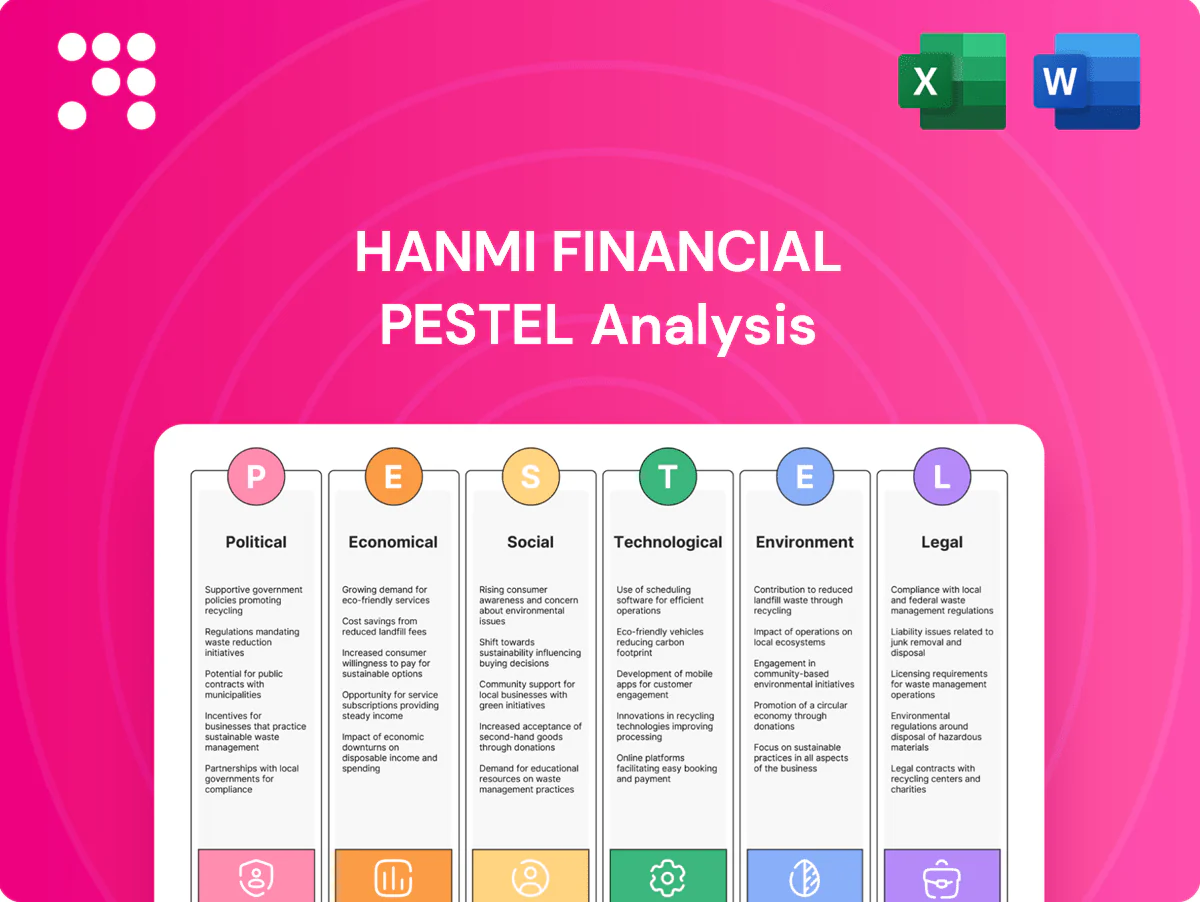
Hanmi Financial PESTLE Analysis

Make Smarter Strategic Decisions with a Complete PESTEL View
Our Hanmi Financial PESTLE highlights how regulatory shifts, regional economic trends, and evolving fintech disruptors shape the bank's prospects, with clear implications for risk and growth strategies. Ideal for investors and strategists needing concise external intelligence. Purchase the full analysis to access the complete, actionable breakdown.
Political factors

Regulatory oversight intensity
As a bank holding company (NASDAQ: HAFC) supervised by the Federal Reserve, FDIC and state regulators, Hanmi faces rules shaping capital, liquidity and risk appetite; regulators' 2024 emphasis on CRE concentration, interest-rate risk and liquidity governance can tighten underwriting or raise compliance costs, constraining growth and dividend flexibility for its roughly $8 billion asset base.
SBA and community banking policy
Policy support for SBA lending directly shapes Hanmi Financials small-business pipeline and fee income, as SBA 7(a) and CDC/504 availability drives origination volumes. Changes to SBA guarantees, fees, or borrower eligibility can materially boost or reduce loan demand and secondary market pricing. Community bank regulatory relief lowers Hanmi’s compliance costs and improves competitiveness, while targeted federal support for minority depository institutions offers potential capital and programmatic tailwinds.

US–Asia policy and diaspora ties
US–Korea trade and investment ties—two-way goods and services trade around $154 billion in recent years—directly affect Hanmi Financial’s cross-border client activity; tightened U.S. export controls on advanced semiconductors and sanctions regimes complicate financing for affected sectors. Strong bilateral relations and rising Korean FDI into the U.S. expand C&I lending opportunities, while visa rules (H-1B cap 85,000) and a Korean-American population ~1.9 million shape deposit and mortgage demand.

Fiscal policy and public programs
Government spending and tax policy shape SME demand and household liquidity; PPP provided roughly 800 billion dollars in 2020 and similar support in downturns can stabilize Hanmi Financial’s small‑business credit performance. Federal deficits remained elevated—about 1.7 trillion dollars in FY2024—so fiscal tightening would pressure small‑business cash flows and local demand.
- PPP support: 800 billion
- FY2024 deficit: ~1.7 trillion
- Tightening → lower SME cash flow
- Municipal health alters local markets
Political stability and confidence
Macropolitical uncertainty, such as policy shifts and geopolitical tensions, dampens business sentiment and can reduce SME loan demand, slowing Hanmi Financials origination volumes.
Election cycles often delay SME investment decisions, compressing near-term fee income from commercial lending and capital markets activity.
Confidence-sensitive deposits may migrate to perceived safe havens during turbulence, raising funding-cost volatility; conversely, political stability supports steadier origination and fee income.
- Macropolitical uncertainty — lower SME loan demand
- Election cycles — delayed SME investments
- Deposit flight — shifts to safe havens
- Stability — steadier origination and fees
Regulatory, rate and SBA shocks hit $8B; US-Korea $154B
Regulatory focus (Fed/FDIC/state) on CRE, interest‑rate and liquidity risk raises compliance costs and could limit growth for Hanmi (~$8B assets). SBA policy and SBA-backed lending volumes drive SME origination and fee income; changes to guarantees/fees shift demand. US–Korea ties (trade ~$154B, Korean‑American ~1.9M) and visa policy (H‑1B cap 85,000) shape cross‑border lending and deposits.
| Metric | Value |
|---|---|
| Assets | $8B |
| US–Korea trade | $154B |
| PPP 2020 | $800B |
| FY2024 deficit | $1.7T |
What is included in the product
 Detailed Word Document
Explores how Political, Economic, Social, Technological, Environmental and Legal forces uniquely affect Hanmi Financial, with data-backed trends and region-specific examples; designed for executives and advisors to identify risks, opportunities and forward-looking scenarios for strategic planning, funding and competitive positioning.

 Customizable Excel Spreadsheet
A concise, visually segmented PESTLE summary of Hanmi Financial that simplifies external risk assessment and market positioning, easily editable for region or business-line notes and drop-ready for presentations or team alignment.
Economic factors

Interest rate trajectory
Net interest margin for Hanmi pivots on Fed policy—federal funds were 5.25–5.50% at the June 2024 peak—and deposit betas; rapid hiking cycles raise funding costs and reprice CRE/C&I risk given Hanmi’s California-heavy commercial loan book. Easing cycles can compress margins but typically improve credit quality and support loan growth. Robust asset–liability management is pivotal to earnings stability.
CRE market health
Hanmi's exposure to retail, multifamily and office CRE concentrates credit risk as valuation declines and refinancing gaps boost potential loss content; U.S. office markets like San Francisco saw vacancy rates above 30% in 2024. Maturing CRE debt through 2024–25 (roughly $1 trillion) tightens refinancing windows. California and core geographies drive localized stress, and heightened regulatory scrutiny of CRE concentrations limits growth options.

SME cycle and employment
Small-business revenue trends drive Hanmi’s loan demand and repayment capacity given small firms employ about 47% of the U.S. private workforce (SBA). Tight labor markets (U.S. unemployment 3.7% June 2025) raise client payroll costs but support consumer deposits. Recessions historically lift delinquencies and compress fee income; Hanmi’s concentration in services and construction amplifies this cyclicality.

Deposit competition and liquidity
Deposit competition from larger banks and money market funds (assets about $5.5 trillion in 2024) has raised deposit costs and pressured regional margins. Stable community relationships can mitigate runoff and preserve lower-cost core deposits. Strong liquidity coverage and contingency funding plans are essential under stress. Disciplined pricing steers the trade-off between growth and margin.
- Money market assets ~5.5T (2024)
- Core deposits provide runoff protection
- Liquidity & contingency plans required
- Pricing discipline impacts growth vs margin
Korean-American market dynamics
Korean-American entrepreneurship and higher-than-average household incomes underpin demand for Hanmi Financial: the 2020 US Census counted about 1.9 million Korean-Americans and 2021 ACS data reports median Korean-American household income near $69,000, while self-employment and small-business ownership remain elevated in trade, services and retail, concentrating sector risk and deposit flows.
- Remittances/FX: cross-border flows create fee revenue.
- Concentration risk: trade, services, retail exposure.
- Regional shifts: diaspora hub dynamics affect branch productivity.
Regulatory, rate and SBA shocks hit $8B; US-Korea $154B
Fed policy (federal funds 5.25–5.50% at the June 2024 peak) plus deposit beta drive NIM volatility; CRE refinancing (~$1T maturing 2024–25) and CA office stress (SF vacancy >30% in 2024) raise credit risk. Unemployment 3.7% (June 2025) supports deposits but lifts payroll costs; money market assets ~5.5T (2024) heighten deposit competition.
| Metric | Value |
|---|---|
| Fed funds (peak) | 5.25–5.50% |
| Unemployment | 3.7% (Jun 2025) |
| MM Funds | $5.5T (2024) |
| CRE maturing | ~$1T (2024–25) |
Full Version Awaits
Hanmi Financial PESTLE Analysis
The preview shown here is the exact Hanmi Financial PESTLE Analysis document you’ll receive after purchase—fully formatted and ready to use. The layout, content, and structure visible are identical to the downloadable file. No placeholders or surprises.

Product Information
Product Information
Shipping & Returns
Shipping & Returns
Description
Make Smarter Strategic Decisions with a Complete PESTEL View
Our Hanmi Financial PESTLE highlights how regulatory shifts, regional economic trends, and evolving fintech disruptors shape the bank's prospects, with clear implications for risk and growth strategies. Ideal for investors and strategists needing concise external intelligence. Purchase the full analysis to access the complete, actionable breakdown.
Political factors
Regulatory oversight intensity
As a bank holding company (NASDAQ: HAFC) supervised by the Federal Reserve, FDIC and state regulators, Hanmi faces rules shaping capital, liquidity and risk appetite; regulators' 2024 emphasis on CRE concentration, interest-rate risk and liquidity governance can tighten underwriting or raise compliance costs, constraining growth and dividend flexibility for its roughly $8 billion asset base.
SBA and community banking policy
Policy support for SBA lending directly shapes Hanmi Financials small-business pipeline and fee income, as SBA 7(a) and CDC/504 availability drives origination volumes. Changes to SBA guarantees, fees, or borrower eligibility can materially boost or reduce loan demand and secondary market pricing. Community bank regulatory relief lowers Hanmi’s compliance costs and improves competitiveness, while targeted federal support for minority depository institutions offers potential capital and programmatic tailwinds.
US–Asia policy and diaspora ties
US–Korea trade and investment ties—two-way goods and services trade around $154 billion in recent years—directly affect Hanmi Financial’s cross-border client activity; tightened U.S. export controls on advanced semiconductors and sanctions regimes complicate financing for affected sectors. Strong bilateral relations and rising Korean FDI into the U.S. expand C&I lending opportunities, while visa rules (H-1B cap 85,000) and a Korean-American population ~1.9 million shape deposit and mortgage demand.
Fiscal policy and public programs
Government spending and tax policy shape SME demand and household liquidity; PPP provided roughly 800 billion dollars in 2020 and similar support in downturns can stabilize Hanmi Financial’s small‑business credit performance. Federal deficits remained elevated—about 1.7 trillion dollars in FY2024—so fiscal tightening would pressure small‑business cash flows and local demand.
- PPP support: 800 billion
- FY2024 deficit: ~1.7 trillion
- Tightening → lower SME cash flow
- Municipal health alters local markets
Political stability and confidence
Macropolitical uncertainty, such as policy shifts and geopolitical tensions, dampens business sentiment and can reduce SME loan demand, slowing Hanmi Financials origination volumes.
Election cycles often delay SME investment decisions, compressing near-term fee income from commercial lending and capital markets activity.
Confidence-sensitive deposits may migrate to perceived safe havens during turbulence, raising funding-cost volatility; conversely, political stability supports steadier origination and fee income.
- Macropolitical uncertainty — lower SME loan demand
- Election cycles — delayed SME investments
- Deposit flight — shifts to safe havens
- Stability — steadier origination and fees
Regulatory, rate and SBA shocks hit $8B; US-Korea $154B
Regulatory focus (Fed/FDIC/state) on CRE, interest‑rate and liquidity risk raises compliance costs and could limit growth for Hanmi (~$8B assets). SBA policy and SBA-backed lending volumes drive SME origination and fee income; changes to guarantees/fees shift demand. US–Korea ties (trade ~$154B, Korean‑American ~1.9M) and visa policy (H‑1B cap 85,000) shape cross‑border lending and deposits.
| Metric | Value |
|---|---|
| Assets | $8B |
| US–Korea trade | $154B |
| PPP 2020 | $800B |
| FY2024 deficit | $1.7T |
What is included in the product
Detailed Word Document
Explores how Political, Economic, Social, Technological, Environmental and Legal forces uniquely affect Hanmi Financial, with data-backed trends and region-specific examples; designed for executives and advisors to identify risks, opportunities and forward-looking scenarios for strategic planning, funding and competitive positioning.
Customizable Excel Spreadsheet
A concise, visually segmented PESTLE summary of Hanmi Financial that simplifies external risk assessment and market positioning, easily editable for region or business-line notes and drop-ready for presentations or team alignment.
Economic factors
Interest rate trajectory
Net interest margin for Hanmi pivots on Fed policy—federal funds were 5.25–5.50% at the June 2024 peak—and deposit betas; rapid hiking cycles raise funding costs and reprice CRE/C&I risk given Hanmi’s California-heavy commercial loan book. Easing cycles can compress margins but typically improve credit quality and support loan growth. Robust asset–liability management is pivotal to earnings stability.
CRE market health
Hanmi's exposure to retail, multifamily and office CRE concentrates credit risk as valuation declines and refinancing gaps boost potential loss content; U.S. office markets like San Francisco saw vacancy rates above 30% in 2024. Maturing CRE debt through 2024–25 (roughly $1 trillion) tightens refinancing windows. California and core geographies drive localized stress, and heightened regulatory scrutiny of CRE concentrations limits growth options.
SME cycle and employment
Small-business revenue trends drive Hanmi’s loan demand and repayment capacity given small firms employ about 47% of the U.S. private workforce (SBA). Tight labor markets (U.S. unemployment 3.7% June 2025) raise client payroll costs but support consumer deposits. Recessions historically lift delinquencies and compress fee income; Hanmi’s concentration in services and construction amplifies this cyclicality.
Deposit competition and liquidity
Deposit competition from larger banks and money market funds (assets about $5.5 trillion in 2024) has raised deposit costs and pressured regional margins. Stable community relationships can mitigate runoff and preserve lower-cost core deposits. Strong liquidity coverage and contingency funding plans are essential under stress. Disciplined pricing steers the trade-off between growth and margin.
- Money market assets ~5.5T (2024)
- Core deposits provide runoff protection
- Liquidity & contingency plans required
- Pricing discipline impacts growth vs margin
Korean-American market dynamics
Korean-American entrepreneurship and higher-than-average household incomes underpin demand for Hanmi Financial: the 2020 US Census counted about 1.9 million Korean-Americans and 2021 ACS data reports median Korean-American household income near $69,000, while self-employment and small-business ownership remain elevated in trade, services and retail, concentrating sector risk and deposit flows.
- Remittances/FX: cross-border flows create fee revenue.
- Concentration risk: trade, services, retail exposure.
- Regional shifts: diaspora hub dynamics affect branch productivity.
Regulatory, rate and SBA shocks hit $8B; US-Korea $154B
Fed policy (federal funds 5.25–5.50% at the June 2024 peak) plus deposit beta drive NIM volatility; CRE refinancing (~$1T maturing 2024–25) and CA office stress (SF vacancy >30% in 2024) raise credit risk. Unemployment 3.7% (June 2025) supports deposits but lifts payroll costs; money market assets ~5.5T (2024) heighten deposit competition.
| Metric | Value |
|---|---|
| Fed funds (peak) | 5.25–5.50% |
| Unemployment | 3.7% (Jun 2025) |
| MM Funds | $5.5T (2024) |
| CRE maturing | ~$1T (2024–25) |
Full Version Awaits
Hanmi Financial PESTLE Analysis
The preview shown here is the exact Hanmi Financial PESTLE Analysis document you’ll receive after purchase—fully formatted and ready to use. The layout, content, and structure visible are identical to the downloadable file. No placeholders or surprises.











