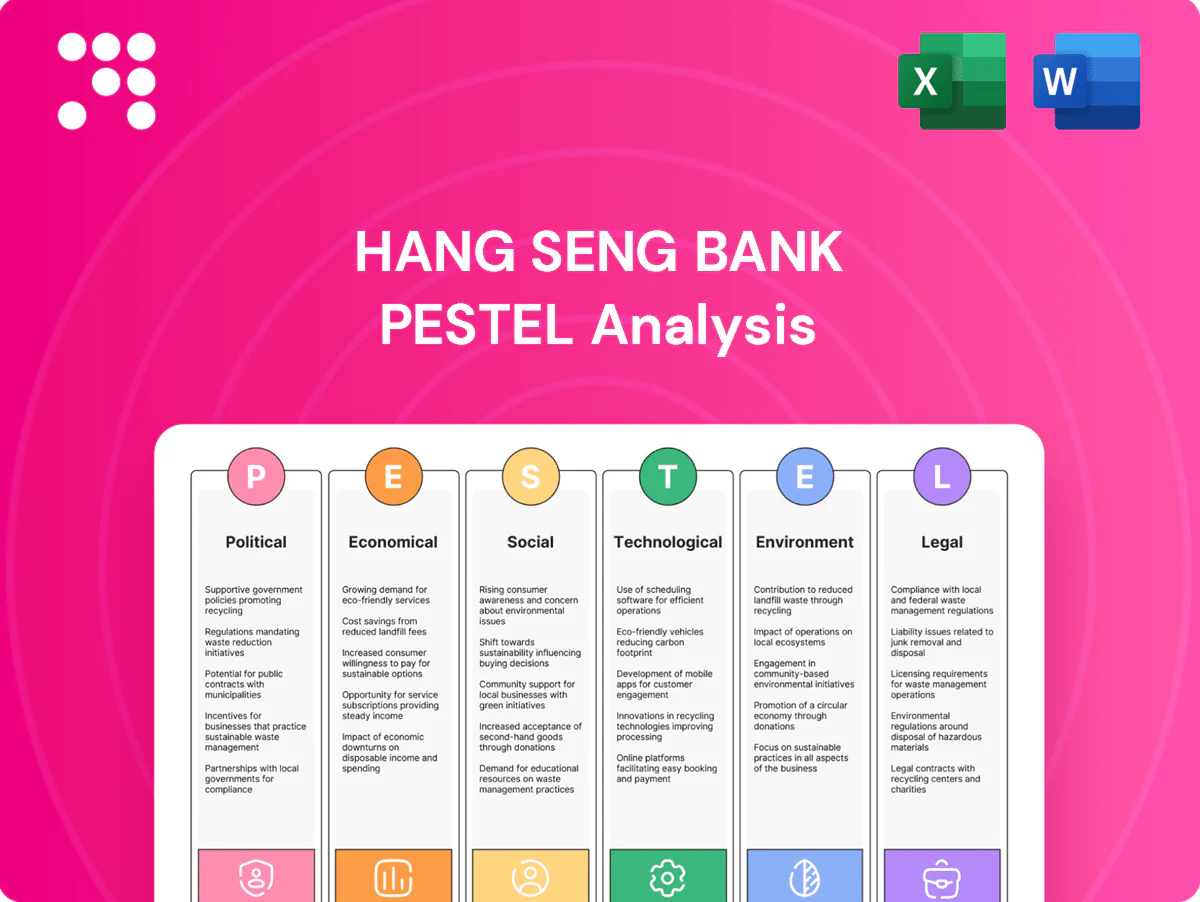
Hang Seng Bank PESTLE Analysis

Make Smarter Strategic Decisions with a Complete PESTEL View
Our PESTLE Analysis of Hang Seng Bank reveals how regulatory shifts, Hong Kong–China economic ties, digital banking trends, and ESG pressures are reshaping its risk and growth profile. Practical, data-driven insights help you anticipate threats and spot opportunities. Purchase the full report for the complete, editable analysis and strategic recommendations.
Political factors

Mainland–Hong Kong policy alignment
Mainland–Hong Kong alignment via the Greater Bay Area (population ~86 million, combined GDP ≈ US$1.7 trillion in 2022) opens sizable cross‑border retail and wealth management corridors for Hang Seng while creating policy dependencies. Programs like Stock/Wealth/Bond Connect materially expand addressable markets and product scope. Sudden shifts in capital controls or quota adjustments can rapidly change flows and fee pools. Proactive compliance and corridor product design are therefore critical.
US–China geopolitical tensions
US–China geopolitical tensions, including expanded US export controls on advanced semiconductors (tightened in 2022–2024) and targeted sanctions, raise counterparty and supply-chain disruption risks that dent investor sentiment and transactional activity. Banks face higher compliance workloads as KYC/AML screening intensifies, pushing operational costs and headcount up. Market volatility from de-risking episodes reduces trading income and elevates credit risk. Hang Seng must run scenario planning for sanction cascades and contagion.

Regulatory stability under HKMA
Hong Kong’s HKMA prudential framework delivers predictability on capital, liquidity and conduct, with a 100% LCR minimum and system-wide LCR around 185% at end-2023. Phased Basel III Endgame implementation through 2025 shapes balance-sheet strategy and CET1 buffer planning. Heightened supervisory focus on operational resilience and climate risk (HKMA climate guidance 2023) raises governance demands. Stable policy anchors support funding and ratings.

One Country, Two Systems dynamics
One Country, Two Systems preserves Hong Kong’s legal-political differentiation that underpins its role as a global financial hub; Hang Seng’s majority owner remains HSBC (62.14%), linking onshore/offshore flows. Shifts in national security or cross-border data rules can reduce foreign participation and liquidity; financial services account for roughly 20% of Hong Kong GDP (2023). Managing reputational risk and investor communications is critical, while diversifying revenue across onshore and offshore channels mitigates concentration.
- HSBC stake: 62.14%
- Financial services ~20% of HK GDP (2023)
- Regulatory/data shifts affect international participation
- Diversify onshore/offshore revenue to reduce concentration
Public finance and infrastructure policy
Government pushes on digital economy and green finance—including Hong Kong's net-zero by 2050 pledge—plus logistics support from airport and port upgrades, are driving demand for Hang Seng's corporate cash management and transaction banking; the 430,000 ten‑year public housing target directly shapes construction lending cycles and mortgage flows, while fiscal measures and stimulus in recent budgets influence consumer confidence and SME credit appetite; strategic partnerships on public schemes expand client reach and fee income.
- net-zero 2050
- 430,000 public housing target
- higher infrastructure spend -> construction lending
- digital/green initiatives -> transaction & green finance demand
GBA integration expands HK cross-border banking; policy dependence and compliance risk rise
Mainland–HK integration (GBA ~86m pop; combined GDP ≈ US$1.7tn) expands Hang Seng’s cross‑border franchise but raises policy dependence; HKMA prudential anchors (system LCR ~185% end‑2023; Basel III Endgame through 2025) guide capital planning. Geopolitical tensions and data/security rules elevate compliance costs and liquidity risk; HSBC 62.14% ownership links onshore/offshore flows.
| Indicator | Value |
|---|---|
| GBA population | ~86m |
| GBA GDP (2022) | US$1.7tn |
| System LCR (end‑2023) | ~185% |
| HSBC stake | 62.14% |
What is included in the product
 Detailed Word Document
Explores how Political, Economic, Social, Technological, Environmental and Legal forces uniquely impact Hang Seng Bank, with data‑backed trends and region-specific regulatory context. Designed for executives and investors, it highlights threats, opportunities and forward-looking implications for strategy and scenario planning.

 Customizable Excel Spreadsheet
A concise, visually segmented PESTLE summary for Hang Seng Bank that can be dropped into presentations, edited with context-specific notes, and easily shared across teams to streamline external risk discussions and strategic planning.
Economic factors

USD peg and rate transmission
Under the Linked Exchange Rate System (established 1983) Hong Kong imports US monetary policy—Fed funds at 5.25–5.50% in mid-2025—driving pronounced NIM cycles for Hang Seng. Rapid rate hikes have compressed mortgage affordability and raised credit risk in rate-sensitive segments. Deposit migration into time products and 3M HIBOR near 5.5% have pushed funding costs higher, making asset-liability agility a core differentiator.
Property market cycles
Real estate represents roughly two-thirds of household wealth in Hong Kong, making property cycles central to Hang Seng’s collateral profile. Double-digit price corrections (≈15–20% from 2021 peaks by mid-2024) elevate provisioning needs and force tighter LTV management. Mortgage and wealth-product fee income is sensitive to transaction volumes, which recovered toward 2019 levels in 2024. Prudent underwriting and forward-looking stress tests remain pivotal.

Greater Bay Area growth
Greater Bay Area GDP reached about RMB 13 trillion in 2023 (≈US$1.9T) and rising per-capita incomes plus strong corporate formation expand cross-border banking opportunities for Hang Seng. Growing RMB internationalization — RMB ~3.2% of global payments in 2024 — and deepening trade finance demand increase product penetration. The pace of regulatory harmonization will dictate scale-up timing, while tailored SME, wealth and treasury solutions can capture disproportionate share.

Tourism and retail recovery
Tourism rebound — inbound arrivals reached roughly 70% of 2019 levels by mid-2024 (Hong Kong Tourism Board), boosting cards, FX and merchant-acquiring flows and lifting Q3–Q4 fee income for retail banking. Consumer sentiment cycles continue to swing deposits and investment-product sales, so Hang Seng’s push to diversify beyond visitor-driven segments improves balance-sheet resilience. Data-driven offers and CRM personalization have raised wallet share in pilots by double digits.
- Inbound arrivals ~70% of 2019 by mid-2024
- Visitor-driven fees key to cards/FX/acquiring
- Diversification reduces volatility
- Data offers: pilot wallet-share gains >10%
Credit cycle and SME health
Global slowdown risks (IMF global growth 2024 3.0%) and China’s 2024 GDP expansion of about 5.2% shape export-led SME demand and supply chains; elevated borrowing costs (US policy rate ~5.25–5.50% mid‑2025) raise default risk in vulnerable sectors. Government guarantee schemes and restructuring tools curb losses, while strict sectoral exposure limits and early‑warning analytics reduce portfolio stress.
- IMF global growth 2024: 3.0%
- China GDP 2024: ~5.2%
- Policy rate mid‑2025: ~5.25–5.50%
- Key mitigants: guarantees, restructuring, exposure limits, EWS
GBA integration expands HK cross-border banking; policy dependence and compliance risk rise
Linked Exchange Rate transmits US rates (Fed funds ~5.25–5.50% mid‑2025), raising funding costs and NIM volatility for Hang Seng. Property down ~15–20% from 2021 peaks by mid‑2024 increases mortgage provisioning and tighter LTVs. Greater Bay Area scale (RMB13tn GDP 2023) and China growth (~5.2% 2024) expand cross‑border trade and RMB flows, while tourism recovery (~70% of 2019 arrivals mid‑2024) supports fee income.
| Metric | Value |
|---|---|
| Fed funds (mid‑2025) | 5.25–5.50% |
| HIBOR (3M) | ≈5.5% |
| Property drawdown | ≈15–20% vs 2021 |
| GBA GDP (2023) | RMB13tn |
| China GDP (2024) | ≈5.2% |
| Inbound arrivals (mid‑2024) | ~70% of 2019 |
What You See Is What You Get
Hang Seng Bank PESTLE Analysis
The preview shown here is the exact document you’ll receive after purchase—fully formatted and ready to use. This Hang Seng Bank PESTLE Analysis contains complete political, economic, sociocultural, technological, legal and environmental assessments, charts and actionable insights. No placeholders or teasers—the file you see is the final version and will be available for immediate download after payment.

Original: $10.00
-65%$10.00
$3.50Product Information
Product Information
Shipping & Returns
Shipping & Returns
Description
Make Smarter Strategic Decisions with a Complete PESTEL View
Our PESTLE Analysis of Hang Seng Bank reveals how regulatory shifts, Hong Kong–China economic ties, digital banking trends, and ESG pressures are reshaping its risk and growth profile. Practical, data-driven insights help you anticipate threats and spot opportunities. Purchase the full report for the complete, editable analysis and strategic recommendations.
Political factors
Mainland–Hong Kong policy alignment
Mainland–Hong Kong alignment via the Greater Bay Area (population ~86 million, combined GDP ≈ US$1.7 trillion in 2022) opens sizable cross‑border retail and wealth management corridors for Hang Seng while creating policy dependencies. Programs like Stock/Wealth/Bond Connect materially expand addressable markets and product scope. Sudden shifts in capital controls or quota adjustments can rapidly change flows and fee pools. Proactive compliance and corridor product design are therefore critical.
US–China geopolitical tensions
US–China geopolitical tensions, including expanded US export controls on advanced semiconductors (tightened in 2022–2024) and targeted sanctions, raise counterparty and supply-chain disruption risks that dent investor sentiment and transactional activity. Banks face higher compliance workloads as KYC/AML screening intensifies, pushing operational costs and headcount up. Market volatility from de-risking episodes reduces trading income and elevates credit risk. Hang Seng must run scenario planning for sanction cascades and contagion.
Regulatory stability under HKMA
Hong Kong’s HKMA prudential framework delivers predictability on capital, liquidity and conduct, with a 100% LCR minimum and system-wide LCR around 185% at end-2023. Phased Basel III Endgame implementation through 2025 shapes balance-sheet strategy and CET1 buffer planning. Heightened supervisory focus on operational resilience and climate risk (HKMA climate guidance 2023) raises governance demands. Stable policy anchors support funding and ratings.
One Country, Two Systems dynamics
One Country, Two Systems preserves Hong Kong’s legal-political differentiation that underpins its role as a global financial hub; Hang Seng’s majority owner remains HSBC (62.14%), linking onshore/offshore flows. Shifts in national security or cross-border data rules can reduce foreign participation and liquidity; financial services account for roughly 20% of Hong Kong GDP (2023). Managing reputational risk and investor communications is critical, while diversifying revenue across onshore and offshore channels mitigates concentration.
- HSBC stake: 62.14%
- Financial services ~20% of HK GDP (2023)
- Regulatory/data shifts affect international participation
- Diversify onshore/offshore revenue to reduce concentration
Public finance and infrastructure policy
Government pushes on digital economy and green finance—including Hong Kong's net-zero by 2050 pledge—plus logistics support from airport and port upgrades, are driving demand for Hang Seng's corporate cash management and transaction banking; the 430,000 ten‑year public housing target directly shapes construction lending cycles and mortgage flows, while fiscal measures and stimulus in recent budgets influence consumer confidence and SME credit appetite; strategic partnerships on public schemes expand client reach and fee income.
- net-zero 2050
- 430,000 public housing target
- higher infrastructure spend -> construction lending
- digital/green initiatives -> transaction & green finance demand
GBA integration expands HK cross-border banking; policy dependence and compliance risk rise
Mainland–HK integration (GBA ~86m pop; combined GDP ≈ US$1.7tn) expands Hang Seng’s cross‑border franchise but raises policy dependence; HKMA prudential anchors (system LCR ~185% end‑2023; Basel III Endgame through 2025) guide capital planning. Geopolitical tensions and data/security rules elevate compliance costs and liquidity risk; HSBC 62.14% ownership links onshore/offshore flows.
| Indicator | Value |
|---|---|
| GBA population | ~86m |
| GBA GDP (2022) | US$1.7tn |
| System LCR (end‑2023) | ~185% |
| HSBC stake | 62.14% |
What is included in the product
Detailed Word Document
Explores how Political, Economic, Social, Technological, Environmental and Legal forces uniquely impact Hang Seng Bank, with data‑backed trends and region-specific regulatory context. Designed for executives and investors, it highlights threats, opportunities and forward-looking implications for strategy and scenario planning.
Customizable Excel Spreadsheet
A concise, visually segmented PESTLE summary for Hang Seng Bank that can be dropped into presentations, edited with context-specific notes, and easily shared across teams to streamline external risk discussions and strategic planning.
Economic factors
USD peg and rate transmission
Under the Linked Exchange Rate System (established 1983) Hong Kong imports US monetary policy—Fed funds at 5.25–5.50% in mid-2025—driving pronounced NIM cycles for Hang Seng. Rapid rate hikes have compressed mortgage affordability and raised credit risk in rate-sensitive segments. Deposit migration into time products and 3M HIBOR near 5.5% have pushed funding costs higher, making asset-liability agility a core differentiator.
Property market cycles
Real estate represents roughly two-thirds of household wealth in Hong Kong, making property cycles central to Hang Seng’s collateral profile. Double-digit price corrections (≈15–20% from 2021 peaks by mid-2024) elevate provisioning needs and force tighter LTV management. Mortgage and wealth-product fee income is sensitive to transaction volumes, which recovered toward 2019 levels in 2024. Prudent underwriting and forward-looking stress tests remain pivotal.
Greater Bay Area growth
Greater Bay Area GDP reached about RMB 13 trillion in 2023 (≈US$1.9T) and rising per-capita incomes plus strong corporate formation expand cross-border banking opportunities for Hang Seng. Growing RMB internationalization — RMB ~3.2% of global payments in 2024 — and deepening trade finance demand increase product penetration. The pace of regulatory harmonization will dictate scale-up timing, while tailored SME, wealth and treasury solutions can capture disproportionate share.
Tourism and retail recovery
Tourism rebound — inbound arrivals reached roughly 70% of 2019 levels by mid-2024 (Hong Kong Tourism Board), boosting cards, FX and merchant-acquiring flows and lifting Q3–Q4 fee income for retail banking. Consumer sentiment cycles continue to swing deposits and investment-product sales, so Hang Seng’s push to diversify beyond visitor-driven segments improves balance-sheet resilience. Data-driven offers and CRM personalization have raised wallet share in pilots by double digits.
- Inbound arrivals ~70% of 2019 by mid-2024
- Visitor-driven fees key to cards/FX/acquiring
- Diversification reduces volatility
- Data offers: pilot wallet-share gains >10%
Credit cycle and SME health
Global slowdown risks (IMF global growth 2024 3.0%) and China’s 2024 GDP expansion of about 5.2% shape export-led SME demand and supply chains; elevated borrowing costs (US policy rate ~5.25–5.50% mid‑2025) raise default risk in vulnerable sectors. Government guarantee schemes and restructuring tools curb losses, while strict sectoral exposure limits and early‑warning analytics reduce portfolio stress.
- IMF global growth 2024: 3.0%
- China GDP 2024: ~5.2%
- Policy rate mid‑2025: ~5.25–5.50%
- Key mitigants: guarantees, restructuring, exposure limits, EWS
GBA integration expands HK cross-border banking; policy dependence and compliance risk rise
Linked Exchange Rate transmits US rates (Fed funds ~5.25–5.50% mid‑2025), raising funding costs and NIM volatility for Hang Seng. Property down ~15–20% from 2021 peaks by mid‑2024 increases mortgage provisioning and tighter LTVs. Greater Bay Area scale (RMB13tn GDP 2023) and China growth (~5.2% 2024) expand cross‑border trade and RMB flows, while tourism recovery (~70% of 2019 arrivals mid‑2024) supports fee income.
| Metric | Value |
|---|---|
| Fed funds (mid‑2025) | 5.25–5.50% |
| HIBOR (3M) | ≈5.5% |
| Property drawdown | ≈15–20% vs 2021 |
| GBA GDP (2023) | RMB13tn |
| China GDP (2024) | ≈5.2% |
| Inbound arrivals (mid‑2024) | ~70% of 2019 |
What You See Is What You Get
Hang Seng Bank PESTLE Analysis
The preview shown here is the exact document you’ll receive after purchase—fully formatted and ready to use. This Hang Seng Bank PESTLE Analysis contains complete political, economic, sociocultural, technological, legal and environmental assessments, charts and actionable insights. No placeholders or teasers—the file you see is the final version and will be available for immediate download after payment.