HAL Trust PESTLE Analysis

Skip the Research. Get the Strategy.
Unlock strategic clarity with our concise PESTLE Analysis of HAL Trust — revealing how political shifts, economic cycles, social trends, tech advances, legal changes and environmental risks shape performance. Ideal for investors and strategists; purchase the full report to access detailed, actionable insights and downloadable charts.
Political factors

Geopolitics and sanctions exposure
HAL Trust’s shipping and industrial stakes are vulnerable to trade sanctions and chokepoint tensions: about 20% of seaborne oil transits the Strait of Hormuz and roughly 12% of global trade by volume transits the Suez route, so disruptions can reroute cargoes and widen margins. Changes in EU/US/global sanction regimes (eg post‑2022 Russia measures) have already forced rerouting and added voyage costs. Political instability in emerging markets elevates operating risk; proactive scenario planning and diversified routing mitigate impact.
EU policy direction and subsidies
EU industrial, sustainability and digital policies—including CBAM, rolled out from October 2023, and the EU ETS trading near €90/t in 2024–25—reshape incentives and compliance costs across HAL’s portfolio. Subsidies and NZIA-style support for clean manufacturing alongside CBAM adjustments can shift competitiveness in industrials and logistics. Optical retail may gain from expanded healthcare reimbursements in some member states while facing price controls. Active policy monitoring informs capital allocation decisions.

Competition and foreign investment screening
Since the EU FDI Regulation became effective in October 2020 and more than 20 member states now operate national screening mechanisms, tighter FDI and antitrust scrutiny across Europe and other regions has slowed M&A and bolt-on deals. HAL Trust’s strategy of taking significant stakes in industrial and tech-related assets increases the probability of review in sensitive sectors. Political priorities on supply-chain sovereignty since 2020 have tightened approvals; early regulatory engagement materially reduces execution risk.

Fiscal policy and public spending
- Tax reforms: affect margins and consumer spend
- VAT 20%: pricing pressure on retail
- Healthcare £176bn: shifts consumer priorities
- Green/infrastructure €800bn+$1.1tn: tailwinds for logistics
- Austerity risk: hurts discretionary retail; diversify
Labor and social policy
Minimum wage changes, stronger labor protections and migration policies materially shift retail and industrial cost structures—global minimum wage growth averaged about 3–5% in 2024, raising direct payroll costs and benefits obligations. Political emphasis on worker rights increases compliance burdens but can cut voluntary turnover; ILO-linked studies show harmonized protections may reduce turnover by up to 8–10%. Training/localization programs often add 1–2% of payroll in implementation costs in emerging markets.
- Minimum wage growth 2024: +3–5%
- Compliance/HR uplift: raises operational costs, improves retention
- Training/localization: ~1–2% of payroll
- Harmonized HR: turnover reduction ~8–10%
Chokepoints, EU ETS and FDI screening raise costs, rerouting risk and slow M&A
Geopolitical chokepoints and sanctions (Strait of Hormuz ~20% oil, Suez ~12% trade) raise voyage costs and rerouting risk. EU policies (CBAM, EU ETS ~€90/t in 2024–25) increase compliance costs for industrials. FDI/antitrust screening (20+ EU states) slows M&A while fiscal/tax and wage shifts (NHS £176bn; NextGenerationEU €800bn) alter demand and operating costs.
| Factor | 2024–25 Metric | Impact |
|---|---|---|
| Chokepoints | Hormuz 20% oil; Suez 12% trade | Rerouting costs |
| EU policy | EU ETS ~€90/t | Higher compliance |
| FDI | 20+ screening states | Deal delays |
What is included in the product
 Detailed Word Document
Explores how external macro-environmental factors uniquely affect the HAL Trust across Political, Economic, Social, Technological, Environmental and Legal dimensions, with each section backed by relevant data and current trends to identify threats and opportunities. Designed for executives and investors, the analysis offers forward-looking insights and scenario-ready recommendations tailored to the HAL Trust's industry and region.

 Customizable Excel Spreadsheet
A clean, summarized HAL Trust PESTLE that’s visually segmented by category for quick interpretation at a glance. Easily droppable into presentations or strategy packs to align teams, surface external risks, and support rapid decision-making during planning sessions.
Economic factors

Interest rates and cost of capital
Policy rates (US fed funds ~5.25–5.50% and India repo ~6.50% in 2024–25) lift discount rates and raise financing costs for HAL Trust and portfolio firms, directly lowering DCF valuations. Elevated rates compress multiples and raise M&A hurdle rates, slowing deal activity. Deleveraging or higher share of fixed‑rate debt cushions cash‑flow impact, while staggered debt maturities improve balance‑sheet resilience.
Consumer spending and optical demand
WHO estimates 2.2 billion people have vision impairment, anchoring non-discretionary baseline demand for optical retail, while OECD unemployment averaged about 5.0% in 2024, making upgrades sensitive to jobs and real incomes. Global inflation eased from 2022 highs but remained elevated (~5–6% in 2024), squeezing discretionary frame and lens upgrades. Higher premium mix and subscription programs—adopted by many chains—help protect margins, and geographic diversification smooths revenue swings across cyclical markets.

Freight, energy, and commodity cycles
Shipping, logistics, and industrial participations face volatile input and freight rates—Baltic Dry Index hovered near 1,200 in mid‑2025, reflecting tight but fluctuating dry bulk markets. Energy shocks feed through costs and pricing power—Brent crude traded around $80–85/barrel in mid‑2025, pressuring margins. Hedging and multi‑year contracts have stabilized cash flows, while counter‑cyclical investing can capture valuation dislocations when rates and asset prices reset.

Currency fluctuations
Multi-currency revenues and costs expose HAL Trust to translation and transaction risks; USD/EUR volatility (EUR/USD ~1.09 in July 2025) directly impacts shipping and import-heavy divisions, pressuring margins. Natural hedges and derivatives are used to reduce P&L volatility, while FX-aware pricing helps protect margins across contracts.
- Translation vs transaction risk
- USD/EUR exposure ~1.09 (Jul 2025)
- Hedging reduces earnings volatility
- FX-aware pricing preserves margins
M&A and exit market conditions
Equity valuations (S&P 500 forward P/E ~17.5 mid-2025) and a rebound in global announced M&A (~$2.8trn in 2024) set the backdrop for HAL Trust acquisitions and divestitures; tighter credit (US 10yr ~4.3% July 2025) widens buyer-seller price gaps and slows exits. Downturns create distressed opportunities for patient capital, while discipline on entry multiples preserves long-term IRR.
- Market valuation: S&P 500 forward P/E ~17.5 (mid-2025)
- M&A volume: ~$2.8trn (2024)
- Credit: US 10yr ~4.3% (Jul 2025)
- Strategy: focus on entry-multiple discipline, target distressed windows
Chokepoints, EU ETS and FDI screening raise costs, rerouting risk and slow M&A
Higher policy rates (US 5.25–5.50%, India repo ~6.50% 2024–25) raise discount rates and financing costs, compressing DCFs and multiples; elevated inflation (~5–6% 2024) squeezes discretionary optical spend; energy (Brent $80–85 mid‑2025) and shipping volatility raise input costs; FX (EUR/USD ~1.09 Jul 2025) and tighter credit (US10yr ~4.3%) shape M&A timing and valuations.
| Metric | Value |
|---|---|
| US policy | 5.25–5.50% |
| India repo | ~6.50% |
| Inflation (2024) | ~5–6% |
| Brent (mid‑2025) | $80–85 |
| EUR/USD (Jul 2025) | ~1.09 |
| S&P fwd P/E | ~17.5 |
| M&A (2024) | ~$2.8tn |
Preview Before You Purchase
HAL Trust PESTLE Analysis
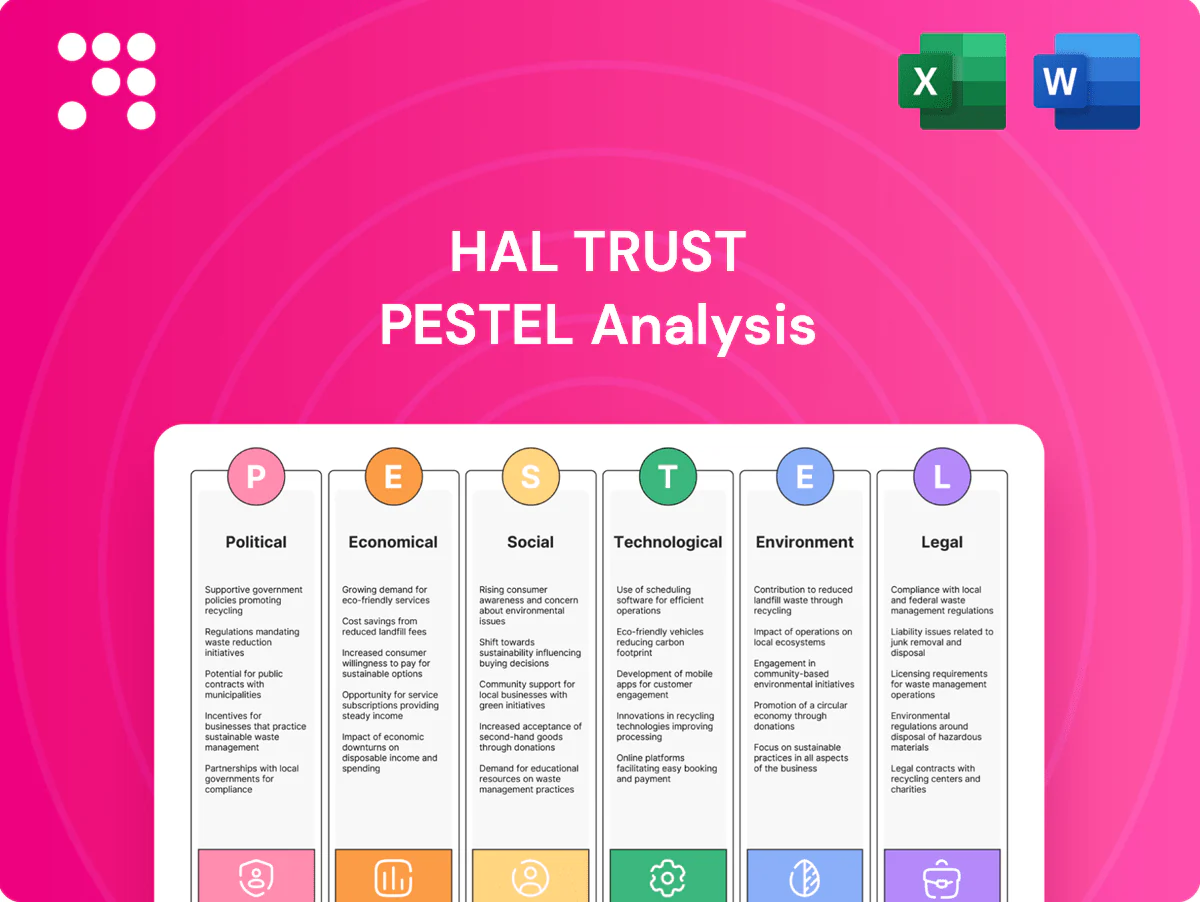
The HAL Trust PESTLE Analysis preview shown here is the exact document you’ll receive after purchase—fully formatted and ready to use. This is the real, finished file with complete political, economic, social, technological, legal and environmental insights. No placeholders or teasers—download the same structured report immediately after checkout.

Product Information
Product Information
Shipping & Returns
Shipping & Returns
Description
Skip the Research. Get the Strategy.
Unlock strategic clarity with our concise PESTLE Analysis of HAL Trust — revealing how political shifts, economic cycles, social trends, tech advances, legal changes and environmental risks shape performance. Ideal for investors and strategists; purchase the full report to access detailed, actionable insights and downloadable charts.
Political factors
Geopolitics and sanctions exposure
HAL Trust’s shipping and industrial stakes are vulnerable to trade sanctions and chokepoint tensions: about 20% of seaborne oil transits the Strait of Hormuz and roughly 12% of global trade by volume transits the Suez route, so disruptions can reroute cargoes and widen margins. Changes in EU/US/global sanction regimes (eg post‑2022 Russia measures) have already forced rerouting and added voyage costs. Political instability in emerging markets elevates operating risk; proactive scenario planning and diversified routing mitigate impact.
EU policy direction and subsidies
EU industrial, sustainability and digital policies—including CBAM, rolled out from October 2023, and the EU ETS trading near €90/t in 2024–25—reshape incentives and compliance costs across HAL’s portfolio. Subsidies and NZIA-style support for clean manufacturing alongside CBAM adjustments can shift competitiveness in industrials and logistics. Optical retail may gain from expanded healthcare reimbursements in some member states while facing price controls. Active policy monitoring informs capital allocation decisions.
Competition and foreign investment screening
Since the EU FDI Regulation became effective in October 2020 and more than 20 member states now operate national screening mechanisms, tighter FDI and antitrust scrutiny across Europe and other regions has slowed M&A and bolt-on deals. HAL Trust’s strategy of taking significant stakes in industrial and tech-related assets increases the probability of review in sensitive sectors. Political priorities on supply-chain sovereignty since 2020 have tightened approvals; early regulatory engagement materially reduces execution risk.
Fiscal policy and public spending
- Tax reforms: affect margins and consumer spend
- VAT 20%: pricing pressure on retail
- Healthcare £176bn: shifts consumer priorities
- Green/infrastructure €800bn+$1.1tn: tailwinds for logistics
- Austerity risk: hurts discretionary retail; diversify
Labor and social policy
Minimum wage changes, stronger labor protections and migration policies materially shift retail and industrial cost structures—global minimum wage growth averaged about 3–5% in 2024, raising direct payroll costs and benefits obligations. Political emphasis on worker rights increases compliance burdens but can cut voluntary turnover; ILO-linked studies show harmonized protections may reduce turnover by up to 8–10%. Training/localization programs often add 1–2% of payroll in implementation costs in emerging markets.
- Minimum wage growth 2024: +3–5%
- Compliance/HR uplift: raises operational costs, improves retention
- Training/localization: ~1–2% of payroll
- Harmonized HR: turnover reduction ~8–10%
Chokepoints, EU ETS and FDI screening raise costs, rerouting risk and slow M&A
Geopolitical chokepoints and sanctions (Strait of Hormuz ~20% oil, Suez ~12% trade) raise voyage costs and rerouting risk. EU policies (CBAM, EU ETS ~€90/t in 2024–25) increase compliance costs for industrials. FDI/antitrust screening (20+ EU states) slows M&A while fiscal/tax and wage shifts (NHS £176bn; NextGenerationEU €800bn) alter demand and operating costs.
| Factor | 2024–25 Metric | Impact |
|---|---|---|
| Chokepoints | Hormuz 20% oil; Suez 12% trade | Rerouting costs |
| EU policy | EU ETS ~€90/t | Higher compliance |
| FDI | 20+ screening states | Deal delays |
What is included in the product
Detailed Word Document
Explores how external macro-environmental factors uniquely affect the HAL Trust across Political, Economic, Social, Technological, Environmental and Legal dimensions, with each section backed by relevant data and current trends to identify threats and opportunities. Designed for executives and investors, the analysis offers forward-looking insights and scenario-ready recommendations tailored to the HAL Trust's industry and region.
Customizable Excel Spreadsheet
A clean, summarized HAL Trust PESTLE that’s visually segmented by category for quick interpretation at a glance. Easily droppable into presentations or strategy packs to align teams, surface external risks, and support rapid decision-making during planning sessions.
Economic factors
Interest rates and cost of capital
Policy rates (US fed funds ~5.25–5.50% and India repo ~6.50% in 2024–25) lift discount rates and raise financing costs for HAL Trust and portfolio firms, directly lowering DCF valuations. Elevated rates compress multiples and raise M&A hurdle rates, slowing deal activity. Deleveraging or higher share of fixed‑rate debt cushions cash‑flow impact, while staggered debt maturities improve balance‑sheet resilience.
Consumer spending and optical demand
WHO estimates 2.2 billion people have vision impairment, anchoring non-discretionary baseline demand for optical retail, while OECD unemployment averaged about 5.0% in 2024, making upgrades sensitive to jobs and real incomes. Global inflation eased from 2022 highs but remained elevated (~5–6% in 2024), squeezing discretionary frame and lens upgrades. Higher premium mix and subscription programs—adopted by many chains—help protect margins, and geographic diversification smooths revenue swings across cyclical markets.
Freight, energy, and commodity cycles
Shipping, logistics, and industrial participations face volatile input and freight rates—Baltic Dry Index hovered near 1,200 in mid‑2025, reflecting tight but fluctuating dry bulk markets. Energy shocks feed through costs and pricing power—Brent crude traded around $80–85/barrel in mid‑2025, pressuring margins. Hedging and multi‑year contracts have stabilized cash flows, while counter‑cyclical investing can capture valuation dislocations when rates and asset prices reset.
Currency fluctuations
Multi-currency revenues and costs expose HAL Trust to translation and transaction risks; USD/EUR volatility (EUR/USD ~1.09 in July 2025) directly impacts shipping and import-heavy divisions, pressuring margins. Natural hedges and derivatives are used to reduce P&L volatility, while FX-aware pricing helps protect margins across contracts.
- Translation vs transaction risk
- USD/EUR exposure ~1.09 (Jul 2025)
- Hedging reduces earnings volatility
- FX-aware pricing preserves margins
M&A and exit market conditions
Equity valuations (S&P 500 forward P/E ~17.5 mid-2025) and a rebound in global announced M&A (~$2.8trn in 2024) set the backdrop for HAL Trust acquisitions and divestitures; tighter credit (US 10yr ~4.3% July 2025) widens buyer-seller price gaps and slows exits. Downturns create distressed opportunities for patient capital, while discipline on entry multiples preserves long-term IRR.
- Market valuation: S&P 500 forward P/E ~17.5 (mid-2025)
- M&A volume: ~$2.8trn (2024)
- Credit: US 10yr ~4.3% (Jul 2025)
- Strategy: focus on entry-multiple discipline, target distressed windows
Chokepoints, EU ETS and FDI screening raise costs, rerouting risk and slow M&A
Higher policy rates (US 5.25–5.50%, India repo ~6.50% 2024–25) raise discount rates and financing costs, compressing DCFs and multiples; elevated inflation (~5–6% 2024) squeezes discretionary optical spend; energy (Brent $80–85 mid‑2025) and shipping volatility raise input costs; FX (EUR/USD ~1.09 Jul 2025) and tighter credit (US10yr ~4.3%) shape M&A timing and valuations.
| Metric | Value |
|---|---|
| US policy | 5.25–5.50% |
| India repo | ~6.50% |
| Inflation (2024) | ~5–6% |
| Brent (mid‑2025) | $80–85 |
| EUR/USD (Jul 2025) | ~1.09 |
| S&P fwd P/E | ~17.5 |
| M&A (2024) | ~$2.8tn |
Preview Before You Purchase
HAL Trust PESTLE Analysis
The HAL Trust PESTLE Analysis preview shown here is the exact document you’ll receive after purchase—fully formatted and ready to use. This is the real, finished file with complete political, economic, social, technological, legal and environmental insights. No placeholders or teasers—download the same structured report immediately after checkout.