Halewood International Ltd. PESTLE Analysis

Make Smarter Strategic Decisions with a Complete PESTEL View
Explore how political, economic, social, technological, legal and environmental forces are reshaping Halewood International Ltd.’s market position and operational risks. Our concise PESTLE highlights key external drivers affecting growth and compliance. Purchase the full, downloadable analysis for actionable insights and strategy-ready data.
Political factors

UK alcohol duty and excise policy
UK excise structures, with segment-specific rates for spirits, wine, beer and RTDs plus CPI-linked upratings and occasional duty freezes, directly shift price points and margins—alcohol duty raised c.£12.5bn for HMRC in 2023–24. Halewood must optimise ABV, pack sizes and promotional cadence to remain profitable across duty bands. Engagement with HM Treasury consultations (including the 2024 RTD review) can mitigate adverse impacts.
Post-Brexit trade and market access
Post-Brexit rules of origin, customs friction and divergent standards raise export costs to the EU—EU remained the UK’s largest trading partner, accounting for about 43% of UK goods trade in 2023—while new UK FTAs (eg CPTPP accession) open non-EU growth but demand compliance changes. Halewood must build inventory buffers, adapt labeling per destination rules and use trade facilitation and bonded warehousing to cut dwell time and cash drag.

Devolved policies and local government agendas
Devolved governments can set alcohol rules: Scotland introduced minimum unit pricing in 2018, Wales in 2020 and Northern Ireland implemented MUP in 2022, all at around £0.50 per unit, affecting pricing strategy. Local licensing boards across Scotland (32 councils), Wales (22) and NI (11) shape hours, distribution and event activations. Regional grants and tourism funds (eg VisitScotland schemes) can subsidise distillery investment, so tailored route-to-market plans by jurisdiction reduce regulatory and revenue risks.

Public health policy and lobbying pressure
Government campaigns on harmful drinking can tighten restrictions, with Scotland's minimum unit pricing set at 50p per unit since 2018 and MUP/de duty escalator debates continuing in the UK; WHO estimates alcohol causes about 3 million deaths annually. Halewood benefits from responsible marketing codes and low/no‑alcohol innovation, while constructive industry engagement helps shape balanced regulation.
- Scotland MUP: 50p/unit
- WHO: ~3 million annual alcohol deaths
- Halewood advantage: low/no‑alcohol R&D
- Policy risk: MUP & duty debates ongoing
Geopolitical supply chain stability
Energy policy shifts, sanctions and shipping disruptions have delayed inputs like glass, corks and botanicals—Drewry container rates swung from a 2021 peak ~USD10,000 to ~USD1,200 in 2024, while industry lead times rose 20–40% in 2021–23; currency and logistics volatility have increased landed costs by an estimated 5–12% (2022–24), and political risk insurance premiums rose ~15–25%.
- Diversify suppliers to cut exposure and reduce lead times up to 30%
- Nearshoring critical materials lowers transit risk and FX impact
- Political risk insurance and flexible contracts improve resilience
Duty £12.5bn; EU 43%; MUP £0.50; logistics +5–12%
UK alcohol duty raised c.£12.5bn in 2023–24, forcing ABV/pack optimisation. EU remained ~43% of UK goods trade in 2023, raising post‑Brexit compliance costs. Scotland/Wales/NI MUP ~£0.50/unit reshapes pricing; logistics volatility (Drewry peak ~USD10,000 -> ~USD1,200 in 2024) pushed landed costs +5–12% (2022–24).
| Policy/Metric | Implication |
|---|---|
| Alcohol duty £12.5bn (2023–24) | Margin pressure |
| EU 43% trade (2023) | Export compliance costs |
| MUP £0.50/unit | Pricing constraints |
| Logistics +5–12% | Higher COGS |
What is included in the product
 Detailed Word Document
Explores how macro-environmental factors uniquely affect Halewood International Ltd across Political, Economic, Social, Technological, Environmental and Legal dimensions, with data-backed insights, sector-specific examples and forward-looking implications to help executives, investors and consultants identify risks, opportunities and strategic responses.

 Customizable Excel Spreadsheet
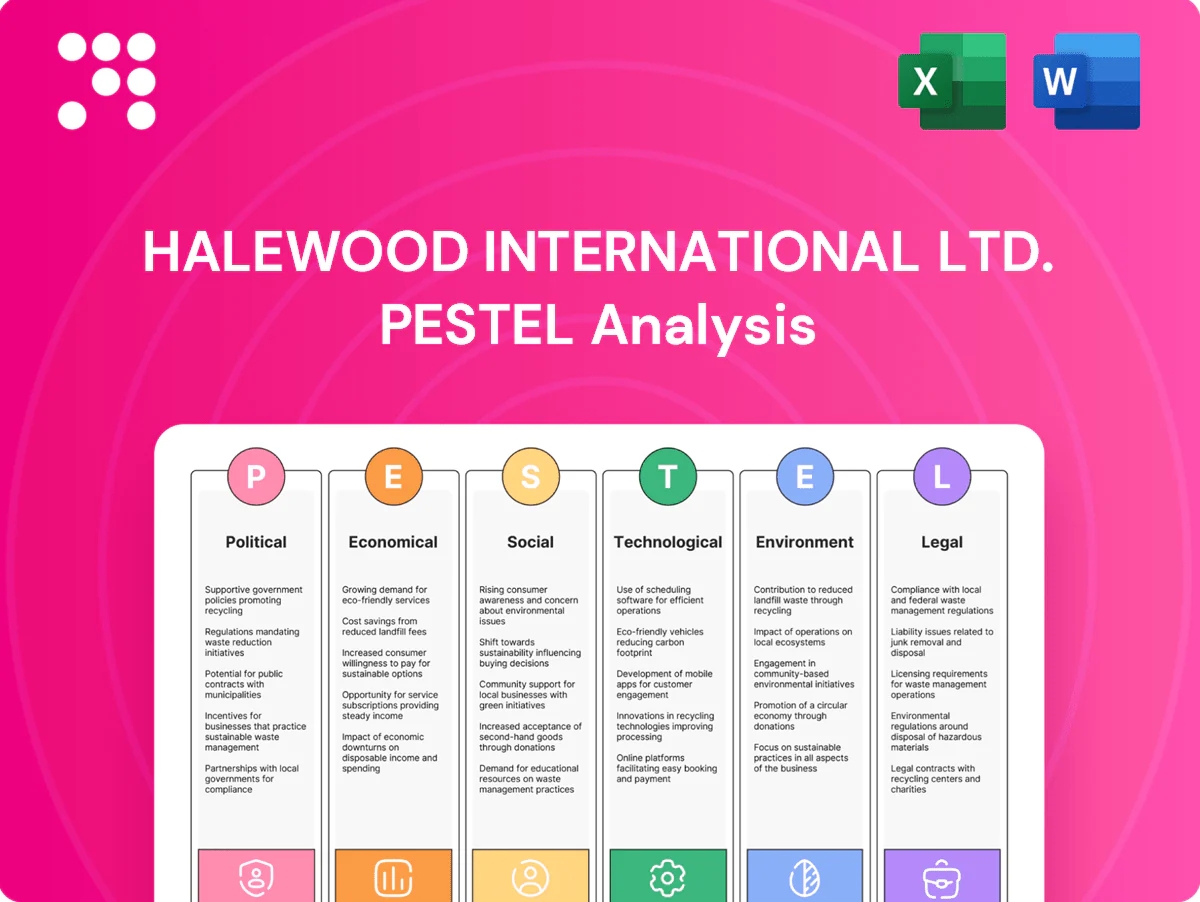
A clean, summarized PESTLE of Halewood International Ltd. that’s visually segmented for quick interpretation, easily dropped into presentations, annotated for regional/business context, and shareable across teams to streamline risk discussions and strategic planning.
Economic factors

Consumer spending and trading down/up
Macro cycles shift demand between value, mainstream and premium tiers, yet IWSR data shows premium and super‑premium spirits grew about 4.5% in value in 2024, suggesting premiumization can persist during mild slowdowns. Halewood should balance accessible price points with high‑margin craft lines, using pack size and RTD multipacks to support affordability and capture household trading down while retaining premium customers.
Inflation, input costs, and margin management
Grain, sugar, energy, glass and aluminium remain the main drivers of Halewood’s COGS; Brent averaged about $83/bbl in 2024, keeping energy input costs materially influential. Hedging and long-term supplier contracts are used to smooth raw-material volatility and protect margins. Price increases must be sequenced to preserve sales velocity while operational efficiencies and yield gains are prioritized to protect EBITDA.

Foreign exchange exposure
Sterling movements (GBP/USD ≈1.27, GBP/EUR ≈1.17 as of mid‑2025) materially affect Halewood’s export competitiveness and UK import costs. USD and EUR volatility drives costs for botanicals, barrels and packaging often priced in those currencies. Use of natural hedges and FX derivatives helps reduce earnings variability. Market pricing should be adjusted by currency conditions to protect margins.

On-trade vs off-trade channel mix
Bars and restaurants drive brand building and premium serves while retail sustains volume; UK on-trade footfall recovered to roughly 90–95% of 2019 levels by 2024 (ONS/CGA trends) affecting mix and promo strategy. Rising hospitality costs and labour inflation compressed margins in 2023–24, pushing Halewood to tailor SKUs by channel. RTDs and convenience packs capture growing off-trade impulse demand; global RTD market was about 30bn USD in 2023 with mid-single-digit CAGR to 2028.
- Channel segmentation: premium on-trade vs high-volume off-trade
- SKU strategy: small formats/RTDs for convenience
- Promo levers: on-trade premium serves, off-trade price packs
Interest rates and capital intensity
Distilling maturation cycles (commonly 3–12+ years for whiskies) tie up working capital and capex, so elevated UK policy rates—Bank of England base rate remained above 5% into 2025—increase financing costs and raise internal hurdle rates for long-duration projects. Phased investments, contract distilling and asset-light partnerships can reduce upfront spend, while inventory planning must align with demand forecasts to avoid capital lock-up.
- Capex intensity: long maturation (3–12+ yrs)
- Rates: BoE base rate >5% (mid‑2025)
- De-risk: phased builds + asset-light deals
- Inventory: align stocks to demand forecasts
Duty £12.5bn; EU 43%; MUP £0.50; logistics +5–12%
Premiumization drove ~4.5% value growth in spirits in 2024, so Halewood should balance premium lines with value RTD packs. Brent averaged $83/bbl in 2024 and BoE base rate remained above 5% into 2025, raising input and financing costs. FX (GBP/USD ~1.27, GBP/EUR ~1.17 mid‑2025) and long maturation cycles (3–12+ yrs) require hedging and inventory discipline.
| Metric | Value |
|---|---|
| Spirits value growth (2024) | +4.5% |
| Brent (2024 avg) | $83/bbl |
| BoE base rate (mid‑2025) | >5% |
| GBP/USD (mid‑2025) | ~1.27 |
| RTD market (2023) | $30bn |
Preview Before You Purchase
Halewood International Ltd. PESTLE Analysis
The Halewood International Ltd. PESTLE Analysis preview shown here is the exact document you’ll receive after purchase, fully formatted and ready to use. It presents political, economic, social, technological, legal, and environmental factors with supporting evidence and implications. No placeholders or teasers—this is the final, professional report available for immediate download.

Product Information
Product Information
Shipping & Returns
Shipping & Returns
Description
Make Smarter Strategic Decisions with a Complete PESTEL View
Explore how political, economic, social, technological, legal and environmental forces are reshaping Halewood International Ltd.’s market position and operational risks. Our concise PESTLE highlights key external drivers affecting growth and compliance. Purchase the full, downloadable analysis for actionable insights and strategy-ready data.
Political factors
UK alcohol duty and excise policy
UK excise structures, with segment-specific rates for spirits, wine, beer and RTDs plus CPI-linked upratings and occasional duty freezes, directly shift price points and margins—alcohol duty raised c.£12.5bn for HMRC in 2023–24. Halewood must optimise ABV, pack sizes and promotional cadence to remain profitable across duty bands. Engagement with HM Treasury consultations (including the 2024 RTD review) can mitigate adverse impacts.
Post-Brexit trade and market access
Post-Brexit rules of origin, customs friction and divergent standards raise export costs to the EU—EU remained the UK’s largest trading partner, accounting for about 43% of UK goods trade in 2023—while new UK FTAs (eg CPTPP accession) open non-EU growth but demand compliance changes. Halewood must build inventory buffers, adapt labeling per destination rules and use trade facilitation and bonded warehousing to cut dwell time and cash drag.
Devolved policies and local government agendas
Devolved governments can set alcohol rules: Scotland introduced minimum unit pricing in 2018, Wales in 2020 and Northern Ireland implemented MUP in 2022, all at around £0.50 per unit, affecting pricing strategy. Local licensing boards across Scotland (32 councils), Wales (22) and NI (11) shape hours, distribution and event activations. Regional grants and tourism funds (eg VisitScotland schemes) can subsidise distillery investment, so tailored route-to-market plans by jurisdiction reduce regulatory and revenue risks.
Public health policy and lobbying pressure
Government campaigns on harmful drinking can tighten restrictions, with Scotland's minimum unit pricing set at 50p per unit since 2018 and MUP/de duty escalator debates continuing in the UK; WHO estimates alcohol causes about 3 million deaths annually. Halewood benefits from responsible marketing codes and low/no‑alcohol innovation, while constructive industry engagement helps shape balanced regulation.
- Scotland MUP: 50p/unit
- WHO: ~3 million annual alcohol deaths
- Halewood advantage: low/no‑alcohol R&D
- Policy risk: MUP & duty debates ongoing
Geopolitical supply chain stability
Energy policy shifts, sanctions and shipping disruptions have delayed inputs like glass, corks and botanicals—Drewry container rates swung from a 2021 peak ~USD10,000 to ~USD1,200 in 2024, while industry lead times rose 20–40% in 2021–23; currency and logistics volatility have increased landed costs by an estimated 5–12% (2022–24), and political risk insurance premiums rose ~15–25%.
- Diversify suppliers to cut exposure and reduce lead times up to 30%
- Nearshoring critical materials lowers transit risk and FX impact
- Political risk insurance and flexible contracts improve resilience
Duty £12.5bn; EU 43%; MUP £0.50; logistics +5–12%
UK alcohol duty raised c.£12.5bn in 2023–24, forcing ABV/pack optimisation. EU remained ~43% of UK goods trade in 2023, raising post‑Brexit compliance costs. Scotland/Wales/NI MUP ~£0.50/unit reshapes pricing; logistics volatility (Drewry peak ~USD10,000 -> ~USD1,200 in 2024) pushed landed costs +5–12% (2022–24).
| Policy/Metric | Implication |
|---|---|
| Alcohol duty £12.5bn (2023–24) | Margin pressure |
| EU 43% trade (2023) | Export compliance costs |
| MUP £0.50/unit | Pricing constraints |
| Logistics +5–12% | Higher COGS |
What is included in the product
Detailed Word Document
Explores how macro-environmental factors uniquely affect Halewood International Ltd across Political, Economic, Social, Technological, Environmental and Legal dimensions, with data-backed insights, sector-specific examples and forward-looking implications to help executives, investors and consultants identify risks, opportunities and strategic responses.
Customizable Excel Spreadsheet
A clean, summarized PESTLE of Halewood International Ltd. that’s visually segmented for quick interpretation, easily dropped into presentations, annotated for regional/business context, and shareable across teams to streamline risk discussions and strategic planning.
Economic factors
Consumer spending and trading down/up
Macro cycles shift demand between value, mainstream and premium tiers, yet IWSR data shows premium and super‑premium spirits grew about 4.5% in value in 2024, suggesting premiumization can persist during mild slowdowns. Halewood should balance accessible price points with high‑margin craft lines, using pack size and RTD multipacks to support affordability and capture household trading down while retaining premium customers.
Inflation, input costs, and margin management
Grain, sugar, energy, glass and aluminium remain the main drivers of Halewood’s COGS; Brent averaged about $83/bbl in 2024, keeping energy input costs materially influential. Hedging and long-term supplier contracts are used to smooth raw-material volatility and protect margins. Price increases must be sequenced to preserve sales velocity while operational efficiencies and yield gains are prioritized to protect EBITDA.
Foreign exchange exposure
Sterling movements (GBP/USD ≈1.27, GBP/EUR ≈1.17 as of mid‑2025) materially affect Halewood’s export competitiveness and UK import costs. USD and EUR volatility drives costs for botanicals, barrels and packaging often priced in those currencies. Use of natural hedges and FX derivatives helps reduce earnings variability. Market pricing should be adjusted by currency conditions to protect margins.
On-trade vs off-trade channel mix
Bars and restaurants drive brand building and premium serves while retail sustains volume; UK on-trade footfall recovered to roughly 90–95% of 2019 levels by 2024 (ONS/CGA trends) affecting mix and promo strategy. Rising hospitality costs and labour inflation compressed margins in 2023–24, pushing Halewood to tailor SKUs by channel. RTDs and convenience packs capture growing off-trade impulse demand; global RTD market was about 30bn USD in 2023 with mid-single-digit CAGR to 2028.
- Channel segmentation: premium on-trade vs high-volume off-trade
- SKU strategy: small formats/RTDs for convenience
- Promo levers: on-trade premium serves, off-trade price packs
Interest rates and capital intensity
Distilling maturation cycles (commonly 3–12+ years for whiskies) tie up working capital and capex, so elevated UK policy rates—Bank of England base rate remained above 5% into 2025—increase financing costs and raise internal hurdle rates for long-duration projects. Phased investments, contract distilling and asset-light partnerships can reduce upfront spend, while inventory planning must align with demand forecasts to avoid capital lock-up.
- Capex intensity: long maturation (3–12+ yrs)
- Rates: BoE base rate >5% (mid‑2025)
- De-risk: phased builds + asset-light deals
- Inventory: align stocks to demand forecasts
Duty £12.5bn; EU 43%; MUP £0.50; logistics +5–12%
Premiumization drove ~4.5% value growth in spirits in 2024, so Halewood should balance premium lines with value RTD packs. Brent averaged $83/bbl in 2024 and BoE base rate remained above 5% into 2025, raising input and financing costs. FX (GBP/USD ~1.27, GBP/EUR ~1.17 mid‑2025) and long maturation cycles (3–12+ yrs) require hedging and inventory discipline.
| Metric | Value |
|---|---|
| Spirits value growth (2024) | +4.5% |
| Brent (2024 avg) | $83/bbl |
| BoE base rate (mid‑2025) | >5% |
| GBP/USD (mid‑2025) | ~1.27 |
| RTD market (2023) | $30bn |
Preview Before You Purchase
Halewood International Ltd. PESTLE Analysis
The Halewood International Ltd. PESTLE Analysis preview shown here is the exact document you’ll receive after purchase, fully formatted and ready to use. It presents political, economic, social, technological, legal, and environmental factors with supporting evidence and implications. No placeholders or teasers—this is the final, professional report available for immediate download.