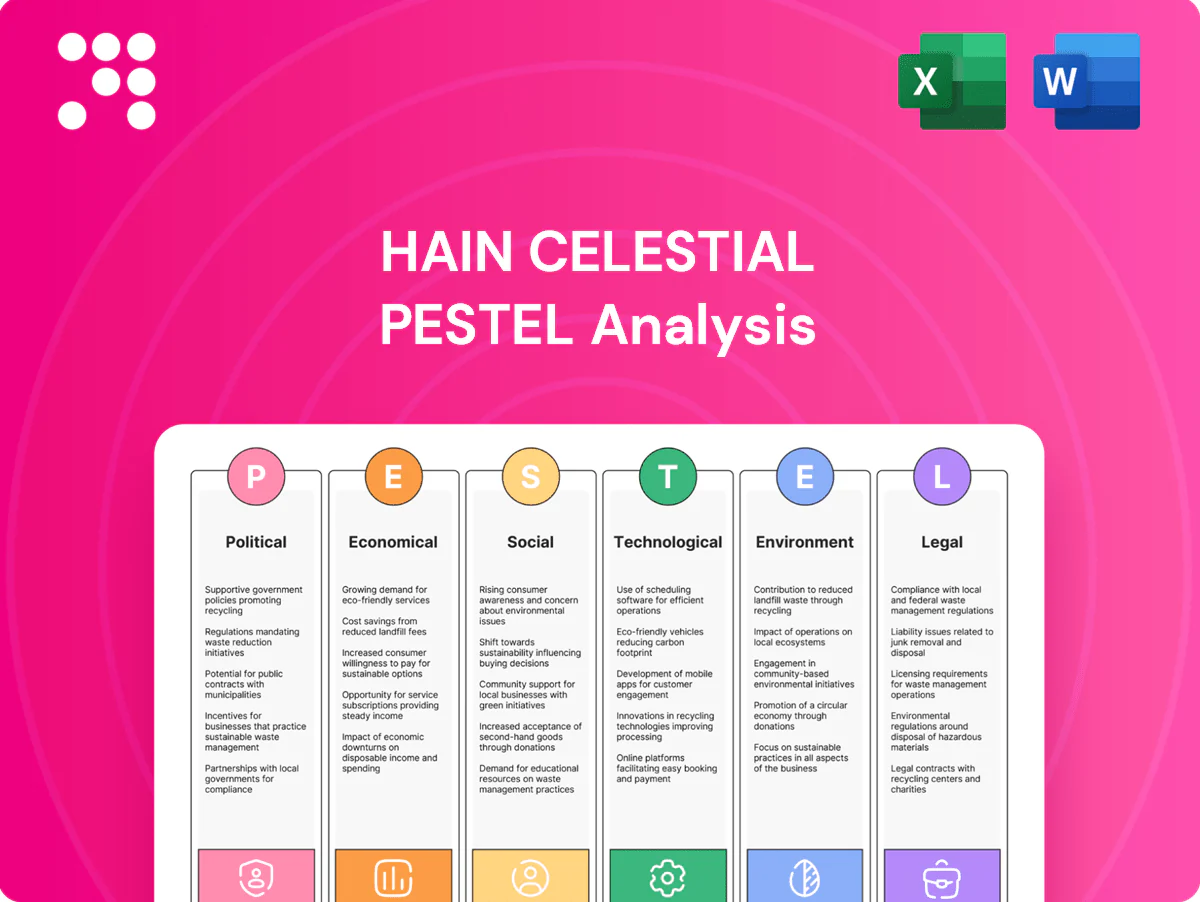
Hain Celestial PESTLE Analysis

Your Shortcut to Market Insight Starts Here
Unlock how regulatory shifts, consumer health trends, and supply-chain dynamics are shaping Hain Celestial’s growth trajectory—our concise PESTLE highlights key risks and opportunities for investors and strategists. For the full, actionable breakdown and editable charts, purchase the complete PESTLE analysis now.
Political factors

Food policy and nutrition agendas
Governments prioritizing healthier diets are boosting demand for organic and better-for-you products—US organic sales hit $63.6 billion in 2022 and the global organic market reached about $263.7 billion in 2022. Policy shifts can open school, military and institutional channels; Hain can align R&D with evolving dietary guidelines. Political reversals or partisan funding cuts could quickly reverse momentum and procurement gains.
Organic standards and certification regimes
Stricter organic certification rules raise sourcing costs and speed-to-market for Hain Celestial amid global organic retail sales of about USD 127 billion (2022) and 74.6 million ha of organic farmland (2023). Harmonization gaps between USDA, EU and post-Brexit UK standards increase compliance complexity and audit burden. Consistent compliance supports premium pricing and trust; divergence raises supply risk.

Trade tariffs and supply chain geopolitics
Tariffs such as US Section 301 duties on certain imports, which remain as high as 25%, can directly squeeze margins on agricultural inputs, packaging and finished goods for Hain Celestial. Geopolitical tensions have disrupted specialty-ingredient flows, prompting the company to diversify suppliers and nearshore production to reduce risk. Trade incentives like the US Inflation Reduction Act’s manufacturing credits can enable localized production strategies and offset some cost pressure.

Subsidies and farm-bill incentives
- Funding scale: $3.1 billion (USDA climate-smart awards)
- Access: contingent on eligibility and program design
- Strategy: proactive engagement boosts grant capture
- Risk: subsidy loss pressures input costs and margins
Public health and school meal regulations
Tighter public-health limits on sugar, sodium and additives—guided by WHO recommendations (free sugars <10% of daily energy) and ongoing U.S. school-meal updates—favor Hain Celestial’s clean-label portfolio but force reformulation and R&D spending to meet institutional standards. Reformulation raises near-term costs yet opens stable institutional channels (schools, hospitals). Advocacy groups accelerate timelines and tougher thresholds, while non-compliance risks exclusion from contracts and reputational damage.
- R&D impact: higher reformulation costs, offset by institutional sales
- Regulatory drivers: WHO sugar guidance (<10%) influences policy through 2024–25
- Risks: contract exclusion and negative publicity from non-compliance
Government policy fuels organic demand amid certification costs, tariffs and USDA grants
Government nutrition policies and procurement shifts boost organic demand (global organic market ~263.7B 2022), favoring Hain Celestial. Certification divergence (USDA/EU/UK) and stricter rules raise compliance costs and delay market entry. Tariffs up to 25% and supply-chain geopolitics squeeze margins while USDA climate grants (~3.1B) partially offset sourcing costs.
| Factor | Impact | Key data |
|---|---|---|
| Policy demand | Market growth | 263.7B (2022) |
| Cert/Reg | Cost/compliance | USDA/EU/UK divergence |
| Trade/Subsidy | Margin/sourcing | Tariffs ≤25% / 3.1B grants |
What is included in the product
 Detailed Word Document
Explores how macro-environmental factors—Political, Economic, Social, Technological, Environmental and Legal—uniquely affect Hain Celestial, with data-backed trends and specific sub-points. Designed for executives and investors to identify threats, opportunities and support scenario planning.

 Customizable Excel Spreadsheet
A clean, summarized PESTLE for Hain Celestial enabling quick reference in meetings, visually segmented by category, editable for regional or business-line notes, and easily dropped into slides to align teams, support external risk discussions, and streamline consultant reporting.
Economic factors

Input cost volatility
Organic grains, nuts, cocoa and plant oils exhibit higher price swings, with organic premiums often 20–60% above conventional equivalents and cocoa futures showing roughly 30% volatility in 2022–23. Weather shocks and geopolitical events (eg, 2022 sunflower oil supply disruptions) amplified volatility versus conventional inputs. Ability to pass costs through hinges on retailer negotiations and private-label bargaining power. Hedging and multi-year supply contracts can materially stabilize margins.
Consumer spending cycles
Economic downturns push consumers toward private label—U.S. grocery private-label penetration reached about 18% of dollar sales in 2023 (NielsenIQ), pressuring Hain Celestial volumes. Premium segments retain shoppers when clear value and functional benefits exist, with organic/snack premium lines showing stronger resilience in 2023. Elasticity differs by category: snacks are more price-elastic than beverages and personal care. Smart pricing architecture and smaller pack sizes helped preserve share during 2022–24 cost pressures.

Retailer consolidation and bargaining power
Large US retailers and e-commerce platforms capture roughly 60% of grocery sales and Amazon held about 10% of online grocery by 2024, compressing trade terms. Slotting fees and promotional spend—often $25k–$100k per SKU—plus in-store placement drive velocity and assortment. Hain needs data-backed category leadership and shopper analytics to defend shelf space. Diversifying channels, incl. DTC and natural-food independents, reduces dependence on few accounts.

FX and geographic mix
USD strength and 2024 currency moves (EUR/USD ~1.09, GBP/USD ~1.27) materially affected Hain Celestial reported revenue and imported input costs, with 5–8% FX swings able to alter reported top-line by several percentage points. Local sourcing and a balanced North America–Europe footprint reduce pass-through exposure, while active hedging programs address translation and transaction risks.
- FX: EUR/USD ~1.09 (2024)
- FX: GBP/USD ~1.27 (2024)
- Mitigation: local sourcing
- Risk control: geographic balance + hedging
Capital costs and investment capacity
Higher interest rates (US Fed funds 5.25–5.50% mid‑2024/2025) raise hurdle rates for automation and sustainability projects, slowing payback timelines. For Hain Celestial, strict cash discipline is vital to fund innovation pipelines and M&A without overleveraging. Efficiency programs can unlock operating cash to invest in growth brands. Lower rates would reduce acquisition costs and could revive accretive deals.
- Higher rates: higher hurdle rates, slower CAPEX payback
- Cash discipline: protects innovation pipeline and M&A optionality
- Efficiency programs: free funds for growth brands
- Lower rates: rekindle accretive acquisition opportunities
Government policy fuels organic demand amid certification costs, tariffs and USDA grants
Input volatility (organic premiums 20–60%; cocoa ~30% vol 2022–23) plus private‑label pressure (US private‑label ~18% 2023) compress margins; USD strength (EUR/USD ~1.09, GBP/USD ~1.27 in 2024) and Fed funds 5.25–5.50% raise financing costs. Retailer concentration (~60% grocery; Amazon ~10% online grocery 2024) heightens trade terms risk; hedging, local sourcing and efficiency free cash for growth.
| Metric | Value |
|---|---|
| Organic premium | 20–60% |
| Private‑label share (US, 2023) | 18% |
| EUR/USD (2024) | 1.09 |
| Fed funds | 5.25–5.50% |
Full Version Awaits
Hain Celestial PESTLE Analysis
The preview shown here is the exact Hain Celestial PESTLE Analysis you’ll receive after purchase—fully formatted and ready to use. It delivers comprehensive Political, Economic, Social, Technological, Legal, and Environmental insights tailored to Hain Celestial’s strategy and risks. No placeholders or teasers; the file available after checkout matches this preview exactly.

Original: $10.00
-65%$10.00
$3.50Product Information
Product Information
Shipping & Returns
Shipping & Returns
Description
Your Shortcut to Market Insight Starts Here
Unlock how regulatory shifts, consumer health trends, and supply-chain dynamics are shaping Hain Celestial’s growth trajectory—our concise PESTLE highlights key risks and opportunities for investors and strategists. For the full, actionable breakdown and editable charts, purchase the complete PESTLE analysis now.
Political factors
Food policy and nutrition agendas
Governments prioritizing healthier diets are boosting demand for organic and better-for-you products—US organic sales hit $63.6 billion in 2022 and the global organic market reached about $263.7 billion in 2022. Policy shifts can open school, military and institutional channels; Hain can align R&D with evolving dietary guidelines. Political reversals or partisan funding cuts could quickly reverse momentum and procurement gains.
Organic standards and certification regimes
Stricter organic certification rules raise sourcing costs and speed-to-market for Hain Celestial amid global organic retail sales of about USD 127 billion (2022) and 74.6 million ha of organic farmland (2023). Harmonization gaps between USDA, EU and post-Brexit UK standards increase compliance complexity and audit burden. Consistent compliance supports premium pricing and trust; divergence raises supply risk.
Trade tariffs and supply chain geopolitics
Tariffs such as US Section 301 duties on certain imports, which remain as high as 25%, can directly squeeze margins on agricultural inputs, packaging and finished goods for Hain Celestial. Geopolitical tensions have disrupted specialty-ingredient flows, prompting the company to diversify suppliers and nearshore production to reduce risk. Trade incentives like the US Inflation Reduction Act’s manufacturing credits can enable localized production strategies and offset some cost pressure.
Subsidies and farm-bill incentives
- Funding scale: $3.1 billion (USDA climate-smart awards)
- Access: contingent on eligibility and program design
- Strategy: proactive engagement boosts grant capture
- Risk: subsidy loss pressures input costs and margins
Public health and school meal regulations
Tighter public-health limits on sugar, sodium and additives—guided by WHO recommendations (free sugars <10% of daily energy) and ongoing U.S. school-meal updates—favor Hain Celestial’s clean-label portfolio but force reformulation and R&D spending to meet institutional standards. Reformulation raises near-term costs yet opens stable institutional channels (schools, hospitals). Advocacy groups accelerate timelines and tougher thresholds, while non-compliance risks exclusion from contracts and reputational damage.
- R&D impact: higher reformulation costs, offset by institutional sales
- Regulatory drivers: WHO sugar guidance (<10%) influences policy through 2024–25
- Risks: contract exclusion and negative publicity from non-compliance
Government policy fuels organic demand amid certification costs, tariffs and USDA grants
Government nutrition policies and procurement shifts boost organic demand (global organic market ~263.7B 2022), favoring Hain Celestial. Certification divergence (USDA/EU/UK) and stricter rules raise compliance costs and delay market entry. Tariffs up to 25% and supply-chain geopolitics squeeze margins while USDA climate grants (~3.1B) partially offset sourcing costs.
| Factor | Impact | Key data |
|---|---|---|
| Policy demand | Market growth | 263.7B (2022) |
| Cert/Reg | Cost/compliance | USDA/EU/UK divergence |
| Trade/Subsidy | Margin/sourcing | Tariffs ≤25% / 3.1B grants |
What is included in the product
Detailed Word Document
Explores how macro-environmental factors—Political, Economic, Social, Technological, Environmental and Legal—uniquely affect Hain Celestial, with data-backed trends and specific sub-points. Designed for executives and investors to identify threats, opportunities and support scenario planning.
Customizable Excel Spreadsheet
A clean, summarized PESTLE for Hain Celestial enabling quick reference in meetings, visually segmented by category, editable for regional or business-line notes, and easily dropped into slides to align teams, support external risk discussions, and streamline consultant reporting.
Economic factors
Input cost volatility
Organic grains, nuts, cocoa and plant oils exhibit higher price swings, with organic premiums often 20–60% above conventional equivalents and cocoa futures showing roughly 30% volatility in 2022–23. Weather shocks and geopolitical events (eg, 2022 sunflower oil supply disruptions) amplified volatility versus conventional inputs. Ability to pass costs through hinges on retailer negotiations and private-label bargaining power. Hedging and multi-year supply contracts can materially stabilize margins.
Consumer spending cycles
Economic downturns push consumers toward private label—U.S. grocery private-label penetration reached about 18% of dollar sales in 2023 (NielsenIQ), pressuring Hain Celestial volumes. Premium segments retain shoppers when clear value and functional benefits exist, with organic/snack premium lines showing stronger resilience in 2023. Elasticity differs by category: snacks are more price-elastic than beverages and personal care. Smart pricing architecture and smaller pack sizes helped preserve share during 2022–24 cost pressures.
Retailer consolidation and bargaining power
Large US retailers and e-commerce platforms capture roughly 60% of grocery sales and Amazon held about 10% of online grocery by 2024, compressing trade terms. Slotting fees and promotional spend—often $25k–$100k per SKU—plus in-store placement drive velocity and assortment. Hain needs data-backed category leadership and shopper analytics to defend shelf space. Diversifying channels, incl. DTC and natural-food independents, reduces dependence on few accounts.
FX and geographic mix
USD strength and 2024 currency moves (EUR/USD ~1.09, GBP/USD ~1.27) materially affected Hain Celestial reported revenue and imported input costs, with 5–8% FX swings able to alter reported top-line by several percentage points. Local sourcing and a balanced North America–Europe footprint reduce pass-through exposure, while active hedging programs address translation and transaction risks.
- FX: EUR/USD ~1.09 (2024)
- FX: GBP/USD ~1.27 (2024)
- Mitigation: local sourcing
- Risk control: geographic balance + hedging
Capital costs and investment capacity
Higher interest rates (US Fed funds 5.25–5.50% mid‑2024/2025) raise hurdle rates for automation and sustainability projects, slowing payback timelines. For Hain Celestial, strict cash discipline is vital to fund innovation pipelines and M&A without overleveraging. Efficiency programs can unlock operating cash to invest in growth brands. Lower rates would reduce acquisition costs and could revive accretive deals.
- Higher rates: higher hurdle rates, slower CAPEX payback
- Cash discipline: protects innovation pipeline and M&A optionality
- Efficiency programs: free funds for growth brands
- Lower rates: rekindle accretive acquisition opportunities
Government policy fuels organic demand amid certification costs, tariffs and USDA grants
Input volatility (organic premiums 20–60%; cocoa ~30% vol 2022–23) plus private‑label pressure (US private‑label ~18% 2023) compress margins; USD strength (EUR/USD ~1.09, GBP/USD ~1.27 in 2024) and Fed funds 5.25–5.50% raise financing costs. Retailer concentration (~60% grocery; Amazon ~10% online grocery 2024) heightens trade terms risk; hedging, local sourcing and efficiency free cash for growth.
| Metric | Value |
|---|---|
| Organic premium | 20–60% |
| Private‑label share (US, 2023) | 18% |
| EUR/USD (2024) | 1.09 |
| Fed funds | 5.25–5.50% |
Full Version Awaits
Hain Celestial PESTLE Analysis
The preview shown here is the exact Hain Celestial PESTLE Analysis you’ll receive after purchase—fully formatted and ready to use. It delivers comprehensive Political, Economic, Social, Technological, Legal, and Environmental insights tailored to Hain Celestial’s strategy and risks. No placeholders or teasers; the file available after checkout matches this preview exactly.