H2o Retailing PESTLE Analysis

Your Shortcut to Market Insight Starts Here
Discover how political shifts, economic trends, social preferences, technological advances, legal changes, and environmental pressures are reshaping H2o Retailing’s strategy and performance in our concise PESTLE snapshot. This expert summary highlights key risks and opportunities to inform investment or strategic decisions. Purchase the full PESTLE for the complete, actionable analysis and ready-to-use insights.
Political factors

Local government retail policies
Osaka Prefecture (≈8.8m residents) and Hyogo (≈5.4m) push urban revitalization, zoning reform, and public-transport integration that directly affect department-store footfall and formats; city-led redevelopments around terminals such as Umeda (Grand Front Osaka opened 2013) drive higher traffic but require multi-stakeholder negotiation. Policy shifts favoring neighborhood revitalization support smaller-format supermarkets over flagships, so H2O must align investments to municipal priorities to secure permits and incentives.
National consumption tax and fiscal stance
Japan’s consumption tax sits at 10% with a reduced 8% rate for food and essentials, directly compressing basket sizes and discretionary spend; targeted relief or exemptions materially shift mix. Cashless incentive campaigns (up to 5% points historically) and regional shopping vouchers have boosted short-term retail sales. Japan’s public debt ~256% of GDP (IMF 2024) signals pressure for fiscal consolidation that could cut stimulus. H2O should align pricing and promotion cadence to announced tax timing and policy signals.

Inbound tourism and visa policy
Relaxed visa regimes and national tourism campaigns materially boost premium department store sales—Japan drew 31.88 million inbound visitors in 2019 and partial recovery to over 20 million by 2023 raised tourist spending in urban retail. Airport-rail connectivity and duty-free rules strongly affect conversion rates for high-spend travelers. Sudden policy tightening or geopolitical tensions can rapidly depress inbound demand, so H2O must diversify revenue beyond tourists while tailoring assortments and services for wealthy visitors.

Trade and import regulations
Import duties, labeling standards and customs can add 5–15% to landed cost and delay luxury and specialty foods days–weeks for H2O Retailing. Economic-security policies since 2022 have tightened supplier screening, complicating sourcing from some countries. Asian FTAs (eg CPTPP) can cut tariffs ~10–20% and expand assortments; strong vendor compliance reduces regulatory delays.
- Import duties: +5–15%
- Delays: days–weeks
- Security rules: tighter since 2022
- FTAs: −10–20% tariffs
- Mitigation: vendor compliance
Disaster preparedness and public health governance
- Kansai population: ~22 million
- Great Hanshin-Awaji deaths (1995): 6,434
- Legal basis: Disaster Countermeasures Basic Act (1961)
- Implication: compliance increases operational cost but lowers disruption
Kansai retail shifts to neighborhood stores; 10% tax, tourist rebound
Municipal zoning and Osaka/Hyogo redevelopment (Osaka ≈8.8m; Hyogo ≈5.4m) push formats toward smaller, neighborhood-focused stores and complicate permitting. Consumption tax 10% (reduced 8% food) plus cashless/voucher campaigns reshape spending patterns. Tourist recovery (2019 31.9m; 2023 >20m) and import duties (+5–15%) with tighter screening since 2022 affect luxury sourcing and margins.
| Metric | Value |
|---|---|
| Consumption tax | 10% (8% food) |
| Kansai population | ≈22m |
| Inbound tourists | 2019 31.9m; 2023 >20m |
| Import duty impact | +5–15% |
What is included in the product
 Detailed Word Document
Explores how Political, Economic, Social, Technological, Environmental, and Legal forces uniquely affect H2o Retailing, using region- and industry-specific data and trends to identify risks and opportunities. Designed for executives and investors, it offers forward-looking insights and ready-to-use formatting for reports and strategy planning.

 Customizable Excel Spreadsheet
A concise, visually segmented PESTLE summary for H2O Retailing that simplifies external risk assessment and market positioning—easy to drop into presentations, share across teams, and customize with region- or business-specific notes for faster, aligned planning.
Economic factors

Consumer confidence and real wage trends
Stagnant real wages—household real pay rose only 0.8% in 2024—constrains discretionary spend for department stores while boosting value-focused supermarkets; with food inflation around 3.5% and utilities near 4–5% YoY in 2024 wallets shift to essentials. Promotional elasticity varies by format and category, and dynamic pricing plus private-label expansion (now ~20% of some chains' sales) helps protect margins.
Exchange rate volatility (JPY)
Weaker yen (USD/JPY about 155 in mid-2024) boosts inbound tourism—arrivals returned to roughly 80–90% of 2019 levels by 2024—while raising import costs for luxury goods and ingredients, squeezing margins. Price pass-through risks dampen demand in sensitive categories; hedging and vendor negotiations help stabilize gross margins. Tourist recovery can offset currency-driven cost pressures if assortments are optimized.

Interest rates and financing conditions
BOJ policy normalization (short-term rate ~0.10% and 10-year JGB ~0.70% as of mid-2025) raises borrowing costs for H2O Retailing store refurbishments and new construction. Credit-services margins hinge on funding costs and delinquency (consumer loan delinquencies ~0.6% in 2024); low-rate periods supported capex and a ~3.5% YoY rise in consumer credit in 2024. Stress-testing credit portfolios is prudent as policy tightens.

Regional economic health (Kansai)
Employment and corporate activity across the Keihanshin metro (about 19 million people) and Kobe (city ~1.53 million) sustain strong weekday retail and restaurant demand; Japan’s unemployment near 2.5% in 2024 supports consumer spending. Major infrastructure works—Osaka metro extensions and Kansai airport upgrades—can shift retail gravity and catchments. Regional-cycle dependence concentrates sales risk; diversifying store formats and local partnerships broadens exposure.
- Employment hubs: Keihanshin ~19M
- Kobe city population ~1.53M
- Unemployment Japan 2024 ~2.5%
- Mitigation: format diversification, strategic partnerships
Supply chain and input cost inflation
Food, energy and logistics cost inflation squeezed H2o Retailing margins as 2024 FAO food prices remained ~15% below 2022 peaks but volatile, while global oil shocks kept energy bills elevated; US trucking faced an estimated 80,000 driver shortfall in 2023–24, disrupting timely supply. Multi-sourcing and local supplier development have reduced stockouts, and energy-efficiency programs commonly cut retail energy spend by 10–20% over 3–5 years.
- Food price volatility: FAO index down ~15% from 2022 peak
- Trucking shortage: ~80,000 US drivers (2023–24)
- Energy savings: efficiency programs lower costs 10–20% in 3–5 years
- Resilience: multi-sourcing + local suppliers reduce disruptions
Kansai retail shifts to neighborhood stores; 10% tax, tourist rebound
Stagnant real wages (+0.8% in 2024) and food inflation (~3.5% in 2024) shift spending to essentials and private-label; weaker yen (USD/JPY ~155 mid-2024) lifts tourism (arrivals ~80–90% of 2019) but raises import costs. BOJ policy normalization (short-term ~0.10%, 10y JGB ~0.70% mid-2025) increases funding costs; unemployment ~2.5% (2024) supports steady demand in Keihanshin (~19M).
| Metric | Value |
|---|---|
| Real wages (2024) | +0.8% |
| Food inflation (2024) | ~3.5% |
| USD/JPY (mid-2024) | ~155 |
| Tourism vs 2019 (2024) | ~80–90% |
| BOJ short-term (mid-2025) | ~0.10% |
| 10y JGB (mid-2025) | ~0.70% |
| Unemployment (2024) | ~2.5% |
| Keihanshin population | ~19M |
Preview the Actual Deliverable
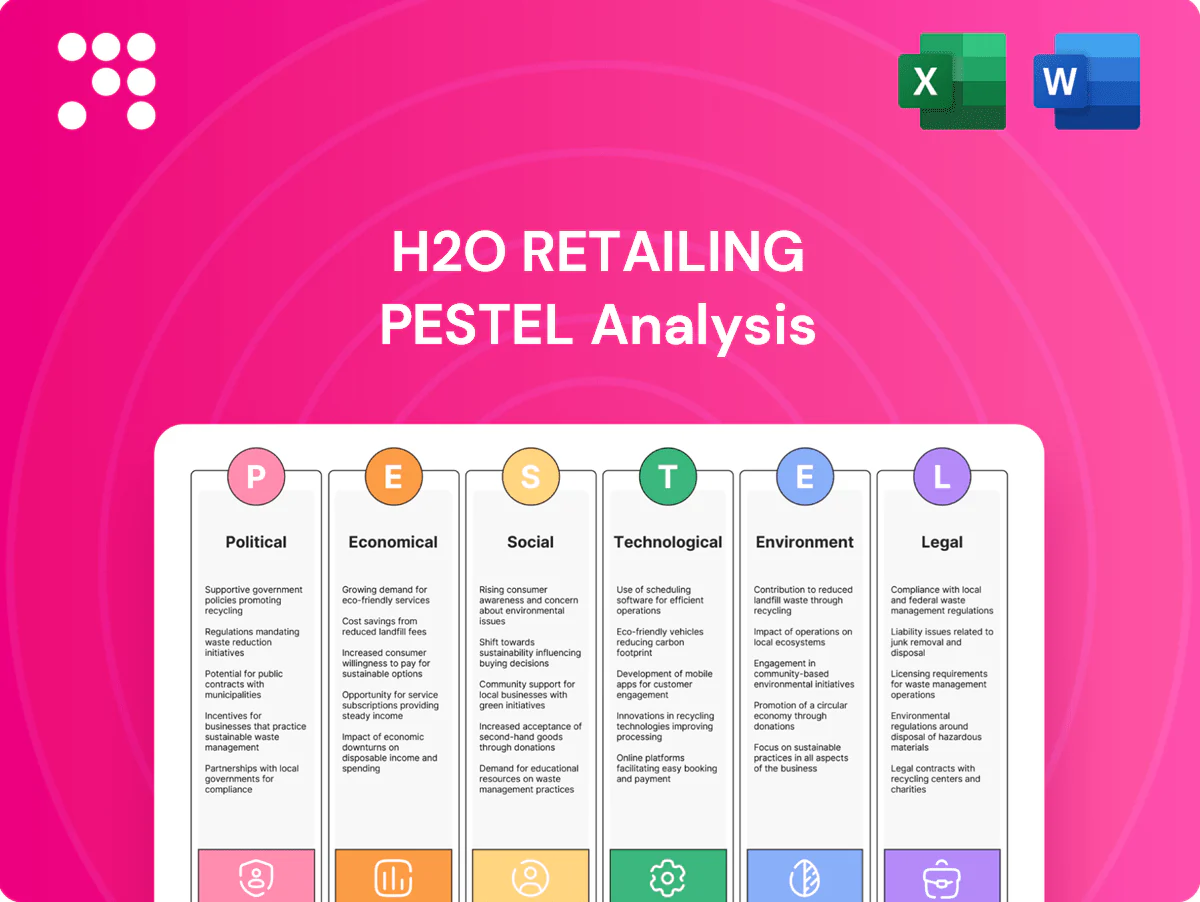
H2o Retailing PESTLE Analysis
The H2O Retailing PESTLE Analysis provides a concise examination of political, economic, social, technological, legal and environmental factors affecting H2O Retailing. The preview shown here is the exact document you’ll receive after purchase—fully formatted and ready to use. It includes actionable insights and implications for strategy and risk management.

Product Information
Product Information
Shipping & Returns
Shipping & Returns
Description
Your Shortcut to Market Insight Starts Here
Discover how political shifts, economic trends, social preferences, technological advances, legal changes, and environmental pressures are reshaping H2o Retailing’s strategy and performance in our concise PESTLE snapshot. This expert summary highlights key risks and opportunities to inform investment or strategic decisions. Purchase the full PESTLE for the complete, actionable analysis and ready-to-use insights.
Political factors
Local government retail policies
Osaka Prefecture (≈8.8m residents) and Hyogo (≈5.4m) push urban revitalization, zoning reform, and public-transport integration that directly affect department-store footfall and formats; city-led redevelopments around terminals such as Umeda (Grand Front Osaka opened 2013) drive higher traffic but require multi-stakeholder negotiation. Policy shifts favoring neighborhood revitalization support smaller-format supermarkets over flagships, so H2O must align investments to municipal priorities to secure permits and incentives.
National consumption tax and fiscal stance
Japan’s consumption tax sits at 10% with a reduced 8% rate for food and essentials, directly compressing basket sizes and discretionary spend; targeted relief or exemptions materially shift mix. Cashless incentive campaigns (up to 5% points historically) and regional shopping vouchers have boosted short-term retail sales. Japan’s public debt ~256% of GDP (IMF 2024) signals pressure for fiscal consolidation that could cut stimulus. H2O should align pricing and promotion cadence to announced tax timing and policy signals.
Inbound tourism and visa policy
Relaxed visa regimes and national tourism campaigns materially boost premium department store sales—Japan drew 31.88 million inbound visitors in 2019 and partial recovery to over 20 million by 2023 raised tourist spending in urban retail. Airport-rail connectivity and duty-free rules strongly affect conversion rates for high-spend travelers. Sudden policy tightening or geopolitical tensions can rapidly depress inbound demand, so H2O must diversify revenue beyond tourists while tailoring assortments and services for wealthy visitors.
Trade and import regulations
Import duties, labeling standards and customs can add 5–15% to landed cost and delay luxury and specialty foods days–weeks for H2O Retailing. Economic-security policies since 2022 have tightened supplier screening, complicating sourcing from some countries. Asian FTAs (eg CPTPP) can cut tariffs ~10–20% and expand assortments; strong vendor compliance reduces regulatory delays.
- Import duties: +5–15%
- Delays: days–weeks
- Security rules: tighter since 2022
- FTAs: −10–20% tariffs
- Mitigation: vendor compliance
Disaster preparedness and public health governance
- Kansai population: ~22 million
- Great Hanshin-Awaji deaths (1995): 6,434
- Legal basis: Disaster Countermeasures Basic Act (1961)
- Implication: compliance increases operational cost but lowers disruption
Kansai retail shifts to neighborhood stores; 10% tax, tourist rebound
Municipal zoning and Osaka/Hyogo redevelopment (Osaka ≈8.8m; Hyogo ≈5.4m) push formats toward smaller, neighborhood-focused stores and complicate permitting. Consumption tax 10% (reduced 8% food) plus cashless/voucher campaigns reshape spending patterns. Tourist recovery (2019 31.9m; 2023 >20m) and import duties (+5–15%) with tighter screening since 2022 affect luxury sourcing and margins.
| Metric | Value |
|---|---|
| Consumption tax | 10% (8% food) |
| Kansai population | ≈22m |
| Inbound tourists | 2019 31.9m; 2023 >20m |
| Import duty impact | +5–15% |
What is included in the product
Detailed Word Document
Explores how Political, Economic, Social, Technological, Environmental, and Legal forces uniquely affect H2o Retailing, using region- and industry-specific data and trends to identify risks and opportunities. Designed for executives and investors, it offers forward-looking insights and ready-to-use formatting for reports and strategy planning.
Customizable Excel Spreadsheet
A concise, visually segmented PESTLE summary for H2O Retailing that simplifies external risk assessment and market positioning—easy to drop into presentations, share across teams, and customize with region- or business-specific notes for faster, aligned planning.
Economic factors
Consumer confidence and real wage trends
Stagnant real wages—household real pay rose only 0.8% in 2024—constrains discretionary spend for department stores while boosting value-focused supermarkets; with food inflation around 3.5% and utilities near 4–5% YoY in 2024 wallets shift to essentials. Promotional elasticity varies by format and category, and dynamic pricing plus private-label expansion (now ~20% of some chains' sales) helps protect margins.
Exchange rate volatility (JPY)
Weaker yen (USD/JPY about 155 in mid-2024) boosts inbound tourism—arrivals returned to roughly 80–90% of 2019 levels by 2024—while raising import costs for luxury goods and ingredients, squeezing margins. Price pass-through risks dampen demand in sensitive categories; hedging and vendor negotiations help stabilize gross margins. Tourist recovery can offset currency-driven cost pressures if assortments are optimized.
Interest rates and financing conditions
BOJ policy normalization (short-term rate ~0.10% and 10-year JGB ~0.70% as of mid-2025) raises borrowing costs for H2O Retailing store refurbishments and new construction. Credit-services margins hinge on funding costs and delinquency (consumer loan delinquencies ~0.6% in 2024); low-rate periods supported capex and a ~3.5% YoY rise in consumer credit in 2024. Stress-testing credit portfolios is prudent as policy tightens.
Regional economic health (Kansai)
Employment and corporate activity across the Keihanshin metro (about 19 million people) and Kobe (city ~1.53 million) sustain strong weekday retail and restaurant demand; Japan’s unemployment near 2.5% in 2024 supports consumer spending. Major infrastructure works—Osaka metro extensions and Kansai airport upgrades—can shift retail gravity and catchments. Regional-cycle dependence concentrates sales risk; diversifying store formats and local partnerships broadens exposure.
- Employment hubs: Keihanshin ~19M
- Kobe city population ~1.53M
- Unemployment Japan 2024 ~2.5%
- Mitigation: format diversification, strategic partnerships
Supply chain and input cost inflation
Food, energy and logistics cost inflation squeezed H2o Retailing margins as 2024 FAO food prices remained ~15% below 2022 peaks but volatile, while global oil shocks kept energy bills elevated; US trucking faced an estimated 80,000 driver shortfall in 2023–24, disrupting timely supply. Multi-sourcing and local supplier development have reduced stockouts, and energy-efficiency programs commonly cut retail energy spend by 10–20% over 3–5 years.
- Food price volatility: FAO index down ~15% from 2022 peak
- Trucking shortage: ~80,000 US drivers (2023–24)
- Energy savings: efficiency programs lower costs 10–20% in 3–5 years
- Resilience: multi-sourcing + local suppliers reduce disruptions
Kansai retail shifts to neighborhood stores; 10% tax, tourist rebound
Stagnant real wages (+0.8% in 2024) and food inflation (~3.5% in 2024) shift spending to essentials and private-label; weaker yen (USD/JPY ~155 mid-2024) lifts tourism (arrivals ~80–90% of 2019) but raises import costs. BOJ policy normalization (short-term ~0.10%, 10y JGB ~0.70% mid-2025) increases funding costs; unemployment ~2.5% (2024) supports steady demand in Keihanshin (~19M).
| Metric | Value |
|---|---|
| Real wages (2024) | +0.8% |
| Food inflation (2024) | ~3.5% |
| USD/JPY (mid-2024) | ~155 |
| Tourism vs 2019 (2024) | ~80–90% |
| BOJ short-term (mid-2025) | ~0.10% |
| 10y JGB (mid-2025) | ~0.70% |
| Unemployment (2024) | ~2.5% |
| Keihanshin population | ~19M |
Preview the Actual Deliverable
H2o Retailing PESTLE Analysis
The H2O Retailing PESTLE Analysis provides a concise examination of political, economic, social, technological, legal and environmental factors affecting H2O Retailing. The preview shown here is the exact document you’ll receive after purchase—fully formatted and ready to use. It includes actionable insights and implications for strategy and risk management.