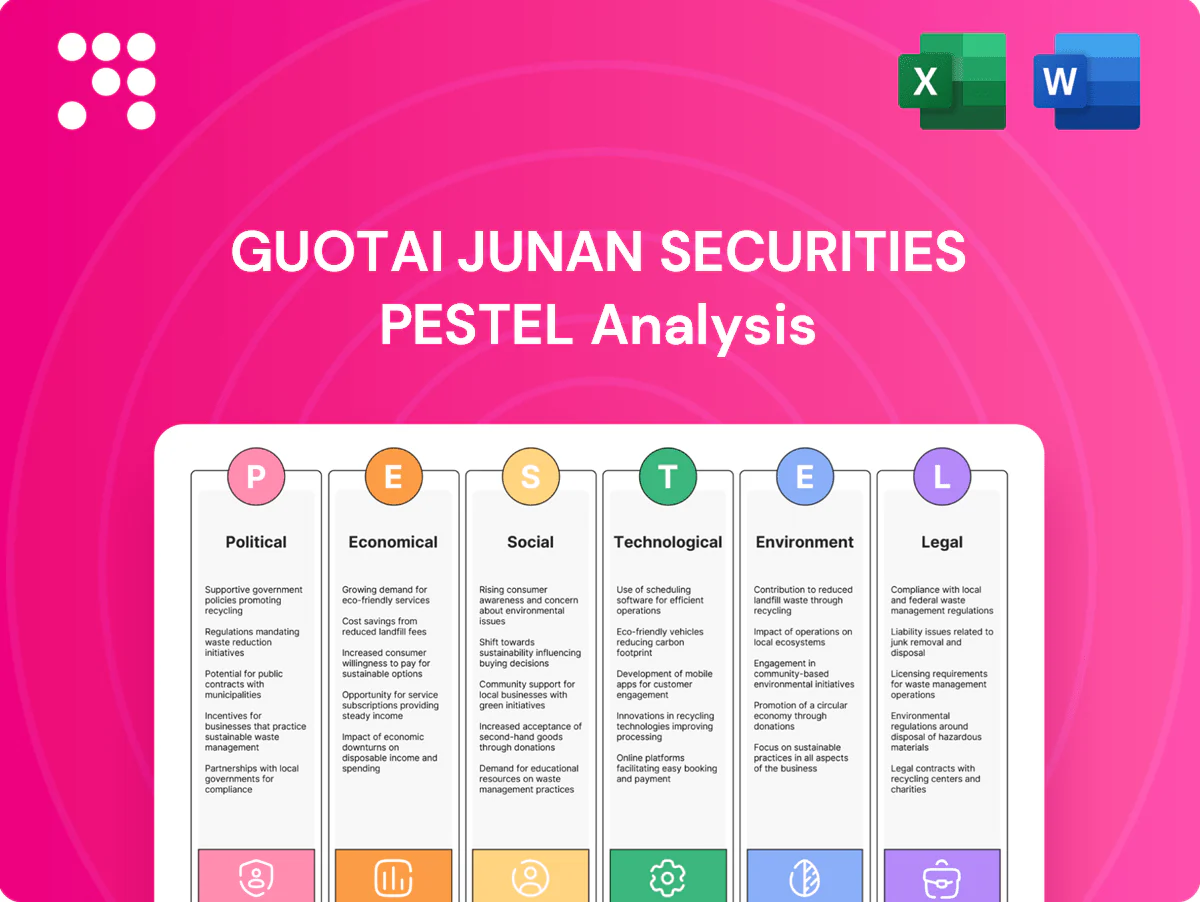
Guotai Junan Securities PESTLE Analysis

Your Competitive Advantage Starts with This Report
Unlock how political shifts, economic cycles, social trends, technological advances, legal changes, and environmental pressures shape Guotai Junan Securities’ strategic outlook and risk profile. This concise PESTLE highlights key external drivers investors and strategists must monitor. Purchase the full analysis for a complete, actionable breakdown ready for decision-making.
Political factors

State guidance and CSRC oversight
China’s party-state sets strategic direction for capital markets and the CSRC shapes rules, approvals and enforcement that directly affect Guotai Junan’s brokerage, underwriting and asset-management income; China A‑share market cap was about US$11 trillion in mid‑2024, amplifying policy impact.
Policy shifts can reprioritize brokerage margins, IPO cadence and leverage; CSRC campaigns raise compliance costs while supportive stances unlock trading volumes and new products.
Guotai Junan must maintain strong policy alignment and active regulatory relationships to protect fee pools and underwriting pipelines.
Capital market reform agenda
Registration-based IPO reforms since 2019, along with STAR and ChiNext market development and expanding mutual market access, have materially driven deal flow and trading volumes, creating recurring windows for investment banking and differentiated research coverage. The pace of reform directly affects pipelines and investor sentiment—delays or reversals visibly compress issuance and secondary market activity. Guotai Junan must stay agile across origination, market-making and research to monetize reform cycles and protect fee pools.

Macropolitical stability and governance
Macropolitical stability underpins investor confidence and risk appetite, with China setting a 2024 GDP growth target of about 5% that guides policy certainty for financial markets. Anti-corruption and common prosperity priorities continue to reshape wealth management product design and fee models, pressuring higher transparency and lower hidden fees. Government support for real-economy financing boosts demand for bond underwriting and structured solutions, while sudden political shocks can rapidly spike market volatility and counterparty risk.

Geopolitics and cross-border finance
US–China tensions constrain listings, tech underwriting and global investor access, with about 200 Chinese ADRs exposed to delisting or extra SEC scrutiny; sanctions and export controls (US Entity List >1,000 entries by 2024) shift sector coverage, valuations and compliance checks. Hong Kong connects partially offset access — Stock Connect northbound avg daily turnover exceeded RMB100bn in 2024 — Guotai Junan must tighten cross‑border due diligence and client screening.
- Listings risk: ~200 ADRs affected
- Sanctions: Entity List >1,000 (2024)
- HK offset: Stock Connect N‑bound >RMB100bn/day (2024)
- Action: enhanced KYC, sector limits, compliance monitoring
Local government financing dynamics
Regulatory treatment of LGFVs and debt resolution reshapes bond markets and raises underwriting risk; LGFV debt is estimated at ~RMB 40 trillion. Policy-led restructurings since 2022 have shifted fee pools from issuance to advisory, increasing advisory demand. Transparency initiatives raise disclosure demands on credit research and force the firm to adapt risk models as fiscal backstops evolve.
- LGFV debt ~RMB 40 trillion
- Fee shift: issuance to advisory post-2022 restructurings
- Higher disclosure demands → stronger credit research
- Risk management must adjust to changing fiscal backstops
China policy, geopolitics and LGFV debt reshape fees, flows and compliance
China’s party-state and CSRC set market direction, directly affecting Guotai Junan’s brokerage, underwriting and asset‑management fees; China A‑share market cap ~US$11tn (mid‑2024).
Geopolitical pressure (≈200 ADRs at risk; US Entity List >1,000 by 2024) and Stock Connect northbound >RMB100bn/day (2024) reshape cross‑border flows and compliance.
LGFV debt ~RMB40tn and post‑2022 restructurings shifted fees toward advisory, raising credit‑research and KYC demands.
| Metric | Value |
|---|---|
| China A‑share mkt cap (mid‑2024) | US$11tn |
| ADRs at risk | ~200 |
| US Entity List (2024) | >1,000 |
| Stock Connect N‑bound (avg/day, 2024) | >RMB100bn |
| LGFV debt | ~RMB40tn |
What is included in the product
 Detailed Word Document
Explores how Political, Economic, Social, Technological, Environmental and Legal forces uniquely impact Guotai Junan Securities, combining data-driven trends, region-specific regulatory insights and forward-looking scenarios to help executives and investors identify risks, opportunities and strategic responses.

 Customizable Excel Spreadsheet
A concise PESTLE snapshot of Guotai Junan Securities that distills regulatory, economic, technological and geopolitical risks into a single, editable page—ideal for quick insertion into presentations, team briefings, or client reports to streamline decision-making and align stakeholders.
Economic factors

China growth cycle and market liquidity
China's GDP growth slowed to 5.2% in 2023, and equity turnover and primary issuance historically track GDP momentum and credit impulse, so softer growth reduces brokerage commissions and asset inflows while stimulus can revive risk-on flows. Liquidity conditions directly affect margin financing and prop trading returns, making Guotai Junan’s earnings highly sensitive to macro cyclicality and credit cycles.
Interest rates and yield curve
PBOC stance—keeping the 1Y LPR at 3.45% and the 5Y LPR at 4.20% in 2024—along with MLF and interbank rate moves directly shape Guotai Junan’s funding costs and onshore bond demand; lower policy rates support client refinancing and higher equity valuation multiples but compress net interest spreads. Curve shifts (10y CN yield ~2.6% mid-2024) alter trading-book P&L and client hedging needs, making active ALM and dynamic rate strategies essential.

Property sector adjustment
China's property downturn—new home sales down about 30% y/y in 2023—weakens wealth effects, depresses collateral values and keeps credit spreads elevated (property HY spreads peaked >800bps), raising NPL and underwriting risk in related sectors; corporate default rates ticked up to ~4% in 2023, investors shifted into high-grade credit and MMFs (RMB ~1.2tn inflows), forcing Guotai Junan to recalibrate product shelves and risk appetite.

RMB volatility and capital flows
RMB volatility and capital flows shape Guotai Junan’s China franchise: USD/CNY averaged about 7.2 in 2024 and China’s FX reserves stood near $3.2 trillion, so depreciation episodes have previously triggered northbound outflow spikes and hedging demand via Connect and OTC products; stability in 2024 supported bond/equity issuance windows. FX sensitivity elevates risk for offshore businesses and structured products, making robust treasury and hedging solutions a competitive differentiator.
- Exchange-rate moves influence foreign participation via Connect and hedging demand
- Depreciation pressures can trigger outflows and risk aversion
- Stability supports issuance windows
- FX sensitivity affects offshore businesses and structured products
- Robust treasury and hedging solutions = differentiator
Household savings and asset allocation
China’s high household saving culture (around 30% of disposable income) and a gradual shift from property toward financial assets have expanded addressable AUM, with retail financial assets rising double digits in 2023–24.
Rising demand for retirement, quant and passive solutions is visible: passive funds and ETFs saw record inflows in 2024, while fee compression forces scale, digital distribution and multi-asset advisory to win wallet share for Guotai Junan.
- Household savings ≈30% of disposable income
- Retail financial assets growing double digits (2023–24)
- Passive/ETF inflows strong in 2024; need scale + digital
China policy, geopolitics and LGFV debt reshape fees, flows and compliance
Macroeconomic softness (GDP 5.2% in 2023) and credit cycles drive brokerage, margin and ECM activity, while PBOC rates (1Y LPR 3.45%, 5Y LPR 4.20%) and a 10y CN yield ~2.6% mid‑2024 set funding and trading dynamics. Property slump (new home sales -30% y/y) and higher defaults (~4% in 2023) raise underwriting and NPL risk; RMB ~7.2 avg and $3.2tn FX reserves shape flows and hedging demand.
| Indicator | Value |
|---|---|
| China GDP (2023) | 5.2% |
| 1Y / 5Y LPR (2024) | 3.45% / 4.20% |
| 10y CN yield (mid‑2024) | ~2.6% |
| New home sales (2023) | -30% y/y |
| Corporate default rate (2023) | ~4% |
| USD/CNY avg (2024) | ~7.2 |
| FX reserves | $3.2tn |
| Household savings | ~30% disposable income |
What You See Is What You Get
Guotai Junan Securities PESTLE Analysis
The preview shown here is the exact Guotai Junan Securities PESTLE Analysis you’ll receive after purchase—fully formatted and ready to use. It contains comprehensive political, economic, social, technological, legal and environmental insights tailored to the firm. No placeholders or teasers—this is the final file, downloadable immediately after payment.

Product Information
Product Information
Shipping & Returns
Shipping & Returns
Description
Your Competitive Advantage Starts with This Report
Unlock how political shifts, economic cycles, social trends, technological advances, legal changes, and environmental pressures shape Guotai Junan Securities’ strategic outlook and risk profile. This concise PESTLE highlights key external drivers investors and strategists must monitor. Purchase the full analysis for a complete, actionable breakdown ready for decision-making.
Political factors
State guidance and CSRC oversight
China’s party-state sets strategic direction for capital markets and the CSRC shapes rules, approvals and enforcement that directly affect Guotai Junan’s brokerage, underwriting and asset-management income; China A‑share market cap was about US$11 trillion in mid‑2024, amplifying policy impact.
Policy shifts can reprioritize brokerage margins, IPO cadence and leverage; CSRC campaigns raise compliance costs while supportive stances unlock trading volumes and new products.
Guotai Junan must maintain strong policy alignment and active regulatory relationships to protect fee pools and underwriting pipelines.
Capital market reform agenda
Registration-based IPO reforms since 2019, along with STAR and ChiNext market development and expanding mutual market access, have materially driven deal flow and trading volumes, creating recurring windows for investment banking and differentiated research coverage. The pace of reform directly affects pipelines and investor sentiment—delays or reversals visibly compress issuance and secondary market activity. Guotai Junan must stay agile across origination, market-making and research to monetize reform cycles and protect fee pools.
Macropolitical stability and governance
Macropolitical stability underpins investor confidence and risk appetite, with China setting a 2024 GDP growth target of about 5% that guides policy certainty for financial markets. Anti-corruption and common prosperity priorities continue to reshape wealth management product design and fee models, pressuring higher transparency and lower hidden fees. Government support for real-economy financing boosts demand for bond underwriting and structured solutions, while sudden political shocks can rapidly spike market volatility and counterparty risk.
Geopolitics and cross-border finance
US–China tensions constrain listings, tech underwriting and global investor access, with about 200 Chinese ADRs exposed to delisting or extra SEC scrutiny; sanctions and export controls (US Entity List >1,000 entries by 2024) shift sector coverage, valuations and compliance checks. Hong Kong connects partially offset access — Stock Connect northbound avg daily turnover exceeded RMB100bn in 2024 — Guotai Junan must tighten cross‑border due diligence and client screening.
- Listings risk: ~200 ADRs affected
- Sanctions: Entity List >1,000 (2024)
- HK offset: Stock Connect N‑bound >RMB100bn/day (2024)
- Action: enhanced KYC, sector limits, compliance monitoring
Local government financing dynamics
Regulatory treatment of LGFVs and debt resolution reshapes bond markets and raises underwriting risk; LGFV debt is estimated at ~RMB 40 trillion. Policy-led restructurings since 2022 have shifted fee pools from issuance to advisory, increasing advisory demand. Transparency initiatives raise disclosure demands on credit research and force the firm to adapt risk models as fiscal backstops evolve.
- LGFV debt ~RMB 40 trillion
- Fee shift: issuance to advisory post-2022 restructurings
- Higher disclosure demands → stronger credit research
- Risk management must adjust to changing fiscal backstops
China policy, geopolitics and LGFV debt reshape fees, flows and compliance
China’s party-state and CSRC set market direction, directly affecting Guotai Junan’s brokerage, underwriting and asset‑management fees; China A‑share market cap ~US$11tn (mid‑2024).
Geopolitical pressure (≈200 ADRs at risk; US Entity List >1,000 by 2024) and Stock Connect northbound >RMB100bn/day (2024) reshape cross‑border flows and compliance.
LGFV debt ~RMB40tn and post‑2022 restructurings shifted fees toward advisory, raising credit‑research and KYC demands.
| Metric | Value |
|---|---|
| China A‑share mkt cap (mid‑2024) | US$11tn |
| ADRs at risk | ~200 |
| US Entity List (2024) | >1,000 |
| Stock Connect N‑bound (avg/day, 2024) | >RMB100bn |
| LGFV debt | ~RMB40tn |
What is included in the product
Detailed Word Document
Explores how Political, Economic, Social, Technological, Environmental and Legal forces uniquely impact Guotai Junan Securities, combining data-driven trends, region-specific regulatory insights and forward-looking scenarios to help executives and investors identify risks, opportunities and strategic responses.
Customizable Excel Spreadsheet
A concise PESTLE snapshot of Guotai Junan Securities that distills regulatory, economic, technological and geopolitical risks into a single, editable page—ideal for quick insertion into presentations, team briefings, or client reports to streamline decision-making and align stakeholders.
Economic factors
China growth cycle and market liquidity
China's GDP growth slowed to 5.2% in 2023, and equity turnover and primary issuance historically track GDP momentum and credit impulse, so softer growth reduces brokerage commissions and asset inflows while stimulus can revive risk-on flows. Liquidity conditions directly affect margin financing and prop trading returns, making Guotai Junan’s earnings highly sensitive to macro cyclicality and credit cycles.
Interest rates and yield curve
PBOC stance—keeping the 1Y LPR at 3.45% and the 5Y LPR at 4.20% in 2024—along with MLF and interbank rate moves directly shape Guotai Junan’s funding costs and onshore bond demand; lower policy rates support client refinancing and higher equity valuation multiples but compress net interest spreads. Curve shifts (10y CN yield ~2.6% mid-2024) alter trading-book P&L and client hedging needs, making active ALM and dynamic rate strategies essential.
Property sector adjustment
China's property downturn—new home sales down about 30% y/y in 2023—weakens wealth effects, depresses collateral values and keeps credit spreads elevated (property HY spreads peaked >800bps), raising NPL and underwriting risk in related sectors; corporate default rates ticked up to ~4% in 2023, investors shifted into high-grade credit and MMFs (RMB ~1.2tn inflows), forcing Guotai Junan to recalibrate product shelves and risk appetite.
RMB volatility and capital flows
RMB volatility and capital flows shape Guotai Junan’s China franchise: USD/CNY averaged about 7.2 in 2024 and China’s FX reserves stood near $3.2 trillion, so depreciation episodes have previously triggered northbound outflow spikes and hedging demand via Connect and OTC products; stability in 2024 supported bond/equity issuance windows. FX sensitivity elevates risk for offshore businesses and structured products, making robust treasury and hedging solutions a competitive differentiator.
- Exchange-rate moves influence foreign participation via Connect and hedging demand
- Depreciation pressures can trigger outflows and risk aversion
- Stability supports issuance windows
- FX sensitivity affects offshore businesses and structured products
- Robust treasury and hedging solutions = differentiator
Household savings and asset allocation
China’s high household saving culture (around 30% of disposable income) and a gradual shift from property toward financial assets have expanded addressable AUM, with retail financial assets rising double digits in 2023–24.
Rising demand for retirement, quant and passive solutions is visible: passive funds and ETFs saw record inflows in 2024, while fee compression forces scale, digital distribution and multi-asset advisory to win wallet share for Guotai Junan.
- Household savings ≈30% of disposable income
- Retail financial assets growing double digits (2023–24)
- Passive/ETF inflows strong in 2024; need scale + digital
China policy, geopolitics and LGFV debt reshape fees, flows and compliance
Macroeconomic softness (GDP 5.2% in 2023) and credit cycles drive brokerage, margin and ECM activity, while PBOC rates (1Y LPR 3.45%, 5Y LPR 4.20%) and a 10y CN yield ~2.6% mid‑2024 set funding and trading dynamics. Property slump (new home sales -30% y/y) and higher defaults (~4% in 2023) raise underwriting and NPL risk; RMB ~7.2 avg and $3.2tn FX reserves shape flows and hedging demand.
| Indicator | Value |
|---|---|
| China GDP (2023) | 5.2% |
| 1Y / 5Y LPR (2024) | 3.45% / 4.20% |
| 10y CN yield (mid‑2024) | ~2.6% |
| New home sales (2023) | -30% y/y |
| Corporate default rate (2023) | ~4% |
| USD/CNY avg (2024) | ~7.2 |
| FX reserves | $3.2tn |
| Household savings | ~30% disposable income |
What You See Is What You Get
Guotai Junan Securities PESTLE Analysis
The preview shown here is the exact Guotai Junan Securities PESTLE Analysis you’ll receive after purchase—fully formatted and ready to use. It contains comprehensive political, economic, social, technological, legal and environmental insights tailored to the firm. No placeholders or teasers—this is the final file, downloadable immediately after payment.