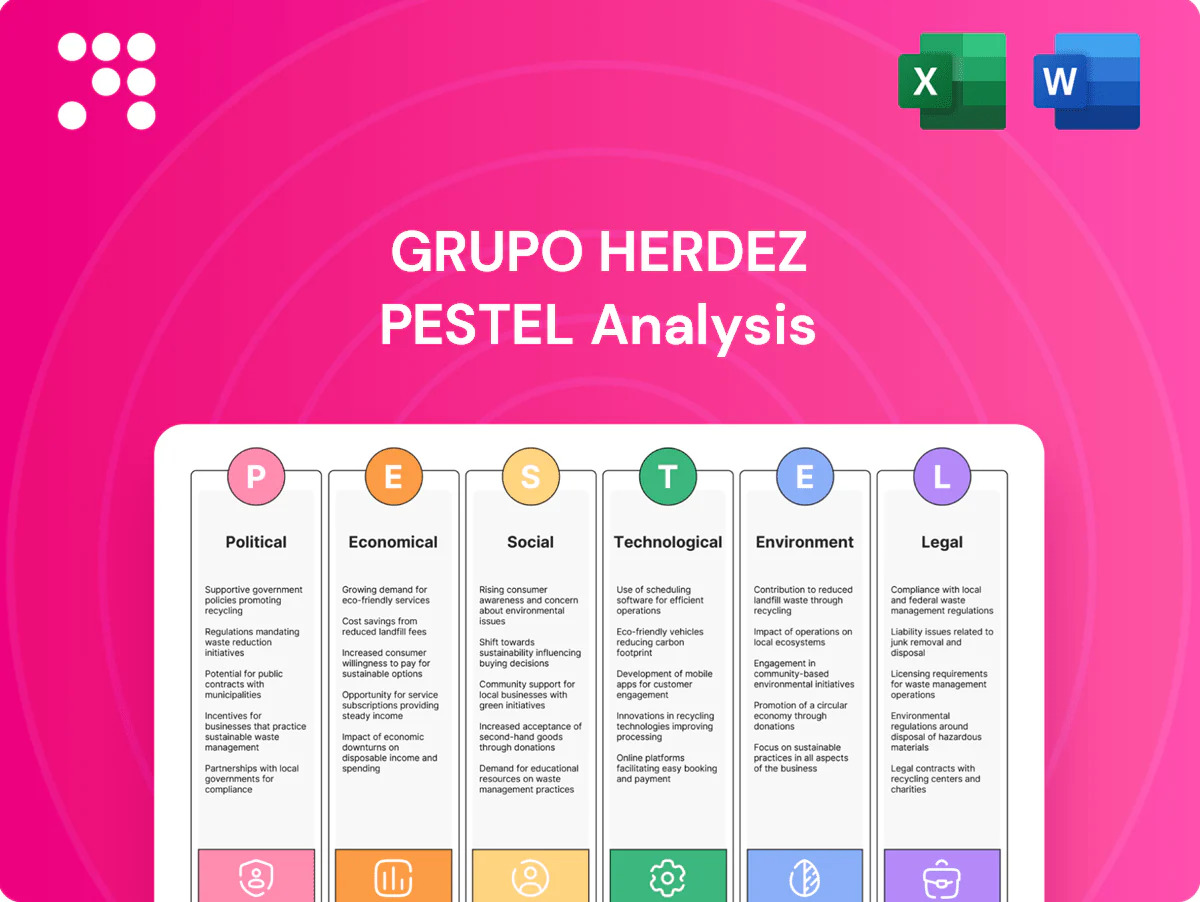
Grupo Herdez PESTLE Analysis

Plan Smarter. Present Sharper. Compete Stronger.
Our PESTLE snapshot reveals how political shifts, inflation trends, social tastes, regulatory pressures and sustainability expectations are reshaping Grupo Herdez’s strategy and margins. These concise insights identify risks and growth pockets for investors and strategists. Purchase the full PESTLE to access the complete, actionable analysis ready for immediate use.
Political factors

USMCA and tariffs
USMCA, in force since July 1, 2020, underpins trade stability for Mexico–U.S. lanes where bilateral goods trade has exceeded 700 billion dollars annually, easing cross‑border sourcing and distribution for Grupo Herdez.
Nutrition taxes and public health
Mexico’s 2014 IEPS (≈1 peso/liter) reduced sugary beverage purchases by 5.5% in year one and 7.6% over two years, shaping Grupo Herdez’s portfolio and pricing architecture; future hikes or category expansions could press volumes in jams, ice cream and sweetened items. Reformulation and portion strategies can mitigate shocks, while proactive engagement with policymakers and health NGOs guides compliant innovation.

Food sovereignty and ag policy
Government support for domestic growers directly affects prices and availability of vegetables and staples; Mexico imported about 16 million tonnes of corn in 2023, influencing feed and tortilla costs. Import permits and quotas can constrain sourcing flexibility for tomatoes, corn and sugar, altering procurement and margins. Subsidies and price controls distort cost baselines, while stable ag policy underpins long-term supplier partnerships.

Security and logistics infrastructure
Regional security issues in Mexico have raised freight-theft incidents roughly 10% year-on-year through 2023–24, increasing delivery risk for Grupo Herdez and raising insurance and loss provisions. Recent federal and state investments in highways, ports and cold-chain nodes — with Mexico targeting multibillion-peso projects in 2024—enhance perishable service levels and reduce spoilage. Political support for infrastructure PPPs lowers distribution costs; proactive route planning and cargo insurance hedge disruptions.
- Security risk: ~10% rise in freight theft (2023–24)
- Infrastructure spending: multibillion-peso projects 2024
- Cold-chain nodes/ports improve perishables uptime
- Mitigation: route planning, insurance, PPP-driven cost cuts
U.S.–Mexico relations
Bilateral tensions over migration, energy, or trade enforcement can spill into customs inspections; Mexico has been the United States largest goods trading partner since 2019 and two-way merchandise trade topped about 800 billion dollars in 2023, raising exposure to border disruptions. Heightened inspections elongate transit times, increasing working capital and inventory carrying costs. Diplomatic stability supports U.S. category expansion; scenario planning helps calibrate inventory positioning near border crossings.
- Risk: longer CBP inspections → higher days inventory
- Exposure: Mexico = top U.S. goods partner (since 2019)
- Mitigation: preposition stock near border, scenario-based reorder points
USMCA sustains Mexico-US trade; IEPS trims sugary drinks, freight theft up 10%
USMCA (since 1 Jul 2020) sustains Mexico–US trade lanes (≈800bn USD two‑way goods trade in 2023), easing Grupo Herdez cross‑border flows; regulatory taxes (IEPS ~1 MXN/L) cut sugary beverage volumes ~5.5% year one and ~7.6% over two years, pressuring sweet SKUs; agricultural imports (corn ≈16m t in 2023) and ~10% rise in freight theft (2023–24) raise input and logistics risk.
| Indicator | Value |
|---|---|
| Mexico‑US trade 2023 | ≈800bn USD |
| Corn imports 2023 | ≈16m tonnes |
| IEPS effect | -5.5% (yr1), -7.6% (2yrs) |
| Freight theft change 2023–24 | +10% |
What is included in the product
 Detailed Word Document
Explores how Political, Economic, Social, Technological, Environmental and Legal forces uniquely impact Grupo Herdez, with data-backed insights and trend analysis to identify risks and opportunities; tailored for executives, investors and strategists to inform proactive, forward-looking decisions.

 Customizable Excel Spreadsheet
A concise, visually segmented PESTLE summary for Grupo Herdez that relieves preparation pain—easy to drop into presentations, share across teams, and annotate with region- or business-line notes to support strategic discussions and external risk assessment.
Economic factors

MXN/USD volatility
MXN/USD volatility—about 17–19 MXN per USD through 2024–mid‑2025—impacts imported packaging/ingredient costs and U.S.‑dollar export receipts; a stronger USD can expand export margins while raising input costs. Hedging programs and natural currency offsets in sourcing mix have historically helped stabilize Grupo Herdez gross margin. Pricing corridors must reflect measurable currency pass‑through capacity to protect margins.
Commodity inflation
Corn, sugar, tomatoes, dairy and edible oils drive Grupo Herdez’s COGS variability through commodity and input-price swings; weather shocks and geopolitics periodically spike spot prices and freight, pressuring margins. Long-term contracts, diversified suppliers and futures are used to reduce volatility, while value-engineering and pack-price architecture protect affordability tiers and shelf penetration.

Consumer purchasing power
Real wages in Mexico lagged behind inflation as headline CPI eased from double digits in 2022 to about 4.6% in 2024 (INEGI), shifting demand from discretionary treats toward staples. Downtrading has elevated private‑label penetration in grocery and boosted sales of family‑size value packs, while premium brands face higher promotional elasticity. Elasticity varies by brand equity and necessity level, with staples less promo‑sensitive. Optimizing channel mix (modern trade, e‑commerce, proximity) preserves volumes across cycles.

Interest rates and capex
Higher interest rates increase financing costs for automation, cold-chain and warehouse capex, tightening payback thresholds and forcing Grupo Herdez to prioritize projects that boost throughput and energy efficiency; working capital discipline gains importance as modern trade commonly extends DSO. Opportunistic M&A timing will hinge on credit availability and spread levels, affecting deal pricing and leverage capacity.
- Higher borrowing costs → stricter capex ROI
- Focus: throughput, energy savings, faster paybacks
- Working capital discipline crucial with longer DSO
- M&A dependent on credit conditions and spreads
U.S. market growth
U.S. Hispanic population ~62 million (U.S. Census Bureau, 2023) underpins rapid demand for Hispanic foods, supporting premium salsas and sauces as higher‑ASP SKUs capture share; NielsenIQ (2024) documents Hispanic food sales growing faster than overall grocery. Mainstream retailer distribution gains widen TAM but logistics and marketing spend must scale with door growth, pressure that can increase SG&A intensity; margin accretion hinges on SKU mix and trade terms.
- Hispanic population: ~62M (US Census 2023)
- Hispanic food sales growth: outpacing total grocery (NielsenIQ 2024)
- Requires higher logistics/marketing per new door
- Margins depend on mix premiumization and negotiated trade terms
USMCA sustains Mexico-US trade; IEPS trims sugary drinks, freight theft up 10%
MXN/USD ~17–19 (2024–mid‑2025) shifts import costs vs. export receipts; hedging and sourcing offsets have stabilized gross margins. Commodity swings (corn, sugar, tomatoes, dairy, oils) drive COGS volatility; long‑term contracts and futures reduce exposure. CPI ~4.6% (INEGI 2024) drove downtrading; US Hispanic ~62M (US Census 2023) lifts export demand.
| Metric | Value |
|---|---|
| MXN/USD | 17–19 (2024–mid‑2025) |
| CPI Mexico | 4.6% (INEGI 2024) |
| US Hispanic pop. | ~62M (US Census 2023) |
| Key commodities | Corn, sugar, tomatoes, dairy, oils |
What You See Is What You Get
Grupo Herdez PESTLE Analysis
The Grupo Herdez PESTLE Analysis preview shown here is the exact document you’ll receive after purchase—fully formatted and ready to use. It contains the complete political, economic, social, technological, legal, and environmental assessment. No placeholders or teasers—this is the final file. Downloadable immediately after payment.

Product Information
Product Information
Shipping & Returns
Shipping & Returns
Description
Plan Smarter. Present Sharper. Compete Stronger.
Our PESTLE snapshot reveals how political shifts, inflation trends, social tastes, regulatory pressures and sustainability expectations are reshaping Grupo Herdez’s strategy and margins. These concise insights identify risks and growth pockets for investors and strategists. Purchase the full PESTLE to access the complete, actionable analysis ready for immediate use.
Political factors
USMCA and tariffs
USMCA, in force since July 1, 2020, underpins trade stability for Mexico–U.S. lanes where bilateral goods trade has exceeded 700 billion dollars annually, easing cross‑border sourcing and distribution for Grupo Herdez.
Nutrition taxes and public health
Mexico’s 2014 IEPS (≈1 peso/liter) reduced sugary beverage purchases by 5.5% in year one and 7.6% over two years, shaping Grupo Herdez’s portfolio and pricing architecture; future hikes or category expansions could press volumes in jams, ice cream and sweetened items. Reformulation and portion strategies can mitigate shocks, while proactive engagement with policymakers and health NGOs guides compliant innovation.
Food sovereignty and ag policy
Government support for domestic growers directly affects prices and availability of vegetables and staples; Mexico imported about 16 million tonnes of corn in 2023, influencing feed and tortilla costs. Import permits and quotas can constrain sourcing flexibility for tomatoes, corn and sugar, altering procurement and margins. Subsidies and price controls distort cost baselines, while stable ag policy underpins long-term supplier partnerships.
Security and logistics infrastructure
Regional security issues in Mexico have raised freight-theft incidents roughly 10% year-on-year through 2023–24, increasing delivery risk for Grupo Herdez and raising insurance and loss provisions. Recent federal and state investments in highways, ports and cold-chain nodes — with Mexico targeting multibillion-peso projects in 2024—enhance perishable service levels and reduce spoilage. Political support for infrastructure PPPs lowers distribution costs; proactive route planning and cargo insurance hedge disruptions.
- Security risk: ~10% rise in freight theft (2023–24)
- Infrastructure spending: multibillion-peso projects 2024
- Cold-chain nodes/ports improve perishables uptime
- Mitigation: route planning, insurance, PPP-driven cost cuts
U.S.–Mexico relations
Bilateral tensions over migration, energy, or trade enforcement can spill into customs inspections; Mexico has been the United States largest goods trading partner since 2019 and two-way merchandise trade topped about 800 billion dollars in 2023, raising exposure to border disruptions. Heightened inspections elongate transit times, increasing working capital and inventory carrying costs. Diplomatic stability supports U.S. category expansion; scenario planning helps calibrate inventory positioning near border crossings.
- Risk: longer CBP inspections → higher days inventory
- Exposure: Mexico = top U.S. goods partner (since 2019)
- Mitigation: preposition stock near border, scenario-based reorder points
USMCA sustains Mexico-US trade; IEPS trims sugary drinks, freight theft up 10%
USMCA (since 1 Jul 2020) sustains Mexico–US trade lanes (≈800bn USD two‑way goods trade in 2023), easing Grupo Herdez cross‑border flows; regulatory taxes (IEPS ~1 MXN/L) cut sugary beverage volumes ~5.5% year one and ~7.6% over two years, pressuring sweet SKUs; agricultural imports (corn ≈16m t in 2023) and ~10% rise in freight theft (2023–24) raise input and logistics risk.
| Indicator | Value |
|---|---|
| Mexico‑US trade 2023 | ≈800bn USD |
| Corn imports 2023 | ≈16m tonnes |
| IEPS effect | -5.5% (yr1), -7.6% (2yrs) |
| Freight theft change 2023–24 | +10% |
What is included in the product
Detailed Word Document
Explores how Political, Economic, Social, Technological, Environmental and Legal forces uniquely impact Grupo Herdez, with data-backed insights and trend analysis to identify risks and opportunities; tailored for executives, investors and strategists to inform proactive, forward-looking decisions.
Customizable Excel Spreadsheet
A concise, visually segmented PESTLE summary for Grupo Herdez that relieves preparation pain—easy to drop into presentations, share across teams, and annotate with region- or business-line notes to support strategic discussions and external risk assessment.
Economic factors
MXN/USD volatility
MXN/USD volatility—about 17–19 MXN per USD through 2024–mid‑2025—impacts imported packaging/ingredient costs and U.S.‑dollar export receipts; a stronger USD can expand export margins while raising input costs. Hedging programs and natural currency offsets in sourcing mix have historically helped stabilize Grupo Herdez gross margin. Pricing corridors must reflect measurable currency pass‑through capacity to protect margins.
Commodity inflation
Corn, sugar, tomatoes, dairy and edible oils drive Grupo Herdez’s COGS variability through commodity and input-price swings; weather shocks and geopolitics periodically spike spot prices and freight, pressuring margins. Long-term contracts, diversified suppliers and futures are used to reduce volatility, while value-engineering and pack-price architecture protect affordability tiers and shelf penetration.
Consumer purchasing power
Real wages in Mexico lagged behind inflation as headline CPI eased from double digits in 2022 to about 4.6% in 2024 (INEGI), shifting demand from discretionary treats toward staples. Downtrading has elevated private‑label penetration in grocery and boosted sales of family‑size value packs, while premium brands face higher promotional elasticity. Elasticity varies by brand equity and necessity level, with staples less promo‑sensitive. Optimizing channel mix (modern trade, e‑commerce, proximity) preserves volumes across cycles.
Interest rates and capex
Higher interest rates increase financing costs for automation, cold-chain and warehouse capex, tightening payback thresholds and forcing Grupo Herdez to prioritize projects that boost throughput and energy efficiency; working capital discipline gains importance as modern trade commonly extends DSO. Opportunistic M&A timing will hinge on credit availability and spread levels, affecting deal pricing and leverage capacity.
- Higher borrowing costs → stricter capex ROI
- Focus: throughput, energy savings, faster paybacks
- Working capital discipline crucial with longer DSO
- M&A dependent on credit conditions and spreads
U.S. market growth
U.S. Hispanic population ~62 million (U.S. Census Bureau, 2023) underpins rapid demand for Hispanic foods, supporting premium salsas and sauces as higher‑ASP SKUs capture share; NielsenIQ (2024) documents Hispanic food sales growing faster than overall grocery. Mainstream retailer distribution gains widen TAM but logistics and marketing spend must scale with door growth, pressure that can increase SG&A intensity; margin accretion hinges on SKU mix and trade terms.
- Hispanic population: ~62M (US Census 2023)
- Hispanic food sales growth: outpacing total grocery (NielsenIQ 2024)
- Requires higher logistics/marketing per new door
- Margins depend on mix premiumization and negotiated trade terms
USMCA sustains Mexico-US trade; IEPS trims sugary drinks, freight theft up 10%
MXN/USD ~17–19 (2024–mid‑2025) shifts import costs vs. export receipts; hedging and sourcing offsets have stabilized gross margins. Commodity swings (corn, sugar, tomatoes, dairy, oils) drive COGS volatility; long‑term contracts and futures reduce exposure. CPI ~4.6% (INEGI 2024) drove downtrading; US Hispanic ~62M (US Census 2023) lifts export demand.
| Metric | Value |
|---|---|
| MXN/USD | 17–19 (2024–mid‑2025) |
| CPI Mexico | 4.6% (INEGI 2024) |
| US Hispanic pop. | ~62M (US Census 2023) |
| Key commodities | Corn, sugar, tomatoes, dairy, oils |
What You See Is What You Get
Grupo Herdez PESTLE Analysis
The Grupo Herdez PESTLE Analysis preview shown here is the exact document you’ll receive after purchase—fully formatted and ready to use. It contains the complete political, economic, social, technological, legal, and environmental assessment. No placeholders or teasers—this is the final file. Downloadable immediately after payment.