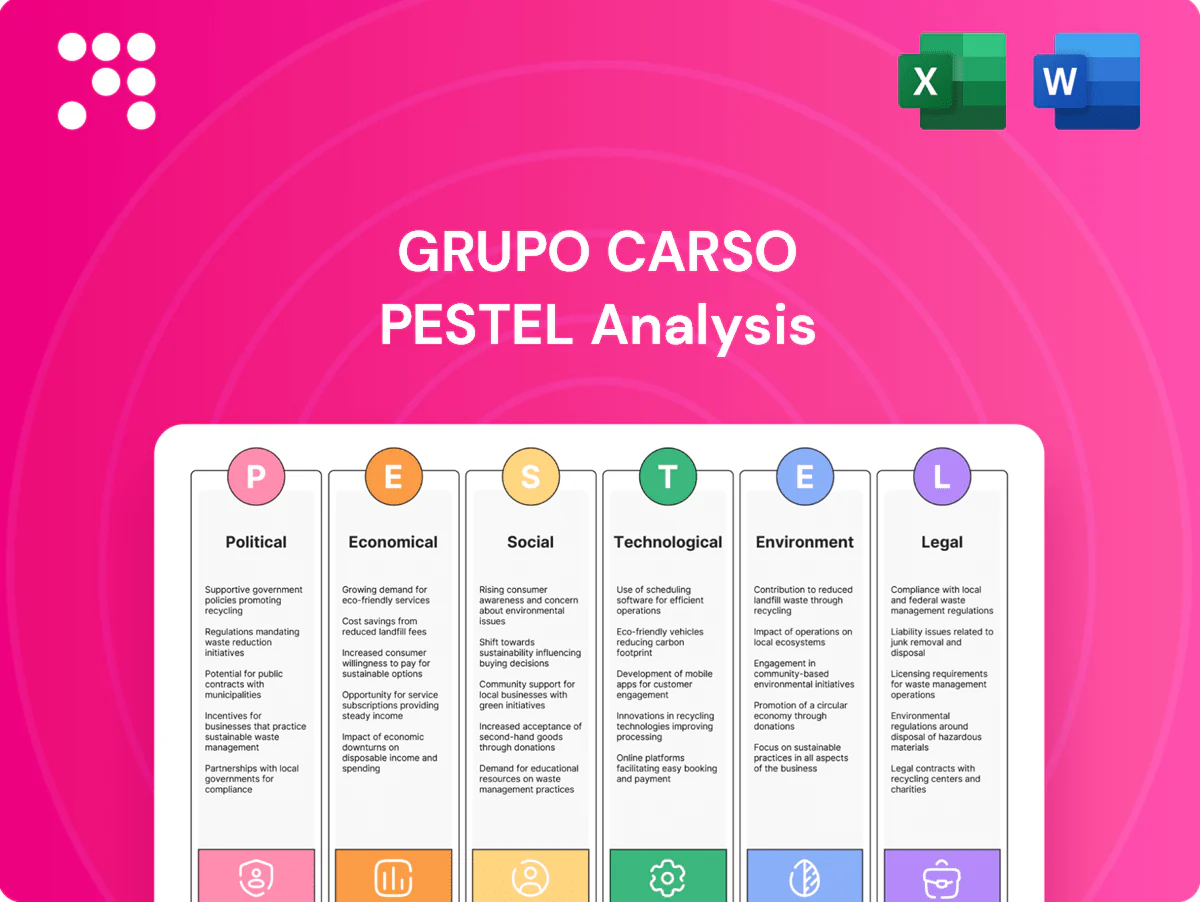
Grupo Carso PESTLE Analysis

Plan Smarter. Present Sharper. Compete Stronger.
Unlock strategic clarity with our focused PESTLE Analysis of Grupo Carso—spot how political shifts, economic cycles, social trends, and tech advances reshape its prospects. Ideal for investors and strategists, this concise report highlights risks and opportunities. Purchase the full analysis to access detailed, actionable insights and ready-to-use slides and tables.
Political factors

Government infrastructure priorities
Grupo Carso is exposed to federal and state infrastructure budgets that drive concessions and construction backlogs, exemplified by flagship projects like Tren Maya (≈150 billion MXN) and Dos Bocas refinery (≈8 billion USD) which shape award timing. Post‑electoral shifts in 2024–25 can accelerate or delay pipeline awards and public payment cycles, affecting cashflow. High dependence on public–private partnerships requires bid alignment with official development plans. Diversification across sectors and geographies cushions project cyclicality.
Trade policy and USMCA effects
USMCA's 75% regional value‑content and 40% high‑wage content rule (wage benchmark ~$16/hr) reshape Grupo Carso's auto and appliance sourcing, favoring Mexico-based inputs to retain tariff-free access. Cross‑border frictions, inspections and trucking rules lengthen lead times and raise logistics costs, increasing inventory and working capital needs. Nearshoring into Mexico expands supplier density and cost competitiveness, but requires sustained compliance investments to protect export access.

Regulatory fragmentation across states
Regulatory fragmentation across Mexico's 32 federal entities forces Grupo Carso to navigate differing permitting, zoning and retail licensing at municipal and state levels, complicating store openings and construction sites. Robust stakeholder mapping and cultivation of local political relationships are essential to secure timely approvals and community buy-in. Timeline risks include localized opposition and administrative bottlenecks that can delay projects. Implement standardized playbooks with predefined local adaptations and escalation paths.

Security and public order
Crime hotspots force Grupo Carso to reroute logistics, expand site protection and push up insurance; Marsh reported ~20% rises in Latin America premium pressure in 2023–24 and cargo-theft typically causes 24–72 hour delays. Coordination with authorities plus private security and armored transport raises OPEX and CAPEX, prompting active portfolio rebalancing away from high-risk corridors.
- Impact: route diversion, site hardening
- Cost: insurance premiums ~+20% (Marsh 2023–24)
- Delay: 24–72 hours typical for theft/disruption
- Response: police coordination, private security, portfolio shift
Subsidies and industrial policy
Subsidies and industrial policy can materially lower Grupo Carsos capex/opex by supporting manufacturing and energy-efficiency upgrades in a sector that accounts for roughly 17–18% of Mexicos GDP; 2024 policy signals increased regional development grants and tax incentives targeting supplier development. Rising domestic-content preferences and continued preferential treatment for state-owned utilities (CFE controls a majority of power generation) create sourcing exposure. Build optionality into projects to capture subsidies and hedge policy shifts.
- Incentives: pursue energy-efficiency grants and regional CAPEX offsets
- Domestic content: monitor supplier-development rules that affect procurement
- State exposure: price power contract risk versus CFE preference
Cashflow tied to federal projects: Tren Maya 150bn MXN, Dos Bocas 8bn USD
Grupo Carso's pipeline and cashflow hinge on federal infrastructure spend and PPP timing (Tren Maya ≈150 billion MXN; Dos Bocas ≈8 billion USD). USMCA sourcing rules and cross‑border frictions raise working capital and compliance costs. Crime, insurance and permitting variability add OPEX and schedule risk, offset by subsidy capture and geographic diversification.
| Impact | Metric | 2023–25 |
|---|---|---|
| Major projects | Value | Tren Maya ≈150 bn MXN; Dos Bocas ≈8 bn USD |
| Insurance | Premium change | ≈+20% (Marsh 2023–24) |
| Logistics | Theft delay | 24–72 hrs |
What is included in the product
 Detailed Word Document
Explores how macro-environmental factors uniquely affect Grupo Carso across Political, Economic, Social, Technological, Environmental and Legal dimensions, with data-backed trends and forward-looking insights that reflect regional market and regulatory dynamics; designed for executives, consultants, and investors and ready for direct use in plans or decks.

 Customizable Excel Spreadsheet
Clean, summarized Grupo Carso PESTLE that’s visually segmented by category for quick interpretation and drop-in use during meetings or presentations. Editable notes and a shareable, concise format make it ideal for cross-team alignment, client reports, and on-the-go decision-making.
Economic factors

FX volatility (MXN/USD)
MXN/USD has traded roughly 16.5–19.0 since 2023, with annualized FX volatility near 8–12%, creating material translation risk on USD-linked revenues and transaction risk on imported inputs; natural hedges—export receipts and increased local sourcing—can offset exposure. Retail segments enjoy stronger pricing power to pass through MXN moves, while fixed-price construction contracts magnify cash-flow risk; set hedge ratios to cover cash flow at risk (e.g., 60–100% for construction, 20–50% for retail).
Interest rates and credit cycles
Banxico's policy rate at 11.25% (Dec 2023) tightened consumer demand and raised Grupo Carso's capex and working-capital funding costs, compressing retail and infrastructure margins; construction backlog is highly sensitive to client financing availability, slowing project starts when credit tightens. Opportunistic locking of long-term debt during easing windows can cut interest expense, while stress-tests of 200–300 bps margin compression are prudent.

Consumer spending resilience
Rising wages (real wage growth ~3.2% in 2024), record remittances to Mexico (about $64.9B in 2023 with continued inflows in 2024) and low unemployment (~3% in 2024) support department store and restaurant traffic, especially in middle-income cohorts.
Segment exposure by income tiers to estimate elasticity and private-label upside; private-label penetration can rise where lower tiers dominate purchases.
Omnichannel sales (e-commerce ~12% of retail in 2024) increase basket size and visit frequency; calibrate promotions to inflation (~4–5% range in 2024) to protect margins and demand.

Commodity and input costs
Rising steel (HRC ≈ $700–800/ton in 2024), cement (regional ~ $60–80/ton), resins and energy (Brent ≈ $86/bbl 2024; Mexican industrial power ≈ $0.11/kWh) compress Grupo Carso’s manufacturing and construction margins; indexation clauses to CPI or commodity-linked formulas plus procurement hedges (for fuel/resins) mitigate pass-through. Optimize make-vs-buy, increase inventory buffers during spikes and monitor supplier concentration—top 5 suppliers exposure should be tracked closely.
Nearshoring and industrial demand
Nearshoring has driven measurable order flow into Grupo Carso from automotive, electronics and construction as Mexico produced ~3.9 million vehicles in 2023 and electronics exports rose sharply, translating into multi-year supplier contracts and FDI-backed projects across plants.
Planned capacity additions focus on border and central corridors—Tijuana, Monterrey, Bajío—requiring phased tooling and automation investment staged to demand, with capex gates to balance cyclical surges.
- Orders: automotive/electronics/construction = FDI-tied multi-year contracts
- Clusters: Tijuana, Monterrey, Bajío
- Capex: phased tooling/automation; gated spend
Cashflow tied to federal projects: Tren Maya 150bn MXN, Dos Bocas 8bn USD
MXN/USD ~16.5–19.0 since 2023 (FX vol 8–12%) creates translation/transaction risk; hedge construction cash flows 60–100% and retail 20–50%. Banxico policy rate 11.25% (Dec 2023) raises funding costs; stress-test 200–300 bps margin compression. Nearshoring (3.9M vehicles 2023), remittances $64.9B (2023) and e-commerce ~12% (2024) support retail and FDI-backed orders.
| Metric | Value (latest) |
|---|---|
| MXN/USD | 16.5–19.0 |
| Banxico rate | 11.25% (Dec 2023) |
| Remittances | $64.9B (2023) |
| Vehicles produced | 3.9M (2023) |
| Retail e‑commerce | ~12% (2024) |
Same Document Delivered
Grupo Carso PESTLE Analysis
The Grupo Carso PESTLE Analysis provides a concise evaluation of political, economic, social, technological, legal, and environmental factors affecting the conglomerate. It highlights key risks and strategic opportunities across Carso’s diversified portfolio. The content and structure shown in the preview is the same document you’ll download after payment.

Original: $10.00
-65%$10.00
$3.50Product Information
Product Information
Shipping & Returns
Shipping & Returns
Description
Plan Smarter. Present Sharper. Compete Stronger.
Unlock strategic clarity with our focused PESTLE Analysis of Grupo Carso—spot how political shifts, economic cycles, social trends, and tech advances reshape its prospects. Ideal for investors and strategists, this concise report highlights risks and opportunities. Purchase the full analysis to access detailed, actionable insights and ready-to-use slides and tables.
Political factors
Government infrastructure priorities
Grupo Carso is exposed to federal and state infrastructure budgets that drive concessions and construction backlogs, exemplified by flagship projects like Tren Maya (≈150 billion MXN) and Dos Bocas refinery (≈8 billion USD) which shape award timing. Post‑electoral shifts in 2024–25 can accelerate or delay pipeline awards and public payment cycles, affecting cashflow. High dependence on public–private partnerships requires bid alignment with official development plans. Diversification across sectors and geographies cushions project cyclicality.
Trade policy and USMCA effects
USMCA's 75% regional value‑content and 40% high‑wage content rule (wage benchmark ~$16/hr) reshape Grupo Carso's auto and appliance sourcing, favoring Mexico-based inputs to retain tariff-free access. Cross‑border frictions, inspections and trucking rules lengthen lead times and raise logistics costs, increasing inventory and working capital needs. Nearshoring into Mexico expands supplier density and cost competitiveness, but requires sustained compliance investments to protect export access.
Regulatory fragmentation across states
Regulatory fragmentation across Mexico's 32 federal entities forces Grupo Carso to navigate differing permitting, zoning and retail licensing at municipal and state levels, complicating store openings and construction sites. Robust stakeholder mapping and cultivation of local political relationships are essential to secure timely approvals and community buy-in. Timeline risks include localized opposition and administrative bottlenecks that can delay projects. Implement standardized playbooks with predefined local adaptations and escalation paths.
Security and public order
Crime hotspots force Grupo Carso to reroute logistics, expand site protection and push up insurance; Marsh reported ~20% rises in Latin America premium pressure in 2023–24 and cargo-theft typically causes 24–72 hour delays. Coordination with authorities plus private security and armored transport raises OPEX and CAPEX, prompting active portfolio rebalancing away from high-risk corridors.
- Impact: route diversion, site hardening
- Cost: insurance premiums ~+20% (Marsh 2023–24)
- Delay: 24–72 hours typical for theft/disruption
- Response: police coordination, private security, portfolio shift
Subsidies and industrial policy
Subsidies and industrial policy can materially lower Grupo Carsos capex/opex by supporting manufacturing and energy-efficiency upgrades in a sector that accounts for roughly 17–18% of Mexicos GDP; 2024 policy signals increased regional development grants and tax incentives targeting supplier development. Rising domestic-content preferences and continued preferential treatment for state-owned utilities (CFE controls a majority of power generation) create sourcing exposure. Build optionality into projects to capture subsidies and hedge policy shifts.
- Incentives: pursue energy-efficiency grants and regional CAPEX offsets
- Domestic content: monitor supplier-development rules that affect procurement
- State exposure: price power contract risk versus CFE preference
Cashflow tied to federal projects: Tren Maya 150bn MXN, Dos Bocas 8bn USD
Grupo Carso's pipeline and cashflow hinge on federal infrastructure spend and PPP timing (Tren Maya ≈150 billion MXN; Dos Bocas ≈8 billion USD). USMCA sourcing rules and cross‑border frictions raise working capital and compliance costs. Crime, insurance and permitting variability add OPEX and schedule risk, offset by subsidy capture and geographic diversification.
| Impact | Metric | 2023–25 |
|---|---|---|
| Major projects | Value | Tren Maya ≈150 bn MXN; Dos Bocas ≈8 bn USD |
| Insurance | Premium change | ≈+20% (Marsh 2023–24) |
| Logistics | Theft delay | 24–72 hrs |
What is included in the product
Detailed Word Document
Explores how macro-environmental factors uniquely affect Grupo Carso across Political, Economic, Social, Technological, Environmental and Legal dimensions, with data-backed trends and forward-looking insights that reflect regional market and regulatory dynamics; designed for executives, consultants, and investors and ready for direct use in plans or decks.
Customizable Excel Spreadsheet
Clean, summarized Grupo Carso PESTLE that’s visually segmented by category for quick interpretation and drop-in use during meetings or presentations. Editable notes and a shareable, concise format make it ideal for cross-team alignment, client reports, and on-the-go decision-making.
Economic factors
FX volatility (MXN/USD)
MXN/USD has traded roughly 16.5–19.0 since 2023, with annualized FX volatility near 8–12%, creating material translation risk on USD-linked revenues and transaction risk on imported inputs; natural hedges—export receipts and increased local sourcing—can offset exposure. Retail segments enjoy stronger pricing power to pass through MXN moves, while fixed-price construction contracts magnify cash-flow risk; set hedge ratios to cover cash flow at risk (e.g., 60–100% for construction, 20–50% for retail).
Interest rates and credit cycles
Banxico's policy rate at 11.25% (Dec 2023) tightened consumer demand and raised Grupo Carso's capex and working-capital funding costs, compressing retail and infrastructure margins; construction backlog is highly sensitive to client financing availability, slowing project starts when credit tightens. Opportunistic locking of long-term debt during easing windows can cut interest expense, while stress-tests of 200–300 bps margin compression are prudent.
Consumer spending resilience
Rising wages (real wage growth ~3.2% in 2024), record remittances to Mexico (about $64.9B in 2023 with continued inflows in 2024) and low unemployment (~3% in 2024) support department store and restaurant traffic, especially in middle-income cohorts.
Segment exposure by income tiers to estimate elasticity and private-label upside; private-label penetration can rise where lower tiers dominate purchases.
Omnichannel sales (e-commerce ~12% of retail in 2024) increase basket size and visit frequency; calibrate promotions to inflation (~4–5% range in 2024) to protect margins and demand.
Commodity and input costs
Rising steel (HRC ≈ $700–800/ton in 2024), cement (regional ~ $60–80/ton), resins and energy (Brent ≈ $86/bbl 2024; Mexican industrial power ≈ $0.11/kWh) compress Grupo Carso’s manufacturing and construction margins; indexation clauses to CPI or commodity-linked formulas plus procurement hedges (for fuel/resins) mitigate pass-through. Optimize make-vs-buy, increase inventory buffers during spikes and monitor supplier concentration—top 5 suppliers exposure should be tracked closely.
Nearshoring and industrial demand
Nearshoring has driven measurable order flow into Grupo Carso from automotive, electronics and construction as Mexico produced ~3.9 million vehicles in 2023 and electronics exports rose sharply, translating into multi-year supplier contracts and FDI-backed projects across plants.
Planned capacity additions focus on border and central corridors—Tijuana, Monterrey, Bajío—requiring phased tooling and automation investment staged to demand, with capex gates to balance cyclical surges.
- Orders: automotive/electronics/construction = FDI-tied multi-year contracts
- Clusters: Tijuana, Monterrey, Bajío
- Capex: phased tooling/automation; gated spend
Cashflow tied to federal projects: Tren Maya 150bn MXN, Dos Bocas 8bn USD
MXN/USD ~16.5–19.0 since 2023 (FX vol 8–12%) creates translation/transaction risk; hedge construction cash flows 60–100% and retail 20–50%. Banxico policy rate 11.25% (Dec 2023) raises funding costs; stress-test 200–300 bps margin compression. Nearshoring (3.9M vehicles 2023), remittances $64.9B (2023) and e-commerce ~12% (2024) support retail and FDI-backed orders.
| Metric | Value (latest) |
|---|---|
| MXN/USD | 16.5–19.0 |
| Banxico rate | 11.25% (Dec 2023) |
| Remittances | $64.9B (2023) |
| Vehicles produced | 3.9M (2023) |
| Retail e‑commerce | ~12% (2024) |
Same Document Delivered
Grupo Carso PESTLE Analysis
The Grupo Carso PESTLE Analysis provides a concise evaluation of political, economic, social, technological, legal, and environmental factors affecting the conglomerate. It highlights key risks and strategic opportunities across Carso’s diversified portfolio. The content and structure shown in the preview is the same document you’ll download after payment.











