Gruma PESTLE Analysis

Make Smarter Strategic Decisions with a Complete PESTEL View
Our PESTLE Analysis for Gruma reveals how political, economic, social, technological, legal, and environmental forces shape its supply chain, margins, and growth opportunities. This concise briefing highlights key risks and strategic levers. Perfect for investors and strategists seeking clarity. Purchase the full report to access detailed, actionable insights and forecasts.
Political factors

Agricultural subsidy and corn policy
Government shifts in corn subsidies alter input costs and planting incentives; Mexico imported about 17 million tonnes of corn in 2024 (USDA), so domestic subsidy withdrawal or price supports can rapidly tighten regional availability. Price supports, import quotas and reserves distort supply; Gruma responds by hedging procurement, diversifying suppliers and engaging policymakers to anticipate reforms and minimize margin shocks.
Trade agreements and tariffs (e.g., USMCA)
Cross-border flows of corn and finished products depend on tariff schedules and rules of origin under USMCA, which entered into force on July 1, 2020, allowing tariff-free trade when origin rules are met. Changes in enforcement or new disputes could raise costs or delay logistics for Gruma’s binational operations. The company benefits from open trade but remains exposed to protectionism; contingency plans include alternative routes and localizing production.

Food security and price stabilization measures
Governments may impose price controls or export restrictions during staple shortages, actions that can compress Gruma’s margins and reallocate corn/flour supply to domestic markets. Gruma, active in over 100 countries, must model scenarios where policy prioritizes affordability over profitability and stress-test margins under supply curbs. Strategic public–private partnerships can help secure feedstock and stabilize supplies while preserving business continuity.

Political stability in key markets
Operational risk rises with elections, social unrest or policy uncertainty in Latin America and other regions; permitting, taxation and subsidies can shift quickly between administrations. Gruma reduces single-country exposure through geographic diversification and, as of 2024, maintains operations in 14 countries and sales in 100+ countries. Strong local stakeholder relations help preserve continuity during political change.
- Operations in 14 countries
- Sales in 100+ countries
- Electoral cycles elevate operational risk
- Permitting, tax and subsidy volatility can compress margins
Public nutrition programs and procurement
Public nutrition programs shape institutional demand for tortillas and corn flour; 388 million children received school meals globally in 2023 (WFP), creating sizeable tender opportunities. Nutritional specifications (e.g., fortified micronutrients) push Gruma to adapt formulations and processing. Winning tenders delivers volume but often at tighter margins; compliance and predictable supply are prerequisites to retain contracts.
- Institutional demand: large, recurring (WFP: 388M school meals, 2023)
- Product specs: fortification drives R&D and reformulation
- Commercial impact: volume vs margin; supply reliability critical
Political shifts amplify feedstock cost volatility and squeeze margins across global corn supply
Political shifts in subsidies, tariffs and export controls drive feedstock cost volatility (Mexico corn imports ~17 million tonnes in 2024, USDA) and raise margin risk; Gruma hedges procurement and diversifies supply. Electoral cycles and local policy changes threaten permitting and taxes across 14 operating countries, 100+ markets. Public programs (WFP: 388M school meals, 2023) create volume but tighter margins.
| Metric | Value |
|---|---|
| Mexico corn imports (2024) | ~17M t |
| Operations | 14 countries |
| Sales | 100+ countries |
| School meals (WFP, 2023) | 388M children |
What is included in the product
 Detailed Word Document
Explores how external macro-environmental factors uniquely affect Gruma across Political, Economic, Social, Technological, Environmental and Legal dimensions; each section is data‑backed, region- and industry-specific, includes detailed sub-points and forward‑looking insights to support executives, investors and strategists in scenario planning, risk mitigation and funding materials.

 Customizable Excel Spreadsheet
A concise, visually segmented PESTLE summary of Gruma that can be dropped into presentations, easily shared across teams, and annotated for regional or business-line specifics—streamlining external risk discussions and strategic planning.
Economic factors

Corn price volatility
Corn price swings—driven by weather, biofuel/ethanol demand and global stocks—remain a key input risk for Gruma; US ethanol uses about one-third of corn output, amplifying demand sensitivity. Input cost spikes can outpace retail/contract repricing, pressuring margins. Gruma mitigates via hedging, flexible formulations and diversified procurement. Cost discipline and product mix management protect margins against short-term feedstock volatility.
Currency fluctuations (MXN, USD, others)
Gruma earns and spends across MXN, USD and other currencies, creating translation and transaction risk; USD/MXN averaged about 17.5 in 2024, so a stronger USD raised Mexican import costs while boosting US-dollar export revenues. Hedging programs and natural currency offsets (US sales vs. MX costs) are essential; pricing must be adjusted proactively to preserve margins amid FX swings.

Consumer spending and inflation
High inflation in Mexico (average CPI ~4.3% in 2024, easing toward ~3.8% in H1 2025) squeezes disposable income and shifts households toward lower-value tiers; staples like corn tortillas remain resilient but face downtrading. Gruma can deploy multi-price ladders and smaller pack sizes to protect volume while preserving margin. Greater operating efficiency and cost control become critical levers during cost-of-living stress.

Interest rates and capital access
Rising interest rates have raised Gruma’s financing costs for capex and working capital, making tenor and debt-structure management critical to preserve liquidity and resilience.
Gruma must prioritize ROI-positive automation and capacity projects while leveraging strong operating cash flow to fund selective expansion in core markets.
Emerging market growth and urbanization
Urban consumers in Latin America (urbanization ~82.8% in 2023) increasingly demand convenient, standardized staples, boosting branded tortilla and flour sales; modern retail now accounts for over half of grocery distribution in key markets. Growth in Latin America and a US Hispanic population ~63.4 million (2024 est) support higher volumes, while route-to-market investments improve shelf presence and freshness.
- Urbanization: ~82.8% (2023)
- US Hispanic market: ~63.4M (2024 est)
- Modern retail >50% grocery share
- Route investments = better shelf/freshness
Political shifts amplify feedstock cost volatility and squeeze margins across global corn supply
Corn input volatility (ethanol uses ~1/3 of US corn) and USD/MXN ~17.5 (2024) drive margin swings; hedging and mix shifts mitigate short-term shocks. Mexican CPI ~4.3% (2024) easing to ~3.8% H1 2025 pressures pricing and downtrading. Urbanization (~82.8% 2023) and US Hispanic ~63.4M (2024) support volume; rising rates raise financing costs.
| Metric | Value |
|---|---|
| USD/MXN (2024) | ~17.5 |
| Mexico CPI (2024) | ~4.3% |
| US Hispanic (2024) | ~63.4M |
Preview Before You Purchase
Gruma PESTLE Analysis
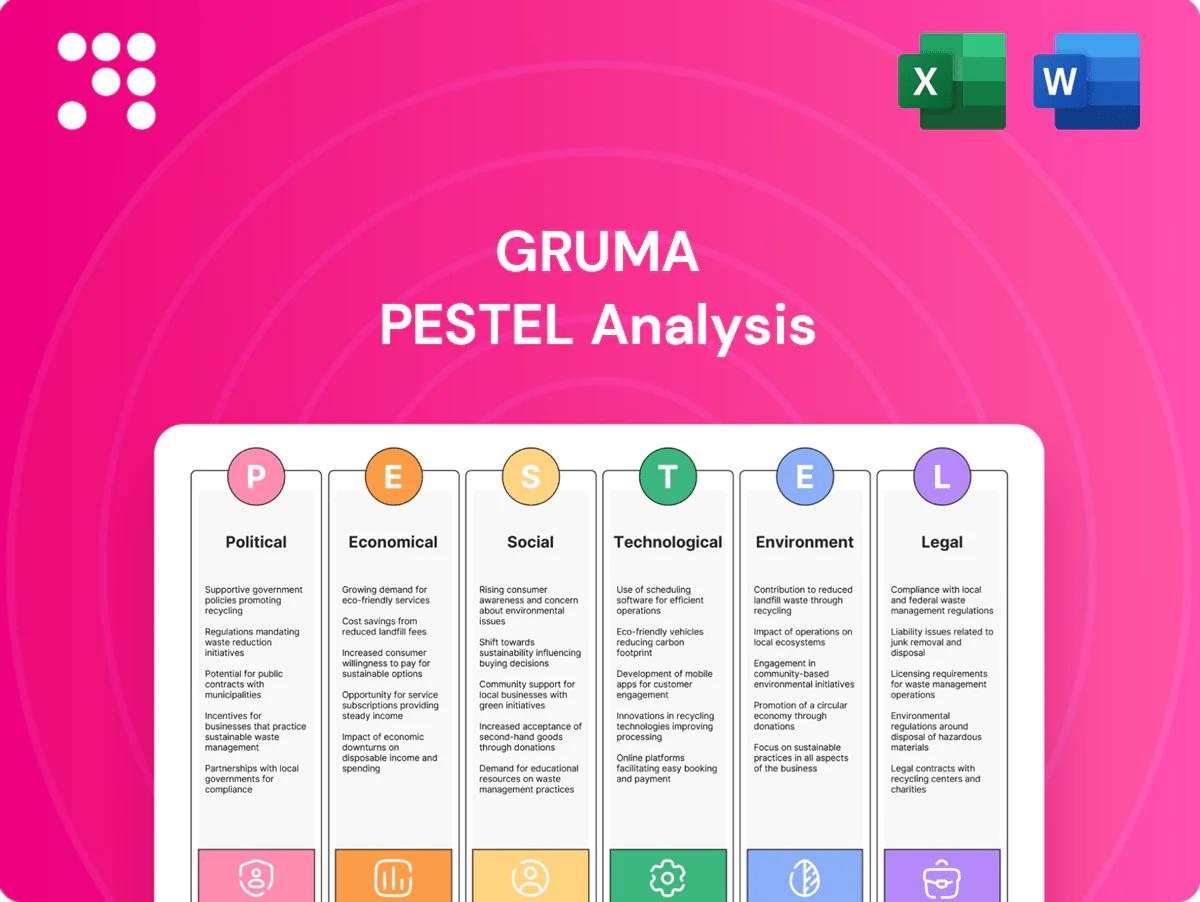
The preview shown here is the exact Gruma PESTLE Analysis document you’ll receive after purchase—fully formatted, professionally structured, and ready to use. This screenshot reflects the real file with no placeholders or teasers, so there are no surprises at checkout. After payment you’ll instantly download the same complete report you see here.

Original: $10.00
-65%$10.00
$3.50Product Information
Product Information
Shipping & Returns
Shipping & Returns
Description
Make Smarter Strategic Decisions with a Complete PESTEL View
Our PESTLE Analysis for Gruma reveals how political, economic, social, technological, legal, and environmental forces shape its supply chain, margins, and growth opportunities. This concise briefing highlights key risks and strategic levers. Perfect for investors and strategists seeking clarity. Purchase the full report to access detailed, actionable insights and forecasts.
Political factors
Agricultural subsidy and corn policy
Government shifts in corn subsidies alter input costs and planting incentives; Mexico imported about 17 million tonnes of corn in 2024 (USDA), so domestic subsidy withdrawal or price supports can rapidly tighten regional availability. Price supports, import quotas and reserves distort supply; Gruma responds by hedging procurement, diversifying suppliers and engaging policymakers to anticipate reforms and minimize margin shocks.
Trade agreements and tariffs (e.g., USMCA)
Cross-border flows of corn and finished products depend on tariff schedules and rules of origin under USMCA, which entered into force on July 1, 2020, allowing tariff-free trade when origin rules are met. Changes in enforcement or new disputes could raise costs or delay logistics for Gruma’s binational operations. The company benefits from open trade but remains exposed to protectionism; contingency plans include alternative routes and localizing production.
Food security and price stabilization measures
Governments may impose price controls or export restrictions during staple shortages, actions that can compress Gruma’s margins and reallocate corn/flour supply to domestic markets. Gruma, active in over 100 countries, must model scenarios where policy prioritizes affordability over profitability and stress-test margins under supply curbs. Strategic public–private partnerships can help secure feedstock and stabilize supplies while preserving business continuity.
Political stability in key markets
Operational risk rises with elections, social unrest or policy uncertainty in Latin America and other regions; permitting, taxation and subsidies can shift quickly between administrations. Gruma reduces single-country exposure through geographic diversification and, as of 2024, maintains operations in 14 countries and sales in 100+ countries. Strong local stakeholder relations help preserve continuity during political change.
- Operations in 14 countries
- Sales in 100+ countries
- Electoral cycles elevate operational risk
- Permitting, tax and subsidy volatility can compress margins
Public nutrition programs and procurement
Public nutrition programs shape institutional demand for tortillas and corn flour; 388 million children received school meals globally in 2023 (WFP), creating sizeable tender opportunities. Nutritional specifications (e.g., fortified micronutrients) push Gruma to adapt formulations and processing. Winning tenders delivers volume but often at tighter margins; compliance and predictable supply are prerequisites to retain contracts.
- Institutional demand: large, recurring (WFP: 388M school meals, 2023)
- Product specs: fortification drives R&D and reformulation
- Commercial impact: volume vs margin; supply reliability critical
Political shifts amplify feedstock cost volatility and squeeze margins across global corn supply
Political shifts in subsidies, tariffs and export controls drive feedstock cost volatility (Mexico corn imports ~17 million tonnes in 2024, USDA) and raise margin risk; Gruma hedges procurement and diversifies supply. Electoral cycles and local policy changes threaten permitting and taxes across 14 operating countries, 100+ markets. Public programs (WFP: 388M school meals, 2023) create volume but tighter margins.
| Metric | Value |
|---|---|
| Mexico corn imports (2024) | ~17M t |
| Operations | 14 countries |
| Sales | 100+ countries |
| School meals (WFP, 2023) | 388M children |
What is included in the product
Detailed Word Document
Explores how external macro-environmental factors uniquely affect Gruma across Political, Economic, Social, Technological, Environmental and Legal dimensions; each section is data‑backed, region- and industry-specific, includes detailed sub-points and forward‑looking insights to support executives, investors and strategists in scenario planning, risk mitigation and funding materials.
Customizable Excel Spreadsheet
A concise, visually segmented PESTLE summary of Gruma that can be dropped into presentations, easily shared across teams, and annotated for regional or business-line specifics—streamlining external risk discussions and strategic planning.
Economic factors
Corn price volatility
Corn price swings—driven by weather, biofuel/ethanol demand and global stocks—remain a key input risk for Gruma; US ethanol uses about one-third of corn output, amplifying demand sensitivity. Input cost spikes can outpace retail/contract repricing, pressuring margins. Gruma mitigates via hedging, flexible formulations and diversified procurement. Cost discipline and product mix management protect margins against short-term feedstock volatility.
Currency fluctuations (MXN, USD, others)
Gruma earns and spends across MXN, USD and other currencies, creating translation and transaction risk; USD/MXN averaged about 17.5 in 2024, so a stronger USD raised Mexican import costs while boosting US-dollar export revenues. Hedging programs and natural currency offsets (US sales vs. MX costs) are essential; pricing must be adjusted proactively to preserve margins amid FX swings.
Consumer spending and inflation
High inflation in Mexico (average CPI ~4.3% in 2024, easing toward ~3.8% in H1 2025) squeezes disposable income and shifts households toward lower-value tiers; staples like corn tortillas remain resilient but face downtrading. Gruma can deploy multi-price ladders and smaller pack sizes to protect volume while preserving margin. Greater operating efficiency and cost control become critical levers during cost-of-living stress.
Interest rates and capital access
Rising interest rates have raised Gruma’s financing costs for capex and working capital, making tenor and debt-structure management critical to preserve liquidity and resilience.
Gruma must prioritize ROI-positive automation and capacity projects while leveraging strong operating cash flow to fund selective expansion in core markets.
Emerging market growth and urbanization
Urban consumers in Latin America (urbanization ~82.8% in 2023) increasingly demand convenient, standardized staples, boosting branded tortilla and flour sales; modern retail now accounts for over half of grocery distribution in key markets. Growth in Latin America and a US Hispanic population ~63.4 million (2024 est) support higher volumes, while route-to-market investments improve shelf presence and freshness.
- Urbanization: ~82.8% (2023)
- US Hispanic market: ~63.4M (2024 est)
- Modern retail >50% grocery share
- Route investments = better shelf/freshness
Political shifts amplify feedstock cost volatility and squeeze margins across global corn supply
Corn input volatility (ethanol uses ~1/3 of US corn) and USD/MXN ~17.5 (2024) drive margin swings; hedging and mix shifts mitigate short-term shocks. Mexican CPI ~4.3% (2024) easing to ~3.8% H1 2025 pressures pricing and downtrading. Urbanization (~82.8% 2023) and US Hispanic ~63.4M (2024) support volume; rising rates raise financing costs.
| Metric | Value |
|---|---|
| USD/MXN (2024) | ~17.5 |
| Mexico CPI (2024) | ~4.3% |
| US Hispanic (2024) | ~63.4M |
Preview Before You Purchase
Gruma PESTLE Analysis
The preview shown here is the exact Gruma PESTLE Analysis document you’ll receive after purchase—fully formatted, professionally structured, and ready to use. This screenshot reflects the real file with no placeholders or teasers, so there are no surprises at checkout. After payment you’ll instantly download the same complete report you see here.