Plastiques du Val de Loire PESTLE Analysis

Your Competitive Advantage Starts with This Report
Understand how political shifts, economic cycles, and environmental trends are reshaping Plastiques du Val de Loire’s strategic landscape in our concise PESTLE overview. These actionable insights help investors and strategists spot risks and growth levers. Purchase the full PESTLE for the complete, ready-to-use analysis and download instantly.
Political factors

EU industrial and sustainability policy
EU Green Deal and Circular Economy Action Plan plus the 55% 2030 emissions target push materials choices, eco-design and recycled-content rules that shape Plastivaloire factory investments; CSRD reporting expands to ~50,000 companies from 2024–25 increasing compliance burden. Access to EU funds within the €1.074tn 2021–27 budget and IPCEI can de-risk modernization, but non-compliance risks exclusion from OEM supplier panels.
Automotive subsidies and EV transition
Government EV incentives such as the US Inflation Reduction Act’s roughly $369 billion clean-energy program and France’s EV purchase bonus up to €5,000 are shifting OEM programs toward battery value chains and electrified platforms, prompting parts portfolios to prioritize battery housings, e-mobility modules and lighter interior/exterior plastics. Timing and renewal of these subsidies directly affect order visibility and capex scheduling for Plastiques du Val de Loire, while abrupt policy reversals have caused historical demand whiplash across suppliers.

Trade policy, tariffs, and localization
US Section 301 tariffs of up to 25% on many Chinese polymers/components, plus varied EU/UK MFN duties, materially shift where Plastiques du Val de Loire locates molding and assembly to protect margins. USMCA and other automotive rules often require ~75% regional content, pushing regional plant footprints and sourcing. Post-Brexit customs frictions and the ICC-estimated $1.7tn trade finance gap raise lead times and working capital needs.

Geopolitical disruption and supply security
Geopolitical conflicts and sanctions since 2022 have repeatedly disrupted resin, pigment and tooling flows, extending lead times and forcing spot premium purchases; European gas TTF spiked to ~€345/MWh in Aug 2022 and industrial power costs remained about double pre-2021 levels into 2024, raising operating costs and eroding competitiveness. Customers now demand multi-region redundancy and dual sourcing, and political-risk hedging has become a core procurement task.
- Supply shocks: resin/pigment/tooling bottlenecks since 2022
- Energy impact: TTF peak ~€345/MWh (Aug 2022); 2024 industrial power ~2x pre-2021
- Customer demand: multi-region redundancy/dual sourcing
- Procurement: political-risk hedging institutionalized
Labor and industrial relations policy
Minimum wage and labor-protection shifts shape Plastiques du Val de Loire operations: 21 of 27 EU countries had statutory minimum wages in 2024 and France’s SMIC was about €1,747 gross/month (2024), raising labor cost pressure on European plants; stronger protections and apprenticeship incentives ease automation/quality skill gaps, while strikes and regulatory changes have repeatedly disrupted delivery chains in 2023–24.
- Minimum wages: 21/27 EU countries (2024)
- France SMIC ~€1,747 gross/month (2024)
- Training subsidies up, easing automation skills
- Strikes/regulatory shifts risk delivery reliability
- Social dialogue boosts employer brand and retention
EU Green Deal, CSRD and IRA push e-mobility, eco-design and capex shifts
EU Green Deal (55% emissions cut by 2030) and CSRD (~50,000 firms from 2024–25) force eco-design, recycled-content and reporting investments; access to EU €1.074tn budget/IPCEI offsets capex but non-compliance risks OEM exclusion. EV incentives (US IRA ~$369bn; France EV bonus €5,000) shift product mix to e-mobility. Energy and trade shocks (TTF €345/MWh peak Aug 2022; 25% US tariffs) raise costs and sourcing risk.
| Metric | Value | Implication |
|---|---|---|
| EU 2030 target | 55% GHG cut | Eco-design/recycling capex |
| CSRD | ~50,000 firms (2024–25) | Reporting burden |
| EU budget | €1.074tn (2021–27) | Funding opportunity |
| US IRA | ~$369bn | EV supply shift |
| France SMIC | ~€1,747/mo (2024) | Labor cost pressure |
| TTF peak | ~€345/MWh (Aug 2022) | Higher energy costs |
| Tariffs | Up to 25% | Sourcing relocation |
What is included in the product
 Detailed Word Document
Explores how Political, Economic, Social, Technological, Environmental and Legal forces uniquely affect Plastiques du Val de Loire, with data-driven, region-specific insights, actionable risks and opportunities, and forward-looking recommendations to support executives, investors and strategists in scenario planning and funding discussions.

 Customizable Excel Spreadsheet
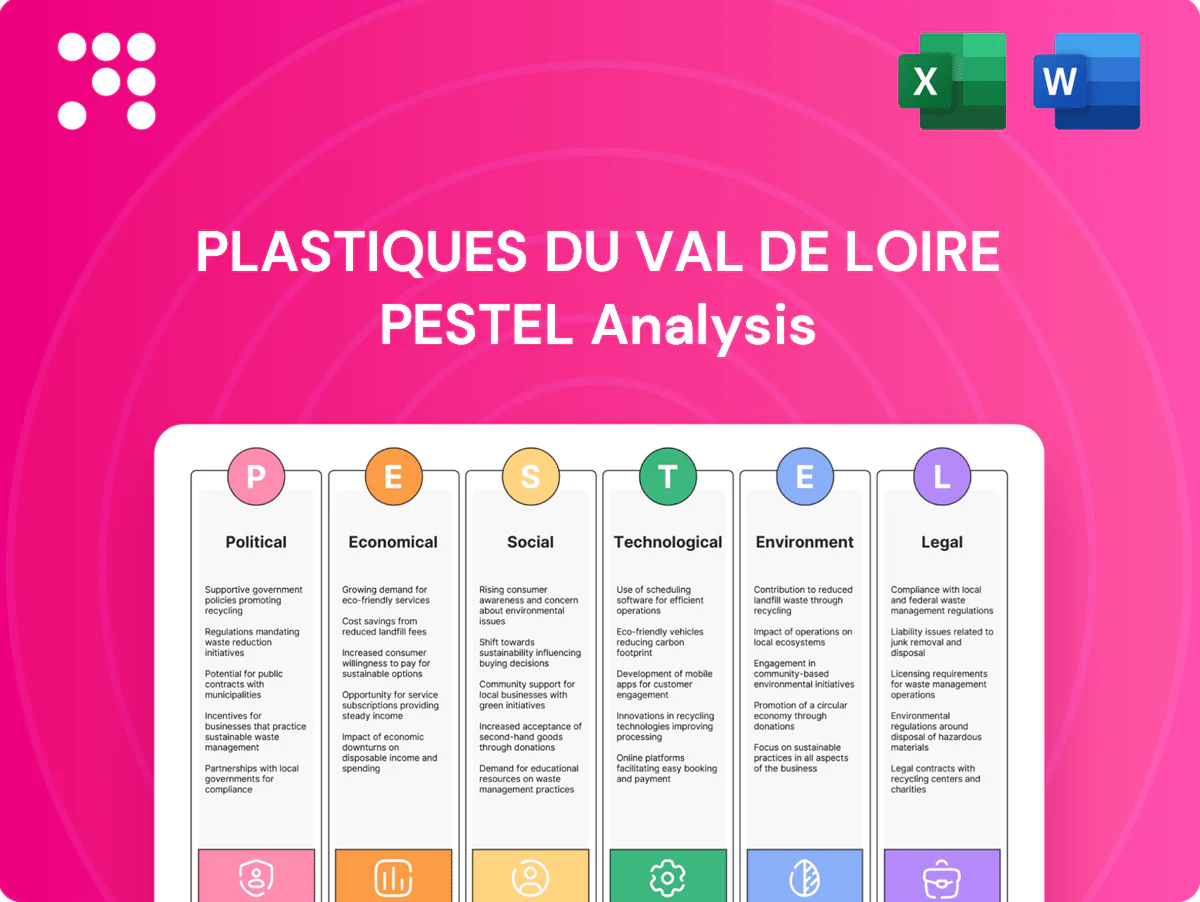
A concise, visually segmented PESTLE summary for Plastiques du Val de Loire that can be dropped into presentations, shared across teams, and annotated for regional or business-line specifics to streamline risk discussions and strategic planning.
Economic factors

Automotive cycle sensitivity
Plastivaloire’s revenue closely tracks OEM production, model launches and platform lifecycles, making sales sensitive to automotive cycles. Demand downturns compress volumes and under-absorb fixed costs, pressuring margins on interior trim and assemblies. Shifts in mix and option rates further drive margin variability. Program diversification across segments and clients mitigates cyclicality.
Resin and energy cost volatility
Polymer prices and European electricity/gas swings have driven gross-margin volatility—polymer spot prices fell roughly 40% from 2022 peaks into 2024 while TTF gas moved from highs near €345/MWh in Oct 2022 to c.€35–50/MWh in 2024, impacting costs through 2024–Q1 2025. Surcharges and index-linked contracts mitigate but lag can erode margins over weeks to months. Procurement scale and multi-year supplier partnerships stabilize input pricing. Energy-efficiency upgrades typically cut energy consumption 10–20%, boosting cost resilience.

FX and multi-country footprint
Exposure to EUR, USD, GBP, PLN and other currencies materially affects consolidated results; EUR/USD traded around 1.09 and EUR/PLN near 4.5 in mid‑2025, amplifying translation and transaction impacts.
Local production for local customers provides natural hedges that reduced FX-related margin volatility in 2024–H1 2025.
Pricing clauses can pass through FX shifts but squeeze competitiveness in markets with fixed contracts; disciplined treasury policy and active hedging are therefore critical.

Customer concentration and pricing power
Large OEMs and Tier-1s exert strong bargaining leverage over Plastiques du Val de Loire, meaning multi-year tooling and SOP wins secure volumes but tend to cap margins through fixed-price schedules and penalty clauses.
Offering value-added services such as design, painting and assembly increases customer stickiness and supports higher-margin contracts; operational KPIs and supplier scorecards are explicitly tied to periodic price adjustments and bonus/penalty mechanisms.
- Customer concentration: high bargaining power
- Multi-year contracts: volume security, margin compression
- Value-added services: increases retention and pricing leverage
- KPI-linked pricing: scorecards drive adjustments
Capex intensity and utilization
Plastiques du Val de Loire faces steady capex for injection presses, paint lines and tooling, where high utilization materially improves ROCE while idle capacity erodes returns. Investment in flexible cells and quick-change tooling raises responsiveness to automotive and industrial demand. Portfolio management must allocate spending across maintenance, growth and automation to sustain margins.
- Capex: presses, paint lines, tooling
- Utilization drives ROCE vs idle drag
- Flexible cells and quick-change tooling for responsiveness
- Portfolio trade-off: maintenance, growth, automation
EU Green Deal, CSRD and IRA push e-mobility, eco-design and capex shifts
Plastivaloire revenue tracks OEM cycles, with volumes/mix driving margin swings; multi‑year programs secure volumes but cap pricing. Polymer prices fell ~40% from 2022 peaks into 2024; TTF gas from ~€345/MWh (Oct 2022) to ~€35–50/MWh in 2024, aiding gross margins. EUR/USD ~1.09 and EUR/PLN ~4.5 (mid‑2025); energy upgrades cut consumption 10–20%.
| Factor | Metric/Value |
|---|---|
| Polymer price change | −40% (2022→2024) |
| TTF gas | €35–50/MWh (2024) vs €345/MWh (Oct 2022) |
| FX | EUR/USD ~1.09, EUR/PLN ~4.5 (mid‑2025) |
| Energy savings | 10–20% |
Full Version Awaits
Plastiques du Val de Loire PESTLE Analysis
The preview shown here is the exact Plastiques du Val de Loire PESTLE Analysis you’ll receive after purchase—fully formatted and ready to use. It includes political, economic, social, technological, legal and environmental insights with charts and actionable takeaways. No placeholders or surprises—this is the final file, ready to download.

Product Information
Product Information
Shipping & Returns
Shipping & Returns
Description
Your Competitive Advantage Starts with This Report
Understand how political shifts, economic cycles, and environmental trends are reshaping Plastiques du Val de Loire’s strategic landscape in our concise PESTLE overview. These actionable insights help investors and strategists spot risks and growth levers. Purchase the full PESTLE for the complete, ready-to-use analysis and download instantly.
Political factors
EU industrial and sustainability policy
EU Green Deal and Circular Economy Action Plan plus the 55% 2030 emissions target push materials choices, eco-design and recycled-content rules that shape Plastivaloire factory investments; CSRD reporting expands to ~50,000 companies from 2024–25 increasing compliance burden. Access to EU funds within the €1.074tn 2021–27 budget and IPCEI can de-risk modernization, but non-compliance risks exclusion from OEM supplier panels.
Automotive subsidies and EV transition
Government EV incentives such as the US Inflation Reduction Act’s roughly $369 billion clean-energy program and France’s EV purchase bonus up to €5,000 are shifting OEM programs toward battery value chains and electrified platforms, prompting parts portfolios to prioritize battery housings, e-mobility modules and lighter interior/exterior plastics. Timing and renewal of these subsidies directly affect order visibility and capex scheduling for Plastiques du Val de Loire, while abrupt policy reversals have caused historical demand whiplash across suppliers.
Trade policy, tariffs, and localization
US Section 301 tariffs of up to 25% on many Chinese polymers/components, plus varied EU/UK MFN duties, materially shift where Plastiques du Val de Loire locates molding and assembly to protect margins. USMCA and other automotive rules often require ~75% regional content, pushing regional plant footprints and sourcing. Post-Brexit customs frictions and the ICC-estimated $1.7tn trade finance gap raise lead times and working capital needs.
Geopolitical disruption and supply security
Geopolitical conflicts and sanctions since 2022 have repeatedly disrupted resin, pigment and tooling flows, extending lead times and forcing spot premium purchases; European gas TTF spiked to ~€345/MWh in Aug 2022 and industrial power costs remained about double pre-2021 levels into 2024, raising operating costs and eroding competitiveness. Customers now demand multi-region redundancy and dual sourcing, and political-risk hedging has become a core procurement task.
- Supply shocks: resin/pigment/tooling bottlenecks since 2022
- Energy impact: TTF peak ~€345/MWh (Aug 2022); 2024 industrial power ~2x pre-2021
- Customer demand: multi-region redundancy/dual sourcing
- Procurement: political-risk hedging institutionalized
Labor and industrial relations policy
Minimum wage and labor-protection shifts shape Plastiques du Val de Loire operations: 21 of 27 EU countries had statutory minimum wages in 2024 and France’s SMIC was about €1,747 gross/month (2024), raising labor cost pressure on European plants; stronger protections and apprenticeship incentives ease automation/quality skill gaps, while strikes and regulatory changes have repeatedly disrupted delivery chains in 2023–24.
- Minimum wages: 21/27 EU countries (2024)
- France SMIC ~€1,747 gross/month (2024)
- Training subsidies up, easing automation skills
- Strikes/regulatory shifts risk delivery reliability
- Social dialogue boosts employer brand and retention
EU Green Deal, CSRD and IRA push e-mobility, eco-design and capex shifts
EU Green Deal (55% emissions cut by 2030) and CSRD (~50,000 firms from 2024–25) force eco-design, recycled-content and reporting investments; access to EU €1.074tn budget/IPCEI offsets capex but non-compliance risks OEM exclusion. EV incentives (US IRA ~$369bn; France EV bonus €5,000) shift product mix to e-mobility. Energy and trade shocks (TTF €345/MWh peak Aug 2022; 25% US tariffs) raise costs and sourcing risk.
| Metric | Value | Implication |
|---|---|---|
| EU 2030 target | 55% GHG cut | Eco-design/recycling capex |
| CSRD | ~50,000 firms (2024–25) | Reporting burden |
| EU budget | €1.074tn (2021–27) | Funding opportunity |
| US IRA | ~$369bn | EV supply shift |
| France SMIC | ~€1,747/mo (2024) | Labor cost pressure |
| TTF peak | ~€345/MWh (Aug 2022) | Higher energy costs |
| Tariffs | Up to 25% | Sourcing relocation |
What is included in the product
Detailed Word Document
Explores how Political, Economic, Social, Technological, Environmental and Legal forces uniquely affect Plastiques du Val de Loire, with data-driven, region-specific insights, actionable risks and opportunities, and forward-looking recommendations to support executives, investors and strategists in scenario planning and funding discussions.
Customizable Excel Spreadsheet
A concise, visually segmented PESTLE summary for Plastiques du Val de Loire that can be dropped into presentations, shared across teams, and annotated for regional or business-line specifics to streamline risk discussions and strategic planning.
Economic factors
Automotive cycle sensitivity
Plastivaloire’s revenue closely tracks OEM production, model launches and platform lifecycles, making sales sensitive to automotive cycles. Demand downturns compress volumes and under-absorb fixed costs, pressuring margins on interior trim and assemblies. Shifts in mix and option rates further drive margin variability. Program diversification across segments and clients mitigates cyclicality.
Resin and energy cost volatility
Polymer prices and European electricity/gas swings have driven gross-margin volatility—polymer spot prices fell roughly 40% from 2022 peaks into 2024 while TTF gas moved from highs near €345/MWh in Oct 2022 to c.€35–50/MWh in 2024, impacting costs through 2024–Q1 2025. Surcharges and index-linked contracts mitigate but lag can erode margins over weeks to months. Procurement scale and multi-year supplier partnerships stabilize input pricing. Energy-efficiency upgrades typically cut energy consumption 10–20%, boosting cost resilience.
FX and multi-country footprint
Exposure to EUR, USD, GBP, PLN and other currencies materially affects consolidated results; EUR/USD traded around 1.09 and EUR/PLN near 4.5 in mid‑2025, amplifying translation and transaction impacts.
Local production for local customers provides natural hedges that reduced FX-related margin volatility in 2024–H1 2025.
Pricing clauses can pass through FX shifts but squeeze competitiveness in markets with fixed contracts; disciplined treasury policy and active hedging are therefore critical.
Customer concentration and pricing power
Large OEMs and Tier-1s exert strong bargaining leverage over Plastiques du Val de Loire, meaning multi-year tooling and SOP wins secure volumes but tend to cap margins through fixed-price schedules and penalty clauses.
Offering value-added services such as design, painting and assembly increases customer stickiness and supports higher-margin contracts; operational KPIs and supplier scorecards are explicitly tied to periodic price adjustments and bonus/penalty mechanisms.
- Customer concentration: high bargaining power
- Multi-year contracts: volume security, margin compression
- Value-added services: increases retention and pricing leverage
- KPI-linked pricing: scorecards drive adjustments
Capex intensity and utilization
Plastiques du Val de Loire faces steady capex for injection presses, paint lines and tooling, where high utilization materially improves ROCE while idle capacity erodes returns. Investment in flexible cells and quick-change tooling raises responsiveness to automotive and industrial demand. Portfolio management must allocate spending across maintenance, growth and automation to sustain margins.
- Capex: presses, paint lines, tooling
- Utilization drives ROCE vs idle drag
- Flexible cells and quick-change tooling for responsiveness
- Portfolio trade-off: maintenance, growth, automation
EU Green Deal, CSRD and IRA push e-mobility, eco-design and capex shifts
Plastivaloire revenue tracks OEM cycles, with volumes/mix driving margin swings; multi‑year programs secure volumes but cap pricing. Polymer prices fell ~40% from 2022 peaks into 2024; TTF gas from ~€345/MWh (Oct 2022) to ~€35–50/MWh in 2024, aiding gross margins. EUR/USD ~1.09 and EUR/PLN ~4.5 (mid‑2025); energy upgrades cut consumption 10–20%.
| Factor | Metric/Value |
|---|---|
| Polymer price change | −40% (2022→2024) |
| TTF gas | €35–50/MWh (2024) vs €345/MWh (Oct 2022) |
| FX | EUR/USD ~1.09, EUR/PLN ~4.5 (mid‑2025) |
| Energy savings | 10–20% |
Full Version Awaits
Plastiques du Val de Loire PESTLE Analysis
The preview shown here is the exact Plastiques du Val de Loire PESTLE Analysis you’ll receive after purchase—fully formatted and ready to use. It includes political, economic, social, technological, legal and environmental insights with charts and actionable takeaways. No placeholders or surprises—this is the final file, ready to download.