Greenyard PESTLE Analysis

Plan Smarter. Present Sharper. Compete Stronger.
Discover how macro forces—from regulatory shifts to climate trends—are reshaping Greenyard's strategy and market position. Our concise PESTLE highlights risks and opportunities you can act on now. Ideal for investors and strategists seeking clarity—purchase the full analysis for the complete, downloadable intelligence.
Political factors

EU Green Deal and Farm to Fork
EU Green Deal and Farm to Fork impose tighter sustainability and pesticide-use standards, including the Farm to Fork target to reduce pesticide use by 50% and reach 25% organic land by 2030. Greenyard must align agronomy and reporting to maintain retailer partnerships; compliance may unlock CAP/Green Deal funding and preferred-supplier access, while non-compliance risks delisting and margin pressure.
Trade policy and tariffs
Produce flows depend on import quotas, seasonal tariffs and origin rules that shape volumes and timing. Policy shifts or retaliatory tariffs can rapidly change sourcing economics and lead times, disrupting supply into Greenyard, headquartered in Sint-Katelijne-Waver and listed on Euronext Brussels. Greenyard needs diversified origins and flexible contracts. Hedging and dual-sourcing mitigate sudden cost spikes.

Geopolitical disruptions
Geopolitical disruptions restrict fertilizer, energy and logistics corridors — Russia and Belarus supplied about 40% of global potash pre-2022 and EU gas imports from Russia fell roughly 80% in 2022, pressuring input costs and transport. Border checks and port congestion increase spoilage risk for perishables; FAO notes post‑harvest losses for fruits and vegetables often exceed 20%. Scenario planning and buffer capacity become critical, and strategic stock positioning helps protect service levels.

Brexit and regulatory divergence
Brexit-driven UK-EU regulatory divergence has added paperwork and inspections that can create 24-48 hour transit delays, increasing freshness loss and shrink for Greenyard; the group reported roughly €2.8bn revenue in FY2023 and must protect margins by adapting documentation and pre-clearance workflows.
- Paperwork/inspections: higher admin burden
- Delays: 24-48h raise shrink/freshness risk
- Actions: enhanced pre-clearance and docs
- Mitigation: stronger UK-local sourcing reduces friction
Agricultural subsidies and farmer support
- CAP 2023–27 budget ~387 billion EUR
- Farm income dependence on subsidies often 20–50%
- Co-investment + long-term contracts = aligned incentives and supply stability
EU Green Deal, geopolitics & Brexit squeeze fresh produce: input shocks, spoilage, sourcing risk
Political risks—EU Green Deal/Farm to Fork (50% pesticide cut, 25% organic by 2030) and CAP 2023–27 (≈€387bn) force agronomy/reporting changes; non‑compliance risks delisting and margin loss. Geopolitics (potash ~40% RU/BY pre‑2022; EU gas from RU −80% in 2022) raise input/logistics costs and spoilage (~20%+ FAO). Brexit 24–48h delays hit freshness; Greenyard (€2.8bn FY2023) needs sourcing diversification and long contracts.
| Metric | Value |
|---|---|
| FY2023 revenue | €2.8bn |
| CAP 2023–27 | ≈€387bn |
| Potash share RU/BY | ~40% |
| EU gas from Russia | −80% (2022) |
| Post‑harvest loss (fruits/veg) | >20% |
What is included in the product
 Detailed Word Document
Explores how external macro-environmental factors uniquely affect Greenyard across six dimensions—Political, Economic, Social, Technological, Environmental, and Legal—with data-backed trends and region-specific examples. Designed for executives, consultants, and investors, the analysis is deliverable-ready, includes detailed sub-points and forward-looking insights to inform strategy, risk mitigation, and funding decisions.

 Customizable Excel Spreadsheet
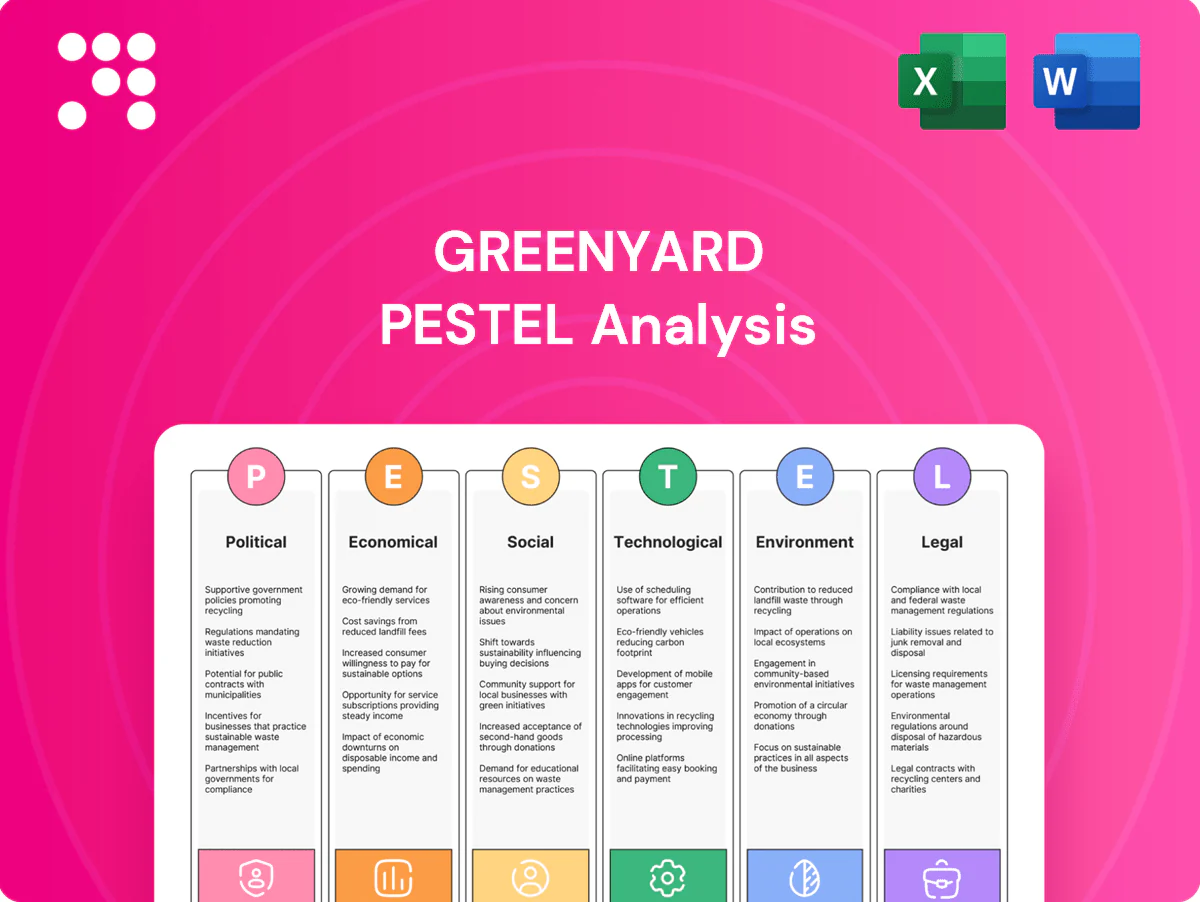
A concise, visually segmented PESTLE summary of Greenyard that simplifies external risk assessment for quick decision-making and can be dropped into presentations or shared across teams for fast alignment.
Economic factors

Food inflation and consumer trade-down
Food inflation stayed above overall inflation through H1 2024 according to Eurostat, pushing price-sensitive shoppers toward private label and promotions; Kantar noted private‑label shares near 40% in parts of Western Europe in 2024. Retailers are demanding sharper pricing and efficiency from suppliers, pressuring margins. Greenyard must optimize mix and yield to protect margins, while value packs and frozen formats can capture budget-conscious demand.
Energy and logistics costs
Cold chain freezing and transport are highly energy-intensive—refrigeration can represent ~20–25% of food-supply energy use; 2024 EU industrial electricity averaged about €0.16–0.20/kWh and diesel ~€1.70–1.85/l, so fuel and power volatility directly raise unit costs. Long-term PPAs and efficiency retrofits have cut site energy spend 10–30% in comparable food logistics projects. Network optimization (route planning, load consolidation) can reduce empty miles by ~15–20% and spoilage by 10–30%, lowering per-unit logistics cost.

FX and emerging-market exposure
Multi-origin sourcing exposes Greenyard to currency risk between purchase and sale; Greenyard reported roughly €3.0bn revenue (FY2023) with substantial non-euro procurement that magnifies translation and transaction risk. FX swings can erode margins on fixed-price retail contracts during 5–10% moves. Hedging policies, natural offsets and currency pass-through clauses in contracts are essential to preserve margins.

Retailer consolidation and bargaining power
Large European retailers exert strong price and service-level pressure on Greenyard, with supplier scorecards increasingly prioritising OTIF and sustainability metrics, driving tighter commercial terms and penalties for non-compliance. Greenyard’s scale helps negotiate slotting and logistics, but margin compression persists as retailers enforce fines and rebates tied to scorecards. Close collaboration via joint planning and vendor-managed inventory can protect shelf space and reduce out-of-stock risk.
- Retailer pressure: price and service-level demands
- Scorecards: OTIF and sustainability drive penalties
- Scale: negotiating advantage yet margin squeeze
- Mitigation: joint planning and VMI to secure shelf space
Demand seasonality and crop yield variability
Weather-driven yields and seasonal peaks force Greenyard to manage capacity swings that can vary harvest volumes by 20-30% year-on-year, complicating pallet and cold-store planning.
Frozen and prepared lines reduce volatility versus fresh, improving gross-margin stability and lowering waste.
Flexible labor pools, agile procurement and data-driven forecasting sync harvesting with retail promos to optimize throughput and reduce spoilage.
EU Green Deal, geopolitics & Brexit squeeze fresh produce: input shocks, spoilage, sourcing risk
Food inflation remained above general inflation in H1 2024, pushing private‑label to ~40% in parts of Western Europe and squeezing margins; energy (refrigeration ~20–25% of supply energy) and 2024 EU power (€0.16–0.20/kWh) and diesel (€1.70–1.85/l) volatility raise unit costs. FY2023 revenue ≈€3.0bn; yield swings 20–30% and retailer scorecards pressure pricing and OTIF.
| Metric | 2024/2023 |
|---|---|
| Revenue | ≈€3.0bn (FY2023) |
| Private label | ~40% (2024) |
| Energy price | €0.16–0.20/kWh; diesel €1.70–1.85/l (2024) |
| Yield variability | 20–30% |
Preview the Actual Deliverable
Greenyard PESTLE Analysis
The preview shown here is the exact document you’ll receive after purchase—fully formatted and ready to use. It contains the complete Greenyard PESTLE Analysis with professional layout, data tables and actionable insights. After payment you’ll be able to download this same final file instantly.

Original: $10.00
-65%$10.00
$3.50Product Information
Product Information
Shipping & Returns
Shipping & Returns
Description
Plan Smarter. Present Sharper. Compete Stronger.
Discover how macro forces—from regulatory shifts to climate trends—are reshaping Greenyard's strategy and market position. Our concise PESTLE highlights risks and opportunities you can act on now. Ideal for investors and strategists seeking clarity—purchase the full analysis for the complete, downloadable intelligence.
Political factors
EU Green Deal and Farm to Fork
EU Green Deal and Farm to Fork impose tighter sustainability and pesticide-use standards, including the Farm to Fork target to reduce pesticide use by 50% and reach 25% organic land by 2030. Greenyard must align agronomy and reporting to maintain retailer partnerships; compliance may unlock CAP/Green Deal funding and preferred-supplier access, while non-compliance risks delisting and margin pressure.
Trade policy and tariffs
Produce flows depend on import quotas, seasonal tariffs and origin rules that shape volumes and timing. Policy shifts or retaliatory tariffs can rapidly change sourcing economics and lead times, disrupting supply into Greenyard, headquartered in Sint-Katelijne-Waver and listed on Euronext Brussels. Greenyard needs diversified origins and flexible contracts. Hedging and dual-sourcing mitigate sudden cost spikes.
Geopolitical disruptions
Geopolitical disruptions restrict fertilizer, energy and logistics corridors — Russia and Belarus supplied about 40% of global potash pre-2022 and EU gas imports from Russia fell roughly 80% in 2022, pressuring input costs and transport. Border checks and port congestion increase spoilage risk for perishables; FAO notes post‑harvest losses for fruits and vegetables often exceed 20%. Scenario planning and buffer capacity become critical, and strategic stock positioning helps protect service levels.
Brexit and regulatory divergence
Brexit-driven UK-EU regulatory divergence has added paperwork and inspections that can create 24-48 hour transit delays, increasing freshness loss and shrink for Greenyard; the group reported roughly €2.8bn revenue in FY2023 and must protect margins by adapting documentation and pre-clearance workflows.
- Paperwork/inspections: higher admin burden
- Delays: 24-48h raise shrink/freshness risk
- Actions: enhanced pre-clearance and docs
- Mitigation: stronger UK-local sourcing reduces friction
Agricultural subsidies and farmer support
- CAP 2023–27 budget ~387 billion EUR
- Farm income dependence on subsidies often 20–50%
- Co-investment + long-term contracts = aligned incentives and supply stability
EU Green Deal, geopolitics & Brexit squeeze fresh produce: input shocks, spoilage, sourcing risk
Political risks—EU Green Deal/Farm to Fork (50% pesticide cut, 25% organic by 2030) and CAP 2023–27 (≈€387bn) force agronomy/reporting changes; non‑compliance risks delisting and margin loss. Geopolitics (potash ~40% RU/BY pre‑2022; EU gas from RU −80% in 2022) raise input/logistics costs and spoilage (~20%+ FAO). Brexit 24–48h delays hit freshness; Greenyard (€2.8bn FY2023) needs sourcing diversification and long contracts.
| Metric | Value |
|---|---|
| FY2023 revenue | €2.8bn |
| CAP 2023–27 | ≈€387bn |
| Potash share RU/BY | ~40% |
| EU gas from Russia | −80% (2022) |
| Post‑harvest loss (fruits/veg) | >20% |
What is included in the product
Detailed Word Document
Explores how external macro-environmental factors uniquely affect Greenyard across six dimensions—Political, Economic, Social, Technological, Environmental, and Legal—with data-backed trends and region-specific examples. Designed for executives, consultants, and investors, the analysis is deliverable-ready, includes detailed sub-points and forward-looking insights to inform strategy, risk mitigation, and funding decisions.
Customizable Excel Spreadsheet
A concise, visually segmented PESTLE summary of Greenyard that simplifies external risk assessment for quick decision-making and can be dropped into presentations or shared across teams for fast alignment.
Economic factors
Food inflation and consumer trade-down
Food inflation stayed above overall inflation through H1 2024 according to Eurostat, pushing price-sensitive shoppers toward private label and promotions; Kantar noted private‑label shares near 40% in parts of Western Europe in 2024. Retailers are demanding sharper pricing and efficiency from suppliers, pressuring margins. Greenyard must optimize mix and yield to protect margins, while value packs and frozen formats can capture budget-conscious demand.
Energy and logistics costs
Cold chain freezing and transport are highly energy-intensive—refrigeration can represent ~20–25% of food-supply energy use; 2024 EU industrial electricity averaged about €0.16–0.20/kWh and diesel ~€1.70–1.85/l, so fuel and power volatility directly raise unit costs. Long-term PPAs and efficiency retrofits have cut site energy spend 10–30% in comparable food logistics projects. Network optimization (route planning, load consolidation) can reduce empty miles by ~15–20% and spoilage by 10–30%, lowering per-unit logistics cost.
FX and emerging-market exposure
Multi-origin sourcing exposes Greenyard to currency risk between purchase and sale; Greenyard reported roughly €3.0bn revenue (FY2023) with substantial non-euro procurement that magnifies translation and transaction risk. FX swings can erode margins on fixed-price retail contracts during 5–10% moves. Hedging policies, natural offsets and currency pass-through clauses in contracts are essential to preserve margins.
Retailer consolidation and bargaining power
Large European retailers exert strong price and service-level pressure on Greenyard, with supplier scorecards increasingly prioritising OTIF and sustainability metrics, driving tighter commercial terms and penalties for non-compliance. Greenyard’s scale helps negotiate slotting and logistics, but margin compression persists as retailers enforce fines and rebates tied to scorecards. Close collaboration via joint planning and vendor-managed inventory can protect shelf space and reduce out-of-stock risk.
- Retailer pressure: price and service-level demands
- Scorecards: OTIF and sustainability drive penalties
- Scale: negotiating advantage yet margin squeeze
- Mitigation: joint planning and VMI to secure shelf space
Demand seasonality and crop yield variability
Weather-driven yields and seasonal peaks force Greenyard to manage capacity swings that can vary harvest volumes by 20-30% year-on-year, complicating pallet and cold-store planning.
Frozen and prepared lines reduce volatility versus fresh, improving gross-margin stability and lowering waste.
Flexible labor pools, agile procurement and data-driven forecasting sync harvesting with retail promos to optimize throughput and reduce spoilage.
EU Green Deal, geopolitics & Brexit squeeze fresh produce: input shocks, spoilage, sourcing risk
Food inflation remained above general inflation in H1 2024, pushing private‑label to ~40% in parts of Western Europe and squeezing margins; energy (refrigeration ~20–25% of supply energy) and 2024 EU power (€0.16–0.20/kWh) and diesel (€1.70–1.85/l) volatility raise unit costs. FY2023 revenue ≈€3.0bn; yield swings 20–30% and retailer scorecards pressure pricing and OTIF.
| Metric | 2024/2023 |
|---|---|
| Revenue | ≈€3.0bn (FY2023) |
| Private label | ~40% (2024) |
| Energy price | €0.16–0.20/kWh; diesel €1.70–1.85/l (2024) |
| Yield variability | 20–30% |
Preview the Actual Deliverable
Greenyard PESTLE Analysis
The preview shown here is the exact document you’ll receive after purchase—fully formatted and ready to use. It contains the complete Greenyard PESTLE Analysis with professional layout, data tables and actionable insights. After payment you’ll be able to download this same final file instantly.