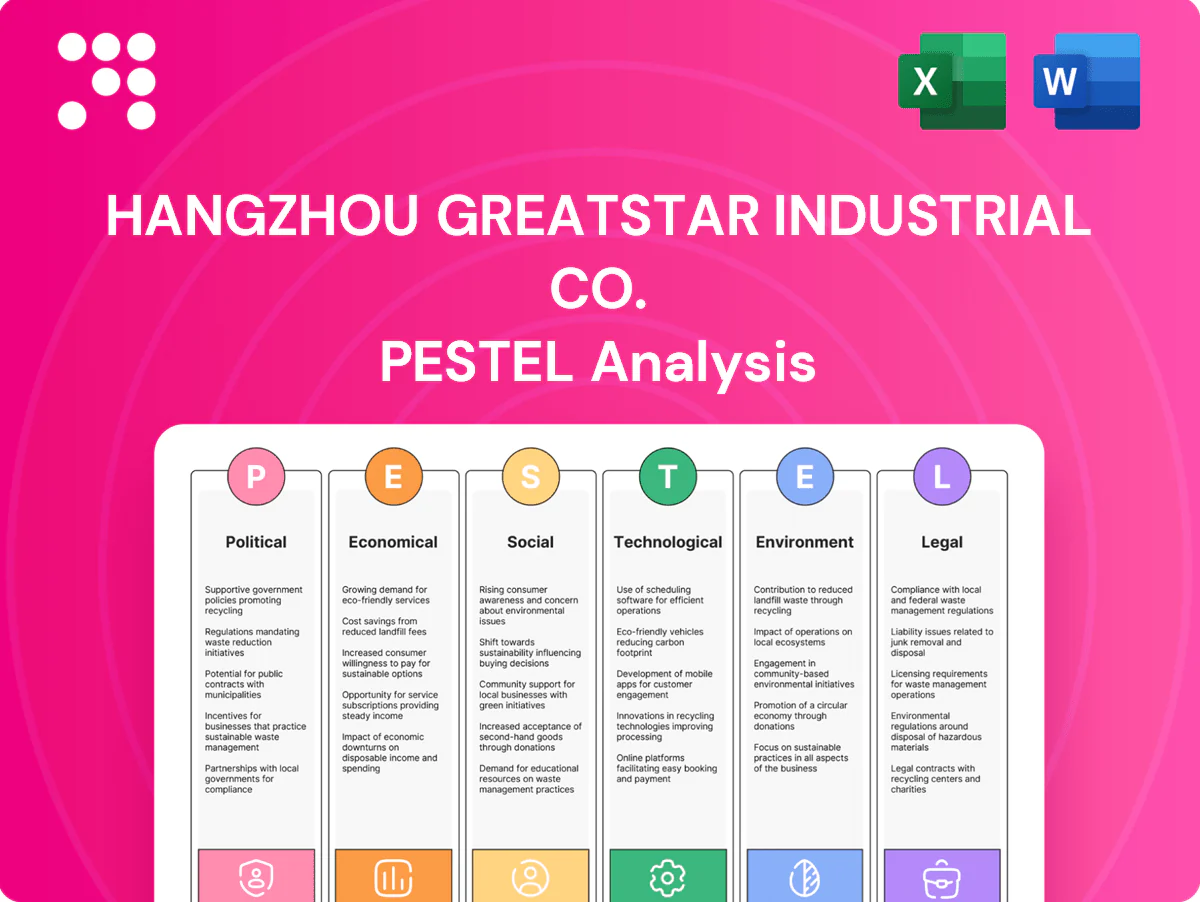
Hangzhou GreatStar Industrial Co. PESTLE Analysis

Plan Smarter. Present Sharper. Compete Stronger.
Our PESTLE Analysis for Hangzhou GreatStar Industrial Co. reveals how political shifts, supply-chain economics, and rapid tech adoption shape its competitive edge, while regulatory and environmental trends pose both risks and opportunities. Ideal for investors and strategists, this briefing pinpoints actionable implications to inform decisions. Purchase the full report to access the complete, ready-to-use analysis.
Political factors

US–China trade and tariffs
Geopolitical tensions can impose or lift tariffs on Chinese-made tools—Section 301 measures on roughly $370 billion of imports and retaliatory tariffs since 2018 (rates up to 25%) materially change landed costs and retail pricing. GreatStar must diversify manufacturing/assembly footprints across ASEAN and Mexico to mitigate tariff shocks. Proactive tariff engineering and country-of-origin planning can preserve margins. Close monitoring of Section 301 and retaliatory lists is essential.
Industrial policy and subsidies
China’s industrial policy, anchored in Made in China 2025, and export incentives—China produced about 30% of global manufacturing output in 2022—can lower capital costs for automation and R&D, enabling Hangzhou GreatStar to tap grants and R&D tax breaks to speed capacity expansion. Reliance on subsidies risks scrutiny in EU/US markets; balanced financing reduces political-exposure risk.

Market access and localization
Local-content rules and government procurement preferences shape entry in India, ASEAN and Latin America; India’s Public Procurement (Preference to Make in India) Order sets the Class I local supplier threshold at >=50%.
ASEAN comprises 10 member states with varied local requirements, while Latin American governments increasingly favor local manufacturing and sourcing for public tenders.
Local partnerships or CKD/SKD assembly and regional warehouses lower compliance barriers and improve service levels; OECD data shows public procurement averages about 12% of GDP, so tender access is material.
Frequent policy shifts require flexible, regionalized supply-chain design to mitigate tariff, content and tender-risk exposure.

Customs and non-tariff barriers
Standards, labeling, and certification requirements act as de facto barriers for Hangzhou GreatStar, forcing SKU harmonization to cut rework and cross-border delays; aligning SKUs across EU, US and ASEAN regimes reduced handling time in peers by up to 30%. As of 2024 China had over 14,000 AEO-certified firms, and pre-certification/AEO status materially speeds customs clearance. Strong regulatory affairs teams shorten cycle times and lower detention risk.
- Standards as barriers—require SKU harmonization
- AEO/pre-certification—faster clearance (industry reports up to 30% faster)
- Regulatory affairs—reduces detention and cycle time
Political stability and sanctions
Tariffs, sanctions and China policy push firms to diversify production to ASEAN and Mexico
Geopolitical tariffs (Section 301 on ~$370B imports) and sanctions (OFAC SDN >9,000 in 2024) raise landed costs and restrict markets; diversify ASEAN/Mexico output. China industrial policy (30% of global manufacturing 2022) offers subsidies but invites scrutiny. Local-content rules and standards (AEO >14,000 China 2024) drive regionalization and compliance resourcing.
| Risk | Metric |
|---|---|
| Section 301 | $370B |
| OFAC SDN | >9,000 (2024) |
| FDI change | -12% (2023) |
| China mfg | 30% (2022) |
| AEO firms China | 14,000+ (2024) |
What is included in the product
 Detailed Word Document
Explores how Political, Economic, Social, Technological, Environmental and Legal forces uniquely affect Hangzhou GreatStar Industrial Co., with data-driven insights and trend analysis to identify risks and opportunities. Designed for executives and investors, the analysis offers forward-looking scenarios and actionable implications for strategy, compliance and market positioning.

 Customizable Excel Spreadsheet
A concise, PESTLE-segmented summary of Hangzhou GreatStar Industrial Co. that distills regulatory, economic, social, technological, environmental and legal risks for quick reference—editable for regional or product-specific notes and formatted for seamless insertion into presentations, reports, or team briefings to speed decision-making and align stakeholders.
Economic factors

Construction and renovation cycles
Hand and power tool demand closely follows housing starts and renovation spend, with the global construction market near USD 13.6 trillion in 2023–24, linking GreatStar sales to broader activity. A balanced pro versus DIY mix lets GreatStar hedge cyclical new-build slumps by leaning on renovation-led DIY growth. Counter-cyclical repair and maintenance channels—often 20–30% of tool aftermarket spend—stabilize revenue, while regional diversification across China, North America and Europe smooths cycle volatility.
Raw material and logistics costs
Steel, aluminum, copper and lithium drive BOM costs for GreatStar, with LME copper near US$9,500/ton and seaborne lithium carbonate prices down from 2022 peaks but still material to batteries as of H1 2025.
Freight and container rates remain a margin lever: Drewry WCI averaged roughly US$2,000/FEU in early 2025, directly affecting delivered margins.
GreatStar uses hedging, multi-sourcing and value engineering to protect price points; nearshoring key SKUs shortens lead times and cuts freight exposure.

FX and interest rate dynamics
Revenue booked in USD/EUR (USD/CNY ~7.2, EUR/CNY ~7.8 mid‑2025) vs CNY costs creates translation and transaction risk; natural hedges plus forward contracts historically protect EBITDA margins. Higher global policy rates (Fed ~5.25%, ECB ~4%) have tempered DIY spending and pressured retailer inventories. Tightened credit pushed firms to shorten receivables and improve inventory turns to preserve cash.

E-commerce and omnichannel growth
E-commerce expansion (global e-commerce $5.7T in 2023; China ~50% of GMV) widens GreatStar’s reach but raises price transparency and margin pressure. Direct-to-consumer channels improve first-party data capture and can lift margins through reduced intermediaries. Building omnichannel fulfillment (faster last-mile, buy-online-pickup) raises service levels and return management. Strategic partnerships with top e-tailers (Tmall/JD ~70% China e‑commerce) secure digital shelf presence.
- reach
- price transparency
- DTC data/margins
- omnichannel fulfillment
- partner e‑tailers
Inflation and consumer purchasing power
Sustained inflation in 2024–25 compresses consumer purchasing power and pressures discretionary DIY spend, prompting trading-down to lower-tier SKUs; GreatStar’s tiered product architecture helps defend share across price points. Retailer private-label penetration typically rises during high-inflation episodes, intensifying margin pressure. Promotional efficiency and mix management become critical to protect gross margins.
- Inflation-driven trading-down: higher demand for entry-level SKUs
- Tiered architecture: preserves share across segments
- Private-label threat: gains in high-inflation periods
- Promotional focus: improves ROIs and mix
Tariffs, sanctions and China policy push firms to diversify production to ASEAN and Mexico
Hand/tool demand tied to a ~US$13.6T global construction market (2023–24); renovation/DIY offsets new-build cycles. Key input costs: LME copper ~US$9,500/t (mid‑2025); seaborne lithium down from 2022 peaks. Freight (Drewry WCI ~US$2,000/FEU early‑2025), FX (USD/CNY ~7.2 mid‑2025), Fed ~5.25% and sustained 2024–25 inflation squeeze margins and DIY spend; e‑commerce ~US$5.7T (2023) expands reach but pressures prices.
| Metric | Value |
|---|---|
| Global construction | US$13.6T (2023–24) |
| LME copper | ~US$9,500/t (mid‑2025) |
| Drewry WCI | ~US$2,000/FEU (early‑2025) |
| USD/CNY | ~7.2 (mid‑2025) |
| Fed rate | ~5.25% (mid‑2025) |
| Global e‑commerce | US$5.7T (2023) |
Preview Before You Purchase
Hangzhou GreatStar Industrial Co. PESTLE Analysis
This Hangzhou GreatStar Industrial Co. PESTLE Analysis preview is the exact, fully formatted document you’ll receive after purchase. The structure, content, and professional formatting shown here match the final downloadable file. No placeholders or teasers—what you see is the ready-to-use report you’ll instantly get upon checkout.

Original: $10.00
-65%$10.00
$3.50Product Information
Product Information
Shipping & Returns
Shipping & Returns
Description
Plan Smarter. Present Sharper. Compete Stronger.
Our PESTLE Analysis for Hangzhou GreatStar Industrial Co. reveals how political shifts, supply-chain economics, and rapid tech adoption shape its competitive edge, while regulatory and environmental trends pose both risks and opportunities. Ideal for investors and strategists, this briefing pinpoints actionable implications to inform decisions. Purchase the full report to access the complete, ready-to-use analysis.
Political factors
US–China trade and tariffs
Geopolitical tensions can impose or lift tariffs on Chinese-made tools—Section 301 measures on roughly $370 billion of imports and retaliatory tariffs since 2018 (rates up to 25%) materially change landed costs and retail pricing. GreatStar must diversify manufacturing/assembly footprints across ASEAN and Mexico to mitigate tariff shocks. Proactive tariff engineering and country-of-origin planning can preserve margins. Close monitoring of Section 301 and retaliatory lists is essential.
Industrial policy and subsidies
China’s industrial policy, anchored in Made in China 2025, and export incentives—China produced about 30% of global manufacturing output in 2022—can lower capital costs for automation and R&D, enabling Hangzhou GreatStar to tap grants and R&D tax breaks to speed capacity expansion. Reliance on subsidies risks scrutiny in EU/US markets; balanced financing reduces political-exposure risk.
Market access and localization
Local-content rules and government procurement preferences shape entry in India, ASEAN and Latin America; India’s Public Procurement (Preference to Make in India) Order sets the Class I local supplier threshold at >=50%.
ASEAN comprises 10 member states with varied local requirements, while Latin American governments increasingly favor local manufacturing and sourcing for public tenders.
Local partnerships or CKD/SKD assembly and regional warehouses lower compliance barriers and improve service levels; OECD data shows public procurement averages about 12% of GDP, so tender access is material.
Frequent policy shifts require flexible, regionalized supply-chain design to mitigate tariff, content and tender-risk exposure.
Customs and non-tariff barriers
Standards, labeling, and certification requirements act as de facto barriers for Hangzhou GreatStar, forcing SKU harmonization to cut rework and cross-border delays; aligning SKUs across EU, US and ASEAN regimes reduced handling time in peers by up to 30%. As of 2024 China had over 14,000 AEO-certified firms, and pre-certification/AEO status materially speeds customs clearance. Strong regulatory affairs teams shorten cycle times and lower detention risk.
- Standards as barriers—require SKU harmonization
- AEO/pre-certification—faster clearance (industry reports up to 30% faster)
- Regulatory affairs—reduces detention and cycle time
Political stability and sanctions
Tariffs, sanctions and China policy push firms to diversify production to ASEAN and Mexico
Geopolitical tariffs (Section 301 on ~$370B imports) and sanctions (OFAC SDN >9,000 in 2024) raise landed costs and restrict markets; diversify ASEAN/Mexico output. China industrial policy (30% of global manufacturing 2022) offers subsidies but invites scrutiny. Local-content rules and standards (AEO >14,000 China 2024) drive regionalization and compliance resourcing.
| Risk | Metric |
|---|---|
| Section 301 | $370B |
| OFAC SDN | >9,000 (2024) |
| FDI change | -12% (2023) |
| China mfg | 30% (2022) |
| AEO firms China | 14,000+ (2024) |
What is included in the product
Detailed Word Document
Explores how Political, Economic, Social, Technological, Environmental and Legal forces uniquely affect Hangzhou GreatStar Industrial Co., with data-driven insights and trend analysis to identify risks and opportunities. Designed for executives and investors, the analysis offers forward-looking scenarios and actionable implications for strategy, compliance and market positioning.
Customizable Excel Spreadsheet
A concise, PESTLE-segmented summary of Hangzhou GreatStar Industrial Co. that distills regulatory, economic, social, technological, environmental and legal risks for quick reference—editable for regional or product-specific notes and formatted for seamless insertion into presentations, reports, or team briefings to speed decision-making and align stakeholders.
Economic factors
Construction and renovation cycles
Hand and power tool demand closely follows housing starts and renovation spend, with the global construction market near USD 13.6 trillion in 2023–24, linking GreatStar sales to broader activity. A balanced pro versus DIY mix lets GreatStar hedge cyclical new-build slumps by leaning on renovation-led DIY growth. Counter-cyclical repair and maintenance channels—often 20–30% of tool aftermarket spend—stabilize revenue, while regional diversification across China, North America and Europe smooths cycle volatility.
Raw material and logistics costs
Steel, aluminum, copper and lithium drive BOM costs for GreatStar, with LME copper near US$9,500/ton and seaborne lithium carbonate prices down from 2022 peaks but still material to batteries as of H1 2025.
Freight and container rates remain a margin lever: Drewry WCI averaged roughly US$2,000/FEU in early 2025, directly affecting delivered margins.
GreatStar uses hedging, multi-sourcing and value engineering to protect price points; nearshoring key SKUs shortens lead times and cuts freight exposure.
FX and interest rate dynamics
Revenue booked in USD/EUR (USD/CNY ~7.2, EUR/CNY ~7.8 mid‑2025) vs CNY costs creates translation and transaction risk; natural hedges plus forward contracts historically protect EBITDA margins. Higher global policy rates (Fed ~5.25%, ECB ~4%) have tempered DIY spending and pressured retailer inventories. Tightened credit pushed firms to shorten receivables and improve inventory turns to preserve cash.
E-commerce and omnichannel growth
E-commerce expansion (global e-commerce $5.7T in 2023; China ~50% of GMV) widens GreatStar’s reach but raises price transparency and margin pressure. Direct-to-consumer channels improve first-party data capture and can lift margins through reduced intermediaries. Building omnichannel fulfillment (faster last-mile, buy-online-pickup) raises service levels and return management. Strategic partnerships with top e-tailers (Tmall/JD ~70% China e‑commerce) secure digital shelf presence.
- reach
- price transparency
- DTC data/margins
- omnichannel fulfillment
- partner e‑tailers
Inflation and consumer purchasing power
Sustained inflation in 2024–25 compresses consumer purchasing power and pressures discretionary DIY spend, prompting trading-down to lower-tier SKUs; GreatStar’s tiered product architecture helps defend share across price points. Retailer private-label penetration typically rises during high-inflation episodes, intensifying margin pressure. Promotional efficiency and mix management become critical to protect gross margins.
- Inflation-driven trading-down: higher demand for entry-level SKUs
- Tiered architecture: preserves share across segments
- Private-label threat: gains in high-inflation periods
- Promotional focus: improves ROIs and mix
Tariffs, sanctions and China policy push firms to diversify production to ASEAN and Mexico
Hand/tool demand tied to a ~US$13.6T global construction market (2023–24); renovation/DIY offsets new-build cycles. Key input costs: LME copper ~US$9,500/t (mid‑2025); seaborne lithium down from 2022 peaks. Freight (Drewry WCI ~US$2,000/FEU early‑2025), FX (USD/CNY ~7.2 mid‑2025), Fed ~5.25% and sustained 2024–25 inflation squeeze margins and DIY spend; e‑commerce ~US$5.7T (2023) expands reach but pressures prices.
| Metric | Value |
|---|---|
| Global construction | US$13.6T (2023–24) |
| LME copper | ~US$9,500/t (mid‑2025) |
| Drewry WCI | ~US$2,000/FEU (early‑2025) |
| USD/CNY | ~7.2 (mid‑2025) |
| Fed rate | ~5.25% (mid‑2025) |
| Global e‑commerce | US$5.7T (2023) |
Preview Before You Purchase
Hangzhou GreatStar Industrial Co. PESTLE Analysis
This Hangzhou GreatStar Industrial Co. PESTLE Analysis preview is the exact, fully formatted document you’ll receive after purchase. The structure, content, and professional formatting shown here match the final downloadable file. No placeholders or teasers—what you see is the ready-to-use report you’ll instantly get upon checkout.