W. L. Gore & Associates PESTLE Analysis

Your Shortcut to Market Insight Starts Here
Discover how political, economic, social, technological, legal, and environmental forces are shaping W. L. Gore & Associates' strategic trajectory in our concise PESTLE overview. Gain actionable insights to anticipate risks and spot growth opportunities across markets and supply chains. Purchase the full PESTLE analysis for a complete, downloadable breakdown ready for presentations and decision-making.
Political factors

Trade policy and tariffs
Gore, operating in more than 25 countries, faces tariff swings on chemicals, medical devices and textiles that can reach 25% under US Section 301 measures. Shifts in US-EU-China relations can change duties on PTFE inputs and finished goods, while trade pacts such as USMCA or CPTPP open markets but create rules-of-origin hurdles. Proactive supply routing and localized finishing reduce exposure to tariff volatility.
Industrial policy and incentives
US industrial policy shifts—notably the CHIPS and Science Act's roughly 52 billion for semiconductor manufacturing and the Inflation Reduction Act's ~369 billion for clean energy—drive plant siting decisions for advanced materials suppliers like W. L. Gore.
Targeted grants and tax credits can offset a significant share of automation and pilot-line capital (often 20–30%), improving project economics.
Buy-local procurement rules increasingly favor regional manufacturing footprints, shortening lead times and protecting margins.
Active monitoring of policy pipelines secures first-mover advantage for grant capture and capacity scaling.

Healthcare policy and reimbursement
Public and private payer decisions, including Medicare Advantage enrollment topping 30 million in 2024, materially shape demand for implantable devices using Gore materials and influence pricing negotiations.
Value-based care pressures force demonstration of superior outcomes and long-term durability through clinical and real-world evidence to secure reimbursements and preferred formulary placement.
EU Health Technology Assessment rules (Regulation (EU) 2021/2282) became applicable in January 2025, and HTA bodies such as NICE and IQWiG can delay uptake without robust clinical data.
Proactive engagement with clinicians, participation in registries and post-market studies increases adoption and supports favorable coverage decisions.

Geopolitical supply risk
Fluorspar and specialty intermediates are concentrated in ~70% of processing capacity in China, exposing Gore to political disruption and export controls that tightened in 2022–23 for dual-use electronics; regional conflicts and sanctions can spike logistics and energy costs, as seen in 2022–24 freight and gas volatility. Dual sourcing and 3–6 month inventory buffers are used as strategic hedges.
- Concentration: China ~70% processing
- Controls: 2022–23 dual-use export curbs
- Hedge: dual sourcing + 3–6 month buffers
Environmental politics on PFAS
Legislators increasingly target PFAS as a class, with EU group restriction proposals (ECHA) and 30+ US states adopting PFAS measures by 2024–25, creating political momentum that can sweep fluoropolymers like PTFE into blanket restrictions despite technical distinctions; accelerated rulemaking risks rapid compliance costs. Gore (approx. $3.7bn sales in 2023) must engage stakeholders, educate regulators, and invest in abatement and alternatives to protect its license to operate and limit financial exposure.
- Regulatory momentum: ECHA group PFAS proposal + 30+ US states (2024–25)
- Risk: blanket bans could include PTFE despite technical differences
- Action: active participation in rulemaking and stakeholder education
- CapEx: invest in abatement/alternatives to preserve market access
Tariff swings to 25% and ~70% fluor supply risk force maker to seek grants, dual-source, abatement
Gore faces tariff swings up to 25% and supply-chain risk with ~70% fluor processing in China; US policy (CHIPS $52B, IRA $369B) and buy-local rules shift siting. PFAS momentum (30+ US states 2024–25, ECHA proposal) risks PTFE restrictions; Gore (≈$3.7bn 2023) must secure grants, dual-source, and invest in abatement.
| Metric | Value |
|---|---|
| 2023 Sales | $3.7bn |
| Fluor capacity China | ~70% |
| Medicare Advantage | 30M (2024) |
What is included in the product
 Detailed Word Document
Explores how external macro-environmental factors uniquely affect W. L. Gore & Associates across Political, Economic, Social, Technological, Environmental, and Legal dimensions; each section is data-backed with industry and regional trends to identify risks and opportunities. Designed for executives, consultants, and investors, the analysis includes forward-looking insights, actionable examples, and formatting ready for reports and decks.

 Customizable Excel Spreadsheet
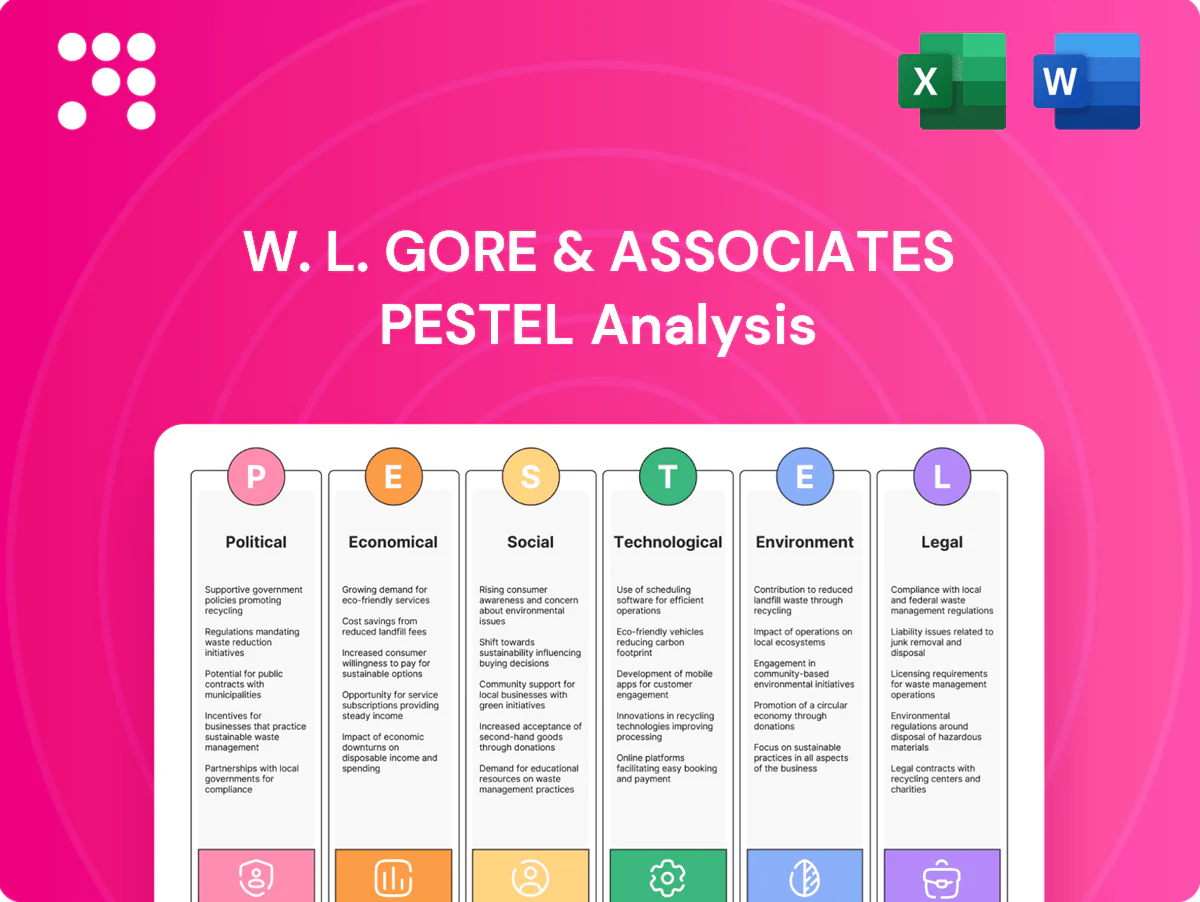
A concise, visually segmented PESTLE summary for W. L. Gore & Associates that simplifies external-risk discussions and market-positioning decisions, easily dropped into presentations or strategy sessions; editable and shareable for quick alignment across teams or client reports.
Economic factors

Industrial and consumer cycles
Capital goods and electronics order cycles strongly affect Gores filtration and cable demand; semiconductor equipment sales reached about 109 billion in 2023 (SEMI), driving upstream materials needs. Outdoor and apparel sales swing with discretionary income and retail inventory cycles—global apparel retail sales rebounded mid-2024 but remain volatile. Medical devices (~530 billion global market 2024) provide defensive demand yet face procedure-volume swings. Gores diversified portfolio smooths revenue volatility.
Raw material and energy costs
PTFE resin, fluorspar and specialty monomer prices remain highly sensitive to mining and processing capacity constraints, driving spot volatility. Sintering and extrusion are energy‑intensive, exposing Gore to gas and power moves (US Henry Hub ~2.64 $/MMBtu in 2024; EU industrial power ~€120/MWh avg in 2024). Long‑term supply contracts and energy hedges have helped stabilize margins. Ongoing process‑efficiency programs cut cost per unit by roughly 5–7%.

FX and global footprint
Multi-currency revenue and costs expose W. L. Gore to translation and transaction risks across its US, European and Asian operations. USD strength (DXY ~105 in 2024) can erode export competitiveness while lowering dollar-priced input costs. Local production and local-currency pricing provide natural hedges, and targeted price adjustments help preserve contribution margins.

Interest rates and capex
Higher interest rates (US federal funds ~5.25–5.50% in 2024–25) raise internal hurdle rates for new product lines and clean-room expansions, slowing approvals. Customer capex in semiconductors and industrials softened in 2024–25, pressuring order books. Phased investments and modular equipment preserve optionality while public incentives (often covering 10–30% of project costs) improve after-tax returns.
- Impact: higher hurdle rates, delayed projects
- Customer cycles: semiconductor & industrial capex slowdown
- Mitigation: phased/modular investment
- Incentives: can boost after-tax IRR by 10–30%
Healthcare and aging demographics
Aging populations expand addressable markets for vascular grafts and soft-tissue repair; UN data show 65+ population rose from 727 million in 2020 to an estimated ~760 million by 2025, pressuring demand for Gore’s implantable technologies. Emerging-market healthcare spending has grown faster than developed markets, lifting long-term device demand, while fiscal constraints tighten pricing and tender dynamics. Demonstrating total cost-of-care savings enables premium positioning in value-based procurements.
- Age 65+ ~760M (2025 est., UN)
- Emerging-market health spend rising—double-digit real growth in many EMs (2010–2023)
- Budget pressure → tender-driven pricing
- Cost-of-care evidence supports premium pricing and adoption
Tariff swings to 25% and ~70% fluor supply risk force maker to seek grants, dual-source, abatement
Capital‑goods cycles (semicap equipment ~$109B 2023) and retail swings drive demand; medical devices (~$530B 2024) add defensive revenue. Input energy (US Henry Hub ~$2.64/MMBtu 2024) and resin supply volatility pressure margins; FX (DXY ~105 2024) and higher rates (Fed 5.25–5.50% 2024–25) raise hurdle rates. Aging population (~760M 65+ 2025) supports device demand.
| Metric | Value |
|---|---|
| Semicap equip | $109B (2023) |
| Med devices | $530B (2024) |
| Fed funds | 5.25–5.50% (2024–25) |
| DXY | ~105 (2024) |
| Henry Hub | $2.64/MMBtu (2024) |
| Age 65+ | ~760M (2025) |
Preview Before You Purchase
W. L. Gore & Associates PESTLE Analysis
The preview shown here is the exact document you’ll receive after purchase—fully formatted and ready to use. This W. L. Gore & Associates PESTLE Analysis examines political, economic, social, technological, legal, and environmental factors affecting the company, with concise insights for strategy and risk assessment. What you see is the final file, ready to download immediately after payment.

Product Information
Product Information
Shipping & Returns
Shipping & Returns
Description
Your Shortcut to Market Insight Starts Here
Discover how political, economic, social, technological, legal, and environmental forces are shaping W. L. Gore & Associates' strategic trajectory in our concise PESTLE overview. Gain actionable insights to anticipate risks and spot growth opportunities across markets and supply chains. Purchase the full PESTLE analysis for a complete, downloadable breakdown ready for presentations and decision-making.
Political factors
Trade policy and tariffs
Gore, operating in more than 25 countries, faces tariff swings on chemicals, medical devices and textiles that can reach 25% under US Section 301 measures. Shifts in US-EU-China relations can change duties on PTFE inputs and finished goods, while trade pacts such as USMCA or CPTPP open markets but create rules-of-origin hurdles. Proactive supply routing and localized finishing reduce exposure to tariff volatility.
Industrial policy and incentives
US industrial policy shifts—notably the CHIPS and Science Act's roughly 52 billion for semiconductor manufacturing and the Inflation Reduction Act's ~369 billion for clean energy—drive plant siting decisions for advanced materials suppliers like W. L. Gore.
Targeted grants and tax credits can offset a significant share of automation and pilot-line capital (often 20–30%), improving project economics.
Buy-local procurement rules increasingly favor regional manufacturing footprints, shortening lead times and protecting margins.
Active monitoring of policy pipelines secures first-mover advantage for grant capture and capacity scaling.
Healthcare policy and reimbursement
Public and private payer decisions, including Medicare Advantage enrollment topping 30 million in 2024, materially shape demand for implantable devices using Gore materials and influence pricing negotiations.
Value-based care pressures force demonstration of superior outcomes and long-term durability through clinical and real-world evidence to secure reimbursements and preferred formulary placement.
EU Health Technology Assessment rules (Regulation (EU) 2021/2282) became applicable in January 2025, and HTA bodies such as NICE and IQWiG can delay uptake without robust clinical data.
Proactive engagement with clinicians, participation in registries and post-market studies increases adoption and supports favorable coverage decisions.
Geopolitical supply risk
Fluorspar and specialty intermediates are concentrated in ~70% of processing capacity in China, exposing Gore to political disruption and export controls that tightened in 2022–23 for dual-use electronics; regional conflicts and sanctions can spike logistics and energy costs, as seen in 2022–24 freight and gas volatility. Dual sourcing and 3–6 month inventory buffers are used as strategic hedges.
- Concentration: China ~70% processing
- Controls: 2022–23 dual-use export curbs
- Hedge: dual sourcing + 3–6 month buffers
Environmental politics on PFAS
Legislators increasingly target PFAS as a class, with EU group restriction proposals (ECHA) and 30+ US states adopting PFAS measures by 2024–25, creating political momentum that can sweep fluoropolymers like PTFE into blanket restrictions despite technical distinctions; accelerated rulemaking risks rapid compliance costs. Gore (approx. $3.7bn sales in 2023) must engage stakeholders, educate regulators, and invest in abatement and alternatives to protect its license to operate and limit financial exposure.
- Regulatory momentum: ECHA group PFAS proposal + 30+ US states (2024–25)
- Risk: blanket bans could include PTFE despite technical differences
- Action: active participation in rulemaking and stakeholder education
- CapEx: invest in abatement/alternatives to preserve market access
Tariff swings to 25% and ~70% fluor supply risk force maker to seek grants, dual-source, abatement
Gore faces tariff swings up to 25% and supply-chain risk with ~70% fluor processing in China; US policy (CHIPS $52B, IRA $369B) and buy-local rules shift siting. PFAS momentum (30+ US states 2024–25, ECHA proposal) risks PTFE restrictions; Gore (≈$3.7bn 2023) must secure grants, dual-source, and invest in abatement.
| Metric | Value |
|---|---|
| 2023 Sales | $3.7bn |
| Fluor capacity China | ~70% |
| Medicare Advantage | 30M (2024) |
What is included in the product
Detailed Word Document
Explores how external macro-environmental factors uniquely affect W. L. Gore & Associates across Political, Economic, Social, Technological, Environmental, and Legal dimensions; each section is data-backed with industry and regional trends to identify risks and opportunities. Designed for executives, consultants, and investors, the analysis includes forward-looking insights, actionable examples, and formatting ready for reports and decks.
Customizable Excel Spreadsheet
A concise, visually segmented PESTLE summary for W. L. Gore & Associates that simplifies external-risk discussions and market-positioning decisions, easily dropped into presentations or strategy sessions; editable and shareable for quick alignment across teams or client reports.
Economic factors
Industrial and consumer cycles
Capital goods and electronics order cycles strongly affect Gores filtration and cable demand; semiconductor equipment sales reached about 109 billion in 2023 (SEMI), driving upstream materials needs. Outdoor and apparel sales swing with discretionary income and retail inventory cycles—global apparel retail sales rebounded mid-2024 but remain volatile. Medical devices (~530 billion global market 2024) provide defensive demand yet face procedure-volume swings. Gores diversified portfolio smooths revenue volatility.
Raw material and energy costs
PTFE resin, fluorspar and specialty monomer prices remain highly sensitive to mining and processing capacity constraints, driving spot volatility. Sintering and extrusion are energy‑intensive, exposing Gore to gas and power moves (US Henry Hub ~2.64 $/MMBtu in 2024; EU industrial power ~€120/MWh avg in 2024). Long‑term supply contracts and energy hedges have helped stabilize margins. Ongoing process‑efficiency programs cut cost per unit by roughly 5–7%.
FX and global footprint
Multi-currency revenue and costs expose W. L. Gore to translation and transaction risks across its US, European and Asian operations. USD strength (DXY ~105 in 2024) can erode export competitiveness while lowering dollar-priced input costs. Local production and local-currency pricing provide natural hedges, and targeted price adjustments help preserve contribution margins.
Interest rates and capex
Higher interest rates (US federal funds ~5.25–5.50% in 2024–25) raise internal hurdle rates for new product lines and clean-room expansions, slowing approvals. Customer capex in semiconductors and industrials softened in 2024–25, pressuring order books. Phased investments and modular equipment preserve optionality while public incentives (often covering 10–30% of project costs) improve after-tax returns.
- Impact: higher hurdle rates, delayed projects
- Customer cycles: semiconductor & industrial capex slowdown
- Mitigation: phased/modular investment
- Incentives: can boost after-tax IRR by 10–30%
Healthcare and aging demographics
Aging populations expand addressable markets for vascular grafts and soft-tissue repair; UN data show 65+ population rose from 727 million in 2020 to an estimated ~760 million by 2025, pressuring demand for Gore’s implantable technologies. Emerging-market healthcare spending has grown faster than developed markets, lifting long-term device demand, while fiscal constraints tighten pricing and tender dynamics. Demonstrating total cost-of-care savings enables premium positioning in value-based procurements.
- Age 65+ ~760M (2025 est., UN)
- Emerging-market health spend rising—double-digit real growth in many EMs (2010–2023)
- Budget pressure → tender-driven pricing
- Cost-of-care evidence supports premium pricing and adoption
Tariff swings to 25% and ~70% fluor supply risk force maker to seek grants, dual-source, abatement
Capital‑goods cycles (semicap equipment ~$109B 2023) and retail swings drive demand; medical devices (~$530B 2024) add defensive revenue. Input energy (US Henry Hub ~$2.64/MMBtu 2024) and resin supply volatility pressure margins; FX (DXY ~105 2024) and higher rates (Fed 5.25–5.50% 2024–25) raise hurdle rates. Aging population (~760M 65+ 2025) supports device demand.
| Metric | Value |
|---|---|
| Semicap equip | $109B (2023) |
| Med devices | $530B (2024) |
| Fed funds | 5.25–5.50% (2024–25) |
| DXY | ~105 (2024) |
| Henry Hub | $2.64/MMBtu (2024) |
| Age 65+ | ~760M (2025) |
Preview Before You Purchase
W. L. Gore & Associates PESTLE Analysis
The preview shown here is the exact document you’ll receive after purchase—fully formatted and ready to use. This W. L. Gore & Associates PESTLE Analysis examines political, economic, social, technological, legal, and environmental factors affecting the company, with concise insights for strategy and risk assessment. What you see is the final file, ready to download immediately after payment.