Goldman Sachs Group PESTLE Analysis

Skip the Research. Get the Strategy.
Discover how political shifts, economic cycles, and regulatory pressure are reshaping Goldman Sachs Group’s strategy and risk profile. Our concise PESTLE highlights the forces driving future performance and strategic choices. Purchase the full analysis for a complete, actionable roadmap you can use immediately.
Political factors

Geopolitics and sanctions
Conflicts, sanctions, and trade tensions reshape cross-border capital flows and client activity: OFAC and EU/UK lists now contain thousands of designated entities, forcing Goldman to track shifting sanctioned-entity lists and extraterritorial enforcement. Deal timelines, underwriting, and market-making can be disrupted suddenly, prompting pauses or exits. Proactive compliance, enhanced screening and country-risk hedging are essential to preserve revenue and limit legal exposure.
Election cycles and policy swings
Election cycles reorient fiscal, industrial and regulatory priorities, reshaping debt and equity issuance and M&A pipelines; US federal corporate tax rate remains 21% while 2024 reform proposals kept restructuring activity elevated. Public investment programs like the $1.2 trillion IIJA and $369 billion IRA create large financing pipelines. Scenario planning anchors advisory and risk positioning at banks.

Regulatory capital diplomacy
Basel III finalisation introduced a 72.5% output floor and tighter liquidity/capital rules that drive trading and booking constraints; Goldman Sachs reported a CET1 ratio near 13.6% in 2024, highlighting capital intensity. Divergent US, EU, UK and APAC implementations force complex booking/product mixes, so active policymaker engagement and capital optimisation now serve as key strategic differentiators.

State participation in markets
Public scrutiny and social license
Political narratives around Wall Street drive increased inquiries and hearings that can convert perception risk into tangible policy risk for Goldman Sachs; public trust matters as the firm manages over 2 trillion in client assets as of 2024. Demonstrable client outcomes and active risk stewardship sustain credibility while consistent stakeholder communications help mitigate market volatility and regulatory responses.
- Perception risk → policy risk
- >2 trillion assets under management (2024)
- Risk stewardship preserves social license
- Consistent communications reduce volatility
Sanctions, election investment and capital rules reroute deals, funding and issuance
Sanctions and trade tensions force enhanced screening, pause deals and shift capital flows (expanded OFAC/EU lists in 2024).
Election-driven policy and public investment (IIJA $1.2T, IRA $369B) reshape issuance and M&A pipelines.
Regulatory capital pressure (Basel output floor; GS CET1 ~13.6% 2024) and state counterparties (SWF AUM $12.3T; Fed assets $8.6T) dictate booking and funding.
| Metric | 2024 value |
|---|---|
| GS AUM | >$2T |
| CET1 | ~13.6% |
| SWF AUM | $12.3T |
| Fed assets | $8.6T |
What is included in the product
 Detailed Word Document
Explores how Political, Economic, Social, Technological, Environmental and Legal forces uniquely affect Goldman Sachs, with data-backed trends and region/industry context. Designed for executives, investors and strategists to identify risks, opportunities and forward-looking scenarios ready for plans and decks.

 Customizable Excel Spreadsheet
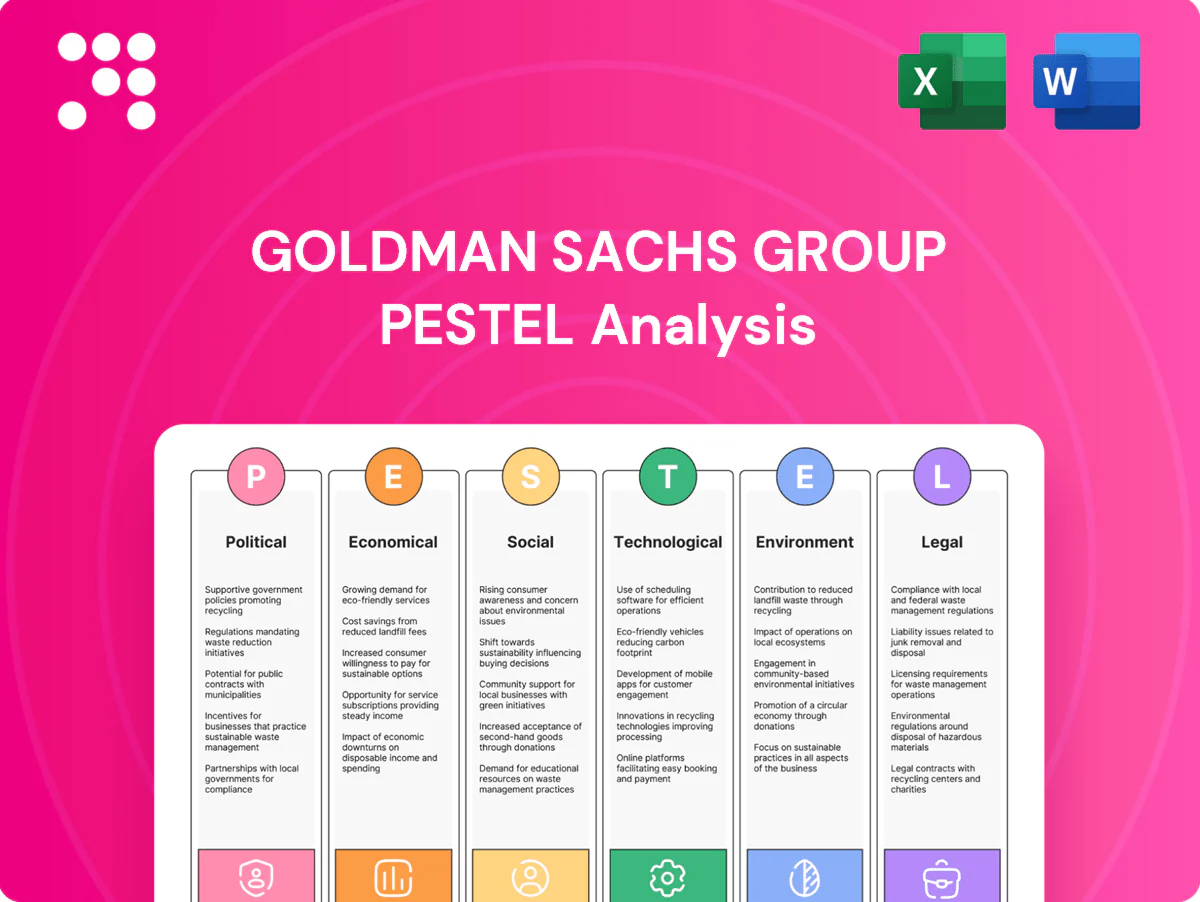
A clean, summarized Goldman Sachs Group PESTLE analysis that’s visually segmented by category for quick interpretation, easily dropped into presentations, shared across teams, and annotated with context-specific notes to support risk discussions and strategic alignment.
Economic factors

Monetary policy and rates
Higher policy rates (federal funds ~5.25–5.50% in mid‑2025) and a steeper/flattening 10‑yr around ~4.2% materially affect Goldman Sachs trading revenues, NIM and valuation multiples, with tightening compressing risk appetite and easing reopening issuance windows. Duration and convexity risks require active hedging across fixed income and mortgage books. Policy path uncertainty elevates volatility, creating both opportunities and downside risks to fee and trading income.
Capital markets cycles
IPOs, leveraged finance and M&A remain cyclical drivers for Goldman Sachs, with global M&A deal value rebounding to roughly $3.6 trillion in 2024, expanding potential fee pools in risk-on regimes and collapsing pipelines during risk-off periods. Backlogs convert into fees once credit spreads stabilize and deal visibility improves, as seen in multi-quarter recoveries post-2023 tightening. Diversification across sectors and geographies smooths earnings volatility and limits single-market drawdowns.

Macro growth and inflation
Goldman Sachs faces a macro environment where global growth is modest—IMF/market estimates ~3.1% for 2025—while inflation remains above pre-pandemic norms (US CPI ~3.3% y/y mid-2025), driving shifts in asset prices and client portfolios. Elevated inflation raises demand for inflation-linked allocations and derivatives, recession risk boosts credit provisioning and VaR vigilance, and macro views shape cross-asset client solutions.

FX and global liquidity
Dollar strength (DXY ~105 in mid‑2025) and tighter global liquidity have pushed basis spreads wider and tightened funding conditions, compressing trading margins and raising treasury funding costs; cross‑currency activity fuels client hedging and structured flow demand while liquidity fragmentation increases execution complexity. Goldman Sachs benefits from robust market access and active inventory management to capture spread and flow opportunities.
- Dollar (DXY ~105 mid‑2025)
- Wider cross‑currency basis (up to ~‑80 bps in stress windows)
- Fragmented liquidity → higher execution costs
- Market access + inventory = competitive edge
Wealth creation trends
Sanctions, election investment and capital rules reroute deals, funding and issuance
Higher policy rates (federal funds 5.25–5.50%) and 10y ~4.2% compress risk appetite and NIM, elevating trading volatility and hedging needs. Global growth ~3.1% and US CPI ~3.3% shift client allocations to inflation-linked and alternatives. M&A ~$3.6T (2024) and HNWI AUM gains expand fee pools, while DXY ~105 and wider basis raise funding/execution costs.
| Metric | Mid‑2025 | Impact |
|---|---|---|
| Fed funds | 5.25–5.50% | Lower risk appetite |
| 10‑yr | ~4.2% | Duration/hedge costs |
| DXY | ~105 | Funding pressure |
What You See Is What You Get
Goldman Sachs Group PESTLE Analysis
This Goldman Sachs Group PESTLE Analysis examines political, economic, social, technological, legal, and environmental factors shaping the firm's strategic outlook. The content and structure shown in the preview is the same document you’ll download after payment. It is fully formatted and ready to use.

Original: $10.00
-65%$10.00
$3.50Product Information
Product Information
Shipping & Returns
Shipping & Returns
Description
Skip the Research. Get the Strategy.
Discover how political shifts, economic cycles, and regulatory pressure are reshaping Goldman Sachs Group’s strategy and risk profile. Our concise PESTLE highlights the forces driving future performance and strategic choices. Purchase the full analysis for a complete, actionable roadmap you can use immediately.
Political factors
Geopolitics and sanctions
Conflicts, sanctions, and trade tensions reshape cross-border capital flows and client activity: OFAC and EU/UK lists now contain thousands of designated entities, forcing Goldman to track shifting sanctioned-entity lists and extraterritorial enforcement. Deal timelines, underwriting, and market-making can be disrupted suddenly, prompting pauses or exits. Proactive compliance, enhanced screening and country-risk hedging are essential to preserve revenue and limit legal exposure.
Election cycles and policy swings
Election cycles reorient fiscal, industrial and regulatory priorities, reshaping debt and equity issuance and M&A pipelines; US federal corporate tax rate remains 21% while 2024 reform proposals kept restructuring activity elevated. Public investment programs like the $1.2 trillion IIJA and $369 billion IRA create large financing pipelines. Scenario planning anchors advisory and risk positioning at banks.
Regulatory capital diplomacy
Basel III finalisation introduced a 72.5% output floor and tighter liquidity/capital rules that drive trading and booking constraints; Goldman Sachs reported a CET1 ratio near 13.6% in 2024, highlighting capital intensity. Divergent US, EU, UK and APAC implementations force complex booking/product mixes, so active policymaker engagement and capital optimisation now serve as key strategic differentiators.
State participation in markets
Public scrutiny and social license
Political narratives around Wall Street drive increased inquiries and hearings that can convert perception risk into tangible policy risk for Goldman Sachs; public trust matters as the firm manages over 2 trillion in client assets as of 2024. Demonstrable client outcomes and active risk stewardship sustain credibility while consistent stakeholder communications help mitigate market volatility and regulatory responses.
- Perception risk → policy risk
- >2 trillion assets under management (2024)
- Risk stewardship preserves social license
- Consistent communications reduce volatility
Sanctions, election investment and capital rules reroute deals, funding and issuance
Sanctions and trade tensions force enhanced screening, pause deals and shift capital flows (expanded OFAC/EU lists in 2024).
Election-driven policy and public investment (IIJA $1.2T, IRA $369B) reshape issuance and M&A pipelines.
Regulatory capital pressure (Basel output floor; GS CET1 ~13.6% 2024) and state counterparties (SWF AUM $12.3T; Fed assets $8.6T) dictate booking and funding.
| Metric | 2024 value |
|---|---|
| GS AUM | >$2T |
| CET1 | ~13.6% |
| SWF AUM | $12.3T |
| Fed assets | $8.6T |
What is included in the product
Detailed Word Document
Explores how Political, Economic, Social, Technological, Environmental and Legal forces uniquely affect Goldman Sachs, with data-backed trends and region/industry context. Designed for executives, investors and strategists to identify risks, opportunities and forward-looking scenarios ready for plans and decks.
Customizable Excel Spreadsheet
A clean, summarized Goldman Sachs Group PESTLE analysis that’s visually segmented by category for quick interpretation, easily dropped into presentations, shared across teams, and annotated with context-specific notes to support risk discussions and strategic alignment.
Economic factors
Monetary policy and rates
Higher policy rates (federal funds ~5.25–5.50% in mid‑2025) and a steeper/flattening 10‑yr around ~4.2% materially affect Goldman Sachs trading revenues, NIM and valuation multiples, with tightening compressing risk appetite and easing reopening issuance windows. Duration and convexity risks require active hedging across fixed income and mortgage books. Policy path uncertainty elevates volatility, creating both opportunities and downside risks to fee and trading income.
Capital markets cycles
IPOs, leveraged finance and M&A remain cyclical drivers for Goldman Sachs, with global M&A deal value rebounding to roughly $3.6 trillion in 2024, expanding potential fee pools in risk-on regimes and collapsing pipelines during risk-off periods. Backlogs convert into fees once credit spreads stabilize and deal visibility improves, as seen in multi-quarter recoveries post-2023 tightening. Diversification across sectors and geographies smooths earnings volatility and limits single-market drawdowns.
Macro growth and inflation
Goldman Sachs faces a macro environment where global growth is modest—IMF/market estimates ~3.1% for 2025—while inflation remains above pre-pandemic norms (US CPI ~3.3% y/y mid-2025), driving shifts in asset prices and client portfolios. Elevated inflation raises demand for inflation-linked allocations and derivatives, recession risk boosts credit provisioning and VaR vigilance, and macro views shape cross-asset client solutions.
FX and global liquidity
Dollar strength (DXY ~105 in mid‑2025) and tighter global liquidity have pushed basis spreads wider and tightened funding conditions, compressing trading margins and raising treasury funding costs; cross‑currency activity fuels client hedging and structured flow demand while liquidity fragmentation increases execution complexity. Goldman Sachs benefits from robust market access and active inventory management to capture spread and flow opportunities.
- Dollar (DXY ~105 mid‑2025)
- Wider cross‑currency basis (up to ~‑80 bps in stress windows)
- Fragmented liquidity → higher execution costs
- Market access + inventory = competitive edge
Wealth creation trends
Sanctions, election investment and capital rules reroute deals, funding and issuance
Higher policy rates (federal funds 5.25–5.50%) and 10y ~4.2% compress risk appetite and NIM, elevating trading volatility and hedging needs. Global growth ~3.1% and US CPI ~3.3% shift client allocations to inflation-linked and alternatives. M&A ~$3.6T (2024) and HNWI AUM gains expand fee pools, while DXY ~105 and wider basis raise funding/execution costs.
| Metric | Mid‑2025 | Impact |
|---|---|---|
| Fed funds | 5.25–5.50% | Lower risk appetite |
| 10‑yr | ~4.2% | Duration/hedge costs |
| DXY | ~105 | Funding pressure |
What You See Is What You Get
Goldman Sachs Group PESTLE Analysis
This Goldman Sachs Group PESTLE Analysis examines political, economic, social, technological, legal, and environmental factors shaping the firm's strategic outlook. The content and structure shown in the preview is the same document you’ll download after payment. It is fully formatted and ready to use.