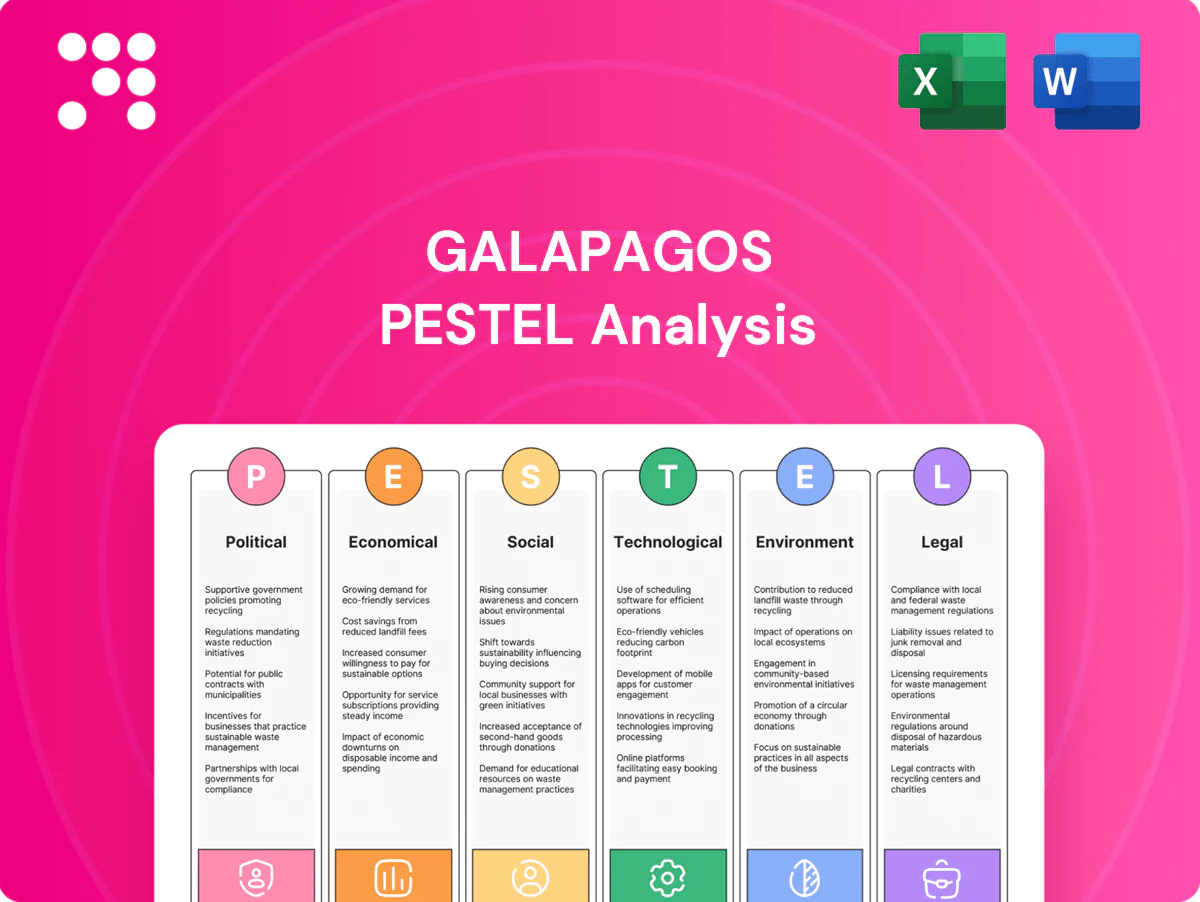
Galapagos PESTLE Analysis

Plan Smarter. Present Sharper. Compete Stronger.
Gain a competitive edge with our PESTLE Analysis of Galapagos. Understand how political, economic, social, technological, legal and environmental forces shape its strategy and risks. Perfect for investors and strategists seeking actionable intelligence. Buy the full report for instant, editable insights.
Political factors

EU health policy and funding
EU priorities on innovative medicines and AMR—backed by the EU4Health budget of €5.3bn (2021–2027) and the 2023 pharma reform proposal—shape grant access, procurement models and evaluation standards; proposed changes could materially affect data exclusivity and first-in-class incentives. The HTA Regulation (EU) 2021/2282 became applicable in Jan 2025, aligning EMA and joint HTA assessments across 27 member states and speeding market access, while divergent national transpositions still drive launch sequencing risk.
Drug pricing and negotiation regimes
Reference pricing and joint procurement across Europe (used by over 20 member states) are intensifying price pressure on novel therapies and shortening launch windows; U.S. Medicare negotiations under the Inflation Reduction Act will begin with 10 drugs selected for 2026, compressing lifetime value in forecasts. Early health-economics evidence now decisively shapes list-to-net dynamics, while outcome-based contracts—increasingly adopted—help deflect political pushback and protect margins.

Geopolitical supply chain risk
Export controls and sanctions (notably measures since 2022 affecting Russia and tightened export rules to China in 2022–24) can disrupt flows of APIs, reagents and specialized equipment; roughly 60% of global APIs are sourced from China and India, concentrating risk. Political instability in supplier regions lengthens lead times and raises costs; dual-sourcing and nearshoring reduce shock exposure. Multi-billion dollar government incentives in 2023–25 for regional biomanufacturing are reshaping footprint decisions.

Public R&D incentives and grants
National and EU funding, notably Horizon Europe’s €95.5 billion 2021–27 budget, accelerates early-stage biotech programs and platform advances; policy shifts can re-prioritize grant flows across therapeutic areas, affecting pipeline timing. Aligning proposals with public health priorities raises award probability, while public co-funding reduces equity dilution and extends runway.
- Horizon Europe: €95.5bn
- Policy shifts can reallocate grant focus
- Strategic alignment improves award odds
- Co-funding lowers dilution, extends runway
Regulatory agency capacity and alignment
EMA-FDA alignment on endpoints and expedited pathways materially shapes Galapagos trial design and timelines; FDA review goals are 6 months for priority and 10 months for standard reviews while EMA centralized reviews target 210 active days. Political oversight can tighten or loosen review rigor, and resourcing constraints at regulators cause clock-stops and backlog-driven delays. Early parallel scientific advice reduces regulatory uncertainty and de-risks pivotal study design.
- Regulatory timing: FDA 6/10 months, EMA 210 days
- Alignment: parallel advice shortens protocol iterations
- Risk: political shifts can change review stringency
- Capacity: staffing/backlogs drive approval delays
EU pharma reforms, HTA Jan 2025: rising price pressure, launch sequencing and supply risk
EU pharma reforms, EU4Health €5.3bn and HTA Regulation effective Jan 2025 reshape market access and data-exclusivity incentives; national transpositions still drive launch sequencing risk. Price pressure rises via EU reference pricing, joint procurement and US IRA negotiations (10 drugs for 2026), compressing lifetime value. Supply-chain risk remains high: ~60% of APIs from China/India; 2023–25 reshoring incentives exceed several billion euros.
| Metric | Value |
|---|---|
| EU4Health | €5.3bn (2021–27) |
| Horizon Europe | €95.5bn (2021–27) |
| HTA effective | Jan 2025 |
| API sourcing | ~60% China/India |
What is included in the product
 Detailed Word Document
Explores how Political, Economic, Social, Technological, Environmental and Legal factors uniquely affect Galapagos, with data-backed trends, forward-looking insights and detailed sub-points to inform executives, investors and entrepreneurs—ready for business plans, decks and scenario-driven strategy.

 Customizable Excel Spreadsheet
A concise, visually segmented Galapagos PESTLE summary that’s easily droppable into presentations and shared across teams, using simple language and editable notes so stakeholders can quickly assess external risks and market positioning.
Economic factors

Capital market cyclicality
Biotech valuations at Galapagos remain highly sensitive to risk appetite, interest rates (10-year US Treasury around 4.5% in mid-2024) and IPO windows, which narrowed to low double-digit US biotech listings in 2024, compressing exit opportunities. Tight funding cycles force program prioritization and partnering to conserve cash and de-risk pipelines. Strong clinical readouts can decouple a program from macro volatility, but timing versus market windows is critical. Increasing use of non-dilutive tools such as milestone-based collaborations and royalty financing smooths valuation swings.
Reimbursement and pricing pressure
Payers increasingly demand comparative effectiveness and budget impact analyses, applying thresholds such as NICEs £20,000–30,000/QALY and ICERs commonly referencing $100,000–150,000/QALY. Net price erosion and access hurdles can slow Galapagos revenue ramp as formulary placement is tightened. Robust HEOR and real-world evidence improve formulary tiering and uptake. Innovative contracting, including outcomes- and risk-sharing agreements, can preserve value in cost-constrained systems.

Cost inflation in trials and CMC
Rising labor, site fees and biologics inputs have pushed clinical trial unit costs up roughly 15% since 2020, materially increasing Galapagos’s burn. Complex CMC for advanced modalities drives higher capex and can extend timelines by 12–18 months. Early manufacturability planning has been shown to cut change-control events by ~40%, while vendor consolidation can unlock scale savings of 20–35% on COGS.

FX exposure and geographic mix
Galapagos runs EUR-based OPEX while many trials and partnerships are USD-denominated, exposing margins to EUR/USD moves (EUR/USD ≈1.10 mid-2025). Active hedging programs aim to stabilize cash-runway predictability. Revenue localization shapes transfer pricing and tax efficiency, so market selection balances growth with FX stability.
- FX exposure: EUR OPEX vs USD contracts
- Hedging: protects cash-runway predictability
- Localization: affects transfer pricing/tax
- Market choice: trade-off growth vs FX risk
Partnering and milestone economics
Partnering structures—upfronts, milestones, and royalties—diversify Galapagos funding and transfer development risk to partners while preserving upside where assets show differentiation and clear target-class fit. Deal economics are calibrated to asset stage and therapeutic differentiation; retaining co-commercial rights in core markets preserves long-term revenue potential. Strong governance and milestone-linked KPIs prevent value leakage across collaborations.
- Upfronts/milestones: risk-sharing
- Stage/differentiation: key pricing lever
- Co-commercial rights: boosts upside
- Clear governance: prevents value leakage
EU pharma reforms, HTA Jan 2025: rising price pressure, launch sequencing and supply risk
Galapagos faces macro sensitivity: 10y US Treasury ~4.5% (mid-2024) and EUR/USD ≈1.10 (mid-2025) press funding costs and exit windows (US biotech IPOs low double-digit in 2024). Trial costs +15% since 2020 and COGS savings potential 20–35% via vendor scale. Payer thresholds (NICE £20–30k/QALY; ICER $100–150k/QALY) pressure net pricing and access.
| Metric | Value |
|---|---|
| 10y US Treasury | ~4.5% (mid-2024) |
| EUR/USD | ≈1.10 (mid-2025) |
| Trial cost change | +15% since 2020 |
| COGS savings | 20–35% |
| Payer thresholds | £20–30k/QALY; $100–150k/QALY |
Same Document Delivered
Galapagos PESTLE Analysis
The preview shown here is the exact Galapagos PESTLE Analysis you’ll receive after purchase—fully formatted and ready to use. The content, structure, and visuals in this snapshot match the downloadable file with no placeholders or edits. After payment you’ll instantly get this same finished document.

Original: $10.00
-65%$10.00
$3.50Product Information
Product Information
Shipping & Returns
Shipping & Returns
Description
Plan Smarter. Present Sharper. Compete Stronger.
Gain a competitive edge with our PESTLE Analysis of Galapagos. Understand how political, economic, social, technological, legal and environmental forces shape its strategy and risks. Perfect for investors and strategists seeking actionable intelligence. Buy the full report for instant, editable insights.
Political factors
EU health policy and funding
EU priorities on innovative medicines and AMR—backed by the EU4Health budget of €5.3bn (2021–2027) and the 2023 pharma reform proposal—shape grant access, procurement models and evaluation standards; proposed changes could materially affect data exclusivity and first-in-class incentives. The HTA Regulation (EU) 2021/2282 became applicable in Jan 2025, aligning EMA and joint HTA assessments across 27 member states and speeding market access, while divergent national transpositions still drive launch sequencing risk.
Drug pricing and negotiation regimes
Reference pricing and joint procurement across Europe (used by over 20 member states) are intensifying price pressure on novel therapies and shortening launch windows; U.S. Medicare negotiations under the Inflation Reduction Act will begin with 10 drugs selected for 2026, compressing lifetime value in forecasts. Early health-economics evidence now decisively shapes list-to-net dynamics, while outcome-based contracts—increasingly adopted—help deflect political pushback and protect margins.
Geopolitical supply chain risk
Export controls and sanctions (notably measures since 2022 affecting Russia and tightened export rules to China in 2022–24) can disrupt flows of APIs, reagents and specialized equipment; roughly 60% of global APIs are sourced from China and India, concentrating risk. Political instability in supplier regions lengthens lead times and raises costs; dual-sourcing and nearshoring reduce shock exposure. Multi-billion dollar government incentives in 2023–25 for regional biomanufacturing are reshaping footprint decisions.
Public R&D incentives and grants
National and EU funding, notably Horizon Europe’s €95.5 billion 2021–27 budget, accelerates early-stage biotech programs and platform advances; policy shifts can re-prioritize grant flows across therapeutic areas, affecting pipeline timing. Aligning proposals with public health priorities raises award probability, while public co-funding reduces equity dilution and extends runway.
- Horizon Europe: €95.5bn
- Policy shifts can reallocate grant focus
- Strategic alignment improves award odds
- Co-funding lowers dilution, extends runway
Regulatory agency capacity and alignment
EMA-FDA alignment on endpoints and expedited pathways materially shapes Galapagos trial design and timelines; FDA review goals are 6 months for priority and 10 months for standard reviews while EMA centralized reviews target 210 active days. Political oversight can tighten or loosen review rigor, and resourcing constraints at regulators cause clock-stops and backlog-driven delays. Early parallel scientific advice reduces regulatory uncertainty and de-risks pivotal study design.
- Regulatory timing: FDA 6/10 months, EMA 210 days
- Alignment: parallel advice shortens protocol iterations
- Risk: political shifts can change review stringency
- Capacity: staffing/backlogs drive approval delays
EU pharma reforms, HTA Jan 2025: rising price pressure, launch sequencing and supply risk
EU pharma reforms, EU4Health €5.3bn and HTA Regulation effective Jan 2025 reshape market access and data-exclusivity incentives; national transpositions still drive launch sequencing risk. Price pressure rises via EU reference pricing, joint procurement and US IRA negotiations (10 drugs for 2026), compressing lifetime value. Supply-chain risk remains high: ~60% of APIs from China/India; 2023–25 reshoring incentives exceed several billion euros.
| Metric | Value |
|---|---|
| EU4Health | €5.3bn (2021–27) |
| Horizon Europe | €95.5bn (2021–27) |
| HTA effective | Jan 2025 |
| API sourcing | ~60% China/India |
What is included in the product
Detailed Word Document
Explores how Political, Economic, Social, Technological, Environmental and Legal factors uniquely affect Galapagos, with data-backed trends, forward-looking insights and detailed sub-points to inform executives, investors and entrepreneurs—ready for business plans, decks and scenario-driven strategy.
Customizable Excel Spreadsheet
A concise, visually segmented Galapagos PESTLE summary that’s easily droppable into presentations and shared across teams, using simple language and editable notes so stakeholders can quickly assess external risks and market positioning.
Economic factors
Capital market cyclicality
Biotech valuations at Galapagos remain highly sensitive to risk appetite, interest rates (10-year US Treasury around 4.5% in mid-2024) and IPO windows, which narrowed to low double-digit US biotech listings in 2024, compressing exit opportunities. Tight funding cycles force program prioritization and partnering to conserve cash and de-risk pipelines. Strong clinical readouts can decouple a program from macro volatility, but timing versus market windows is critical. Increasing use of non-dilutive tools such as milestone-based collaborations and royalty financing smooths valuation swings.
Reimbursement and pricing pressure
Payers increasingly demand comparative effectiveness and budget impact analyses, applying thresholds such as NICEs £20,000–30,000/QALY and ICERs commonly referencing $100,000–150,000/QALY. Net price erosion and access hurdles can slow Galapagos revenue ramp as formulary placement is tightened. Robust HEOR and real-world evidence improve formulary tiering and uptake. Innovative contracting, including outcomes- and risk-sharing agreements, can preserve value in cost-constrained systems.
Cost inflation in trials and CMC
Rising labor, site fees and biologics inputs have pushed clinical trial unit costs up roughly 15% since 2020, materially increasing Galapagos’s burn. Complex CMC for advanced modalities drives higher capex and can extend timelines by 12–18 months. Early manufacturability planning has been shown to cut change-control events by ~40%, while vendor consolidation can unlock scale savings of 20–35% on COGS.
FX exposure and geographic mix
Galapagos runs EUR-based OPEX while many trials and partnerships are USD-denominated, exposing margins to EUR/USD moves (EUR/USD ≈1.10 mid-2025). Active hedging programs aim to stabilize cash-runway predictability. Revenue localization shapes transfer pricing and tax efficiency, so market selection balances growth with FX stability.
- FX exposure: EUR OPEX vs USD contracts
- Hedging: protects cash-runway predictability
- Localization: affects transfer pricing/tax
- Market choice: trade-off growth vs FX risk
Partnering and milestone economics
Partnering structures—upfronts, milestones, and royalties—diversify Galapagos funding and transfer development risk to partners while preserving upside where assets show differentiation and clear target-class fit. Deal economics are calibrated to asset stage and therapeutic differentiation; retaining co-commercial rights in core markets preserves long-term revenue potential. Strong governance and milestone-linked KPIs prevent value leakage across collaborations.
- Upfronts/milestones: risk-sharing
- Stage/differentiation: key pricing lever
- Co-commercial rights: boosts upside
- Clear governance: prevents value leakage
EU pharma reforms, HTA Jan 2025: rising price pressure, launch sequencing and supply risk
Galapagos faces macro sensitivity: 10y US Treasury ~4.5% (mid-2024) and EUR/USD ≈1.10 (mid-2025) press funding costs and exit windows (US biotech IPOs low double-digit in 2024). Trial costs +15% since 2020 and COGS savings potential 20–35% via vendor scale. Payer thresholds (NICE £20–30k/QALY; ICER $100–150k/QALY) pressure net pricing and access.
| Metric | Value |
|---|---|
| 10y US Treasury | ~4.5% (mid-2024) |
| EUR/USD | ≈1.10 (mid-2025) |
| Trial cost change | +15% since 2020 |
| COGS savings | 20–35% |
| Payer thresholds | £20–30k/QALY; $100–150k/QALY |
Same Document Delivered
Galapagos PESTLE Analysis
The preview shown here is the exact Galapagos PESTLE Analysis you’ll receive after purchase—fully formatted and ready to use. The content, structure, and visuals in this snapshot match the downloadable file with no placeholders or edits. After payment you’ll instantly get this same finished document.