Gibson, Dunn & Crutcher PESTLE Analysis

Your Competitive Advantage Starts with This Report
Discover how political, economic, social, technological, legal and environmental forces are reshaping Gibson, Dunn & Crutcher's strategy and risk profile. Our concise PESTLE highlights key external threats and opportunities. Ideal for investors and advisors seeking actionable intelligence. Purchase the full analysis for a complete, downloadable report.
Political factors

Geopolitical volatility
Geopolitical volatility from shifting US-China and EU relations, expanding sanctions and trade policy frictions—US-China goods trade was about $690bn in 2023—has driven demand for cross-border advisory and disputes. Gibson Dunn can leverage its government-relations and international-arbitration strengths to capture this work. Instability heightens conflicts-checks and matter-selection complexity, so scenario planning for sanctions and export-control pipelines is critical.
Regulatory activism
Heightened enforcement by agencies—DOJ, FTC, SEC and EU DG COMP—has increased investigations and litigation as merger reviews and competition probes remain elevated while HSR filings run around 2,000 annually; Gibson Dunn benefits across antitrust, white‑collar and regulatory defense. Political turnover shifts enforcement priorities and case volumes, so building bipartisan credibility and hiring ex‑regulators mitigates cyclicality.

Public procurement and infrastructure
Government spending programs like the US Bipartisan Infrastructure Law (about $1.2 trillion) and EU NextGenerationEU (€806.9 billion) drive PPPs, energy transition and digital infrastructure mandates. Gibson Dunn can advise on procurement, compliance and disputes for sponsors and lenders in deals often worth billions. Political scrutiny raises transparency and ESG obligations as ESG assets are forecast near $53 trillion by 2025, and proactive stakeholder engagement reduces approval risk.

Global policy fragmentation
Divergent data, tax, and sustainability rules—with roughly 137 jurisdictions having data protection laws and 136 jurisdictions agreeing Pillar Two by 2023—complicate multinational strategies; Gibson Dunn’s global platform harmonizes multi-jurisdictional advice and limits forum risk. Fragmentation fuels venue-shopping and forum risk, so coordinated matter management across offices measurably improves outcomes.
- Fragmentation: 137+ data regimes
- Tax: 136 jurisdictions Pillar Two
- Risk: increased venue-shopping
- Mitigation: coordinated global matter management
Political litigation trends
Election-law, administrative-law and constitutional disputes have risen since 2020 with hundreds of election-related suits persisting through 2024, and Gibson Dunn’s appellate and Supreme Court capabilities position the firm to capture high-impact matters; political salience heightens reputational risk and media scrutiny, so robust matter vetting and a proactive communications strategy are essential.
- Election law: hundreds of suits continued into 2024
- Appellate/Supreme: top-tier bench to capture high-impact cases
- Reputational risk: heightened media scrutiny in 2020–24 cycles
- Mitigation: strict vetting and proactive communications
Geopolitics, sanctions and enforcement fuel cross‑border disputes; US‑China trade at risk
Geopolitical friction (US‑China goods trade ~$690bn in 2023) and sanctions boost cross‑border disputes; scale sanctions/export‑control pipelines. Heightened enforcement (DOJ/SEC/FTC; ~2,000 HSR filings/yr) increases antitrust and white‑collar demand—hire ex‑regulators. Infrastructure ($1.2T US; €806.9bn EU) and 137 data regimes/136 Pillar Two complicate multinational deals.
| Item | Key figure |
|---|---|
| US‑China trade 2023 | $690bn |
| HSR filings/year | ~2,000 |
| US infrastructure | $1.2T |
| NextGenerationEU | €806.9bn |
| Data regimes | 137 |
| Pillar Two | 136 jurisdictions |
What is included in the product
 Detailed Word Document
Explores how macro-environmental forces—Political, Economic, Social, Technological, Environmental, and Legal—specifically impact Gibson, Dunn & Crutcher, with data-driven trends, industry and regional context, actionable forward-looking insights, and detailed sub-points to aid executives, advisors, and investors in risk identification and strategic planning.

 Customizable Excel Spreadsheet
A clean, summarized Gibson, Dunn & Crutcher PESTLE that distills legal, regulatory, economic and technological drivers into a single-page reference, enabling quick alignment in meetings and easy insertion into presentations or client reports.
Economic factors

Deal cycle sensitivity
Deal cycle sensitivity: M&A, capital markets and restructuring volumes closely track interest rates, valuations and credit spreads; with the US federal funds target at 5.25–5.50% in 2024–2025, transaction pacing remains uneven. Gibson Dunn must flex between high-volume transactional teams and disputes/restructuring capacity as downturns drive insolvency and litigation demand. A balanced practice mix hedges revenue volatility by shifting resources to countercyclical workstreams.
Client cost pressure
Corporate legal departments are pressing for AFAs, tighter budgets and value-based billing, with cost control ranked a top priority in the 2024 ACC Chief Legal Officers survey; Gibson Dunn can segment pricing by matter criticality and risk to preserve revenue. Process efficiency, staffing leverage and alternative resourcing protect margins, while clear ROI narratives and metrics strengthen panel placement and retention.

Global growth dispersion
IMF WEO (Apr 2025) highlights widening global growth dispersion — advanced economies ~1.5% vs emerging markets ~4.0% — shifting client opportunity maps toward faster-growing regions and sectors.
Targeting energy, tech, life sciences and private capital (global PE dry powder ≈ $2.5tn in 2024, Preqin) can offset weaker pockets.
FX volatility and a stronger USD in 2024 compressed cross-border fee realization; localized BD and partner hires are required to capture upside.

Private capital expansion
PE, private credit and infrastructure funds drive steady deal and portfolio work—global private capital AUM exceeded $13 trillion in 2024, with private credit reaching roughly $1.4 trillion and infrastructure funds over $1.3 trillion, sustaining demand for cradle-to-exit counsel and regulatory coverage from firms like Gibson Dunn.
Increasing scrutiny on fees and disclosure (heightened by regulators and LPs) raises compliance and monitoring needs, while long-term fund relationships underpin recurring revenue from advisory and enforcement matters.
- PE deal flow: sustained advisory demand
- Private credit: ~$1.4T AUM driving refinancing and covenants work
- Infrastructure: >$1.3T AUM, steady portfolio management needs
- Regulatory/fee scrutiny: higher compliance workload
- Long-term relationships: recurring revenue engine
Inflation and wage dynamics
Rising associate compensation (US BigLaw starting salaries around 215,000 USD) and support costs compress margins, making rate discipline and pyramid optimization (aiming higher leverage) critical to maintain profitability. Tech-enabled delivery and knowledge management can lower delivery overhead roughly 15%, while close monitoring of realization (~80% industry average) and write-offs (10–15%) safeguards net margins.
- Associate pay: 215,000 USD
- Realization: ~80%
- Write-offs: 10–15%
- Tech savings: ~15%
- Focus: rate discipline & pyramid optimization
Geopolitics, sanctions and enforcement fuel cross‑border disputes; US‑China trade at risk
Transaction volumes trail rates and spreads (US fed funds 5.25–5.50% in 2024–25), shifting work toward restructurings and disputes; private capital (≈$13T AUM) and PE dry powder ≈$2.5T sustain advisory demand. Cost pressures (US BigLaw start ≈215,000 USD) and FX/realization (~80%) require pricing discipline and tech-driven delivery to protect margins.
| Metric | 2024–25 |
|---|---|
| Fed funds | 5.25–5.50% |
| Private capital AUM | $13T |
| PE dry powder | $2.5T |
| Starting associate pay | $215,000 |
| Realization | ~80% |
Preview Before You Purchase
Gibson, Dunn & Crutcher PESTLE Analysis
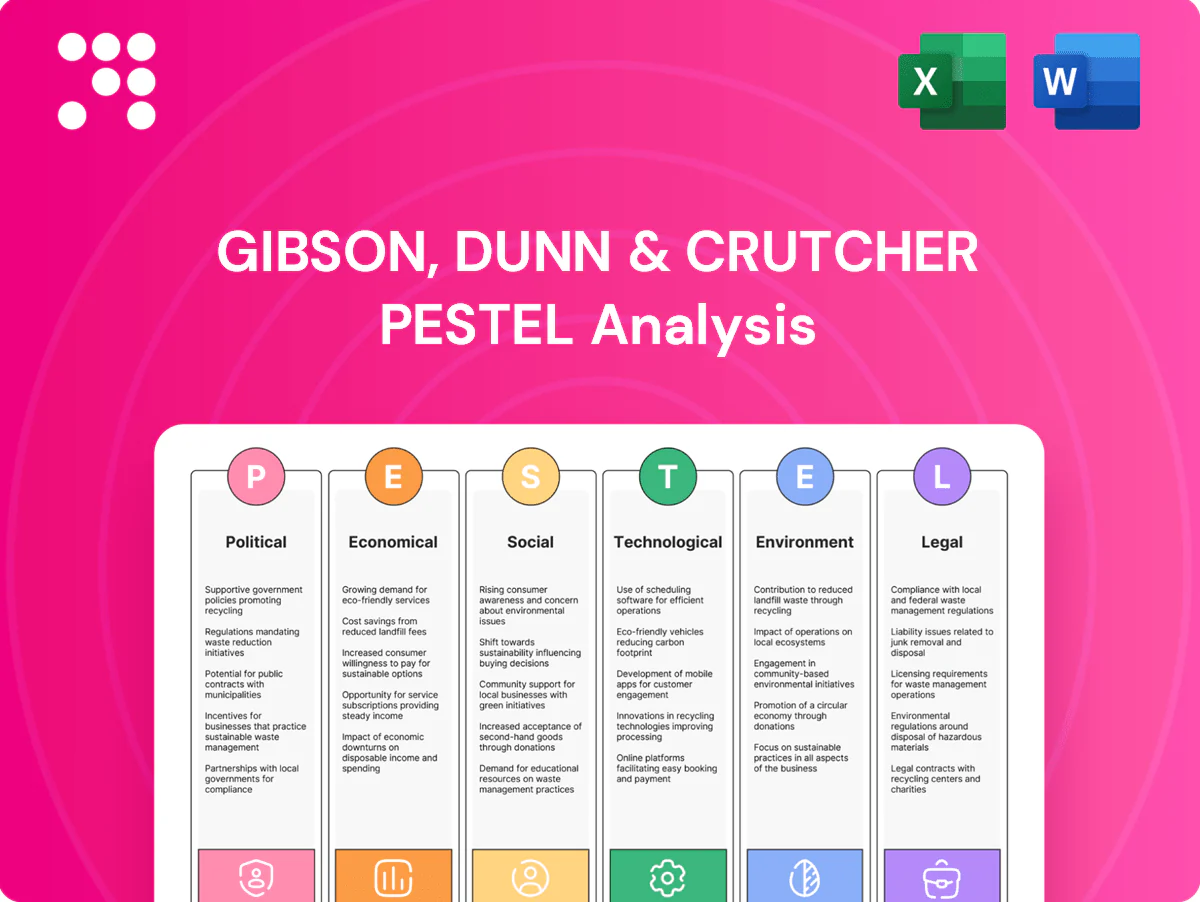
The preview shown here is the exact document you’ll receive after purchase—fully formatted and ready to use. This Gibson, Dunn & Crutcher PESTLE Analysis is presented in its final professional structure, with complete political, economic, social, technological, legal and environmental sections. No placeholders or teasers—what you see is what you’ll download instantly after checkout.

Original: $10.00
-65%$10.00
$3.50Product Information
Product Information
Shipping & Returns
Shipping & Returns
Description
Your Competitive Advantage Starts with This Report
Discover how political, economic, social, technological, legal and environmental forces are reshaping Gibson, Dunn & Crutcher's strategy and risk profile. Our concise PESTLE highlights key external threats and opportunities. Ideal for investors and advisors seeking actionable intelligence. Purchase the full analysis for a complete, downloadable report.
Political factors
Geopolitical volatility
Geopolitical volatility from shifting US-China and EU relations, expanding sanctions and trade policy frictions—US-China goods trade was about $690bn in 2023—has driven demand for cross-border advisory and disputes. Gibson Dunn can leverage its government-relations and international-arbitration strengths to capture this work. Instability heightens conflicts-checks and matter-selection complexity, so scenario planning for sanctions and export-control pipelines is critical.
Regulatory activism
Heightened enforcement by agencies—DOJ, FTC, SEC and EU DG COMP—has increased investigations and litigation as merger reviews and competition probes remain elevated while HSR filings run around 2,000 annually; Gibson Dunn benefits across antitrust, white‑collar and regulatory defense. Political turnover shifts enforcement priorities and case volumes, so building bipartisan credibility and hiring ex‑regulators mitigates cyclicality.
Public procurement and infrastructure
Government spending programs like the US Bipartisan Infrastructure Law (about $1.2 trillion) and EU NextGenerationEU (€806.9 billion) drive PPPs, energy transition and digital infrastructure mandates. Gibson Dunn can advise on procurement, compliance and disputes for sponsors and lenders in deals often worth billions. Political scrutiny raises transparency and ESG obligations as ESG assets are forecast near $53 trillion by 2025, and proactive stakeholder engagement reduces approval risk.
Global policy fragmentation
Divergent data, tax, and sustainability rules—with roughly 137 jurisdictions having data protection laws and 136 jurisdictions agreeing Pillar Two by 2023—complicate multinational strategies; Gibson Dunn’s global platform harmonizes multi-jurisdictional advice and limits forum risk. Fragmentation fuels venue-shopping and forum risk, so coordinated matter management across offices measurably improves outcomes.
- Fragmentation: 137+ data regimes
- Tax: 136 jurisdictions Pillar Two
- Risk: increased venue-shopping
- Mitigation: coordinated global matter management
Political litigation trends
Election-law, administrative-law and constitutional disputes have risen since 2020 with hundreds of election-related suits persisting through 2024, and Gibson Dunn’s appellate and Supreme Court capabilities position the firm to capture high-impact matters; political salience heightens reputational risk and media scrutiny, so robust matter vetting and a proactive communications strategy are essential.
- Election law: hundreds of suits continued into 2024
- Appellate/Supreme: top-tier bench to capture high-impact cases
- Reputational risk: heightened media scrutiny in 2020–24 cycles
- Mitigation: strict vetting and proactive communications
Geopolitics, sanctions and enforcement fuel cross‑border disputes; US‑China trade at risk
Geopolitical friction (US‑China goods trade ~$690bn in 2023) and sanctions boost cross‑border disputes; scale sanctions/export‑control pipelines. Heightened enforcement (DOJ/SEC/FTC; ~2,000 HSR filings/yr) increases antitrust and white‑collar demand—hire ex‑regulators. Infrastructure ($1.2T US; €806.9bn EU) and 137 data regimes/136 Pillar Two complicate multinational deals.
| Item | Key figure |
|---|---|
| US‑China trade 2023 | $690bn |
| HSR filings/year | ~2,000 |
| US infrastructure | $1.2T |
| NextGenerationEU | €806.9bn |
| Data regimes | 137 |
| Pillar Two | 136 jurisdictions |
What is included in the product
Detailed Word Document
Explores how macro-environmental forces—Political, Economic, Social, Technological, Environmental, and Legal—specifically impact Gibson, Dunn & Crutcher, with data-driven trends, industry and regional context, actionable forward-looking insights, and detailed sub-points to aid executives, advisors, and investors in risk identification and strategic planning.
Customizable Excel Spreadsheet
A clean, summarized Gibson, Dunn & Crutcher PESTLE that distills legal, regulatory, economic and technological drivers into a single-page reference, enabling quick alignment in meetings and easy insertion into presentations or client reports.
Economic factors
Deal cycle sensitivity
Deal cycle sensitivity: M&A, capital markets and restructuring volumes closely track interest rates, valuations and credit spreads; with the US federal funds target at 5.25–5.50% in 2024–2025, transaction pacing remains uneven. Gibson Dunn must flex between high-volume transactional teams and disputes/restructuring capacity as downturns drive insolvency and litigation demand. A balanced practice mix hedges revenue volatility by shifting resources to countercyclical workstreams.
Client cost pressure
Corporate legal departments are pressing for AFAs, tighter budgets and value-based billing, with cost control ranked a top priority in the 2024 ACC Chief Legal Officers survey; Gibson Dunn can segment pricing by matter criticality and risk to preserve revenue. Process efficiency, staffing leverage and alternative resourcing protect margins, while clear ROI narratives and metrics strengthen panel placement and retention.
Global growth dispersion
IMF WEO (Apr 2025) highlights widening global growth dispersion — advanced economies ~1.5% vs emerging markets ~4.0% — shifting client opportunity maps toward faster-growing regions and sectors.
Targeting energy, tech, life sciences and private capital (global PE dry powder ≈ $2.5tn in 2024, Preqin) can offset weaker pockets.
FX volatility and a stronger USD in 2024 compressed cross-border fee realization; localized BD and partner hires are required to capture upside.
Private capital expansion
PE, private credit and infrastructure funds drive steady deal and portfolio work—global private capital AUM exceeded $13 trillion in 2024, with private credit reaching roughly $1.4 trillion and infrastructure funds over $1.3 trillion, sustaining demand for cradle-to-exit counsel and regulatory coverage from firms like Gibson Dunn.
Increasing scrutiny on fees and disclosure (heightened by regulators and LPs) raises compliance and monitoring needs, while long-term fund relationships underpin recurring revenue from advisory and enforcement matters.
- PE deal flow: sustained advisory demand
- Private credit: ~$1.4T AUM driving refinancing and covenants work
- Infrastructure: >$1.3T AUM, steady portfolio management needs
- Regulatory/fee scrutiny: higher compliance workload
- Long-term relationships: recurring revenue engine
Inflation and wage dynamics
Rising associate compensation (US BigLaw starting salaries around 215,000 USD) and support costs compress margins, making rate discipline and pyramid optimization (aiming higher leverage) critical to maintain profitability. Tech-enabled delivery and knowledge management can lower delivery overhead roughly 15%, while close monitoring of realization (~80% industry average) and write-offs (10–15%) safeguards net margins.
- Associate pay: 215,000 USD
- Realization: ~80%
- Write-offs: 10–15%
- Tech savings: ~15%
- Focus: rate discipline & pyramid optimization
Geopolitics, sanctions and enforcement fuel cross‑border disputes; US‑China trade at risk
Transaction volumes trail rates and spreads (US fed funds 5.25–5.50% in 2024–25), shifting work toward restructurings and disputes; private capital (≈$13T AUM) and PE dry powder ≈$2.5T sustain advisory demand. Cost pressures (US BigLaw start ≈215,000 USD) and FX/realization (~80%) require pricing discipline and tech-driven delivery to protect margins.
| Metric | 2024–25 |
|---|---|
| Fed funds | 5.25–5.50% |
| Private capital AUM | $13T |
| PE dry powder | $2.5T |
| Starting associate pay | $215,000 |
| Realization | ~80% |
Preview Before You Purchase
Gibson, Dunn & Crutcher PESTLE Analysis
The preview shown here is the exact document you’ll receive after purchase—fully formatted and ready to use. This Gibson, Dunn & Crutcher PESTLE Analysis is presented in its final professional structure, with complete political, economic, social, technological, legal and environmental sections. No placeholders or teasers—what you see is what you’ll download instantly after checkout.