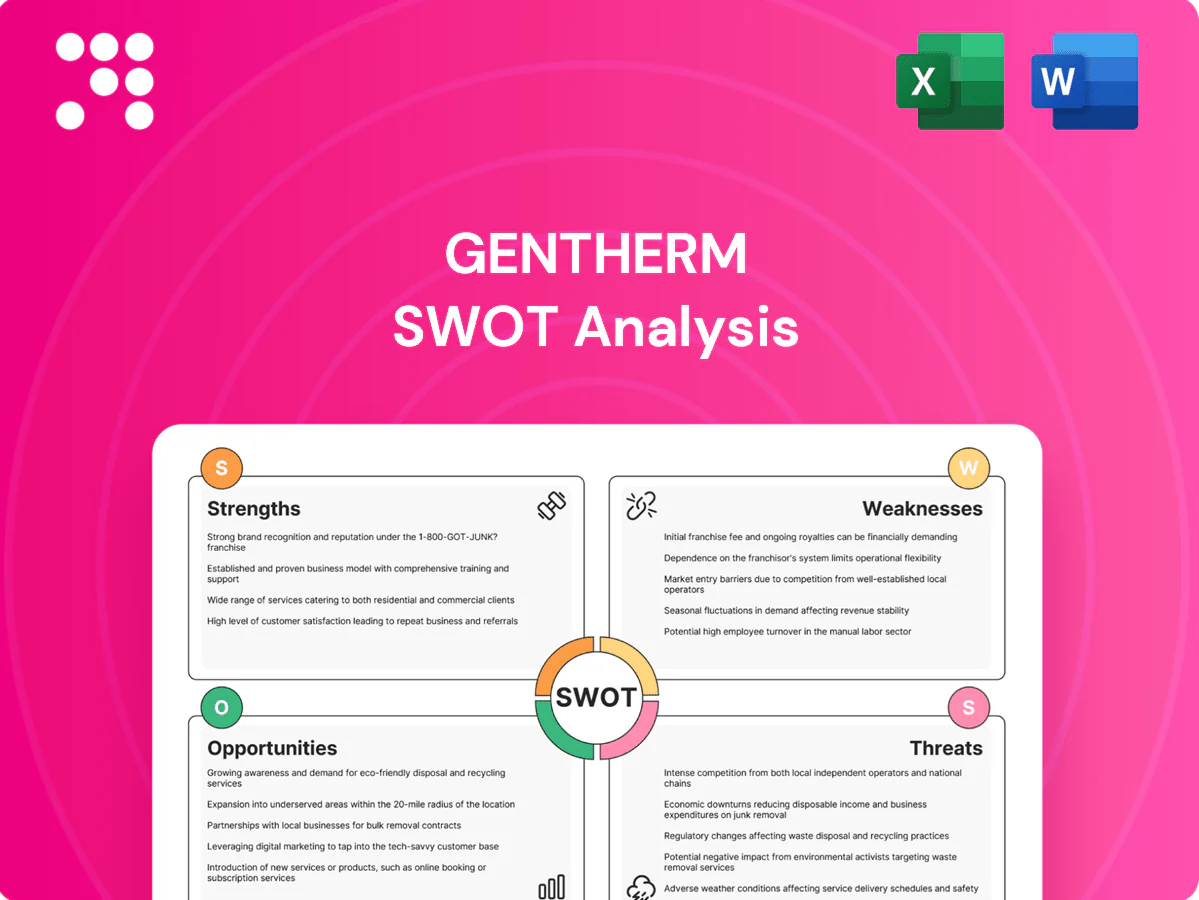
Gentherm SWOT Analysis

Go Beyond the Preview—Access the Full Strategic Report
Gentherm’s innovative thermal-management tech and automotive partnerships are clear strengths, while supply-chain exposure and EV market shifts pose real risks. Opportunities in climate control for EVs and medical devices could drive growth, yet competitive pressure and raw-material volatility threaten margins. Purchase the full SWOT analysis for a detailed, editable report and Excel tools to guide strategic or investment decisions.
Strengths

Thermal management expertise
With 30+ years of focused R&D, Gentherm has deep know-how in heating, cooling and ventilation at both component and system levels, enabling superior performance-to-weight and power-efficiency trade-offs. Their engineering depth supports rapid OEM customization and testing throughput, backed by strong IP holdings. In 2024 Gentherm reported roughly $1.3B in revenue, underscoring commercial scale and defensibility.
Strong automotive OEM integration
Gentherm’s thermal and comfort systems are embedded early in vehicle design cycles and secured on multi-year platforms, creating high switching costs and predictable, recurring revenue visibility. Proven quality and extensive validation credentials meet stringent OEM standards across powertrain and interior systems. Robust global program management and regional launch teams support synchronized rollouts across North America, Europe and Asia.

Diversified applications
Beyond automotive seats and interiors, Gentherm serves medical and industrial thermal-control markets, including patient warming and perioperative temperature management that tap into a global healthcare warming market exceeding $1 billion. This diversification reduces reliance on automotive cyclicality and broadens end-market exposure. Cross-industry learning speeds transfer of innovations from medical and industrial applications back into automotive products.

Energy efficiency and comfort focus
Gentherm's zonal and contact-based HVAC solutions enhance occupant comfort while lowering vehicle energy draw, a critical factor as cabin heating can cut EV range by up to 40% in cold conditions. By shifting load from central HVAC to seat and zone-level systems, Gentherm reduces HVAC energy use and helps OEMs meet tighter 2025/26 regulatory efficiency and sustainability targets. The value proposition supports premium per-vehicle content, aligning with Gentherm's ~ $1.4B annual revenue scale and EV supplier footprint.
- Comfort-driven efficiency
- Up to 40% EV range impact
- Zonal/contact HVAC lowers central load
- Supports OEM sustainability and premium content
Global manufacturing footprint
Gentherm operates a global manufacturing footprint with roughly 22 plants in 14 countries and ~6,600 employees (2024), allowing distributed plants and supplier networks to optimize cost, logistics, and localization while reducing lead times and currency/transport risk for near-customer operations.
- Distributed plants: lower logistics/costs
- Near-customer ops: shorter lead times, lower FX risk
- Scale: procurement leverage across $1.6B revenue (2024)
- Quality systems: consistent output across regions
Decades of thermal R&D power automotive and medical warming growth with recurring OEM programs
Gentherm’s 30+ years R&D and strong IP enable efficient zone/contact thermal systems; 2024 revenue ~ $1.3B, ~6,600 employees, 22 plants in 14 countries. Multi-year OEM programs create high switching costs and recurring content. Diversification into medical/industrial warming (> $1B market) reduces automotive cyclicality.
| Metric | 2024 |
|---|---|
| Revenue | $1.3B |
| Employees | 6,600 |
| Plants/Countries | 22/14 |
| EV range impact | up to 40% |
What is included in the product
 Detailed Word Document
Delivers a strategic overview of Gentherm’s internal capabilities and external market forces, outlining strengths, weaknesses, opportunities, and threats that shape its competitive position and future growth prospects.

 Customizable Excel Spreadsheet
Provides a focused SWOT matrix tailored to Gentherm for rapid identification of thermal-management strengths, weaknesses, opportunities, and threats, enabling faster strategic decisions and clear stakeholder alignment.
Weaknesses

Automotive concentration
In 2024 Gentherm remained heavily concentrated in automotive, with roughly three-quarters of revenue tied to vehicle production and platform programs; industry downturns or platform cancellations can therefore materially dent results. Medical and industrial segments remain smaller offsets today, increasing sensitivity to macro auto cycles and OEM volume/mix shifts.
Customer concentration
A limited number of large OEMs and tier-1 suppliers account for a significant portion of Gentherm’s sales, with the top 10 customers representing about 66% of net revenue in fiscal 2024. Pricing power is constrained by annual contract negotiations and competitive bidding, compressing margin upside. Loss of a key platform or OEM program would create a noticeable revenue gap. Active relationship management and timely program renewals are therefore critical to stability.

Margin pressure
Margin pressure is acute as rising commodity inputs, persistent labor inflation, and OEM cost-down demands squeeze operating margins and force price concessions. Frequent engineering changes raise launch costs and warranty exposure, while maintaining dual tooling and regional redundancy adds fixed overhead that depresses unit economics. Early-stage scaling in medical products often dilutes margins until volumes and process maturity improve.

High R&D and tooling needs
High R&D and tooling needs force sustained spending for thermal innovations, with lengthy validation cycles and capital-intensive tooling. Automotive suppliers averaged 4-6% of revenue on R&D in 2024, tying returns to platform longevity and creating long paybacks. Mis-reads of tech direction can strand assets and portfolio complexity raises engineering burden.
- R&D/tooling intensity — sustained capex and long validation
- Long paybacks — returns tied to platform life
- Technology risk — potential stranded assets
- Portfolio complexity — higher engineering costs
Limited consumer brand
As a B2B supplier Gentherm’s brand is rarely recognized by end users, constraining value capture to OEM packaging and options take-rates; FY2024 revenue was about $1.1bn, reflecting OEM-driven sales. That reliance limits pricing latitude versus branded consumer add-ons and leaves minimal marketing leverage to influence end-customer demand.
- OEM-dependent pricing
- Options take-rate sensitivity (typical 10–25% penetration)
- Low end-customer brand equity
Auto-reliant supplier: ~75% rev tied to OEM cycles; 66% top-customer risk
Gentherm remains highly auto-centric (~75% of FY2024 revenue), making results sensitive to OEM volume, platform cancellations and cyclicality.
Top 10 customers ~66% of net revenue in 2024, limiting pricing power and raising concentration risk; options take-rates (~10–25%) constrain upside.
R&D/tooling intensity (~5% of revenue) and long validation cycles create high capex and margin pressure, with technology/portfolio risk of stranded assets.
| Metric | 2024 |
|---|---|
| Revenue | $1.1bn |
| Auto exposure | ~75% |
| Top 10 customers | 66% |
| R&D (% rev) | ~5% |
| Options take-rate | 10–25% |
Full Version Awaits
Gentherm SWOT Analysis
This is the actual Gentherm SWOT analysis document you’ll receive upon purchase—no surprises, just professional quality. The preview below is taken directly from the full SWOT report you'll get; purchase unlocks the entire in-depth, editable version. Buy now to download the complete, ready-to-use file.

Original: $10.00
-65%$10.00
$3.50Product Information
Product Information
Shipping & Returns
Shipping & Returns
Description
Go Beyond the Preview—Access the Full Strategic Report
Gentherm’s innovative thermal-management tech and automotive partnerships are clear strengths, while supply-chain exposure and EV market shifts pose real risks. Opportunities in climate control for EVs and medical devices could drive growth, yet competitive pressure and raw-material volatility threaten margins. Purchase the full SWOT analysis for a detailed, editable report and Excel tools to guide strategic or investment decisions.
Strengths
Thermal management expertise
With 30+ years of focused R&D, Gentherm has deep know-how in heating, cooling and ventilation at both component and system levels, enabling superior performance-to-weight and power-efficiency trade-offs. Their engineering depth supports rapid OEM customization and testing throughput, backed by strong IP holdings. In 2024 Gentherm reported roughly $1.3B in revenue, underscoring commercial scale and defensibility.
Strong automotive OEM integration
Gentherm’s thermal and comfort systems are embedded early in vehicle design cycles and secured on multi-year platforms, creating high switching costs and predictable, recurring revenue visibility. Proven quality and extensive validation credentials meet stringent OEM standards across powertrain and interior systems. Robust global program management and regional launch teams support synchronized rollouts across North America, Europe and Asia.
Diversified applications
Beyond automotive seats and interiors, Gentherm serves medical and industrial thermal-control markets, including patient warming and perioperative temperature management that tap into a global healthcare warming market exceeding $1 billion. This diversification reduces reliance on automotive cyclicality and broadens end-market exposure. Cross-industry learning speeds transfer of innovations from medical and industrial applications back into automotive products.
Energy efficiency and comfort focus
Gentherm's zonal and contact-based HVAC solutions enhance occupant comfort while lowering vehicle energy draw, a critical factor as cabin heating can cut EV range by up to 40% in cold conditions. By shifting load from central HVAC to seat and zone-level systems, Gentherm reduces HVAC energy use and helps OEMs meet tighter 2025/26 regulatory efficiency and sustainability targets. The value proposition supports premium per-vehicle content, aligning with Gentherm's ~ $1.4B annual revenue scale and EV supplier footprint.
- Comfort-driven efficiency
- Up to 40% EV range impact
- Zonal/contact HVAC lowers central load
- Supports OEM sustainability and premium content
Global manufacturing footprint
Gentherm operates a global manufacturing footprint with roughly 22 plants in 14 countries and ~6,600 employees (2024), allowing distributed plants and supplier networks to optimize cost, logistics, and localization while reducing lead times and currency/transport risk for near-customer operations.
- Distributed plants: lower logistics/costs
- Near-customer ops: shorter lead times, lower FX risk
- Scale: procurement leverage across $1.6B revenue (2024)
- Quality systems: consistent output across regions
Decades of thermal R&D power automotive and medical warming growth with recurring OEM programs
Gentherm’s 30+ years R&D and strong IP enable efficient zone/contact thermal systems; 2024 revenue ~ $1.3B, ~6,600 employees, 22 plants in 14 countries. Multi-year OEM programs create high switching costs and recurring content. Diversification into medical/industrial warming (> $1B market) reduces automotive cyclicality.
| Metric | 2024 |
|---|---|
| Revenue | $1.3B |
| Employees | 6,600 |
| Plants/Countries | 22/14 |
| EV range impact | up to 40% |
What is included in the product
Detailed Word Document
Delivers a strategic overview of Gentherm’s internal capabilities and external market forces, outlining strengths, weaknesses, opportunities, and threats that shape its competitive position and future growth prospects.
Customizable Excel Spreadsheet
Provides a focused SWOT matrix tailored to Gentherm for rapid identification of thermal-management strengths, weaknesses, opportunities, and threats, enabling faster strategic decisions and clear stakeholder alignment.
Weaknesses
Automotive concentration
In 2024 Gentherm remained heavily concentrated in automotive, with roughly three-quarters of revenue tied to vehicle production and platform programs; industry downturns or platform cancellations can therefore materially dent results. Medical and industrial segments remain smaller offsets today, increasing sensitivity to macro auto cycles and OEM volume/mix shifts.
Customer concentration
A limited number of large OEMs and tier-1 suppliers account for a significant portion of Gentherm’s sales, with the top 10 customers representing about 66% of net revenue in fiscal 2024. Pricing power is constrained by annual contract negotiations and competitive bidding, compressing margin upside. Loss of a key platform or OEM program would create a noticeable revenue gap. Active relationship management and timely program renewals are therefore critical to stability.
Margin pressure
Margin pressure is acute as rising commodity inputs, persistent labor inflation, and OEM cost-down demands squeeze operating margins and force price concessions. Frequent engineering changes raise launch costs and warranty exposure, while maintaining dual tooling and regional redundancy adds fixed overhead that depresses unit economics. Early-stage scaling in medical products often dilutes margins until volumes and process maturity improve.
High R&D and tooling needs
High R&D and tooling needs force sustained spending for thermal innovations, with lengthy validation cycles and capital-intensive tooling. Automotive suppliers averaged 4-6% of revenue on R&D in 2024, tying returns to platform longevity and creating long paybacks. Mis-reads of tech direction can strand assets and portfolio complexity raises engineering burden.
- R&D/tooling intensity — sustained capex and long validation
- Long paybacks — returns tied to platform life
- Technology risk — potential stranded assets
- Portfolio complexity — higher engineering costs
Limited consumer brand
As a B2B supplier Gentherm’s brand is rarely recognized by end users, constraining value capture to OEM packaging and options take-rates; FY2024 revenue was about $1.1bn, reflecting OEM-driven sales. That reliance limits pricing latitude versus branded consumer add-ons and leaves minimal marketing leverage to influence end-customer demand.
- OEM-dependent pricing
- Options take-rate sensitivity (typical 10–25% penetration)
- Low end-customer brand equity
Auto-reliant supplier: ~75% rev tied to OEM cycles; 66% top-customer risk
Gentherm remains highly auto-centric (~75% of FY2024 revenue), making results sensitive to OEM volume, platform cancellations and cyclicality.
Top 10 customers ~66% of net revenue in 2024, limiting pricing power and raising concentration risk; options take-rates (~10–25%) constrain upside.
R&D/tooling intensity (~5% of revenue) and long validation cycles create high capex and margin pressure, with technology/portfolio risk of stranded assets.
| Metric | 2024 |
|---|---|
| Revenue | $1.1bn |
| Auto exposure | ~75% |
| Top 10 customers | 66% |
| R&D (% rev) | ~5% |
| Options take-rate | 10–25% |
Full Version Awaits
Gentherm SWOT Analysis
This is the actual Gentherm SWOT analysis document you’ll receive upon purchase—no surprises, just professional quality. The preview below is taken directly from the full SWOT report you'll get; purchase unlocks the entire in-depth, editable version. Buy now to download the complete, ready-to-use file.