Assicurazioni Generali PESTLE Analysis

Plan Smarter. Present Sharper. Compete Stronger.
Assicurazioni Generali faces regulatory shifts, economic volatility, and accelerating insurtech disruption that will reshape growth and risk exposure. Our PESTLE pinpoints political, social, technological and environmental drivers affecting strategy and capital allocation. Purchase the full analysis to access actionable insights and ready-to-use slides for decision-making.
Political factors

EU policy and supervision
EU regulatory priorities—across 27 member states—shape capital, product and conduct expectations that directly affect Generali, which operates in 50+ countries; EIOPA, established in 2011, issues guidance influencing pricing, solvency and cross‑border operations. Policy shifts on consumer protection or sustainability (EU net‑zero by 2050) can force strategic reallocation, so Generali must adapt quickly across multiple EU markets.
Geopolitical tensions and sanctions
Geopolitical conflicts and sanctions (EU: 11 packages on Russia since 2022) disrupt premiums, investment returns and claims patterns for Assicurazioni Generali, which operates in over 50 countries. Evolving sanction lists force rebalancing of asset exposures and tighter compliance; reinsurers’ pricing hardened (global reinsurance rates rose ~20% in 2023–24 per Aon), increasing costs and reserve prudence. Operations in affected regions require strict controls and enhanced reporting.

Healthcare and welfare reforms
Government healthcare policies shape demand for private health and life cover; Generali, operating in over 50 countries, sees national reforms materially affect sales mix and underwriting volumes.
Shifts toward expanded public provision can compress private growth, while coverage gaps — amid an EU population 65+ projected to reach ~30% by 2050 (Eurostat) — spur uptake of supplemental policies.
Tax incentives and fiscal changes alter product profitability and distribution; Generali continuously tailors offerings to each national policy landscape to preserve margins and market share.

Catastrophe risk public schemes
State-backed pools for nat-cat or terrorism in 20+ countries are reshaping underwriting roles by shifting first-loss layers to public backstops, altering Generali’s capital relief and pricing dynamics.
Participation terms—coverage caps, attachment points and premium-sharing—directly affect Generali’s retained risk and reinsurance spend, with public schemes sometimes covering up to full eligible losses.
Political will to expand or retract schemes changes expected risk retention; Generali calibrates reinsurance programs and product design accordingly to manage solvency and pricing volatility.
- 20+ countries: prevalence of state-backed nat-cat/terror pools
- Public schemes: can cover up to 100% of eligible losses
- Impact: shifts capital relief, pricing and reinsurance structure
Trade and investment policy
Changes in trade rules reshape cross-border distribution and asset allocation for Assicurazioni Generali; global FDI fell 12% to about $1.02 trillion in 2023 (UNCTAD), illustrating reduced cross-border flows. Market access in Asia or the Americas hinges on bilateral agreements and regulatory regimes; rising protectionism can slow expansion and capital mobility. Generali adapts distribution channels and portfolio tilts to prevailing policy regimes.
- Impact: FDI -12% (2023)
- Risk: protectionism limits expansion
- Response: align distribution & portfolio
EIOPA rules, +20% reinsurance rates and ~30% 65+ by 2050 reshape EU insurance landscape
EU regulation (EIOPA, est.2011) and 27-member rules drive capital, pricing and cross‑border conduct for Generali (50+ countries), while sanctions and geopolitical risk raised reinsurance rates ~+20% (2023–24). Aging EU pop 65+ ~30% by 2050 boosts supplemental demand; FDI fell −12% in 2023, constraining expansion.
| Metric | Value |
|---|---|
| Markets | 50+ |
| EIOPA | 2011 |
| Reinsurance rate change | +20% (2023–24) |
| FDI | −12% (2023) |
| EU 65+ (2050) | ~30% |
What is included in the product
 Detailed Word Document
Explores how macro-environmental factors uniquely impact Assicurazioni Generali across Political, Economic, Social, Technological, Environmental and Legal dimensions, with data-backed trends and forward-looking insights to inform scenario planning. Designed for executives and advisors to identify strategic threats, opportunities and actionable responses tailored to the insurer’s region and market.

 Customizable Excel Spreadsheet
Condensed PESTLE insights on Assicurazioni Generali, neatly segmented for quick reference in meetings or presentations to streamline external risk discussions and market-positioning decisions.
Economic factors

Interest rate cycle
Interest rate levels drive life liability discounting and investment income for Generali: rising euro area yields since 2023 have boosted reinvestment returns but raise stress on legacy guaranteed products. Duration gaps and strict ALM discipline are critical to absorb repricing risk. Generali actively manages credit spreads while keeping Solvency II ratio around 220% (H1 2024) to protect capital.
Inflation and claims severity
High inflation has pushed motor and property repair costs into double-digit territory in several markets, while medical inflation running roughly 3–5 percentage points above headline CPI has driven higher health claims. Pricing and reserving must be adjusted quarterly to prevent margin erosion; Generali increasingly uses reinsurance and indexation clauses to dampen volatility and protect combined ratios.

Growth and employment trends
Premium growth for Assicurazioni Generali closely follows GDP and household income, with group gross written premiums near €75bn in 2023 and modest growth into 2024. Rising unemployment — eurozone rate ~6.5% in 2024 — weakens new business and persistency, especially in protection lines. Corporate coverage demand fluctuates with business cycles; Generali offsets volatility via product, geographic and channel diversification to stabilize flows.

Market volatility and AUM
Market volatility compresses Assicurazioni Generali fee income because asset management fees scale with AUM and performance; Generali reported roughly EUR 620bn in AUM in 2024, making fee sensitivity material to group revenue.
Equity and credit swings have pressured fee revenue and capital buffers in 2023–24, prompting flight-to-quality moves that reshape duration and credit exposure across portfolios.
Generali actively balances client mandates with solvency constraints, adjusting risk budgets and liquidity to protect SCR ratios while preserving mandate returns.
- AUM: EUR 620bn (2024)
- Fee linkage: performance + AUM-driven
- Risk actions: flight-to-quality, solvency-focused rebalancing
FX movements
Assicurazioni Generali, operating in over 50 countries with around 70,000 employees, faces translation and transaction FX risk across multi-currency operations; currency swings can alter reported capital, premiums and claims costs. The group uses targeted hedging policies and ALM strategies to protect solvency and earnings volatility. Product pricing and technical reserves are adjusted to local currencies to limit mismatch and preserve margins.
- FX exposure: multi-currency operations, 50+ markets
- Impact: affects capital, premiums, claims costs
- Mitigation: hedging policies, ALM
- Pricing: local-currency-aligned pricing and reserves
EIOPA rules, +20% reinsurance rates and ~30% 65+ by 2050 reshape EU insurance landscape
Interest rates and yield recovery since 2023 improved investment income but stress legacy guaranteed life products; strict ALM and duration management remain vital as Solvency II ~220% (H1 2024). Inflation drove double-digit motor/property repair costs and medical inflation ~+3–5pp, forcing frequent repricing and reinsurance. GWP ~€75bn (2023) and AUM €620bn (2024) make fee and market volatility material; eurozone unemployment ~6.5% (2024) pressures new business and persistency.
| Metric | Value (latest) |
|---|---|
| Solvency II ratio | ~220% (H1 2024) |
| Gross written premiums | €75bn (2023) |
| AUM | €620bn (2024) |
| Eurozone unemployment | ~6.5% (2024) |
| Medical inflation vs CPI | +3–5 pp |
Preview Before You Purchase
Assicurazioni Generali PESTLE Analysis
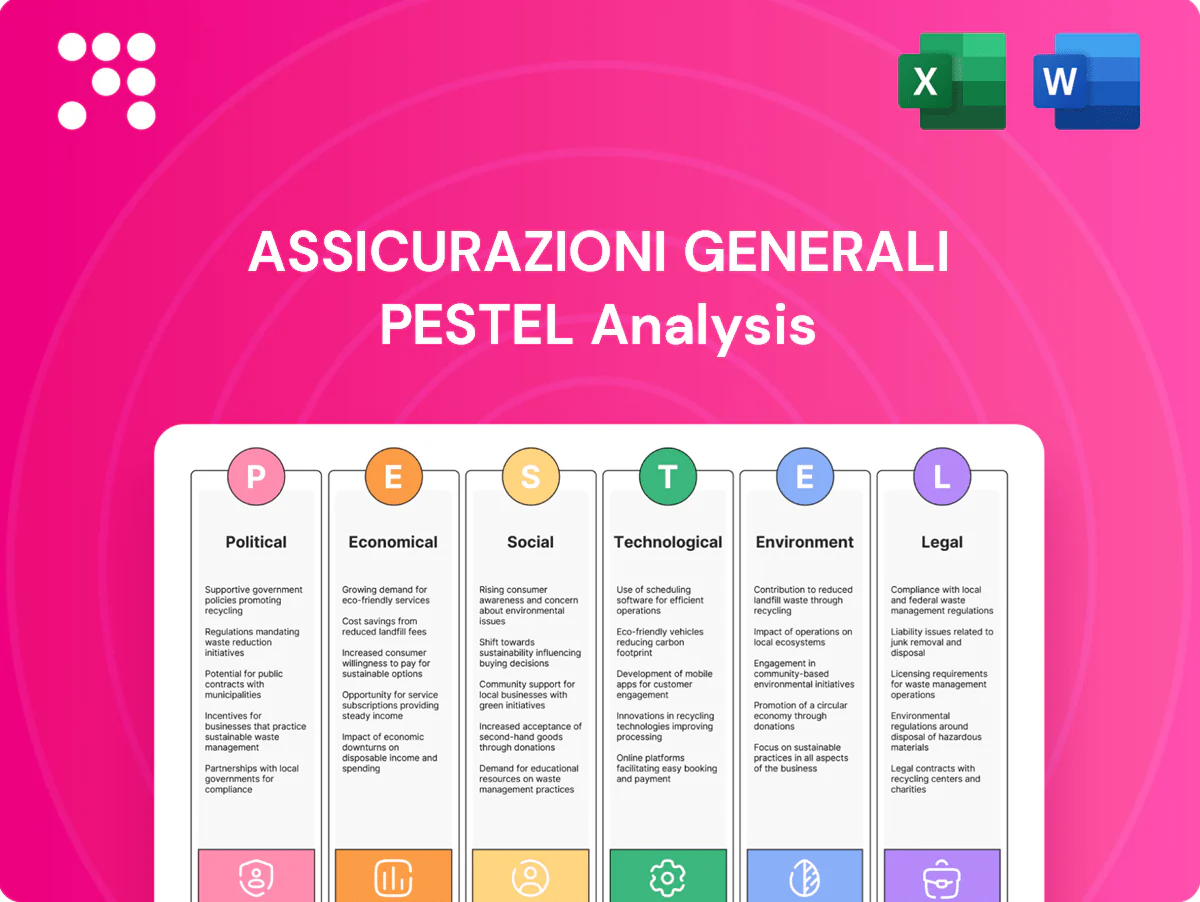
This Assicurazioni Generali PESTLE Analysis provides a concise review of political, economic, social, technological, legal and environmental factors affecting the insurer. The preview shown here is the exact document you’ll receive after purchase—fully formatted and ready to use. It contains actionable insights and structured findings for strategic decision-making.

Original: $10.00
-65%$10.00
$3.50Product Information
Product Information
Shipping & Returns
Shipping & Returns
Description
Plan Smarter. Present Sharper. Compete Stronger.
Assicurazioni Generali faces regulatory shifts, economic volatility, and accelerating insurtech disruption that will reshape growth and risk exposure. Our PESTLE pinpoints political, social, technological and environmental drivers affecting strategy and capital allocation. Purchase the full analysis to access actionable insights and ready-to-use slides for decision-making.
Political factors
EU policy and supervision
EU regulatory priorities—across 27 member states—shape capital, product and conduct expectations that directly affect Generali, which operates in 50+ countries; EIOPA, established in 2011, issues guidance influencing pricing, solvency and cross‑border operations. Policy shifts on consumer protection or sustainability (EU net‑zero by 2050) can force strategic reallocation, so Generali must adapt quickly across multiple EU markets.
Geopolitical tensions and sanctions
Geopolitical conflicts and sanctions (EU: 11 packages on Russia since 2022) disrupt premiums, investment returns and claims patterns for Assicurazioni Generali, which operates in over 50 countries. Evolving sanction lists force rebalancing of asset exposures and tighter compliance; reinsurers’ pricing hardened (global reinsurance rates rose ~20% in 2023–24 per Aon), increasing costs and reserve prudence. Operations in affected regions require strict controls and enhanced reporting.
Healthcare and welfare reforms
Government healthcare policies shape demand for private health and life cover; Generali, operating in over 50 countries, sees national reforms materially affect sales mix and underwriting volumes.
Shifts toward expanded public provision can compress private growth, while coverage gaps — amid an EU population 65+ projected to reach ~30% by 2050 (Eurostat) — spur uptake of supplemental policies.
Tax incentives and fiscal changes alter product profitability and distribution; Generali continuously tailors offerings to each national policy landscape to preserve margins and market share.
Catastrophe risk public schemes
State-backed pools for nat-cat or terrorism in 20+ countries are reshaping underwriting roles by shifting first-loss layers to public backstops, altering Generali’s capital relief and pricing dynamics.
Participation terms—coverage caps, attachment points and premium-sharing—directly affect Generali’s retained risk and reinsurance spend, with public schemes sometimes covering up to full eligible losses.
Political will to expand or retract schemes changes expected risk retention; Generali calibrates reinsurance programs and product design accordingly to manage solvency and pricing volatility.
- 20+ countries: prevalence of state-backed nat-cat/terror pools
- Public schemes: can cover up to 100% of eligible losses
- Impact: shifts capital relief, pricing and reinsurance structure
Trade and investment policy
Changes in trade rules reshape cross-border distribution and asset allocation for Assicurazioni Generali; global FDI fell 12% to about $1.02 trillion in 2023 (UNCTAD), illustrating reduced cross-border flows. Market access in Asia or the Americas hinges on bilateral agreements and regulatory regimes; rising protectionism can slow expansion and capital mobility. Generali adapts distribution channels and portfolio tilts to prevailing policy regimes.
- Impact: FDI -12% (2023)
- Risk: protectionism limits expansion
- Response: align distribution & portfolio
EIOPA rules, +20% reinsurance rates and ~30% 65+ by 2050 reshape EU insurance landscape
EU regulation (EIOPA, est.2011) and 27-member rules drive capital, pricing and cross‑border conduct for Generali (50+ countries), while sanctions and geopolitical risk raised reinsurance rates ~+20% (2023–24). Aging EU pop 65+ ~30% by 2050 boosts supplemental demand; FDI fell −12% in 2023, constraining expansion.
| Metric | Value |
|---|---|
| Markets | 50+ |
| EIOPA | 2011 |
| Reinsurance rate change | +20% (2023–24) |
| FDI | −12% (2023) |
| EU 65+ (2050) | ~30% |
What is included in the product
Detailed Word Document
Explores how macro-environmental factors uniquely impact Assicurazioni Generali across Political, Economic, Social, Technological, Environmental and Legal dimensions, with data-backed trends and forward-looking insights to inform scenario planning. Designed for executives and advisors to identify strategic threats, opportunities and actionable responses tailored to the insurer’s region and market.
Customizable Excel Spreadsheet
Condensed PESTLE insights on Assicurazioni Generali, neatly segmented for quick reference in meetings or presentations to streamline external risk discussions and market-positioning decisions.
Economic factors
Interest rate cycle
Interest rate levels drive life liability discounting and investment income for Generali: rising euro area yields since 2023 have boosted reinvestment returns but raise stress on legacy guaranteed products. Duration gaps and strict ALM discipline are critical to absorb repricing risk. Generali actively manages credit spreads while keeping Solvency II ratio around 220% (H1 2024) to protect capital.
Inflation and claims severity
High inflation has pushed motor and property repair costs into double-digit territory in several markets, while medical inflation running roughly 3–5 percentage points above headline CPI has driven higher health claims. Pricing and reserving must be adjusted quarterly to prevent margin erosion; Generali increasingly uses reinsurance and indexation clauses to dampen volatility and protect combined ratios.
Growth and employment trends
Premium growth for Assicurazioni Generali closely follows GDP and household income, with group gross written premiums near €75bn in 2023 and modest growth into 2024. Rising unemployment — eurozone rate ~6.5% in 2024 — weakens new business and persistency, especially in protection lines. Corporate coverage demand fluctuates with business cycles; Generali offsets volatility via product, geographic and channel diversification to stabilize flows.
Market volatility and AUM
Market volatility compresses Assicurazioni Generali fee income because asset management fees scale with AUM and performance; Generali reported roughly EUR 620bn in AUM in 2024, making fee sensitivity material to group revenue.
Equity and credit swings have pressured fee revenue and capital buffers in 2023–24, prompting flight-to-quality moves that reshape duration and credit exposure across portfolios.
Generali actively balances client mandates with solvency constraints, adjusting risk budgets and liquidity to protect SCR ratios while preserving mandate returns.
- AUM: EUR 620bn (2024)
- Fee linkage: performance + AUM-driven
- Risk actions: flight-to-quality, solvency-focused rebalancing
FX movements
Assicurazioni Generali, operating in over 50 countries with around 70,000 employees, faces translation and transaction FX risk across multi-currency operations; currency swings can alter reported capital, premiums and claims costs. The group uses targeted hedging policies and ALM strategies to protect solvency and earnings volatility. Product pricing and technical reserves are adjusted to local currencies to limit mismatch and preserve margins.
- FX exposure: multi-currency operations, 50+ markets
- Impact: affects capital, premiums, claims costs
- Mitigation: hedging policies, ALM
- Pricing: local-currency-aligned pricing and reserves
EIOPA rules, +20% reinsurance rates and ~30% 65+ by 2050 reshape EU insurance landscape
Interest rates and yield recovery since 2023 improved investment income but stress legacy guaranteed life products; strict ALM and duration management remain vital as Solvency II ~220% (H1 2024). Inflation drove double-digit motor/property repair costs and medical inflation ~+3–5pp, forcing frequent repricing and reinsurance. GWP ~€75bn (2023) and AUM €620bn (2024) make fee and market volatility material; eurozone unemployment ~6.5% (2024) pressures new business and persistency.
| Metric | Value (latest) |
|---|---|
| Solvency II ratio | ~220% (H1 2024) |
| Gross written premiums | €75bn (2023) |
| AUM | €620bn (2024) |
| Eurozone unemployment | ~6.5% (2024) |
| Medical inflation vs CPI | +3–5 pp |
Preview Before You Purchase
Assicurazioni Generali PESTLE Analysis
This Assicurazioni Generali PESTLE Analysis provides a concise review of political, economic, social, technological, legal and environmental factors affecting the insurer. The preview shown here is the exact document you’ll receive after purchase—fully formatted and ready to use. It contains actionable insights and structured findings for strategic decision-making.