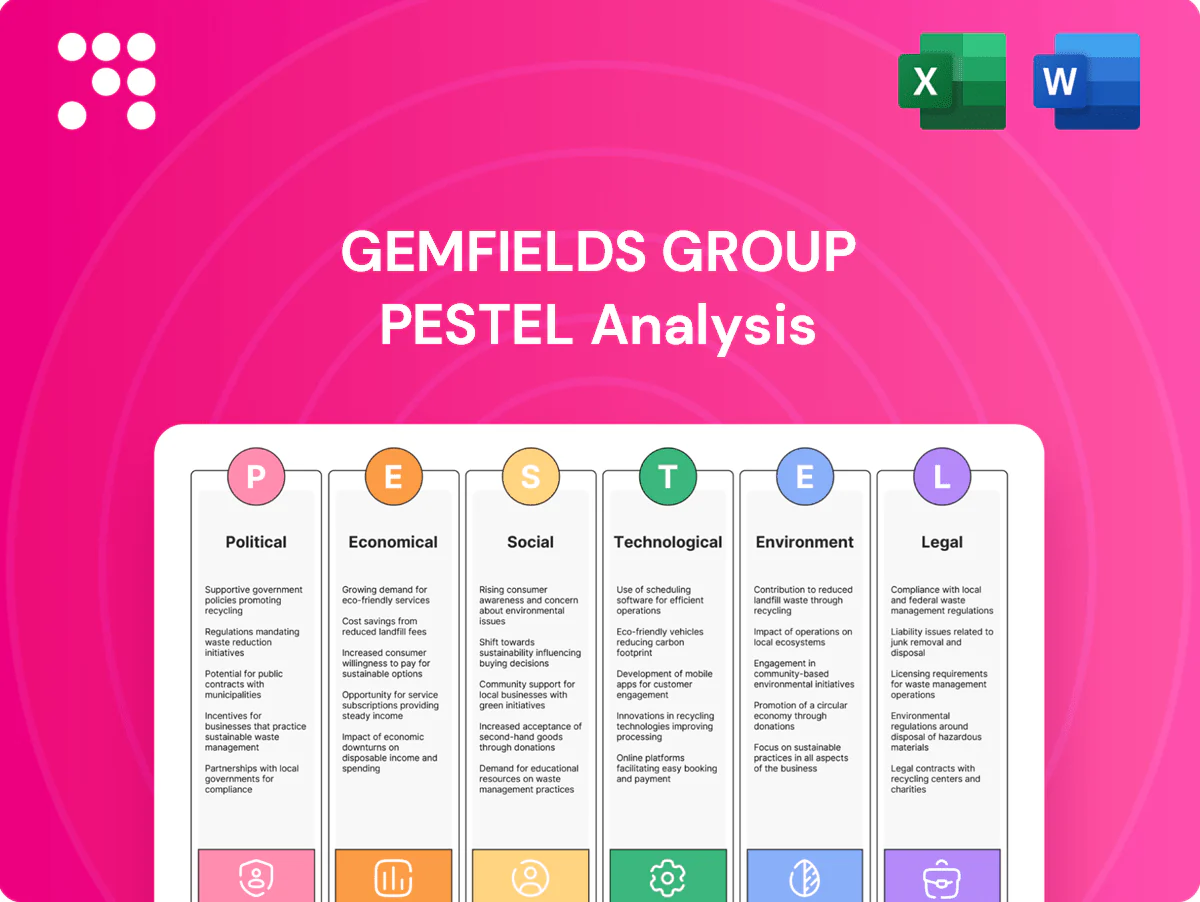
Gemfields Group PESTLE Analysis

Your Competitive Advantage Starts with This Report
Unlock strategic clarity with our PESTLE Analysis of Gemfields Group — three to five sentence snapshot won’t cut it: this report maps political, economic, social, technological, legal and environmental forces shaping value and risk. Ideal for investors and strategists, it’s fully sourced and ready to act on. Purchase the full analysis now to get the detailed insights that drive smarter decisions.
Political factors

Regulatory stability in Zambia
Zambia’s mining policy direction, royalty rates and fiscal regime directly affect Kagem’s profitability and investment cadence; shifts between investor-friendly and resource-nationalist stances can change capex timing and mine plans, increasing NPV risk. Consistent engagement with ministries and ZCCM-IH helps anticipate policy updates. Scenario planning should include royalty and withholding-tax sensitivities of +/-2 percentage points to stress test returns.
Mozambique security dynamics
Operations around Montepuez in Cabo Delgado, where Gemfields holds a 75% stake in Montepuez Ruby Mining, face periodic insurgency that has displaced over 800,000 people since 2017 and risks disrupting logistics and workforce mobility. Coordinated security frameworks with Mozambican authorities and post-2021 Rwandan/SADC deployments are critical to maintain continuity. Insurance and contingency stockpiles must reflect residual risk, and sustained community trust-building reduces insurgent recruitment.

Resource nationalism and royalties
Resource nationalism across Gemfields’ jurisdictions, notably at its Kagem emerald mine in Zambia and Montepuez ruby operations in Mozambique, can drive higher royalties, stricter local content rules and beneficiation mandates that compress project IRRs and shift capital allocation among deposits.
Active engagement in policy consultations—Gemfields has previously participated in national stakeholder forums—can help moderate regulatory outcomes and timing.
Consistent, transparent reporting on payments, community investment and environmental performance strengthens social and political license to operate and reduces risk of abrupt fiscal changes.

Government relations & state partners
Partnerships with state-linked entities shape governance, dividend flows and disclosure expectations at Gemfields, with alignment on ESG outcomes critical to maintaining legitimacy and operating continuity amid host-country scrutiny.
Regular joint committees help pre-empt disputes over production targets and capex, while clear shareholder agreements reduce the risk of political interference and protect minority rights.
- Governance: state partners influence reporting cadence and approvals
- ESG: joint targets underpin social licence to operate
- Committees: reduce dispute risk on production/capex
- Agreements: limit political intervention
Trade policy and export controls
Export permitting, valuation rules and customs processes directly set shipment cadence and auction timing for Gemfields, especially at Montepuez, one of the world’s largest ruby operations, causing working capital cycles to lengthen when clearances delay sales. Changes to tariff regimes or gemstone export rules can strain cashflow; diplomatic shifts affect market access to key buyers in India, China and the US. Proactive compliance and robust documentation shorten clearances and protect auction schedules.
- Export permits determine auction cadence
- Valuation/customs impact working capital
- Diplomacy alters access to India/China/US
- Compliance speeds clearances
Zambia royalty swings and Cabo Delgado instability strain mine cashflow and NPV
Political risks: Zambia fiscal shifts and royalty swings (stress-test +/-2 percentage points) directly affect Kagem cashflow and NPV. Montepuez faces Cabo Delgado instability (>800,000 displaced since 2017) and requires state security coordination. State partners (Kagem joint-venture) and export rules shape auction cadence and working-capital timing.
| Issue | Metric | Impact |
|---|---|---|
| Montepuez stake | 75% | Operational control/returns |
| Displacement | >800,000 | Logistics/security |
| Royalty sensitivity | +/-2pp | NPV/IRR stress |
What is included in the product
 Detailed Word Document
Provides a concise PESTLE evaluation of how political, economic, social, technological, environmental, and legal forces uniquely shape Gemfields Group’s colored gemstone mining, trading, and marketing operations. Each dimension links current data and trends to practical risks, opportunities, and forward-looking implications for strategy and investor decisions.

 Customizable Excel Spreadsheet
Concise PESTLE summary of Gemfields Group that highlights regulatory, environmental, market and geopolitical risks for quick reference in meetings or presentations, easily shareable and editable for regional or business-line notes.
Economic factors

Gemstone demand cycles
Colored gemstone demand tracks luxury consumption and jewelry trends; Bain reported the personal luxury goods market plunged about 23% in 2020, illustrating sensitivity to macro cycles. Macro slowdowns commonly defer wholesale buying and soften auction realizations, as seen during 2020. Targeted marketing to diversify end-markets and strict inventory discipline help preserve pricing power in downturns.
USD pricing & FX volatility
Rubies and emeralds are largely USD-priced while operating costs accrue in ZMW and MZN, producing translation gains and losses that directly affect reported margins and cash-flow forecasting; recent years have seen elevated FX volatility in Zambia and Mozambique, increasing planning uncertainty. Robust hedging policies and natural revenue-cost offsets (USD sales vs local currency costs) help stabilize cash flows and preserve margin, but stress tests must include multi-currency shock scenarios to quantify tail risks.

Auction model & price discovery
Periodic auctions (typically quarterly) drive realized pricing and rapid working-capital release for Gemfields, underpinning cashflow timing. Auction cadence, lot mix and buyer attendance materially influence revenue volatility, often producing double-digit swings in realized prices. In 2024 Gemfields expanded digital and hybrid auctions to broaden participation and deepen liquidity, while data-driven lot curation improved yield per carat.

Cost inflation & supply chain
Diesel, explosives, reagents and security costs for Gemfields are highly sensitive to global inflation (IMF global inflation ~6.8% in 2024) and regional logistics; diesel and security premiums in Southern Africa rose double digits in 2024, while port congestion and remote-site premiums can add 10–30% to landed cost.
- Multi-sourcing/local supplier development — lowers exposure to 30–40% price spikes
- Port congestion — increases lead times and landed cost by ~10–25%
- Preventive maintenance — can cut unplanned downtime costs by up to 25–30%
Artisanal competition & market supply
Artisanal mining introduces untracked supply that can destabilize pricing; ILO estimates 40.5 million artisanal miners worldwide (2020), underscoring scale and grey-market risk.
Gemfields' formalization and community engagement programs (expanded 2022–24) aim to curb illegal extraction and smuggling, while industrial output delivers consistent quality that supports premium positioning.
Ongoing market intelligence efforts help anticipate grey-market flows and protect auction pricing and brand integrity.
- ILO 40.5M artisanal miners (2020)
- Formalization programs expanded 2022–24
- Industrial output = consistent premium quality
- Market intelligence mitigates grey-market impact
Zambia royalty swings and Cabo Delgado instability strain mine cashflow and NPV
Colored-gem demand tracks luxury cycles; auctions (quarterly) create double-digit realized-price volatility. Currency mismatches (USD revenue vs ZMW/MZN costs) and 2024 FX/energy shocks elevated planning risk. Operational cost inflation (diesel/security +10–20% in 2024) and artisanal supply (ILO 40.5M) are key tail risks mitigated by formalization and hedging.
| Metric | 2024 | Impact |
|---|---|---|
| Global inflation (IMF) | 6.8% | input cost pressure |
| Artisanal miners (ILO) | 40.5M | grey-market supply |
| Diesel/security | +10–20% | higher Opex |
| Auction cadence | Quarterly | revenue volatility |
Preview Before You Purchase
Gemfields Group PESTLE Analysis
This Gemfields Group PESTLE Analysis provides a concise, professional assessment of political, economic, social, technological, legal and environmental factors affecting the company. The preview shown here is the exact document you’ll receive after purchase—fully formatted and ready to use. Use it immediately for strategic planning, investment assessment, or academic work.

Product Information
Product Information
Shipping & Returns
Shipping & Returns
Description
Your Competitive Advantage Starts with This Report
Unlock strategic clarity with our PESTLE Analysis of Gemfields Group — three to five sentence snapshot won’t cut it: this report maps political, economic, social, technological, legal and environmental forces shaping value and risk. Ideal for investors and strategists, it’s fully sourced and ready to act on. Purchase the full analysis now to get the detailed insights that drive smarter decisions.
Political factors
Regulatory stability in Zambia
Zambia’s mining policy direction, royalty rates and fiscal regime directly affect Kagem’s profitability and investment cadence; shifts between investor-friendly and resource-nationalist stances can change capex timing and mine plans, increasing NPV risk. Consistent engagement with ministries and ZCCM-IH helps anticipate policy updates. Scenario planning should include royalty and withholding-tax sensitivities of +/-2 percentage points to stress test returns.
Mozambique security dynamics
Operations around Montepuez in Cabo Delgado, where Gemfields holds a 75% stake in Montepuez Ruby Mining, face periodic insurgency that has displaced over 800,000 people since 2017 and risks disrupting logistics and workforce mobility. Coordinated security frameworks with Mozambican authorities and post-2021 Rwandan/SADC deployments are critical to maintain continuity. Insurance and contingency stockpiles must reflect residual risk, and sustained community trust-building reduces insurgent recruitment.
Resource nationalism and royalties
Resource nationalism across Gemfields’ jurisdictions, notably at its Kagem emerald mine in Zambia and Montepuez ruby operations in Mozambique, can drive higher royalties, stricter local content rules and beneficiation mandates that compress project IRRs and shift capital allocation among deposits.
Active engagement in policy consultations—Gemfields has previously participated in national stakeholder forums—can help moderate regulatory outcomes and timing.
Consistent, transparent reporting on payments, community investment and environmental performance strengthens social and political license to operate and reduces risk of abrupt fiscal changes.
Government relations & state partners
Partnerships with state-linked entities shape governance, dividend flows and disclosure expectations at Gemfields, with alignment on ESG outcomes critical to maintaining legitimacy and operating continuity amid host-country scrutiny.
Regular joint committees help pre-empt disputes over production targets and capex, while clear shareholder agreements reduce the risk of political interference and protect minority rights.
- Governance: state partners influence reporting cadence and approvals
- ESG: joint targets underpin social licence to operate
- Committees: reduce dispute risk on production/capex
- Agreements: limit political intervention
Trade policy and export controls
Export permitting, valuation rules and customs processes directly set shipment cadence and auction timing for Gemfields, especially at Montepuez, one of the world’s largest ruby operations, causing working capital cycles to lengthen when clearances delay sales. Changes to tariff regimes or gemstone export rules can strain cashflow; diplomatic shifts affect market access to key buyers in India, China and the US. Proactive compliance and robust documentation shorten clearances and protect auction schedules.
- Export permits determine auction cadence
- Valuation/customs impact working capital
- Diplomacy alters access to India/China/US
- Compliance speeds clearances
Zambia royalty swings and Cabo Delgado instability strain mine cashflow and NPV
Political risks: Zambia fiscal shifts and royalty swings (stress-test +/-2 percentage points) directly affect Kagem cashflow and NPV. Montepuez faces Cabo Delgado instability (>800,000 displaced since 2017) and requires state security coordination. State partners (Kagem joint-venture) and export rules shape auction cadence and working-capital timing.
| Issue | Metric | Impact |
|---|---|---|
| Montepuez stake | 75% | Operational control/returns |
| Displacement | >800,000 | Logistics/security |
| Royalty sensitivity | +/-2pp | NPV/IRR stress |
What is included in the product
Detailed Word Document
Provides a concise PESTLE evaluation of how political, economic, social, technological, environmental, and legal forces uniquely shape Gemfields Group’s colored gemstone mining, trading, and marketing operations. Each dimension links current data and trends to practical risks, opportunities, and forward-looking implications for strategy and investor decisions.
Customizable Excel Spreadsheet
Concise PESTLE summary of Gemfields Group that highlights regulatory, environmental, market and geopolitical risks for quick reference in meetings or presentations, easily shareable and editable for regional or business-line notes.
Economic factors
Gemstone demand cycles
Colored gemstone demand tracks luxury consumption and jewelry trends; Bain reported the personal luxury goods market plunged about 23% in 2020, illustrating sensitivity to macro cycles. Macro slowdowns commonly defer wholesale buying and soften auction realizations, as seen during 2020. Targeted marketing to diversify end-markets and strict inventory discipline help preserve pricing power in downturns.
USD pricing & FX volatility
Rubies and emeralds are largely USD-priced while operating costs accrue in ZMW and MZN, producing translation gains and losses that directly affect reported margins and cash-flow forecasting; recent years have seen elevated FX volatility in Zambia and Mozambique, increasing planning uncertainty. Robust hedging policies and natural revenue-cost offsets (USD sales vs local currency costs) help stabilize cash flows and preserve margin, but stress tests must include multi-currency shock scenarios to quantify tail risks.
Auction model & price discovery
Periodic auctions (typically quarterly) drive realized pricing and rapid working-capital release for Gemfields, underpinning cashflow timing. Auction cadence, lot mix and buyer attendance materially influence revenue volatility, often producing double-digit swings in realized prices. In 2024 Gemfields expanded digital and hybrid auctions to broaden participation and deepen liquidity, while data-driven lot curation improved yield per carat.
Cost inflation & supply chain
Diesel, explosives, reagents and security costs for Gemfields are highly sensitive to global inflation (IMF global inflation ~6.8% in 2024) and regional logistics; diesel and security premiums in Southern Africa rose double digits in 2024, while port congestion and remote-site premiums can add 10–30% to landed cost.
- Multi-sourcing/local supplier development — lowers exposure to 30–40% price spikes
- Port congestion — increases lead times and landed cost by ~10–25%
- Preventive maintenance — can cut unplanned downtime costs by up to 25–30%
Artisanal competition & market supply
Artisanal mining introduces untracked supply that can destabilize pricing; ILO estimates 40.5 million artisanal miners worldwide (2020), underscoring scale and grey-market risk.
Gemfields' formalization and community engagement programs (expanded 2022–24) aim to curb illegal extraction and smuggling, while industrial output delivers consistent quality that supports premium positioning.
Ongoing market intelligence efforts help anticipate grey-market flows and protect auction pricing and brand integrity.
- ILO 40.5M artisanal miners (2020)
- Formalization programs expanded 2022–24
- Industrial output = consistent premium quality
- Market intelligence mitigates grey-market impact
Zambia royalty swings and Cabo Delgado instability strain mine cashflow and NPV
Colored-gem demand tracks luxury cycles; auctions (quarterly) create double-digit realized-price volatility. Currency mismatches (USD revenue vs ZMW/MZN costs) and 2024 FX/energy shocks elevated planning risk. Operational cost inflation (diesel/security +10–20% in 2024) and artisanal supply (ILO 40.5M) are key tail risks mitigated by formalization and hedging.
| Metric | 2024 | Impact |
|---|---|---|
| Global inflation (IMF) | 6.8% | input cost pressure |
| Artisanal miners (ILO) | 40.5M | grey-market supply |
| Diesel/security | +10–20% | higher Opex |
| Auction cadence | Quarterly | revenue volatility |
Preview Before You Purchase
Gemfields Group PESTLE Analysis
This Gemfields Group PESTLE Analysis provides a concise, professional assessment of political, economic, social, technological, legal and environmental factors affecting the company. The preview shown here is the exact document you’ll receive after purchase—fully formatted and ready to use. Use it immediately for strategic planning, investment assessment, or academic work.