Gemdale PESTLE Analysis

Your Competitive Advantage Starts with This Report
Our PESTLE analysis of Gemdale highlights the political, economic, social, technological, legal and environmental forces shaping its real estate trajectory, revealing regulatory risks and growth levers investors need to know. Use these insights to refine strategy and spot opportunities—buy the full, downloadable PESTLE report for a complete, actionable breakdown.
Political factors

Central housing policy direction
Beijing’s long-standing slogan since 2016 that housing is for living, not speculation continues to constrain pricing, sales pace and marketing latitude for developers. Easing and tightening cycles in 2023–24—including targeted mortgage relief and regulatory nudges—have shown demand can swing rapidly. Gemdale must align product mix and inventory strategy with shifting central guidance. Close government engagement is essential to anticipate adjustments.
Land supply and auction reforms
Centralized land release schedules and online auctions tighten timing and pricing, with floor-price rules directly setting input costs and city exposure; Gemdale (HK 0535 / SSE 600383) faces concentration risk when fewer, larger auctions compress bidding windows. Larger auction blocks can strain cashflow and raise project-city concentration; Gemdale’s pipeline depends on securing quality parcels at sustainable prices, so partnerships and disciplined bidding are used to mitigate volatility.

Local government fiscal health
Local government fiscal health matters for Gemdale because urban investment and approvals remain tied to land-sale proceeds, which account for about 25% of Chinese local fiscal revenue; shocks to that stream heighten permit and delivery delays. Fiscal stress is evident: special local government bond issuance reached 3.65 trillion RMB in 2023 while hidden LGFV debt stood near 64.5 trillion RMB, so city selection must weigh municipal credit; diversifying across tiers reduces policy and execution risk.

State support and stabilization tools
State liquidity facilities, white-list financing and guaranteed pre-sale completion programs expanded in 2024, improving access to funding for accredited developers and lowering market borrowing spreads for top-tier firms; Gemdale’s strong compliance and credit standing improved eligibility and allowed swift take-up of support, enhancing cashflow resilience and preserving project delivery.
- State schemes expanded in 2024
- White-list access prioritizes quality developers
- Gemdale compliance boosts eligibility
- Swift participation reduces funding stress
Geopolitical and macro policy shifts
External geopolitical tensions can drive intermittent capital outflows and weaken investor sentiment toward Chinese real estate; 1-year LPR held at 3.45% through 2024, leaving monetary room for targeted easing to support developers and buyers.
Macro easing via RRR cuts and targeted credit increases affordability; tightening reverses that effect, so Gemdale’s treasury must actively hedge FX and rate risks and maintain transparent communication to sustain market confidence.
- Impact: capital flows, FX volatility
- Policy lever: RRR/targeted credit
- Rate marker: 1yr LPR 3.45% (2024)
- Action: hedge FX/rates; disclose regularly
Beijing housing-for-living rules and land-floor prices reshape developer sales and funding
Beijing policy of housing-for-living, land-auction floor prices and local fiscal stress shape Gemdale’s sales, bidding and delivery; targeted 2023–24 support improved funding access for compliant developers. Key metrics: 1yr LPR 3.45% (2024), local land revenue ~25% of fiscal, 2023 SLB 3.65trn RMB, LGFV debt ~64.5trn RMB.
| Factor | Metric | Value |
|---|---|---|
| Monetary | 1yr LPR | 3.45% (2024) |
| Local fiscal | Land revenue share | ~25% |
| Credit | 2023 SLB / LGFV debt | 3.65trn / 64.5trn RMB |
What is included in the product
 Detailed Word Document
Explores how external macro-environmental factors uniquely affect the Gemdale across six dimensions—Political, Economic, Social, Technological, Environmental, and Legal—backed by current data and trends to identify threats and opportunities. Designed for executives and investors, it delivers forward-looking insights and practical examples tailored to the region and industry.

 Customizable Excel Spreadsheet
Concise, visually segmented Gemdale PESTLE summary that’s editable for local context and ready to drop into presentations or share across teams for fast alignment on external risks and strategic positioning.
Economic factors

Housing demand and affordability
Income growth of roughly 5–6% (urban disposable income) alongside a 5-year LPR near 4% and down-payment requirements of 20–30% largely drive absorption and buyer ability. Affordability pressure is damping upgrade demand in many Tier-1/2 cities. Gemdale must tailor pricing and unit mix by micro-market, using targeted, flexible sales incentives to protect velocity without eroding brand.
Property cycle and inventory
Market corrections lift inventory days and discounting risk: China new-home sales remained roughly 30–40% below 2019 peaks into 2023–24, extending developer stock turn and forcing markdowns. Recovery phases favour developers with low leverage and land banks; Gemdale’s emphasis on cash preservation and owned land buffers value capture. Gemdale must pace starts to match cash flow and sell-through, using scenario plans to cushion prolonged downturns.

Credit conditions and developer funding
Bank lending appetite remains cautious with China's 1-year LPR at 3.45% (July 2025), while bond market access is fragmented and trust financing—with trust assets ~22 trillion CNY end-2023—has contracted, jointly shaping developer liquidity. Higher risk premiums lift project hurdle rates and increase financing costs. Gemdale benefits from diversified funding channels and prudent leverage management. Robust pre-sales (about 70% of project funding historically) and tight pre-sales cash management are critical to on-time delivery.

Urbanization and city-tier divergence
Urbanization in China reached 64.7% in 2023, with net migration skewing to core Tier-1 and strong Tier-2 nodes, leaving weaker third- and fourth-tier cities facing oversupply and softer absorption.
Price elasticity and absorption vary markedly by tier, so Gemdale should overweight resilient clusters and deploy data-led city rotation to improve capital efficiency and reduce vacancy risk.
- Migration: favors Tier-1/strong Tier-2
- Oversupply: weaker cities, higher vacancy
- Strategy: overweight resilient clusters
- Execution: data-led city rotation for efficiency
Commercial property cycles
Commercial property cycles remain tied to GDP and employment—China GDP grew 5.2% in 2024 and urban surveyed unemployment averaged about 5.2%, driving office and retail demand shifts. Hybrid work and e-commerce (online retail >30% of retail sales in 2024) are reducing traditional office use and pressuring city‑center rents, with office vacancy in major tier‑1 cities near 17% in 2024 (JLL). Gemdale’s commercial assets need adaptive leasing, active repositioning, and mixed‑use conversions to stabilize cash flows.
- GDP 2024: 5.2%
- Urban unemployment 2024: ~5.2%
- E‑commerce share 2024: >30%
- Tier‑1 office vacancy 2024: ~17%
Beijing housing-for-living rules and land-floor prices reshape developer sales and funding
Urban disposable income rising ~5–6% and 1y LPR ~3.45% (Jul 2025) support demand but 20–30% down‑payments and affordability squeeze limit upgrades; new‑home sales ~30–40% below 2019 peaks (2023–24) extend inventory risk. Developers face higher funding costs; Gemdale’s low leverage, cash focus and targeted pricing improve resilience.
| Indicator | Value |
|---|---|
| 1y LPR (Jul 2025) | 3.45% |
| GDP 2024 | 5.2% |
| Urban income growth | 5–6% |
| New‑home sales vs 2019 | -30–40% |
| Pre‑sales funding | ~70% |
Full Version Awaits
Gemdale PESTLE Analysis
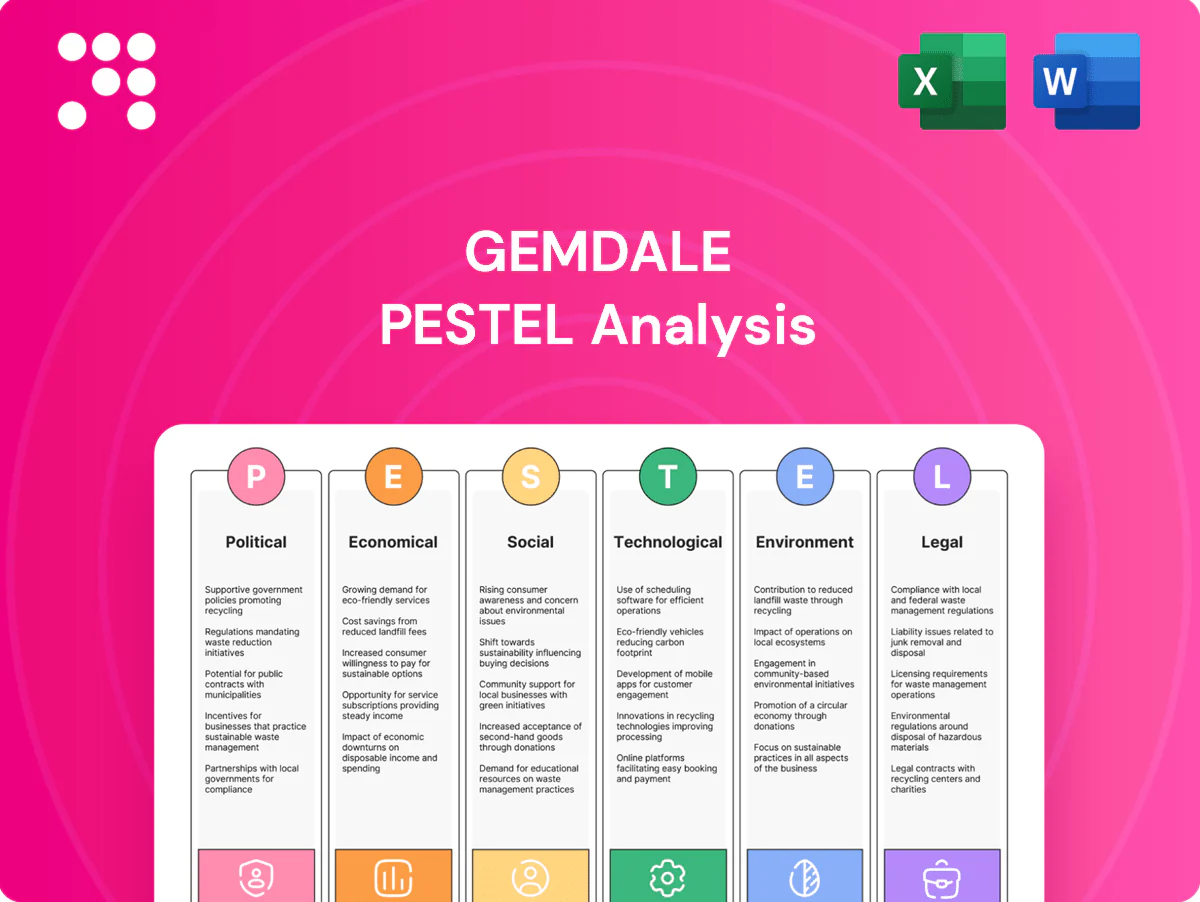
The preview shown here is the exact Gemdale PESTLE Analysis document you’ll receive after purchase—fully formatted and ready to use. It contains the complete Political, Economic, Social, Technological, Legal, and Environmental assessment tailored to Gemdale. No placeholders or teasers—this is the finished file available for immediate download.

Original: $10.00
-65%$10.00
$3.50Product Information
Product Information
Shipping & Returns
Shipping & Returns
Description
Your Competitive Advantage Starts with This Report
Our PESTLE analysis of Gemdale highlights the political, economic, social, technological, legal and environmental forces shaping its real estate trajectory, revealing regulatory risks and growth levers investors need to know. Use these insights to refine strategy and spot opportunities—buy the full, downloadable PESTLE report for a complete, actionable breakdown.
Political factors
Central housing policy direction
Beijing’s long-standing slogan since 2016 that housing is for living, not speculation continues to constrain pricing, sales pace and marketing latitude for developers. Easing and tightening cycles in 2023–24—including targeted mortgage relief and regulatory nudges—have shown demand can swing rapidly. Gemdale must align product mix and inventory strategy with shifting central guidance. Close government engagement is essential to anticipate adjustments.
Land supply and auction reforms
Centralized land release schedules and online auctions tighten timing and pricing, with floor-price rules directly setting input costs and city exposure; Gemdale (HK 0535 / SSE 600383) faces concentration risk when fewer, larger auctions compress bidding windows. Larger auction blocks can strain cashflow and raise project-city concentration; Gemdale’s pipeline depends on securing quality parcels at sustainable prices, so partnerships and disciplined bidding are used to mitigate volatility.
Local government fiscal health
Local government fiscal health matters for Gemdale because urban investment and approvals remain tied to land-sale proceeds, which account for about 25% of Chinese local fiscal revenue; shocks to that stream heighten permit and delivery delays. Fiscal stress is evident: special local government bond issuance reached 3.65 trillion RMB in 2023 while hidden LGFV debt stood near 64.5 trillion RMB, so city selection must weigh municipal credit; diversifying across tiers reduces policy and execution risk.
State support and stabilization tools
State liquidity facilities, white-list financing and guaranteed pre-sale completion programs expanded in 2024, improving access to funding for accredited developers and lowering market borrowing spreads for top-tier firms; Gemdale’s strong compliance and credit standing improved eligibility and allowed swift take-up of support, enhancing cashflow resilience and preserving project delivery.
- State schemes expanded in 2024
- White-list access prioritizes quality developers
- Gemdale compliance boosts eligibility
- Swift participation reduces funding stress
Geopolitical and macro policy shifts
External geopolitical tensions can drive intermittent capital outflows and weaken investor sentiment toward Chinese real estate; 1-year LPR held at 3.45% through 2024, leaving monetary room for targeted easing to support developers and buyers.
Macro easing via RRR cuts and targeted credit increases affordability; tightening reverses that effect, so Gemdale’s treasury must actively hedge FX and rate risks and maintain transparent communication to sustain market confidence.
- Impact: capital flows, FX volatility
- Policy lever: RRR/targeted credit
- Rate marker: 1yr LPR 3.45% (2024)
- Action: hedge FX/rates; disclose regularly
Beijing housing-for-living rules and land-floor prices reshape developer sales and funding
Beijing policy of housing-for-living, land-auction floor prices and local fiscal stress shape Gemdale’s sales, bidding and delivery; targeted 2023–24 support improved funding access for compliant developers. Key metrics: 1yr LPR 3.45% (2024), local land revenue ~25% of fiscal, 2023 SLB 3.65trn RMB, LGFV debt ~64.5trn RMB.
| Factor | Metric | Value |
|---|---|---|
| Monetary | 1yr LPR | 3.45% (2024) |
| Local fiscal | Land revenue share | ~25% |
| Credit | 2023 SLB / LGFV debt | 3.65trn / 64.5trn RMB |
What is included in the product
Detailed Word Document
Explores how external macro-environmental factors uniquely affect the Gemdale across six dimensions—Political, Economic, Social, Technological, Environmental, and Legal—backed by current data and trends to identify threats and opportunities. Designed for executives and investors, it delivers forward-looking insights and practical examples tailored to the region and industry.
Customizable Excel Spreadsheet
Concise, visually segmented Gemdale PESTLE summary that’s editable for local context and ready to drop into presentations or share across teams for fast alignment on external risks and strategic positioning.
Economic factors
Housing demand and affordability
Income growth of roughly 5–6% (urban disposable income) alongside a 5-year LPR near 4% and down-payment requirements of 20–30% largely drive absorption and buyer ability. Affordability pressure is damping upgrade demand in many Tier-1/2 cities. Gemdale must tailor pricing and unit mix by micro-market, using targeted, flexible sales incentives to protect velocity without eroding brand.
Property cycle and inventory
Market corrections lift inventory days and discounting risk: China new-home sales remained roughly 30–40% below 2019 peaks into 2023–24, extending developer stock turn and forcing markdowns. Recovery phases favour developers with low leverage and land banks; Gemdale’s emphasis on cash preservation and owned land buffers value capture. Gemdale must pace starts to match cash flow and sell-through, using scenario plans to cushion prolonged downturns.
Credit conditions and developer funding
Bank lending appetite remains cautious with China's 1-year LPR at 3.45% (July 2025), while bond market access is fragmented and trust financing—with trust assets ~22 trillion CNY end-2023—has contracted, jointly shaping developer liquidity. Higher risk premiums lift project hurdle rates and increase financing costs. Gemdale benefits from diversified funding channels and prudent leverage management. Robust pre-sales (about 70% of project funding historically) and tight pre-sales cash management are critical to on-time delivery.
Urbanization and city-tier divergence
Urbanization in China reached 64.7% in 2023, with net migration skewing to core Tier-1 and strong Tier-2 nodes, leaving weaker third- and fourth-tier cities facing oversupply and softer absorption.
Price elasticity and absorption vary markedly by tier, so Gemdale should overweight resilient clusters and deploy data-led city rotation to improve capital efficiency and reduce vacancy risk.
- Migration: favors Tier-1/strong Tier-2
- Oversupply: weaker cities, higher vacancy
- Strategy: overweight resilient clusters
- Execution: data-led city rotation for efficiency
Commercial property cycles
Commercial property cycles remain tied to GDP and employment—China GDP grew 5.2% in 2024 and urban surveyed unemployment averaged about 5.2%, driving office and retail demand shifts. Hybrid work and e-commerce (online retail >30% of retail sales in 2024) are reducing traditional office use and pressuring city‑center rents, with office vacancy in major tier‑1 cities near 17% in 2024 (JLL). Gemdale’s commercial assets need adaptive leasing, active repositioning, and mixed‑use conversions to stabilize cash flows.
- GDP 2024: 5.2%
- Urban unemployment 2024: ~5.2%
- E‑commerce share 2024: >30%
- Tier‑1 office vacancy 2024: ~17%
Beijing housing-for-living rules and land-floor prices reshape developer sales and funding
Urban disposable income rising ~5–6% and 1y LPR ~3.45% (Jul 2025) support demand but 20–30% down‑payments and affordability squeeze limit upgrades; new‑home sales ~30–40% below 2019 peaks (2023–24) extend inventory risk. Developers face higher funding costs; Gemdale’s low leverage, cash focus and targeted pricing improve resilience.
| Indicator | Value |
|---|---|
| 1y LPR (Jul 2025) | 3.45% |
| GDP 2024 | 5.2% |
| Urban income growth | 5–6% |
| New‑home sales vs 2019 | -30–40% |
| Pre‑sales funding | ~70% |
Full Version Awaits
Gemdale PESTLE Analysis
The preview shown here is the exact Gemdale PESTLE Analysis document you’ll receive after purchase—fully formatted and ready to use. It contains the complete Political, Economic, Social, Technological, Legal, and Environmental assessment tailored to Gemdale. No placeholders or teasers—this is the finished file available for immediate download.