GCM Grosvenor PESTLE Analysis

Skip the Research. Get the Strategy.
Discover how political shifts, economic cycles, and regulatory changes are shaping GCM Grosvenor's strategic outlook in our concise PESTLE snapshot. This analysis highlights risks and opportunities across markets and sustainability trends. Ideal for investors and advisors seeking clarity. Purchase the full PESTLE for the complete, actionable breakdown—download instantly.
Political factors

Geopolitical tensions and sanctions
Regional conflicts and layered sanctions regimes—EU/US measures on Russia and Iran remain expansive—disrupt cross-border deals, manager selection, and portfolio supply chains, forcing diligence on jurisdictional exposure and counterparties to avoid over 15,000+ listed restricted entities on OFAC-style lists (2024).
Shifts in foreign policy can reprice risk premia by hundreds of basis points, changing required returns; active hedging and geographic diversification reduce such shocks.
Government spending and infrastructure policy
Public investment agendas and PPP frameworks—exemplified by the US Infrastructure Investment and Jobs Act ($1.2 trillion) and the EU NextGenerationEU plan (€806.9 billion)—drive deal flow into infrastructure and real assets, with Global Infrastructure Hub estimating multi‑trillion annual needs for 2030s markets.
Policy incentives for energy transition and digital infrastructure (IEA: clean energy investment ≈ $1.9 trillion in 2023) are catalyzing pipelines and valuation uplift for managers like GCM Grosvenor.
Changes in procurement rules and concession terms reallocate construction, demand and political risk, directly affecting IRRs and underwriting; proactive engagement with policymakers aligns fund strategies to multi‑year programs and improves deal certainty.

Pension and sovereign wealth fund priorities
Asset allocation shifts by public plans and sovereign wealth funds respond to political leadership and liability profiles—U.S. public pensions’ funded ratio averaged about 75% in 2024, driving greater appetite for return-seeking allocations. Global SWF AUM was roughly $10.5 trillion in 2024, and emphasis on domestic or strategic sectors can reshape mandates. GCM Grosvenor’s customized solutions align to sponsor policy goals, while transparent governance eases allocation rebalances.

Trade policy and protectionism
Election cycles and policy uncertainty
Sanctions, elections and mega-spending reshape jurisdictional risk and infrastructure flows
Regional sanctions and trade controls (OFAC ~15,000 entities, 2024) plus elections drive jurisdictional exposure and repricing; large public programs (US IIJA $1.2tn; EU €806.9bn) and clean‑energy spending (~$1.9tn, 2023) expand infrastructure pipelines; sovereign wealth (~$10.5tn AUM, 2024) and ~75% US pension funded ratio (2024) shift allocations; procurement and export controls raise execution and exit risk.
| Metric | Value |
|---|---|
| OFAC-listed entities (2024) | 15,000+ |
| US IIJA | $1.2tn |
| EU NextGenerationEU | €806.9bn |
| Clean energy spend (2023) | $1.9tn |
| Global SWF AUM (2024) | $10.5tn |
| US pension funded ratio (2024) | ~75% |
What is included in the product
 Detailed Word Document
Explores how macro-environmental forces uniquely affect GCM Grosvenor across Political, Economic, Social, Technological, Environmental and Legal dimensions, with data-driven trends, forward-looking insights and sector-specific subpoints to support strategy, risk mitigation and investor communications.

 Customizable Excel Spreadsheet
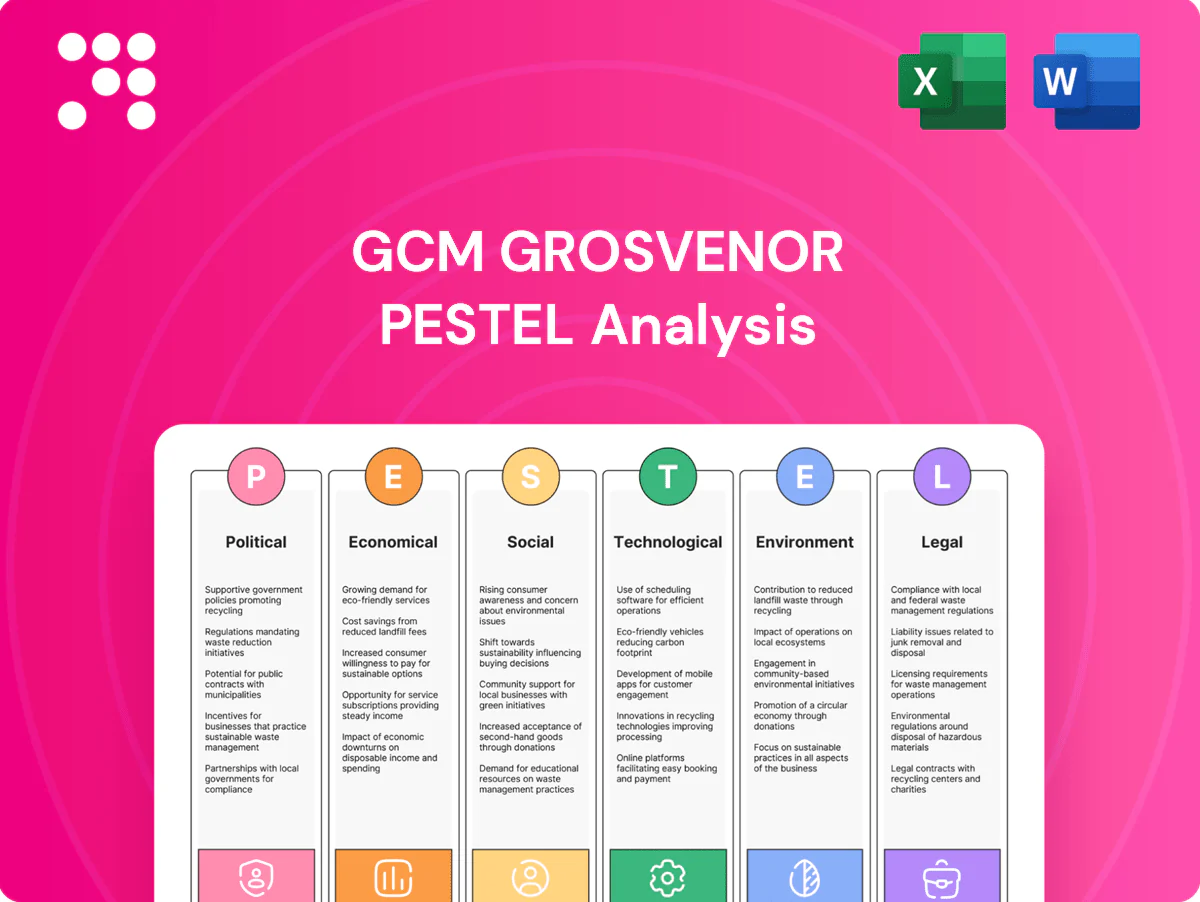
A concise, visually segmented PESTLE summary of GCM Grosvenor that’s easily dropped into presentations, shared across teams, and annotated for local context—enabling fast alignment and focused external risk discussions during planning sessions.
Economic factors

Interest rates and liquidity cycles
Higher-for-longer US policy rates at a 5.25–5.50% federal funds target raise discount rates, widen credit spreads and constrain LBO leverage, pressuring valuations and favoring cash-flow resilient assets. With global private capital dry powder around 2.7 trillion dollars, deployment must adapt to tighter debt markets and higher financing costs. Active liability management and opportunistic credit strategies can capture dislocations from stressed borrowers and spread volatility.
Inflation and input costs
Inflation reshapes margins, capex and rent escalators across real assets: US CPI 12‑month at about 3.4% (June 2025) and construction cost inflation running roughly 5–7% in 2024 compress underwriting buffers and lift required yields. Inflation‑linked contracts and leases hedge purchasing power, while pricing power and operational levers become central to protect margins. Changes in cost of capital versus inflation paths then recalibrate target returns for GCM Grosvenor’s portfolios.

Economic growth and labor markets
GDP trends drive demand—US real GDP grew ~2.5% in 2024 (BEA) and IMF estimated global growth at 3.0% in 2024, shaping portfolio-company toplines. Tight labor markets (US unemployment ~3.7% in 2024, BLS) lift wage costs and execution risk for value‑creation. Sector rotation toward healthcare, staples and software supports resilience in downturns. Active ownership and tech enablement (McKinsey: digital adoption can boost productivity up to 20%) unlock value.

Currency volatility in global portfolios
FX moves materially affect unhedged returns and cash distributions; the US Dollar (DXY) hovered near 105 in mid‑2025, often amplifying currency gains or losses for global portfolios.
Hedging policies must weigh explicit hedging costs, basis risk and hedge duration against client return and liquidity objectives.
Local financing and multi‑currency diversification reduce translation risk and smooth performance dispersion across market cycles.
- Unhedged FX can swing distributions
- Hedge cost vs duration tradeoff
- Local debt lowers translation risk
- Currency diversification smooths volatility
Fundraising and denominator effect
Public market drawdowns, exemplified by the S&P 500 decline of 19.44% in 2022, can compress LP alternatives allocations via denominator constraints; staggered closings and co-investments are used to fit commitments into LP pacing, while performance dispersion typically widens as capital scarcity rises; GCM Grosvenor’s multi-strategy platform can tailor commitment size and timing to LP liquidity needs.
- Drawdown: S&P 500 -19.44% (2022)
- Pacing tools: staggered closings, co-invests
- Benefit: multi-strategy customization to LP liquidity
Sanctions, elections and mega-spending reshape jurisdictional risk and infrastructure flows
Higher-for-longer US policy rates (fed funds 5.25–5.50%) raise discount rates, tighten LBO leverage and favor cash-flow resilient assets; global private capital dry powder ~$2.7T adapts to costlier debt.
Inflation (US CPI 12m 3.4% Jun 2025) and construction inflation 5–7% compress underwriting and lift required yields.
GDP (US real GDP ~2.5% 2024), DXY ~105 mid-2025 and S&P 500 drawdown -19.44% (2022) drive demand, FX and LP pacing decisions.
| Metric | Value |
|---|---|
| Fed funds | 5.25–5.50% |
| Dry powder | $2.7T |
| US CPI (12m) | 3.4% Jun 2025 |
| DXY | ~105 mid-2025 |
Same Document Delivered
GCM Grosvenor PESTLE Analysis
The preview of the GCM Grosvenor PESTLE Analysis is the exact document you’ll receive after purchase—fully formatted and professionally structured. No placeholders or teasers: the content, layout, and structure match the downloadable file. After checkout you’ll instantly get this finished, ready-to-use report as shown.

Product Information
Product Information
Shipping & Returns
Shipping & Returns
Description
Skip the Research. Get the Strategy.
Discover how political shifts, economic cycles, and regulatory changes are shaping GCM Grosvenor's strategic outlook in our concise PESTLE snapshot. This analysis highlights risks and opportunities across markets and sustainability trends. Ideal for investors and advisors seeking clarity. Purchase the full PESTLE for the complete, actionable breakdown—download instantly.
Political factors
Geopolitical tensions and sanctions
Regional conflicts and layered sanctions regimes—EU/US measures on Russia and Iran remain expansive—disrupt cross-border deals, manager selection, and portfolio supply chains, forcing diligence on jurisdictional exposure and counterparties to avoid over 15,000+ listed restricted entities on OFAC-style lists (2024).
Shifts in foreign policy can reprice risk premia by hundreds of basis points, changing required returns; active hedging and geographic diversification reduce such shocks.
Government spending and infrastructure policy
Public investment agendas and PPP frameworks—exemplified by the US Infrastructure Investment and Jobs Act ($1.2 trillion) and the EU NextGenerationEU plan (€806.9 billion)—drive deal flow into infrastructure and real assets, with Global Infrastructure Hub estimating multi‑trillion annual needs for 2030s markets.
Policy incentives for energy transition and digital infrastructure (IEA: clean energy investment ≈ $1.9 trillion in 2023) are catalyzing pipelines and valuation uplift for managers like GCM Grosvenor.
Changes in procurement rules and concession terms reallocate construction, demand and political risk, directly affecting IRRs and underwriting; proactive engagement with policymakers aligns fund strategies to multi‑year programs and improves deal certainty.
Pension and sovereign wealth fund priorities
Asset allocation shifts by public plans and sovereign wealth funds respond to political leadership and liability profiles—U.S. public pensions’ funded ratio averaged about 75% in 2024, driving greater appetite for return-seeking allocations. Global SWF AUM was roughly $10.5 trillion in 2024, and emphasis on domestic or strategic sectors can reshape mandates. GCM Grosvenor’s customized solutions align to sponsor policy goals, while transparent governance eases allocation rebalances.
Trade policy and protectionism
Election cycles and policy uncertainty
Sanctions, elections and mega-spending reshape jurisdictional risk and infrastructure flows
Regional sanctions and trade controls (OFAC ~15,000 entities, 2024) plus elections drive jurisdictional exposure and repricing; large public programs (US IIJA $1.2tn; EU €806.9bn) and clean‑energy spending (~$1.9tn, 2023) expand infrastructure pipelines; sovereign wealth (~$10.5tn AUM, 2024) and ~75% US pension funded ratio (2024) shift allocations; procurement and export controls raise execution and exit risk.
| Metric | Value |
|---|---|
| OFAC-listed entities (2024) | 15,000+ |
| US IIJA | $1.2tn |
| EU NextGenerationEU | €806.9bn |
| Clean energy spend (2023) | $1.9tn |
| Global SWF AUM (2024) | $10.5tn |
| US pension funded ratio (2024) | ~75% |
What is included in the product
Detailed Word Document
Explores how macro-environmental forces uniquely affect GCM Grosvenor across Political, Economic, Social, Technological, Environmental and Legal dimensions, with data-driven trends, forward-looking insights and sector-specific subpoints to support strategy, risk mitigation and investor communications.
Customizable Excel Spreadsheet
A concise, visually segmented PESTLE summary of GCM Grosvenor that’s easily dropped into presentations, shared across teams, and annotated for local context—enabling fast alignment and focused external risk discussions during planning sessions.
Economic factors
Interest rates and liquidity cycles
Higher-for-longer US policy rates at a 5.25–5.50% federal funds target raise discount rates, widen credit spreads and constrain LBO leverage, pressuring valuations and favoring cash-flow resilient assets. With global private capital dry powder around 2.7 trillion dollars, deployment must adapt to tighter debt markets and higher financing costs. Active liability management and opportunistic credit strategies can capture dislocations from stressed borrowers and spread volatility.
Inflation and input costs
Inflation reshapes margins, capex and rent escalators across real assets: US CPI 12‑month at about 3.4% (June 2025) and construction cost inflation running roughly 5–7% in 2024 compress underwriting buffers and lift required yields. Inflation‑linked contracts and leases hedge purchasing power, while pricing power and operational levers become central to protect margins. Changes in cost of capital versus inflation paths then recalibrate target returns for GCM Grosvenor’s portfolios.
Economic growth and labor markets
GDP trends drive demand—US real GDP grew ~2.5% in 2024 (BEA) and IMF estimated global growth at 3.0% in 2024, shaping portfolio-company toplines. Tight labor markets (US unemployment ~3.7% in 2024, BLS) lift wage costs and execution risk for value‑creation. Sector rotation toward healthcare, staples and software supports resilience in downturns. Active ownership and tech enablement (McKinsey: digital adoption can boost productivity up to 20%) unlock value.
Currency volatility in global portfolios
FX moves materially affect unhedged returns and cash distributions; the US Dollar (DXY) hovered near 105 in mid‑2025, often amplifying currency gains or losses for global portfolios.
Hedging policies must weigh explicit hedging costs, basis risk and hedge duration against client return and liquidity objectives.
Local financing and multi‑currency diversification reduce translation risk and smooth performance dispersion across market cycles.
- Unhedged FX can swing distributions
- Hedge cost vs duration tradeoff
- Local debt lowers translation risk
- Currency diversification smooths volatility
Fundraising and denominator effect
Public market drawdowns, exemplified by the S&P 500 decline of 19.44% in 2022, can compress LP alternatives allocations via denominator constraints; staggered closings and co-investments are used to fit commitments into LP pacing, while performance dispersion typically widens as capital scarcity rises; GCM Grosvenor’s multi-strategy platform can tailor commitment size and timing to LP liquidity needs.
- Drawdown: S&P 500 -19.44% (2022)
- Pacing tools: staggered closings, co-invests
- Benefit: multi-strategy customization to LP liquidity
Sanctions, elections and mega-spending reshape jurisdictional risk and infrastructure flows
Higher-for-longer US policy rates (fed funds 5.25–5.50%) raise discount rates, tighten LBO leverage and favor cash-flow resilient assets; global private capital dry powder ~$2.7T adapts to costlier debt.
Inflation (US CPI 12m 3.4% Jun 2025) and construction inflation 5–7% compress underwriting and lift required yields.
GDP (US real GDP ~2.5% 2024), DXY ~105 mid-2025 and S&P 500 drawdown -19.44% (2022) drive demand, FX and LP pacing decisions.
| Metric | Value |
|---|---|
| Fed funds | 5.25–5.50% |
| Dry powder | $2.7T |
| US CPI (12m) | 3.4% Jun 2025 |
| DXY | ~105 mid-2025 |
Same Document Delivered
GCM Grosvenor PESTLE Analysis
The preview of the GCM Grosvenor PESTLE Analysis is the exact document you’ll receive after purchase—fully formatted and professionally structured. No placeholders or teasers: the content, layout, and structure match the downloadable file. After checkout you’ll instantly get this finished, ready-to-use report as shown.