FormFactor, Inc. PESTLE Analysis

Skip the Research. Get the Strategy.
Unlock strategic clarity with our PESTLE Analysis of FormFactor, Inc.: three concise sections revealing political, economic, social, technological, legal, and environmental forces shaping its trajectory. Ideal for investors and strategists—purchase the full report to access in-depth, actionable insights and ready-to-use data.
Political factors

Export controls on semiconductor tools
US and allied export restrictions since October 2022 (expanded in 2023) on advanced semiconductor tools, alongside the $52 billion CHIPS Act incentives, have constrained probe card and metrology shipments to China and select end-users. Licensing delays lengthen sales cycles and shift revenue timing for FormFactor. The company may need product variants and enhanced compliance controls to meet end-use/end-user rules. Policy tightening or loosening will directly change regional addressable demand.
Industrial subsidies and incentives
US CHIPS Act incentives (about $52.7 billion) and EU plans targeting roughly €43 billion, plus Asia programs such as South Korea’s multi-year ~$450 billion semiconductor push, have spurred fab expansions that boost test-equipment demand benefiting FormFactor. Accessing grants or tax credits can materially lower local manufacturing and R&D costs, while participation often requires local content or collaboration commitments. The geographic allocation of subsidies influences where FormFactor locates capacity and strategic partnerships.

Geopolitical supply chain resilience
US–China tensions and regional flashpoints drive customers to multi-source and regionalize; FormFactor, a U.S.-based supplier of semiconductor test and measurement equipment, benefits from onshoring incentives like the CHIPS and Science Act (~$52.7B). Tightened U.S. export controls since 2023 increase paperwork, shipping costs and lead-time variability, so political alignment with key customers’ geographies is a clear competitive edge.

Standards and government-led consortia
Public procurement and defense
Defense-related semiconductors require vetted, trusted suppliers and compliance with ITAR/EAR; US DoD topline was about 858 billion USD in FY2024, underscoring program scale and long procurement cycles that become sticky once qualified. Winning defense programs often cushions revenue through downturns and offers multi-year visibility for suppliers.
- Trusted supplier vetting: mandatory
- ITAR/EAR: eligibility constraint
- US DoD FY2024: ~858B USD
- Procurement: long cycles, high stickiness
Chip subsidies and export curbs reshape supply chains, boost fab investment and defense sourcing
Political factors: US export controls since 2022 (tightened 2023) constrain China sales and lengthen FormFactor’s cycles; CHIPS Act $52.7B, EU ~€43B and South Korea ~$450B spur fab expansion and localization decisions; US defense spend (DoD FY2024 ~ $858B) increases demand for vetted suppliers and long procurements.
| Policy | Value |
|---|---|
| US CHIPS | $52.7B |
| EU | €43B |
| South Korea | ~$450B |
| US DoD FY24 | $858B |
What is included in the product
 Detailed Word Document
Provides a concise PESTLE overview of how Political, Economic, Social, Technological, Environmental, and Legal forces shape FormFactor, Inc., with data-backed trends and industry-specific examples; designed for executives, investors, and strategists to identify risks, opportunities, and actionable, forward-looking implications ready for inclusion in reports or pitch materials.

 Customizable Excel Spreadsheet
A concise, visually segmented PESTLE summary for FormFactor, Inc. that can be dropped into presentations, annotated for local context, and quickly shared across teams to streamline external-risk discussions and strategic planning.
Economic factors

Semiconductor capex cycles
Probe card demand at FormFactor closely tracks wafer starts and yield ramps, with FY2024 revenue about $1.11B while global wafer fab capex remains concentrated at top foundries (TSMC ~$36B, Samsung ~$27B, Intel ~$14B in 2024), driving order volatility and pricing pressure. Advanced-node ramps (N5/N3) lift ASPs enough to offset unit declines, and missing customers’ tape-outs shifts revenue cadence by quarters.
End-market mix: AI, mobile, auto
AI accelerators and HBM spur complex test demand and premium tooling, raising ASPs and uptake of specialized probe cards.
Mobile cycles remain large but price sensitive, supporting volume while compressing margins and service attach economics.
Auto adds reliability-driven test that lengthens test time and service needs; FormFactor reported fiscal 2024 revenue of 658.2 million, and a diversified mix reduces single-vertical reliance.

Currency and cost inflation
FormFactor's global sales expose revenue to USD volatility versus KRW, TWD, JPY and EUR, with 2024 revenue of about $1.12B amplifying FX translation and transaction risk as DXY strengthened roughly 5% in 2024. Precision components saw input-cost pressure from metals and specialty polymers—copper and palladium moved up ~10%–15% in 2024—squeezing margins. Hedging programs and localized sourcing have materially reduced margin swings, while ultimate pricing power hinges on FormFactor's technology differentiation and customer stickiness.

Supply chain lead times
Custom materials and long‑lead parts have constrained FormFactor shipments, with semiconductor industry component lead times remaining elevated through 2024 and into 2025, pressuring delivery schedules and backlogs.
Maintaining buffer inventory to mitigate delays raises working capital needs and carrying costs, while vendor concentration increases expedite and premium freight expenses during demand surges.
Dual‑sourcing and design‑for‑supply initiatives have been prioritized to shorten lead times and improve resilience.
Aftermarket and services growth
Aftermarket consumables, refurbishment, and calibration provide steadier, cyclical revenue for FormFactor, reducing exposure to wafer fab capex swings and supporting recurring cash flow.
Service contracts deepen customer stickiness and generate telemetry for product improvement; higher-margin services can lift blended gross margin while installed base expansion compounds recurring opportunities.
- consumables/refurbishment: smoother revenue
- service contracts: stickiness + data
- higher-margin services: gross margin uplift
- installed base growth: recurring upside
Chip subsidies and export curbs reshape supply chains, boost fab investment and defense sourcing
FormFactor revenue (~$1.11B FY2024) closely follows wafer starts as top foundries concentrate capex (TSMC ~$36B, Samsung ~$27B, Intel ~$14B in 2024), causing order volatility and pricing pressure. FX moved DXY ~+5% in 2024 and metals rose ~10–15%, squeezing margins despite hedging and localized sourcing. Elevated component lead times raise working capital and premium logistics; services and consumables smooth cash flow and improve stickiness (FF reported fiscal 2024 revenue $658.2M).
| Metric | Value (2024) |
|---|---|
| FormFactor FY2024 revenue | $1.11B |
| FormFactor fiscal 2024 revenue (reported) | $658.2M |
| TSMC capex | $36B |
| DXY change | +5% |
| Metals (Cu/Pd) | +10–15% |
Preview Before You Purchase
FormFactor, Inc. PESTLE Analysis
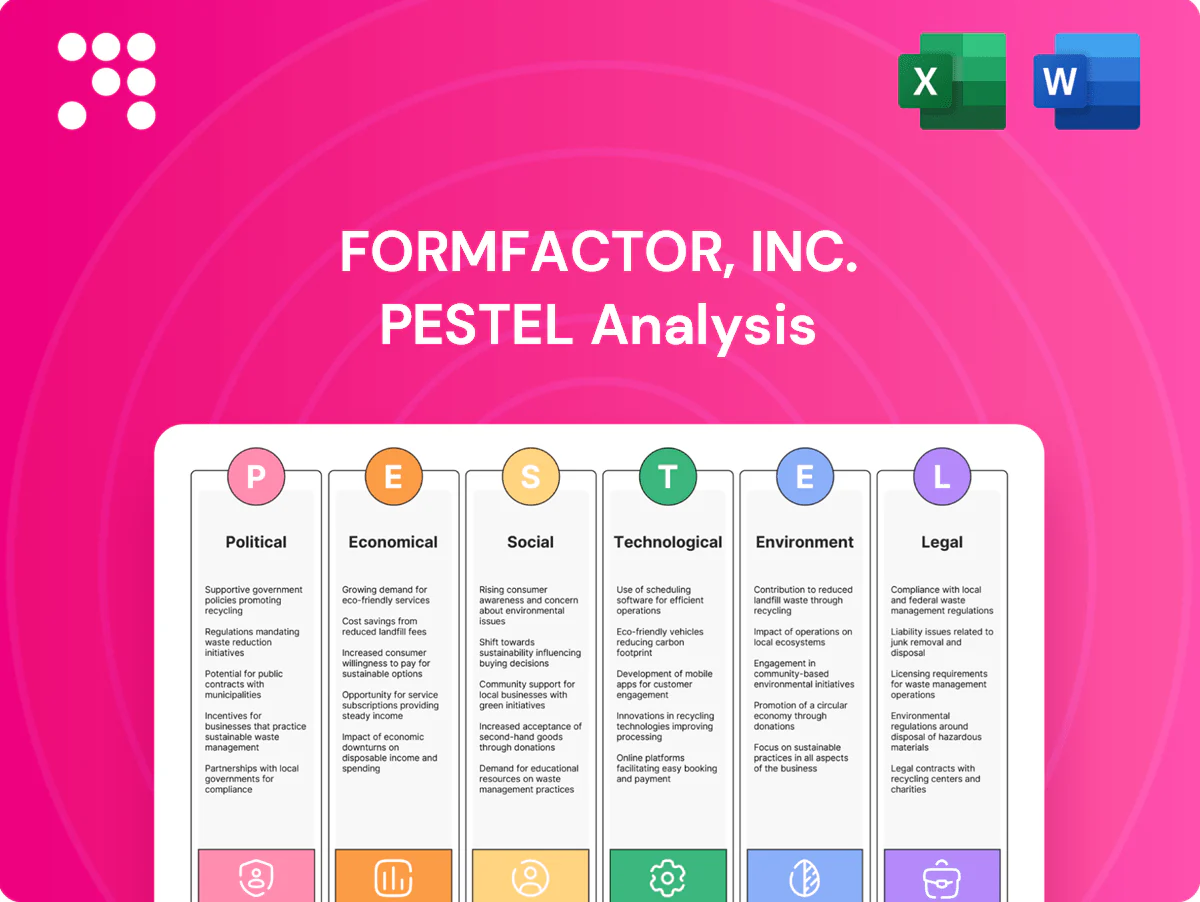
This PESTLE analysis of FormFactor, Inc. examines political, economic, social, technological, legal, and environmental factors shaping its semiconductor test and probe-card markets, highlighting risks and strategic opportunities. Use it for competitive positioning, risk mitigation, and long-term planning. The preview shown here is the exact document you’ll receive after purchase—fully formatted and ready to use.

Original: $10.00
-65%$10.00
$3.50Product Information
Product Information
Shipping & Returns
Shipping & Returns
Description
Skip the Research. Get the Strategy.
Unlock strategic clarity with our PESTLE Analysis of FormFactor, Inc.: three concise sections revealing political, economic, social, technological, legal, and environmental forces shaping its trajectory. Ideal for investors and strategists—purchase the full report to access in-depth, actionable insights and ready-to-use data.
Political factors
Export controls on semiconductor tools
US and allied export restrictions since October 2022 (expanded in 2023) on advanced semiconductor tools, alongside the $52 billion CHIPS Act incentives, have constrained probe card and metrology shipments to China and select end-users. Licensing delays lengthen sales cycles and shift revenue timing for FormFactor. The company may need product variants and enhanced compliance controls to meet end-use/end-user rules. Policy tightening or loosening will directly change regional addressable demand.
Industrial subsidies and incentives
US CHIPS Act incentives (about $52.7 billion) and EU plans targeting roughly €43 billion, plus Asia programs such as South Korea’s multi-year ~$450 billion semiconductor push, have spurred fab expansions that boost test-equipment demand benefiting FormFactor. Accessing grants or tax credits can materially lower local manufacturing and R&D costs, while participation often requires local content or collaboration commitments. The geographic allocation of subsidies influences where FormFactor locates capacity and strategic partnerships.
Geopolitical supply chain resilience
US–China tensions and regional flashpoints drive customers to multi-source and regionalize; FormFactor, a U.S.-based supplier of semiconductor test and measurement equipment, benefits from onshoring incentives like the CHIPS and Science Act (~$52.7B). Tightened U.S. export controls since 2023 increase paperwork, shipping costs and lead-time variability, so political alignment with key customers’ geographies is a clear competitive edge.
Standards and government-led consortia
Public procurement and defense
Defense-related semiconductors require vetted, trusted suppliers and compliance with ITAR/EAR; US DoD topline was about 858 billion USD in FY2024, underscoring program scale and long procurement cycles that become sticky once qualified. Winning defense programs often cushions revenue through downturns and offers multi-year visibility for suppliers.
- Trusted supplier vetting: mandatory
- ITAR/EAR: eligibility constraint
- US DoD FY2024: ~858B USD
- Procurement: long cycles, high stickiness
Chip subsidies and export curbs reshape supply chains, boost fab investment and defense sourcing
Political factors: US export controls since 2022 (tightened 2023) constrain China sales and lengthen FormFactor’s cycles; CHIPS Act $52.7B, EU ~€43B and South Korea ~$450B spur fab expansion and localization decisions; US defense spend (DoD FY2024 ~ $858B) increases demand for vetted suppliers and long procurements.
| Policy | Value |
|---|---|
| US CHIPS | $52.7B |
| EU | €43B |
| South Korea | ~$450B |
| US DoD FY24 | $858B |
What is included in the product
Detailed Word Document
Provides a concise PESTLE overview of how Political, Economic, Social, Technological, Environmental, and Legal forces shape FormFactor, Inc., with data-backed trends and industry-specific examples; designed for executives, investors, and strategists to identify risks, opportunities, and actionable, forward-looking implications ready for inclusion in reports or pitch materials.
Customizable Excel Spreadsheet
A concise, visually segmented PESTLE summary for FormFactor, Inc. that can be dropped into presentations, annotated for local context, and quickly shared across teams to streamline external-risk discussions and strategic planning.
Economic factors
Semiconductor capex cycles
Probe card demand at FormFactor closely tracks wafer starts and yield ramps, with FY2024 revenue about $1.11B while global wafer fab capex remains concentrated at top foundries (TSMC ~$36B, Samsung ~$27B, Intel ~$14B in 2024), driving order volatility and pricing pressure. Advanced-node ramps (N5/N3) lift ASPs enough to offset unit declines, and missing customers’ tape-outs shifts revenue cadence by quarters.
End-market mix: AI, mobile, auto
AI accelerators and HBM spur complex test demand and premium tooling, raising ASPs and uptake of specialized probe cards.
Mobile cycles remain large but price sensitive, supporting volume while compressing margins and service attach economics.
Auto adds reliability-driven test that lengthens test time and service needs; FormFactor reported fiscal 2024 revenue of 658.2 million, and a diversified mix reduces single-vertical reliance.
Currency and cost inflation
FormFactor's global sales expose revenue to USD volatility versus KRW, TWD, JPY and EUR, with 2024 revenue of about $1.12B amplifying FX translation and transaction risk as DXY strengthened roughly 5% in 2024. Precision components saw input-cost pressure from metals and specialty polymers—copper and palladium moved up ~10%–15% in 2024—squeezing margins. Hedging programs and localized sourcing have materially reduced margin swings, while ultimate pricing power hinges on FormFactor's technology differentiation and customer stickiness.
Supply chain lead times
Custom materials and long‑lead parts have constrained FormFactor shipments, with semiconductor industry component lead times remaining elevated through 2024 and into 2025, pressuring delivery schedules and backlogs.
Maintaining buffer inventory to mitigate delays raises working capital needs and carrying costs, while vendor concentration increases expedite and premium freight expenses during demand surges.
Dual‑sourcing and design‑for‑supply initiatives have been prioritized to shorten lead times and improve resilience.
Aftermarket and services growth
Aftermarket consumables, refurbishment, and calibration provide steadier, cyclical revenue for FormFactor, reducing exposure to wafer fab capex swings and supporting recurring cash flow.
Service contracts deepen customer stickiness and generate telemetry for product improvement; higher-margin services can lift blended gross margin while installed base expansion compounds recurring opportunities.
- consumables/refurbishment: smoother revenue
- service contracts: stickiness + data
- higher-margin services: gross margin uplift
- installed base growth: recurring upside
Chip subsidies and export curbs reshape supply chains, boost fab investment and defense sourcing
FormFactor revenue (~$1.11B FY2024) closely follows wafer starts as top foundries concentrate capex (TSMC ~$36B, Samsung ~$27B, Intel ~$14B in 2024), causing order volatility and pricing pressure. FX moved DXY ~+5% in 2024 and metals rose ~10–15%, squeezing margins despite hedging and localized sourcing. Elevated component lead times raise working capital and premium logistics; services and consumables smooth cash flow and improve stickiness (FF reported fiscal 2024 revenue $658.2M).
| Metric | Value (2024) |
|---|---|
| FormFactor FY2024 revenue | $1.11B |
| FormFactor fiscal 2024 revenue (reported) | $658.2M |
| TSMC capex | $36B |
| DXY change | +5% |
| Metals (Cu/Pd) | +10–15% |
Preview Before You Purchase
FormFactor, Inc. PESTLE Analysis
This PESTLE analysis of FormFactor, Inc. examines political, economic, social, technological, legal, and environmental factors shaping its semiconductor test and probe-card markets, highlighting risks and strategic opportunities. Use it for competitive positioning, risk mitigation, and long-term planning. The preview shown here is the exact document you’ll receive after purchase—fully formatted and ready to use.