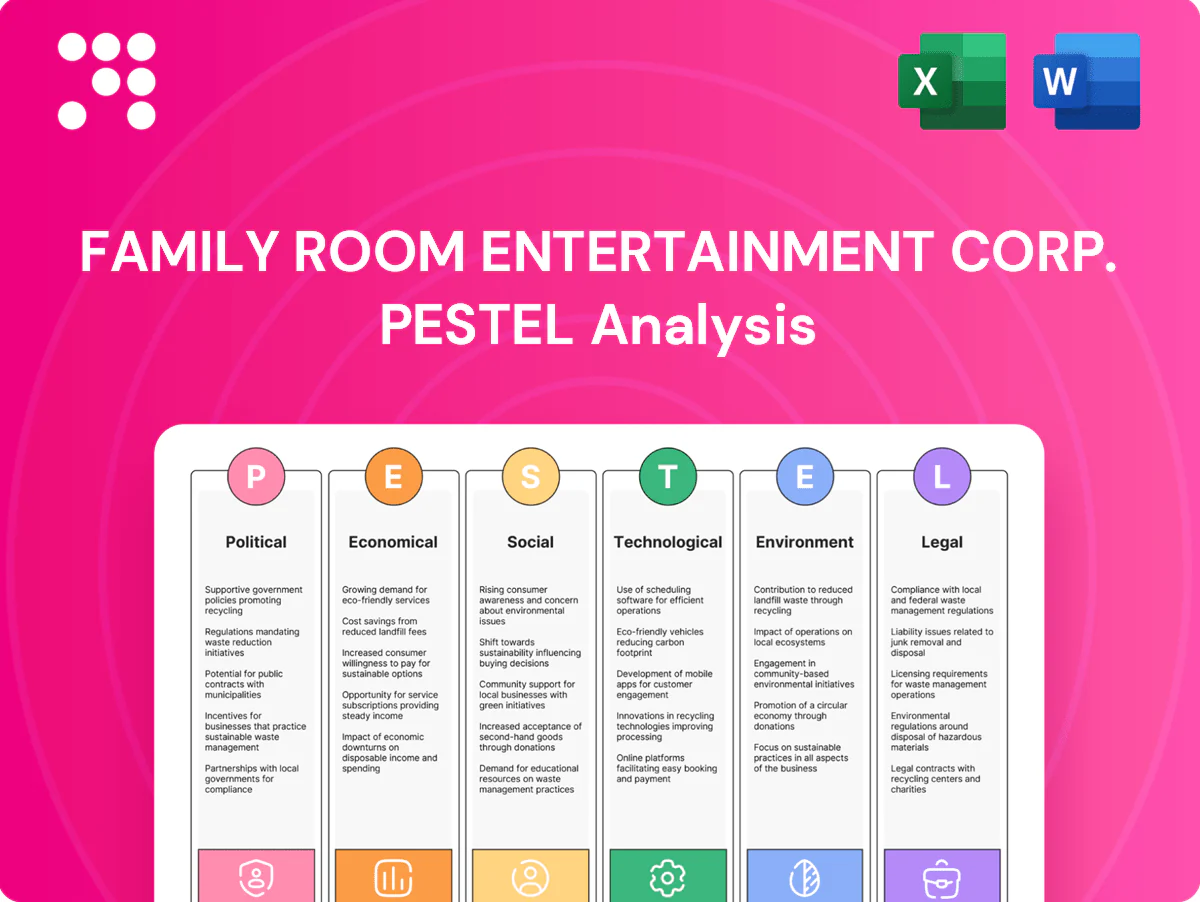
Family Room Entertainment Corp. PESTLE Analysis

Your Competitive Advantage Starts with This Report
Unlock competitive advantage with our targeted PESTLE Analysis of Family Room Entertainment Corp., revealing how political, economic, social, technological, legal, and environmental forces are shaping its prospects. Perfect for investors and strategists, this concise report highlights risks and growth levers to inform smarter decisions. Purchase the full analysis for an instant, actionable deep dive.
Political factors

Content regulation and censorship
Broadcast and streaming rules vary widely by country, from Europe’s Ofcom codes to the US FCC and China’s NRTA (formerly SARFT), which still enforces a 34-title annual foreign film import quota. Restrictions on violence, politics and morality routinely force edits or block distribution, and regulators can impose six-figure fines or licensing delays. Navigating these bodies adds measurable timelines and costs, while proactive compliance shortens clearance windows and protects release schedules.
Production incentives and subsidies
Tax credits and rebates of roughly 15–35% across US and Canadian jurisdictions in 2024 materially drive Family Room Entertainment Corp.'s location and budget efficiency decisions, often improving project cash-on-cash returns. Policy shifts can change ROI assumptions within months, flipping incentives that once added 10–30% to NPV. Securing incentives requires local partners, certified vendors and compliance documentation, with approval timelines commonly 30–120 days. Diversifying across 3+ jurisdictions reduces concentration risk from single-policy reversals.

Geopolitical stability and permits
Unrest, contested elections, and sanctions (notably expanded after Russia’s 2022 invasion) increasingly disrupt shoots and logistics, forcing Family Room Entertainment to factor cross-border delays into budgets across 193 UN member states where permits and visas vary. Film permits and visa approval times correlate with bilateral relations and local governance quality, raising compliance costs and lead times. Political risk ratings drive higher insurance premiums and push producers toward contingency locations and modular schedules to mitigate delays.

Trade policies and tariffs
Equipment imports and customs duties materially affect Family Room Entertainment Corp production costs; global average MFN applied tariff stood at about 2.9% (WTO, 2022), with higher sectoral tariffs raising capex and margins pressure.
Co-production treaties expand distribution and funding access across markets; protectionist measures and rising non-tariff barriers impede cross-border collaboration and release schedules.
Aligning supply chains to low-friction corridors (nearshoring, bonded logistics) preserves margins and reduces customs delays and demurrage exposure.
- Tariff pressure: global MFN avg ~2.9% (WTO 2022)
- Co-production: expands funding/distribution
- Protectionism: risk to cross-border projects
- Supply-chain alignment: lowers customs friction
Public broadcasting and cultural quotas
National content quotas, notably the EU AVMSD 30% rule for on‑demand catalogs, create steady demand for local‑language programming; public funding and grants tied to cultural promotion influence editorial choices and commissioning, shaping Family Room Entertainment Corp.’s slate and margins. Co‑productions are used to meet quotas while expanding reach; tracking legislative updates guides pipeline timing and spend.
- Quota: EU 30%
- Public funding steers commissions
- Co‑prods expand reach, meet rules
- Monitor laws for pipeline planning
Regulatory & tax risk: China 34-title quota, EU 30% local content, 15–35% credits
Fragmented broadcast and censorship rules (US FCC, EU Ofcom, China NRTA 34-title import quota) raise clearance risk and can trigger six-figure fines or bans. 2024 tax incentives (roughly 15–35% in key US/CA jurisdictions) materially alter location ROI and NPV. EU AVMSD 30% local-content quota and global MFN avg tariff ~2.9% (WTO 2022) shape slate, co-productions and supply‑chain choices.
| Factor | Metric | Impact |
|---|---|---|
| Regulation | Six-figure fines | Delay/cost |
| China quota | 34 titles | Distribution cap |
| Tax incentives | 15–35% (2024) | Location ROI |
| EU quota | 30% AVMSD | Local content demand |
| Tariffs | 2.9% (WTO 2022) | Capex pressure |
What is included in the product
 Detailed Word Document
Explores how external macro-environmental factors uniquely affect Family Room Entertainment Corp across Political, Economic, Social, Technological, Environmental and Legal dimensions, with each section backed by relevant data and trends. Designed to equip executives and investors with forward-looking insights to identify threats, opportunities and strategic responses.

 Customizable Excel Spreadsheet
A concise, PESTLE-segmented summary of Family Room Entertainment Corp. that clarifies external risks and opportunities for quick inclusion in presentations, notes, or team planning, enabling fast alignment and tailored annotations by region or business line.
Economic factors

Ad spend and macro cycles
Advertising budgets closely track GDP and consumer confidence; GroupM reported global ad spend rose about 8% in 2024 to roughly $870bn, reflecting recovery in consumer demand. During downturns advertisers shift to cost-efficient unscripted formats, lowering per-hour production costs by up to 40% versus premium scripted. As economies recover, premium scripted commissions reopen, lifting margins. Maintaining a flexible slate smooths revenue volatility across cycles.
Streaming economics and ARPU
Streaming economics hinge on subscriber growth—global paid OTT subscriptions exceeded 1 billion in 2023–24—while churn (commonly 2–4% monthly) and bundling materially drive buyer appetite and valuation multiples. Platforms push cost-per-hour efficiency and bingeable series to boost ARPU and retention. Back-end participation is shrinking as streamers increasingly prefer buyouts, so negotiating performance bonuses preserves upside for content owners.

Currency and cross-border costs
Revenues and expenses in multiple currencies expose Family Room Entertainment to translation and transaction risk as seen when the US Dollar surged (DXY peak in 2022), which compressed production margins and lowered foreign licensing values. Active use of forwards, options and natural offsets (local revenues vs local costs) measurably reduces volatility. Contracting in USD or in local incentive currency further stabilizes cash flows and protects licensing revenue streams.

Labor inflation and scarcity
Crew, talent, and post-production rates have risen following the 2023 WGA/SAG-AFTRA labor actions and new contracts, increasing baseline costs and hourly minimums; overtime premiums (commonly time-and-a-half) during peak windows further inflate budgets. Peak demand windows create scheduling bottlenecks and overtime expense spikes. Training pipelines and regional crews, plus calendaring and multi-project staffing, improve availability and utilization.
- labor: post-2023 contracts raised minimums
- bottlenecks: peak windows → overtime (1.5x)
- availability: regional crews & training pipelines
- utilization: calendaring & multi-project staffing
Financing and cost of capital
- Interest rates: Fed 5.25–5.50%, 10y ≈4.2%
- Impact: higher financing costs, tighter rebates
- Buyer preference: proven IP/formats
- Mitigation: pre-sales, MGs de-risk budgets
- Strategy: maintain lender relationships to accelerate greenlights
Regulatory & tax risk: China 34-title quota, EU 30% local content, 15–35% credits
Ad spend ~$870bn (2024) ties revenue to GDP and ad cycles; unscripted cuts production cost up to 40% in downturns. Global paid OTT >1bn (2023–24) — churn 2–4%/mo drives ARPU focus. Fed funds 5.25–5.50% and 10y ≈4.2% (Jul 2025) raises financing costs; post-2023 labor deals lifted baseline rates and overtime.
| Metric | Value |
|---|---|
| Global ad spend (2024) | $870bn |
| Paid OTT subs | >1bn |
| Fed funds / 10y (Jul 2025) | 5.25–5.50% / 4.2% |
| Production cost cut (unscripted) | ~40% |
Preview the Actual Deliverable
Family Room Entertainment Corp. PESTLE Analysis
This Family Room Entertainment Corp. PESTLE Analysis preview is the exact, fully formatted document you’ll receive after purchase. It contains the complete political, economic, social, technological, legal, and environmental assessment—no placeholders or teasers. The layout, content, and structure shown here are the final downloadable file ready for immediate use.

Original: $10.00
-65%$10.00
$3.50Product Information
Product Information
Shipping & Returns
Shipping & Returns
Description
Your Competitive Advantage Starts with This Report
Unlock competitive advantage with our targeted PESTLE Analysis of Family Room Entertainment Corp., revealing how political, economic, social, technological, legal, and environmental forces are shaping its prospects. Perfect for investors and strategists, this concise report highlights risks and growth levers to inform smarter decisions. Purchase the full analysis for an instant, actionable deep dive.
Political factors
Content regulation and censorship
Broadcast and streaming rules vary widely by country, from Europe’s Ofcom codes to the US FCC and China’s NRTA (formerly SARFT), which still enforces a 34-title annual foreign film import quota. Restrictions on violence, politics and morality routinely force edits or block distribution, and regulators can impose six-figure fines or licensing delays. Navigating these bodies adds measurable timelines and costs, while proactive compliance shortens clearance windows and protects release schedules.
Production incentives and subsidies
Tax credits and rebates of roughly 15–35% across US and Canadian jurisdictions in 2024 materially drive Family Room Entertainment Corp.'s location and budget efficiency decisions, often improving project cash-on-cash returns. Policy shifts can change ROI assumptions within months, flipping incentives that once added 10–30% to NPV. Securing incentives requires local partners, certified vendors and compliance documentation, with approval timelines commonly 30–120 days. Diversifying across 3+ jurisdictions reduces concentration risk from single-policy reversals.
Geopolitical stability and permits
Unrest, contested elections, and sanctions (notably expanded after Russia’s 2022 invasion) increasingly disrupt shoots and logistics, forcing Family Room Entertainment to factor cross-border delays into budgets across 193 UN member states where permits and visas vary. Film permits and visa approval times correlate with bilateral relations and local governance quality, raising compliance costs and lead times. Political risk ratings drive higher insurance premiums and push producers toward contingency locations and modular schedules to mitigate delays.
Trade policies and tariffs
Equipment imports and customs duties materially affect Family Room Entertainment Corp production costs; global average MFN applied tariff stood at about 2.9% (WTO, 2022), with higher sectoral tariffs raising capex and margins pressure.
Co-production treaties expand distribution and funding access across markets; protectionist measures and rising non-tariff barriers impede cross-border collaboration and release schedules.
Aligning supply chains to low-friction corridors (nearshoring, bonded logistics) preserves margins and reduces customs delays and demurrage exposure.
- Tariff pressure: global MFN avg ~2.9% (WTO 2022)
- Co-production: expands funding/distribution
- Protectionism: risk to cross-border projects
- Supply-chain alignment: lowers customs friction
Public broadcasting and cultural quotas
National content quotas, notably the EU AVMSD 30% rule for on‑demand catalogs, create steady demand for local‑language programming; public funding and grants tied to cultural promotion influence editorial choices and commissioning, shaping Family Room Entertainment Corp.’s slate and margins. Co‑productions are used to meet quotas while expanding reach; tracking legislative updates guides pipeline timing and spend.
- Quota: EU 30%
- Public funding steers commissions
- Co‑prods expand reach, meet rules
- Monitor laws for pipeline planning
Regulatory & tax risk: China 34-title quota, EU 30% local content, 15–35% credits
Fragmented broadcast and censorship rules (US FCC, EU Ofcom, China NRTA 34-title import quota) raise clearance risk and can trigger six-figure fines or bans. 2024 tax incentives (roughly 15–35% in key US/CA jurisdictions) materially alter location ROI and NPV. EU AVMSD 30% local-content quota and global MFN avg tariff ~2.9% (WTO 2022) shape slate, co-productions and supply‑chain choices.
| Factor | Metric | Impact |
|---|---|---|
| Regulation | Six-figure fines | Delay/cost |
| China quota | 34 titles | Distribution cap |
| Tax incentives | 15–35% (2024) | Location ROI |
| EU quota | 30% AVMSD | Local content demand |
| Tariffs | 2.9% (WTO 2022) | Capex pressure |
What is included in the product
Detailed Word Document
Explores how external macro-environmental factors uniquely affect Family Room Entertainment Corp across Political, Economic, Social, Technological, Environmental and Legal dimensions, with each section backed by relevant data and trends. Designed to equip executives and investors with forward-looking insights to identify threats, opportunities and strategic responses.
Customizable Excel Spreadsheet
A concise, PESTLE-segmented summary of Family Room Entertainment Corp. that clarifies external risks and opportunities for quick inclusion in presentations, notes, or team planning, enabling fast alignment and tailored annotations by region or business line.
Economic factors
Ad spend and macro cycles
Advertising budgets closely track GDP and consumer confidence; GroupM reported global ad spend rose about 8% in 2024 to roughly $870bn, reflecting recovery in consumer demand. During downturns advertisers shift to cost-efficient unscripted formats, lowering per-hour production costs by up to 40% versus premium scripted. As economies recover, premium scripted commissions reopen, lifting margins. Maintaining a flexible slate smooths revenue volatility across cycles.
Streaming economics and ARPU
Streaming economics hinge on subscriber growth—global paid OTT subscriptions exceeded 1 billion in 2023–24—while churn (commonly 2–4% monthly) and bundling materially drive buyer appetite and valuation multiples. Platforms push cost-per-hour efficiency and bingeable series to boost ARPU and retention. Back-end participation is shrinking as streamers increasingly prefer buyouts, so negotiating performance bonuses preserves upside for content owners.
Currency and cross-border costs
Revenues and expenses in multiple currencies expose Family Room Entertainment to translation and transaction risk as seen when the US Dollar surged (DXY peak in 2022), which compressed production margins and lowered foreign licensing values. Active use of forwards, options and natural offsets (local revenues vs local costs) measurably reduces volatility. Contracting in USD or in local incentive currency further stabilizes cash flows and protects licensing revenue streams.
Labor inflation and scarcity
Crew, talent, and post-production rates have risen following the 2023 WGA/SAG-AFTRA labor actions and new contracts, increasing baseline costs and hourly minimums; overtime premiums (commonly time-and-a-half) during peak windows further inflate budgets. Peak demand windows create scheduling bottlenecks and overtime expense spikes. Training pipelines and regional crews, plus calendaring and multi-project staffing, improve availability and utilization.
- labor: post-2023 contracts raised minimums
- bottlenecks: peak windows → overtime (1.5x)
- availability: regional crews & training pipelines
- utilization: calendaring & multi-project staffing
Financing and cost of capital
- Interest rates: Fed 5.25–5.50%, 10y ≈4.2%
- Impact: higher financing costs, tighter rebates
- Buyer preference: proven IP/formats
- Mitigation: pre-sales, MGs de-risk budgets
- Strategy: maintain lender relationships to accelerate greenlights
Regulatory & tax risk: China 34-title quota, EU 30% local content, 15–35% credits
Ad spend ~$870bn (2024) ties revenue to GDP and ad cycles; unscripted cuts production cost up to 40% in downturns. Global paid OTT >1bn (2023–24) — churn 2–4%/mo drives ARPU focus. Fed funds 5.25–5.50% and 10y ≈4.2% (Jul 2025) raises financing costs; post-2023 labor deals lifted baseline rates and overtime.
| Metric | Value |
|---|---|
| Global ad spend (2024) | $870bn |
| Paid OTT subs | >1bn |
| Fed funds / 10y (Jul 2025) | 5.25–5.50% / 4.2% |
| Production cost cut (unscripted) | ~40% |
Preview the Actual Deliverable
Family Room Entertainment Corp. PESTLE Analysis
This Family Room Entertainment Corp. PESTLE Analysis preview is the exact, fully formatted document you’ll receive after purchase. It contains the complete political, economic, social, technological, legal, and environmental assessment—no placeholders or teasers. The layout, content, and structure shown here are the final downloadable file ready for immediate use.