FINEOS PESTLE Analysis

Plan Smarter. Present Sharper. Compete Stronger.
Unlock strategic foresight with our concise PESTLE Analysis of FINEOS—three to five key-factor insights that reveal how political, economic, social and technological forces are reshaping its market prospects. Ideal for investors and strategists, this brief highlights risks and opportunities you can act on today. Purchase the full analysis for the complete, editable deep-dive and immediately applicable intelligence.
Political factors

Healthcare reform and public policy
Shifts in health and insurance policy—with US national health expenditures topping about $4.5 trillion (2023) and US health spending near 18% of GDP (2022)—reshape product rules, claims eligibility, and reporting needs. FINEOS must track mandates across the US, EU and APAC to keep AdminSuite compliant. Rapid rule changes demand configurable workflows and release agility. Proactive policy mapping can be a competitive differentiator.
Government procurement and funding cycles
Public-sector insurers and quasi-government programs typically run RFP cycles of 12–24 months and tie core-system replacements to annual budget approvals and fiscal-year windows (eg March, June, Sept, Dec). FINEOS can align product roadmaps and pricing to these fiscal calendars to capture procurement windows. Strong references in regulated markets such as Australia, UK and Canada help secure multi-year deals, often spanning 3–7 years.

Data localization and sovereignty
Governments in over 60 jurisdictions now impose data localization or strict residency rules, forcing AdminSuite to support regional clouds and localized processing. This shifts deployment to multi-region architectures, alters vendor partnerships toward local providers, and increases support-model complexity and operating costs. Non-compliance risks disqualification from public tenders and exposure to fines such as GDPR penalties up to €20 million or 4% of global turnover.

Trade relations and cross-border delivery
Geopolitical tensions and tariffs can disrupt global implementation teams and supply chains; UNCTAD reported global FDI fell about 12% to roughly $1.02 trillion in 2023, tightening cross-border project funding. Visa constraints (H-1B cap 85,000) limit specialist mobility for complex FINEOS deployments, so local partners and distributed delivery reduce interruption, while contracts should explicitly price geopolitical risk and contingencies.
- Risk: tariffs/geopolitics → FDI down ~12% (2023)
- Mobility: H-1B cap 85,000 limits specialist moves
- Mitigation: local partners + distributed delivery
- Commercial: contract pricing for geopolitical contingencies
Public digital transformation agendas
National digital strategies in over 100 countries now promote e-ID, e-signatures and open data, enabling smoother integrations and faster onboarding for platforms like FINEOS. Aligning with gov-tech frameworks reduces procurement friction; certification against standards (eg eIDAS in the EU) can open public sector contracts. Active participation in standards bodies lets FINEOS shape requirements and future-proof product roadmaps.
- e-ID / e-signature adoption: over 100 countries
- Benefit: faster onboarding and integration
- Action: certify vs gov-tech frameworks
- Strategy: join standards bodies to influence rules
Policy, data, geopolitics reshape health; $4.5T system impact
Policy shifts in health/insurance (US health spend ~$4.5T in 2023; health ~18% GDP 2022) alter claims, eligibility and reporting. Data localization in 60+ jurisdictions and GDPR fines up to €20M/4% revenue raise compliance costs. Geopolitical headwinds cut FDI ~12% to $1.02T (2023) and mobility (H-1B cap 85,000) limits specialist deployment. e-ID/e-sign adoption in 100+ countries speeds integrations and procurement.
| Factor | Impact | Data | Action |
|---|---|---|---|
| Health policy | Product rules | $4.5T (2023) | Configurable workflows |
| Data residency | Costs/eligibility | 60+ jurisdictions | Multi-region clouds |
| Geopolitics | Delivery risk | FDI $1.02T (2023) | Local partners |
| Gov-tech | Procurement | 100+ e-ID countries | Certify eIDAS |
What is included in the product
 Detailed Word Document
Explores how external macro-environmental factors uniquely affect FINEOS across Political, Economic, Social, Technological, Environmental and Legal dimensions, with data-backed trends and region-specific regulatory context; designed for executives and investors, it provides detailed subpoints, forward-looking insights and clean formatting ready for plans, decks and scenario planning.

 Customizable Excel Spreadsheet
FINEOS PESTLE Analysis delivers a clean, visually segmented summary that’s easily dropped into presentations or shared across teams, and includes editable notes so stakeholders can tailor external risk insights to their region or business line for faster alignment in planning sessions.
Economic factors

Insurer IT spending cycles
Macroeconomic headwinds directly shape insurer IT spending cycles: insurers typically allocate about 8–12% of IT budgets to core-system modernization, with digital transformation representing roughly 35–45% of tech spend in 2024.
In downturns up to 60% of modernization projects are re-scoped toward clear ROI and cost takeout, prioritizing short payback and automation.
FINEOS should emphasize measurable efficiency gains in claims and billing—claims automation can reduce cost per claim by 20–40%—to align with buyer priorities.
Offering flexible contracting and consumption-based pricing sustains sales pipeline through cycles by lowering procurement barriers and enabling phased deployments.
Interest rates and investment returns
Higher policy rates (Fed funds ~5.25–5.50% mid‑2025, 10‑yr ~4.2%) lift insurer investment income, supporting capex and M&A. Lower rates compress investment margins, increasing pressure to cut operating costs. FINEOS can position AdminSuite as a margin‑resilience lever; value cases should quantify expense ratio cuts of ~1–2ppt and combined‑ratio improvements of ~100–250bps.

Employment trends and group benefits demand
Labor market shifts—US unemployment around 3.7% in 2024 (BLS)—drive demand for group and voluntary benefits as employers compete for talent. Growth in gig and hybrid work expands complex eligibility and billing needs, with gig workforce estimates rising into the mid-teens of employed adults. FINEOS can leverage absence and leave management plus dynamic rating and billing to support new benefit designs.

M&A and carrier consolidation
Consolidation among carriers in 2024 accelerated platform rationalization, with buyers prioritizing scalable, multi-entity administration—Celent’s 2024 survey found ~72% of insurers listing core admin consolidation as a top initiative. FINEOS can position faster migration and portfolio roll-ups to capture deal-driven demand; post-merger integration services further deepen account value and recurring revenue.
- Opportunity: platform rationalization
- Demand: scalable multi-entity admin (~72% priority)
- FINEOS play: faster migration + portfolio roll-ups
- Value add: post-merger integration services
SaaS pricing and total cost of ownership
Customers now scrutinize subscription, usage and implementation costs, often demanding ROI within 12 months and transparent TCO comparisons versus legacy on‑prem solutions; clear TCO advantages materially strengthen FINEOS adoption. Modular rollouts (pilot to full production) enable staged value realization, with pilots typically delivering measurable benefits in 3–6 months. Introducing outcome‑based pricing tied to KPIs aligns economics with customer success and reduces buyer friction.
- Subscription vs TCO: demonstrate 12‑month payback
- Modular rollouts: pilot 3–6 months to prove value
- Outcome pricing: link fees to KPIs to de‑risk buyer
Policy, data, geopolitics reshape health; $4.5T system impact
Macroeconomic cycles drive insurer IT spend: 8–12% on core modernization, 35–45% digital tech share in 2024. Higher rates (Fed funds ~5.25–5.50% mid‑2025, 10‑yr ~4.2%) support capex and M&A; lower rates pressure margins. Buyers demand 12‑month ROI, pilots 3–6 months, claims automation cuts cost/claim 20–40%.
| Metric | Value |
|---|---|
| Core IT spend | 8–12% |
| Digital tech share | 35–45% (2024) |
| Fed funds | 5.25–5.50% (mid‑2025) |
Preview Before You Purchase
FINEOS PESTLE Analysis
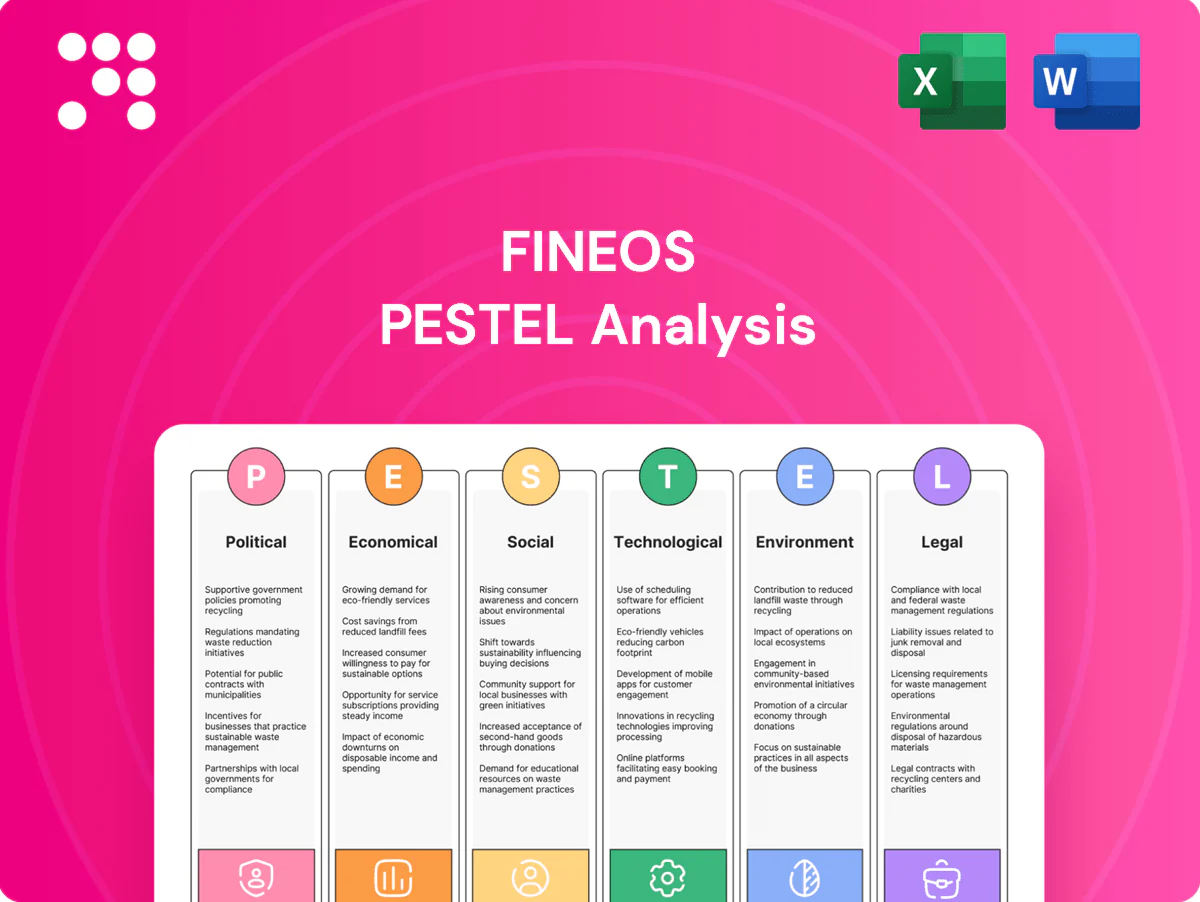
The FINEOS PESTLE Analysis preview shown here is the exact document you’ll receive after purchase—fully formatted, professionally structured, and ready to use. It contains the same content, layout, and insights visible now, with no placeholders or edits required. After checkout you’ll instantly download this finished file and can apply its strategic findings immediately.

Product Information
Product Information
Shipping & Returns
Shipping & Returns
Description
Plan Smarter. Present Sharper. Compete Stronger.
Unlock strategic foresight with our concise PESTLE Analysis of FINEOS—three to five key-factor insights that reveal how political, economic, social and technological forces are reshaping its market prospects. Ideal for investors and strategists, this brief highlights risks and opportunities you can act on today. Purchase the full analysis for the complete, editable deep-dive and immediately applicable intelligence.
Political factors
Healthcare reform and public policy
Shifts in health and insurance policy—with US national health expenditures topping about $4.5 trillion (2023) and US health spending near 18% of GDP (2022)—reshape product rules, claims eligibility, and reporting needs. FINEOS must track mandates across the US, EU and APAC to keep AdminSuite compliant. Rapid rule changes demand configurable workflows and release agility. Proactive policy mapping can be a competitive differentiator.
Government procurement and funding cycles
Public-sector insurers and quasi-government programs typically run RFP cycles of 12–24 months and tie core-system replacements to annual budget approvals and fiscal-year windows (eg March, June, Sept, Dec). FINEOS can align product roadmaps and pricing to these fiscal calendars to capture procurement windows. Strong references in regulated markets such as Australia, UK and Canada help secure multi-year deals, often spanning 3–7 years.
Data localization and sovereignty
Governments in over 60 jurisdictions now impose data localization or strict residency rules, forcing AdminSuite to support regional clouds and localized processing. This shifts deployment to multi-region architectures, alters vendor partnerships toward local providers, and increases support-model complexity and operating costs. Non-compliance risks disqualification from public tenders and exposure to fines such as GDPR penalties up to €20 million or 4% of global turnover.
Trade relations and cross-border delivery
Geopolitical tensions and tariffs can disrupt global implementation teams and supply chains; UNCTAD reported global FDI fell about 12% to roughly $1.02 trillion in 2023, tightening cross-border project funding. Visa constraints (H-1B cap 85,000) limit specialist mobility for complex FINEOS deployments, so local partners and distributed delivery reduce interruption, while contracts should explicitly price geopolitical risk and contingencies.
- Risk: tariffs/geopolitics → FDI down ~12% (2023)
- Mobility: H-1B cap 85,000 limits specialist moves
- Mitigation: local partners + distributed delivery
- Commercial: contract pricing for geopolitical contingencies
Public digital transformation agendas
National digital strategies in over 100 countries now promote e-ID, e-signatures and open data, enabling smoother integrations and faster onboarding for platforms like FINEOS. Aligning with gov-tech frameworks reduces procurement friction; certification against standards (eg eIDAS in the EU) can open public sector contracts. Active participation in standards bodies lets FINEOS shape requirements and future-proof product roadmaps.
- e-ID / e-signature adoption: over 100 countries
- Benefit: faster onboarding and integration
- Action: certify vs gov-tech frameworks
- Strategy: join standards bodies to influence rules
Policy, data, geopolitics reshape health; $4.5T system impact
Policy shifts in health/insurance (US health spend ~$4.5T in 2023; health ~18% GDP 2022) alter claims, eligibility and reporting. Data localization in 60+ jurisdictions and GDPR fines up to €20M/4% revenue raise compliance costs. Geopolitical headwinds cut FDI ~12% to $1.02T (2023) and mobility (H-1B cap 85,000) limits specialist deployment. e-ID/e-sign adoption in 100+ countries speeds integrations and procurement.
| Factor | Impact | Data | Action |
|---|---|---|---|
| Health policy | Product rules | $4.5T (2023) | Configurable workflows |
| Data residency | Costs/eligibility | 60+ jurisdictions | Multi-region clouds |
| Geopolitics | Delivery risk | FDI $1.02T (2023) | Local partners |
| Gov-tech | Procurement | 100+ e-ID countries | Certify eIDAS |
What is included in the product
Detailed Word Document
Explores how external macro-environmental factors uniquely affect FINEOS across Political, Economic, Social, Technological, Environmental and Legal dimensions, with data-backed trends and region-specific regulatory context; designed for executives and investors, it provides detailed subpoints, forward-looking insights and clean formatting ready for plans, decks and scenario planning.
Customizable Excel Spreadsheet
FINEOS PESTLE Analysis delivers a clean, visually segmented summary that’s easily dropped into presentations or shared across teams, and includes editable notes so stakeholders can tailor external risk insights to their region or business line for faster alignment in planning sessions.
Economic factors
Insurer IT spending cycles
Macroeconomic headwinds directly shape insurer IT spending cycles: insurers typically allocate about 8–12% of IT budgets to core-system modernization, with digital transformation representing roughly 35–45% of tech spend in 2024.
In downturns up to 60% of modernization projects are re-scoped toward clear ROI and cost takeout, prioritizing short payback and automation.
FINEOS should emphasize measurable efficiency gains in claims and billing—claims automation can reduce cost per claim by 20–40%—to align with buyer priorities.
Offering flexible contracting and consumption-based pricing sustains sales pipeline through cycles by lowering procurement barriers and enabling phased deployments.
Interest rates and investment returns
Higher policy rates (Fed funds ~5.25–5.50% mid‑2025, 10‑yr ~4.2%) lift insurer investment income, supporting capex and M&A. Lower rates compress investment margins, increasing pressure to cut operating costs. FINEOS can position AdminSuite as a margin‑resilience lever; value cases should quantify expense ratio cuts of ~1–2ppt and combined‑ratio improvements of ~100–250bps.
Employment trends and group benefits demand
Labor market shifts—US unemployment around 3.7% in 2024 (BLS)—drive demand for group and voluntary benefits as employers compete for talent. Growth in gig and hybrid work expands complex eligibility and billing needs, with gig workforce estimates rising into the mid-teens of employed adults. FINEOS can leverage absence and leave management plus dynamic rating and billing to support new benefit designs.
M&A and carrier consolidation
Consolidation among carriers in 2024 accelerated platform rationalization, with buyers prioritizing scalable, multi-entity administration—Celent’s 2024 survey found ~72% of insurers listing core admin consolidation as a top initiative. FINEOS can position faster migration and portfolio roll-ups to capture deal-driven demand; post-merger integration services further deepen account value and recurring revenue.
- Opportunity: platform rationalization
- Demand: scalable multi-entity admin (~72% priority)
- FINEOS play: faster migration + portfolio roll-ups
- Value add: post-merger integration services
SaaS pricing and total cost of ownership
Customers now scrutinize subscription, usage and implementation costs, often demanding ROI within 12 months and transparent TCO comparisons versus legacy on‑prem solutions; clear TCO advantages materially strengthen FINEOS adoption. Modular rollouts (pilot to full production) enable staged value realization, with pilots typically delivering measurable benefits in 3–6 months. Introducing outcome‑based pricing tied to KPIs aligns economics with customer success and reduces buyer friction.
- Subscription vs TCO: demonstrate 12‑month payback
- Modular rollouts: pilot 3–6 months to prove value
- Outcome pricing: link fees to KPIs to de‑risk buyer
Policy, data, geopolitics reshape health; $4.5T system impact
Macroeconomic cycles drive insurer IT spend: 8–12% on core modernization, 35–45% digital tech share in 2024. Higher rates (Fed funds ~5.25–5.50% mid‑2025, 10‑yr ~4.2%) support capex and M&A; lower rates pressure margins. Buyers demand 12‑month ROI, pilots 3–6 months, claims automation cuts cost/claim 20–40%.
| Metric | Value |
|---|---|
| Core IT spend | 8–12% |
| Digital tech share | 35–45% (2024) |
| Fed funds | 5.25–5.50% (mid‑2025) |
Preview Before You Purchase
FINEOS PESTLE Analysis
The FINEOS PESTLE Analysis preview shown here is the exact document you’ll receive after purchase—fully formatted, professionally structured, and ready to use. It contains the same content, layout, and insights visible now, with no placeholders or edits required. After checkout you’ll instantly download this finished file and can apply its strategic findings immediately.