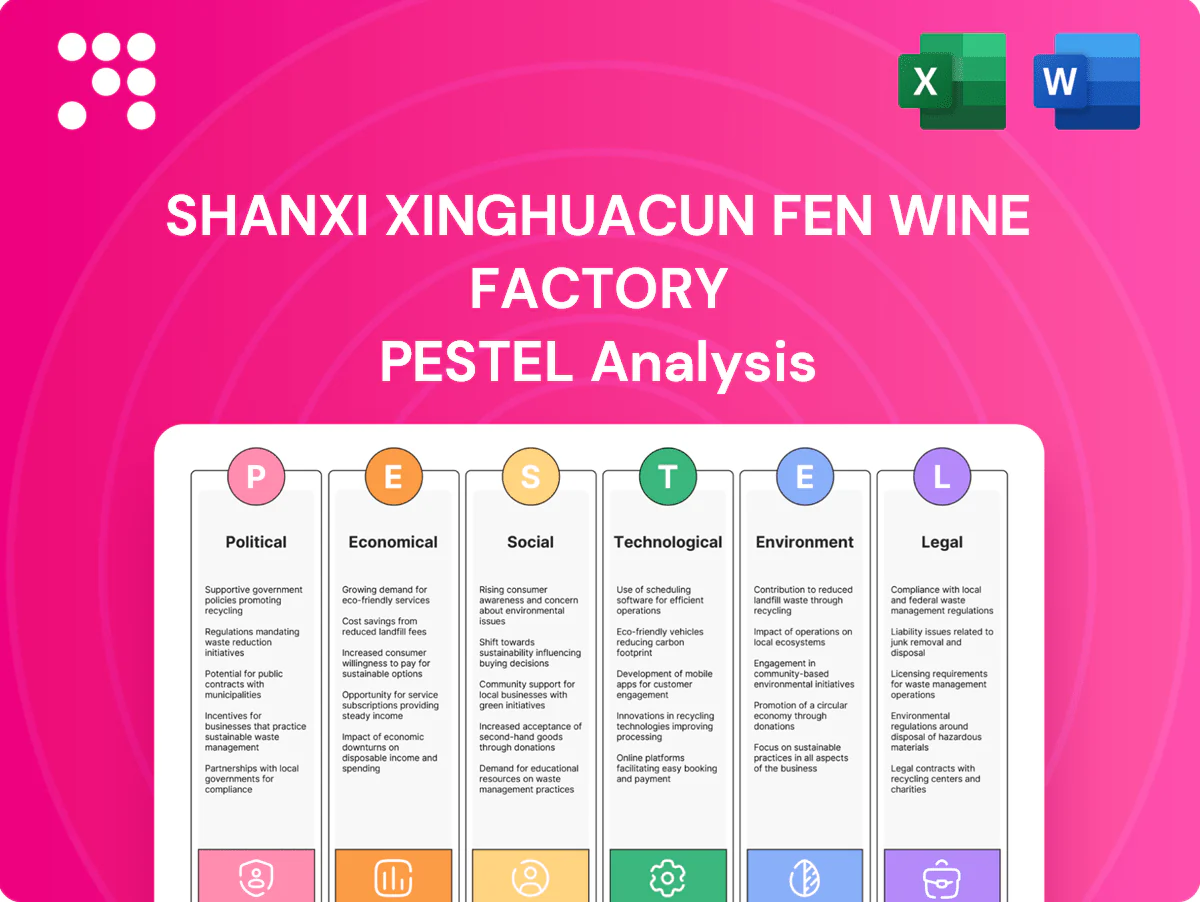
Shanxi Xinghuacun Fen Wine Factory PESTLE Analysis

Plan Smarter. Present Sharper. Compete Stronger.
Our PESTLE snapshot for Shanxi Xinghuacun Fen Wine Factory reveals how regulatory shifts, economic cycles, social tastes, and environmental pressures are reshaping its competitive edge. We translate these external trends into practical risks and opportunities for investors and strategists. Ready-made and research-backed, the full PESTLE gives detailed, actionable insights. Purchase now to download the complete analysis instantly.
Political factors

Central alcohol policy direction
China’s central government—notably the 2013 anti-corruption campaign and the 2016 Healthy China 2030 plan—sets broad alcohol policies that shape production quotas, distribution rules and public-health priorities. Stricter oversight has curbed high-end gifting and can limit marketing intensity and channel expansion for brands like Shanxi Xinghuacun Fen Wine. The company must align with national guidance on responsible consumption. Policy stability enables long-term capacity and brand investment planning.
Provincial support and regional development
Provincial support can translate into incentives for heritage brands, tourism integration and industrial upgrading, leveraging Shanxi’s 2023 GDP of about 2.27 trillion CNY to co-finance regional projects. Local approvals remain decisive for land use, plant expansions and environmental permits, often determining project timelines. Collaboration with authorities amplifies Fenjiu’s cultural branding and destination marketing. Policy shifts can change subsidy availability and accelerate or delay investment schedules.

Geopolitics and trade conditions
Export markets for baijiu hinge on bilateral relations, tariffs and customs rules, with supply chains sensitive to trade barriers. Geopolitical tensions raise compliance costs and hinder international distribution and brand-building. The company must diversify shipping routes and ensure jurisdictional compliance. Diplomatic normalization and trade pacts like RCEP (covering ~30% of world GDP and 2.3 billion people) can unlock visibility and preferential tariff access.

Public health and anti-alcohol campaigns
Government-led public health and anti-alcohol campaigns are tightening promotion and urging moderation, constraining advertising creativity and event sponsorships; Fenjiu must foreground cultural heritage, product quality and responsible drinking to maintain market access. Aligning marketing with health messaging reduces regulatory risk and helps preserve consumer trust.
- Limit promotions: adapt advertising to stricter standards
- Brand focus: heritage and quality over flashy campaigns
- Risk control: responsible-drinking alignment lowers compliance exposure
Government procurement and state-enterprise norms
Government procurement rules and anti-extravagance directives have shifted premium baijiu demand away from official banquets and gifting, forcing Fenjiu to rebalance away from institutional channels toward retail and personal consumption while maintaining premium positioning. Transparent distribution and direct-to-consumer channels help mitigate sudden policy-driven volatility in institutional orders.
- policy-impact: reduced institutional purchases
- channel-strategy: strengthen retail and DTC
- brand-positioning: preserve premium image
- risk-mitigation: transparent sales channels
Reforms push liquor makers to retail/DTC; Shanxi backing and RCEP boost export access
Central anti-corruption reforms (since 2013) and Healthy China 2030 tighten promotion, gifting and marketing, forcing Fenjiu to shift from institutional to retail/DTC channels. Provincial support in Shanxi (2023 GDP ~2.27 trillion CNY) enables tourism and industrial upgrades but local permits determine pace. Exports depend on trade ties; RCEP covers ~2.3 billion people (~30% global GDP), easing regional access.
| Factor | Key data |
|---|---|
| Shanxi GDP (2023) | ≈2.27 trillion CNY |
| RCEP reach | ~2.3bn people, ~30% global GDP |
| Policy drivers | Anti-corruption since 2013; Healthy China 2030 |
What is included in the product
 Detailed Word Document
Provides a concise PESTLE evaluation of Shanxi Xinghuacun Fen Wine Factory, examining Political, Economic, Social, Technological, Environmental and Legal forces with region-specific data and trend drivers; designed for executives and investors to identify risks, opportunities and scenario-based strategic actions to enhance competitive resilience and growth.

 Customizable Excel Spreadsheet
A concise, visually segmented PESTLE summary of Shanxi Xinghuacun Fen Wine Factory that clarifies regulatory, economic, social, technological, environmental and legal risks and opportunities for quick inclusion in presentations or strategy sessions, editable for local context and easily shared across teams.
Economic factors

GDP growth and income elasticity
Baijiu consumption tracks income and business activity: China GDP rose 5.2% in 2023, supporting banquet and premium demand, but forecasts for 2024–25 around 4.8–5.0% imply slower premium upgrades. Core mass segments have remained resilient in the post‑COVID recovery, and Fenjiu’s broad portfolio hedges across price tiers. Regional 2024 divergence—coastal outperformance versus inland—calls for tailored channel strategies.
Premiumization and trading-up
Consumers continue trading up for brand heritage, quality assurance and gifting value, driving double-digit value growth in premium baijiu in 2024 and expanding Fenjiu’s addressable market. Light-aroma Fenjiu can capture share with clear tiered SKUs and limited editions—recent limited drops sold out within weeks, lifting visibility. Margin-accretive premium lines boost profitability and marketing ROI while careful price architecture preserves affordability and brand equity.

Input cost volatility (sorghum, energy, packaging)
Sorghum, grain, energy and glass/paper costs move with commodity cycles—price swings of 20–40% are common—putting pressure on gross margins and forcing pricing, SKU mix or efficiency responses. Brent crude averaged about $86/barrel in 2024, feeding higher energy and transport input costs. Long-term supplier contracts and inventory buffers help stabilize production and cash flow. Energy-efficiency upgrades (lighting, boilers) lower utility operating leverage and cut variable cost exposure.

Channel mix and retail economics
On-trade, off-trade and e-commerce show distinct margins and velocity: e-commerce benefits from scale but lower basket margins, while on-trade drives premium velocity; China online retail of physical goods reached 13.3 trillion RMB in 2023 (NBS). Distributor terms and rebates shift sell-in versus sell-out; DTC can lift gross margin but requires digital capability and fulfillment; regional wholesalers remain vital for banquet and corporate channels.
- Channel: on-trade/off-trade/e‑commerce
- Stat: 13.3 trillion RMB online retail (2023)
- Distributor rebates drive sell-in
- DTC boosts GP if digital ready
- Wholesalers key for banquets
FX and export market development
Currency swings directly affect export pricing and overseas margins; RMB traded around 7.3 per USD in 2024, so a weaker RMB can improve competitiveness but raises costs for imported distillation equipment and packaging. Shanxi Xinghuacun can use FX hedging and natural operational offsets to stabilize reported results; early-stage export growth is typically volume-light and brand-building heavy.
- FX impact: pricing & margins
- 2024 USD/CNY ~7.3
- Weaker RMB aids exports, ups import costs
- Hedging & natural offsets stabilize P&L
- Exports: low volume, high brand investment
Reforms push liquor makers to retail/DTC; Shanxi backing and RCEP boost export access
China GDP 5.2% in 2023 with 2024–25 forecasts ~4.8–5.0% moderates premium upgrade pace; Fenjiu’s tiered portfolio offsets regional divergence. Premium baijiu value growth remained double-digit in 2024, boosting margins; commodity swings (sorghum, glass, energy) and Brent ~$86/bbl in 2024 squeeze costs. RMB ~7.3/USD in 2024 affects exports and capex imports; DTC lifts GP if digital-ready.
| Metric | Value (year) |
|---|---|
| China GDP | 5.2% (2023) |
| GDP forecast | 4.8–5.0% (2024–25) |
| Online retail | 13.3 tn RMB (2023) |
| Brent | $86/bbl (2024) |
| USD/CNY | ~7.3 (2024) |
Preview the Actual Deliverable
Shanxi Xinghuacun Fen Wine Factory PESTLE Analysis
The preview shown here is the exact Shanxi Xinghuacun Fen Wine Factory PESTLE Analysis you’ll receive after purchase—fully formatted and ready to use. The content, layout, and structure visible are the final file delivered upon checkout. No placeholders or surprises; download immediately after payment.

Original: $10.00
-65%$10.00
$3.50Product Information
Product Information
Shipping & Returns
Shipping & Returns
Description
Plan Smarter. Present Sharper. Compete Stronger.
Our PESTLE snapshot for Shanxi Xinghuacun Fen Wine Factory reveals how regulatory shifts, economic cycles, social tastes, and environmental pressures are reshaping its competitive edge. We translate these external trends into practical risks and opportunities for investors and strategists. Ready-made and research-backed, the full PESTLE gives detailed, actionable insights. Purchase now to download the complete analysis instantly.
Political factors
Central alcohol policy direction
China’s central government—notably the 2013 anti-corruption campaign and the 2016 Healthy China 2030 plan—sets broad alcohol policies that shape production quotas, distribution rules and public-health priorities. Stricter oversight has curbed high-end gifting and can limit marketing intensity and channel expansion for brands like Shanxi Xinghuacun Fen Wine. The company must align with national guidance on responsible consumption. Policy stability enables long-term capacity and brand investment planning.
Provincial support and regional development
Provincial support can translate into incentives for heritage brands, tourism integration and industrial upgrading, leveraging Shanxi’s 2023 GDP of about 2.27 trillion CNY to co-finance regional projects. Local approvals remain decisive for land use, plant expansions and environmental permits, often determining project timelines. Collaboration with authorities amplifies Fenjiu’s cultural branding and destination marketing. Policy shifts can change subsidy availability and accelerate or delay investment schedules.
Geopolitics and trade conditions
Export markets for baijiu hinge on bilateral relations, tariffs and customs rules, with supply chains sensitive to trade barriers. Geopolitical tensions raise compliance costs and hinder international distribution and brand-building. The company must diversify shipping routes and ensure jurisdictional compliance. Diplomatic normalization and trade pacts like RCEP (covering ~30% of world GDP and 2.3 billion people) can unlock visibility and preferential tariff access.
Public health and anti-alcohol campaigns
Government-led public health and anti-alcohol campaigns are tightening promotion and urging moderation, constraining advertising creativity and event sponsorships; Fenjiu must foreground cultural heritage, product quality and responsible drinking to maintain market access. Aligning marketing with health messaging reduces regulatory risk and helps preserve consumer trust.
- Limit promotions: adapt advertising to stricter standards
- Brand focus: heritage and quality over flashy campaigns
- Risk control: responsible-drinking alignment lowers compliance exposure
Government procurement and state-enterprise norms
Government procurement rules and anti-extravagance directives have shifted premium baijiu demand away from official banquets and gifting, forcing Fenjiu to rebalance away from institutional channels toward retail and personal consumption while maintaining premium positioning. Transparent distribution and direct-to-consumer channels help mitigate sudden policy-driven volatility in institutional orders.
- policy-impact: reduced institutional purchases
- channel-strategy: strengthen retail and DTC
- brand-positioning: preserve premium image
- risk-mitigation: transparent sales channels
Reforms push liquor makers to retail/DTC; Shanxi backing and RCEP boost export access
Central anti-corruption reforms (since 2013) and Healthy China 2030 tighten promotion, gifting and marketing, forcing Fenjiu to shift from institutional to retail/DTC channels. Provincial support in Shanxi (2023 GDP ~2.27 trillion CNY) enables tourism and industrial upgrades but local permits determine pace. Exports depend on trade ties; RCEP covers ~2.3 billion people (~30% global GDP), easing regional access.
| Factor | Key data |
|---|---|
| Shanxi GDP (2023) | ≈2.27 trillion CNY |
| RCEP reach | ~2.3bn people, ~30% global GDP |
| Policy drivers | Anti-corruption since 2013; Healthy China 2030 |
What is included in the product
Detailed Word Document
Provides a concise PESTLE evaluation of Shanxi Xinghuacun Fen Wine Factory, examining Political, Economic, Social, Technological, Environmental and Legal forces with region-specific data and trend drivers; designed for executives and investors to identify risks, opportunities and scenario-based strategic actions to enhance competitive resilience and growth.
Customizable Excel Spreadsheet
A concise, visually segmented PESTLE summary of Shanxi Xinghuacun Fen Wine Factory that clarifies regulatory, economic, social, technological, environmental and legal risks and opportunities for quick inclusion in presentations or strategy sessions, editable for local context and easily shared across teams.
Economic factors
GDP growth and income elasticity
Baijiu consumption tracks income and business activity: China GDP rose 5.2% in 2023, supporting banquet and premium demand, but forecasts for 2024–25 around 4.8–5.0% imply slower premium upgrades. Core mass segments have remained resilient in the post‑COVID recovery, and Fenjiu’s broad portfolio hedges across price tiers. Regional 2024 divergence—coastal outperformance versus inland—calls for tailored channel strategies.
Premiumization and trading-up
Consumers continue trading up for brand heritage, quality assurance and gifting value, driving double-digit value growth in premium baijiu in 2024 and expanding Fenjiu’s addressable market. Light-aroma Fenjiu can capture share with clear tiered SKUs and limited editions—recent limited drops sold out within weeks, lifting visibility. Margin-accretive premium lines boost profitability and marketing ROI while careful price architecture preserves affordability and brand equity.
Input cost volatility (sorghum, energy, packaging)
Sorghum, grain, energy and glass/paper costs move with commodity cycles—price swings of 20–40% are common—putting pressure on gross margins and forcing pricing, SKU mix or efficiency responses. Brent crude averaged about $86/barrel in 2024, feeding higher energy and transport input costs. Long-term supplier contracts and inventory buffers help stabilize production and cash flow. Energy-efficiency upgrades (lighting, boilers) lower utility operating leverage and cut variable cost exposure.
Channel mix and retail economics
On-trade, off-trade and e-commerce show distinct margins and velocity: e-commerce benefits from scale but lower basket margins, while on-trade drives premium velocity; China online retail of physical goods reached 13.3 trillion RMB in 2023 (NBS). Distributor terms and rebates shift sell-in versus sell-out; DTC can lift gross margin but requires digital capability and fulfillment; regional wholesalers remain vital for banquet and corporate channels.
- Channel: on-trade/off-trade/e‑commerce
- Stat: 13.3 trillion RMB online retail (2023)
- Distributor rebates drive sell-in
- DTC boosts GP if digital ready
- Wholesalers key for banquets
FX and export market development
Currency swings directly affect export pricing and overseas margins; RMB traded around 7.3 per USD in 2024, so a weaker RMB can improve competitiveness but raises costs for imported distillation equipment and packaging. Shanxi Xinghuacun can use FX hedging and natural operational offsets to stabilize reported results; early-stage export growth is typically volume-light and brand-building heavy.
- FX impact: pricing & margins
- 2024 USD/CNY ~7.3
- Weaker RMB aids exports, ups import costs
- Hedging & natural offsets stabilize P&L
- Exports: low volume, high brand investment
Reforms push liquor makers to retail/DTC; Shanxi backing and RCEP boost export access
China GDP 5.2% in 2023 with 2024–25 forecasts ~4.8–5.0% moderates premium upgrade pace; Fenjiu’s tiered portfolio offsets regional divergence. Premium baijiu value growth remained double-digit in 2024, boosting margins; commodity swings (sorghum, glass, energy) and Brent ~$86/bbl in 2024 squeeze costs. RMB ~7.3/USD in 2024 affects exports and capex imports; DTC lifts GP if digital-ready.
| Metric | Value (year) |
|---|---|
| China GDP | 5.2% (2023) |
| GDP forecast | 4.8–5.0% (2024–25) |
| Online retail | 13.3 tn RMB (2023) |
| Brent | $86/bbl (2024) |
| USD/CNY | ~7.3 (2024) |
Preview the Actual Deliverable
Shanxi Xinghuacun Fen Wine Factory PESTLE Analysis
The preview shown here is the exact Shanxi Xinghuacun Fen Wine Factory PESTLE Analysis you’ll receive after purchase—fully formatted and ready to use. The content, layout, and structure visible are the final file delivered upon checkout. No placeholders or surprises; download immediately after payment.