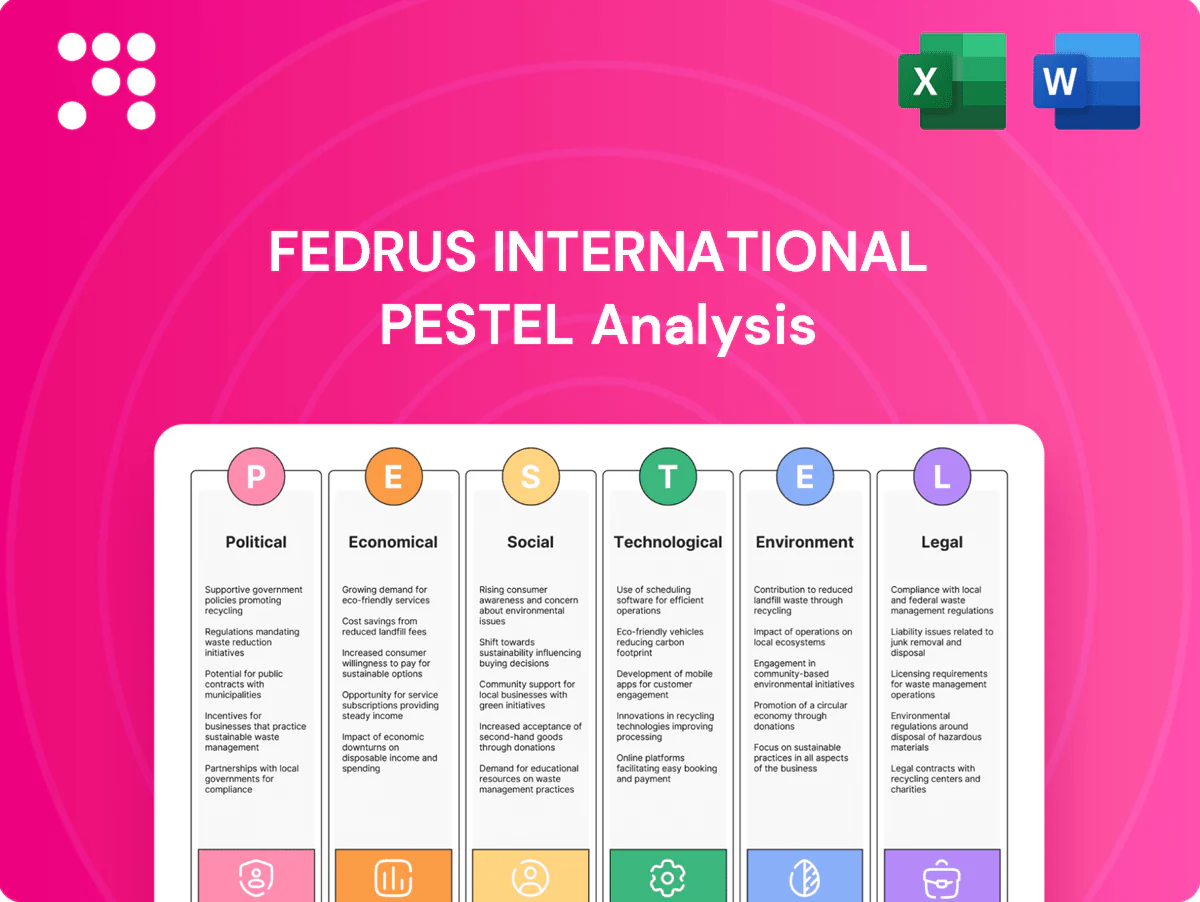
Fedrus International PESTLE Analysis

Your Shortcut to Market Insight Starts Here
Gain a strategic edge with our PESTLE Analysis of Fedrus International — uncover how political, economic, social, technological, legal, and environmental forces shape its trajectory. Ideal for investors and strategists, this ready-to-use report translates trends into clear decisions. Download the full analysis now for actionable insights and editable deliverables.
Political factors

Public procurement and infrastructure
Government-funded housing, schools and infrastructure projects drive demand for roofing and facade systems; public procurement represents roughly 12% of global GDP (OECD) and the EU public procurement market is about €2 trillion annually (European Commission). Procurement rules increasingly favor local sourcing, certified products and whole-life-cost bids, affecting supplier selection. Shifts in public budgets or stimulus plans can alter order pipelines within quarters, so Fedrus must align products and pricing with tender criteria and framework agreements.
Energy-efficiency policy incentives
EU and national incentives under the Renovation Wave (aiming to double renovation rates and renovate ~35 million buildings by 2030) and EPBD revisions boost insulation and membrane upgrades in a sector responsible for ~40% of EU energy use and ~36% of CO2. Subsidies, tax credits and renovation mandates create predictable demand waves, while tightening energy performance standards favor integrated envelope solutions. Policy stability is critical for Fedrus International’s long-term capacity planning and capex timing.

Trade policy and cross-border logistics
Tariffs, customs checks and rules-of-origin raise material costs and extend delivery times; container spot rates surged above $10,000 per FEU at the 2021 peak, illustrating logistics cost volatility. Brexit-like frictions rerouted supply chains and UK goods trade with the EU dropped about 15% in 2021 versus 2019 (ONS). Heavy import dependence for bitumen and polymers increases geopolitical exposure; diversified sourcing and regional suppliers cut disruption risk.

Geopolitical energy dynamics
Geopolitical energy dynamics drive feedstock cost volatility for membrane production as oil-linked naphtha and gas-derived ethylene inputs respond to supply shocks; Brent averaged roughly $80–90/bbl in 2024–H1 2025, keeping upstream cost pressure elevated. Political tensions that disrupt oil and gas flows ripple into bituminous and synthetic inputs, prompting governments to deploy price caps or export controls seen since 2022. Robust scenario planning and hedging reduce margin swings and protect procurement strategies.
- feedstock sensitivity: oil/gas price swings directly raise membrane input costs
- policy risk: price caps/export controls can constrain exports and domestic supply
- mitigation: scenario planning, forward contracts and vertical sourcing stabilize margins
Local permitting and urban policies
City-level rules on façades, reflectivity and green roofs increasingly drive Fedrus product selection and coatings; municipal codes and heritage overlays limit system profiles and installation methods, while urban densification raises demand for low-profile solutions. Municipal resilience plans are prioritizing roof upgrades as urban populations reach about 57% by 2025 (UN WUP 2022) and EU mitigation targets of 55% by 2030 boost retrofit funding.
Renovation wave fuels policy-led demand for low-profile high-performance roofing
Public procurement (≈12% global GDP; EU ≈€2tn) and Renovation Wave (≈35M buildings by 2030) create sizable, policy-driven demand for roofing/façades. Energy/CO2 rules (buildings ≈40% EU energy, ≈36% CO2) and municipal codes push low-profile, high-performance systems. Tariffs, Brexit impacts and feedstock volatility (Brent ≈$80–90/bbl in 2024–H1 2025) raise cost and delivery risk, so Fedrus must align sourcing, tenders and hedging.
| Metric | Value |
|---|---|
| Public procurement | ≈12% global GDP; EU €2tn |
| Renovation target | ≈35M buildings by 2030 |
| Buildings share | ≈40% energy; ≈36% CO2 (EU) |
| Brent | $80–90/bbl (2024–H1 2025) |
What is included in the product
 Detailed Word Document
Explores how macro-environmental factors uniquely affect Fedrus International across Political, Economic, Social, Technological, Environmental, and Legal dimensions, with data-backed insights, detailed sub-points, and forward-looking scenarios to support executives, consultants, and entrepreneurs in spotting risks, opportunities, and strategies aligned with current market and regulatory dynamics.

 Customizable Excel Spreadsheet
A concise, visually segmented PESTLE summary of Fedrus International that’s easily dropped into presentations, editable for regional or business-line context, and shareable across teams to streamline external risk discussions and strategic planning.
Economic factors

Construction cycle sensitivity
Construction-cycle swings drive core volumes: residential housing starts averaged ~1.3m annualized in the US during 2024 while global construction output was about $13.8trn in 2023, signaling sensitivity to new-build trends. Slowdowns in new builds are often offset by renovation and maintenance spending, which rose in many markets in 2024. Backlog health and installer capacity, typically measured in months of work, mirror broader macro momentum. A balanced portfolio across residential, commercial and renovation reduces revenue volatility.
Interest rates and financing
Higher policy rates (US fed funds ~5.25-5.50% in 2024) and 30-year mortgage rates near 6.5-7% have dampened real-estate development and large reroofing capex; demand is muted. Deferred maintenance may cluster when rates ease. In tight cycles supplier credit and working capital tighten, so Fedrus must optimize cash conversion and monitor receivables quality closely.

Raw material price volatility
Raw material costs—bitumen, polymers (TPO, PVC, EPDM), metals and insulation—tracked energy/commodity swings, with Brent averaging about $86/bbl in 2024 driving polymer feedstock moves and metal prices up ~10% YoY. Cost pass-through lags eroded margins in 2024, while Fedrus used hedging, indexed contracts and product-mix optimization to protect EBITDA. Dual-sourcing cut supply-shock exposure.

FX exposure in sourcing and sales
Multi-country sourcing and sales create currency mismatches as inputs billed in USD/EUR while end-market revenues are local; Fedrus faced margin swings in 2024 when the US dollar index averaged about 104, intensifying relative pricing pressure against local rivals. Natural hedges and FX forwards reduced volatility, while transparent surcharge clauses preserved price integrity and customer trust.
- FX risk: USD index ~104 in 2024
- Mitigation: natural hedges + forwards
- Pricing: transparent surcharges
Logistics and distribution costs
Transport fuel volatility (fuel often accounts for 15-25% of delivered cost) and capacity constraints raise delivered cost for bulky insulation; regional warehousing and last-mile efficiency are critical for rolls that drive volume-to-weight inefficiencies. Inventory placement near demand centers cuts stockouts by as much as 30-40%, while route optimization typically trims transport costs 10-15%, sustaining service levels.
- fuel-share: 15-25%
- stockout reduction: 30-40%
- route savings: 10-15%
- focus: regional warehousing, last-mile
Renovation wave fuels policy-led demand for low-profile high-performance roofing
Construction cyclical: US housing starts ~1.3m (2024); global construction ~$13.8trn (2023), renovation offsets slow new-builds. Rates & demand: fed funds ~5.25-5.50% (2024), 30y mortgage ~6.5-7% — dampens development. Costs & FX: Brent ~$86/bbl (2024), USD index ~104; fuel 15-25% of delivery cost; hedges, regional warehousing, and surcharges mitigate pressure.
| Metric | Value |
|---|---|
| US housing starts (2024) | ~1.3m |
| Global construction (2023) | $13.8trn |
| Fed funds (2024) | 5.25-5.50% |
| Brent (2024) | $86/bbl |
| USD index (2024) | ~104 |
Preview the Actual Deliverable
Fedrus International PESTLE Analysis
The preview shown here is the exact Fedrus International PESTLE Analysis you’ll receive after purchase—fully formatted, professionally structured, and ready to use. This is the real file with complete content and no placeholders or teasers. After checkout you’ll instantly download this same finished document with the layout, analysis, and appendices intact.

Original: $10.00
-65%$10.00
$3.50Product Information
Product Information
Shipping & Returns
Shipping & Returns
Description
Your Shortcut to Market Insight Starts Here
Gain a strategic edge with our PESTLE Analysis of Fedrus International — uncover how political, economic, social, technological, legal, and environmental forces shape its trajectory. Ideal for investors and strategists, this ready-to-use report translates trends into clear decisions. Download the full analysis now for actionable insights and editable deliverables.
Political factors
Public procurement and infrastructure
Government-funded housing, schools and infrastructure projects drive demand for roofing and facade systems; public procurement represents roughly 12% of global GDP (OECD) and the EU public procurement market is about €2 trillion annually (European Commission). Procurement rules increasingly favor local sourcing, certified products and whole-life-cost bids, affecting supplier selection. Shifts in public budgets or stimulus plans can alter order pipelines within quarters, so Fedrus must align products and pricing with tender criteria and framework agreements.
Energy-efficiency policy incentives
EU and national incentives under the Renovation Wave (aiming to double renovation rates and renovate ~35 million buildings by 2030) and EPBD revisions boost insulation and membrane upgrades in a sector responsible for ~40% of EU energy use and ~36% of CO2. Subsidies, tax credits and renovation mandates create predictable demand waves, while tightening energy performance standards favor integrated envelope solutions. Policy stability is critical for Fedrus International’s long-term capacity planning and capex timing.
Trade policy and cross-border logistics
Tariffs, customs checks and rules-of-origin raise material costs and extend delivery times; container spot rates surged above $10,000 per FEU at the 2021 peak, illustrating logistics cost volatility. Brexit-like frictions rerouted supply chains and UK goods trade with the EU dropped about 15% in 2021 versus 2019 (ONS). Heavy import dependence for bitumen and polymers increases geopolitical exposure; diversified sourcing and regional suppliers cut disruption risk.
Geopolitical energy dynamics
Geopolitical energy dynamics drive feedstock cost volatility for membrane production as oil-linked naphtha and gas-derived ethylene inputs respond to supply shocks; Brent averaged roughly $80–90/bbl in 2024–H1 2025, keeping upstream cost pressure elevated. Political tensions that disrupt oil and gas flows ripple into bituminous and synthetic inputs, prompting governments to deploy price caps or export controls seen since 2022. Robust scenario planning and hedging reduce margin swings and protect procurement strategies.
- feedstock sensitivity: oil/gas price swings directly raise membrane input costs
- policy risk: price caps/export controls can constrain exports and domestic supply
- mitigation: scenario planning, forward contracts and vertical sourcing stabilize margins
Local permitting and urban policies
City-level rules on façades, reflectivity and green roofs increasingly drive Fedrus product selection and coatings; municipal codes and heritage overlays limit system profiles and installation methods, while urban densification raises demand for low-profile solutions. Municipal resilience plans are prioritizing roof upgrades as urban populations reach about 57% by 2025 (UN WUP 2022) and EU mitigation targets of 55% by 2030 boost retrofit funding.
Renovation wave fuels policy-led demand for low-profile high-performance roofing
Public procurement (≈12% global GDP; EU ≈€2tn) and Renovation Wave (≈35M buildings by 2030) create sizable, policy-driven demand for roofing/façades. Energy/CO2 rules (buildings ≈40% EU energy, ≈36% CO2) and municipal codes push low-profile, high-performance systems. Tariffs, Brexit impacts and feedstock volatility (Brent ≈$80–90/bbl in 2024–H1 2025) raise cost and delivery risk, so Fedrus must align sourcing, tenders and hedging.
| Metric | Value |
|---|---|
| Public procurement | ≈12% global GDP; EU €2tn |
| Renovation target | ≈35M buildings by 2030 |
| Buildings share | ≈40% energy; ≈36% CO2 (EU) |
| Brent | $80–90/bbl (2024–H1 2025) |
What is included in the product
Detailed Word Document
Explores how macro-environmental factors uniquely affect Fedrus International across Political, Economic, Social, Technological, Environmental, and Legal dimensions, with data-backed insights, detailed sub-points, and forward-looking scenarios to support executives, consultants, and entrepreneurs in spotting risks, opportunities, and strategies aligned with current market and regulatory dynamics.
Customizable Excel Spreadsheet
A concise, visually segmented PESTLE summary of Fedrus International that’s easily dropped into presentations, editable for regional or business-line context, and shareable across teams to streamline external risk discussions and strategic planning.
Economic factors
Construction cycle sensitivity
Construction-cycle swings drive core volumes: residential housing starts averaged ~1.3m annualized in the US during 2024 while global construction output was about $13.8trn in 2023, signaling sensitivity to new-build trends. Slowdowns in new builds are often offset by renovation and maintenance spending, which rose in many markets in 2024. Backlog health and installer capacity, typically measured in months of work, mirror broader macro momentum. A balanced portfolio across residential, commercial and renovation reduces revenue volatility.
Interest rates and financing
Higher policy rates (US fed funds ~5.25-5.50% in 2024) and 30-year mortgage rates near 6.5-7% have dampened real-estate development and large reroofing capex; demand is muted. Deferred maintenance may cluster when rates ease. In tight cycles supplier credit and working capital tighten, so Fedrus must optimize cash conversion and monitor receivables quality closely.
Raw material price volatility
Raw material costs—bitumen, polymers (TPO, PVC, EPDM), metals and insulation—tracked energy/commodity swings, with Brent averaging about $86/bbl in 2024 driving polymer feedstock moves and metal prices up ~10% YoY. Cost pass-through lags eroded margins in 2024, while Fedrus used hedging, indexed contracts and product-mix optimization to protect EBITDA. Dual-sourcing cut supply-shock exposure.
FX exposure in sourcing and sales
Multi-country sourcing and sales create currency mismatches as inputs billed in USD/EUR while end-market revenues are local; Fedrus faced margin swings in 2024 when the US dollar index averaged about 104, intensifying relative pricing pressure against local rivals. Natural hedges and FX forwards reduced volatility, while transparent surcharge clauses preserved price integrity and customer trust.
- FX risk: USD index ~104 in 2024
- Mitigation: natural hedges + forwards
- Pricing: transparent surcharges
Logistics and distribution costs
Transport fuel volatility (fuel often accounts for 15-25% of delivered cost) and capacity constraints raise delivered cost for bulky insulation; regional warehousing and last-mile efficiency are critical for rolls that drive volume-to-weight inefficiencies. Inventory placement near demand centers cuts stockouts by as much as 30-40%, while route optimization typically trims transport costs 10-15%, sustaining service levels.
- fuel-share: 15-25%
- stockout reduction: 30-40%
- route savings: 10-15%
- focus: regional warehousing, last-mile
Renovation wave fuels policy-led demand for low-profile high-performance roofing
Construction cyclical: US housing starts ~1.3m (2024); global construction ~$13.8trn (2023), renovation offsets slow new-builds. Rates & demand: fed funds ~5.25-5.50% (2024), 30y mortgage ~6.5-7% — dampens development. Costs & FX: Brent ~$86/bbl (2024), USD index ~104; fuel 15-25% of delivery cost; hedges, regional warehousing, and surcharges mitigate pressure.
| Metric | Value |
|---|---|
| US housing starts (2024) | ~1.3m |
| Global construction (2023) | $13.8trn |
| Fed funds (2024) | 5.25-5.50% |
| Brent (2024) | $86/bbl |
| USD index (2024) | ~104 |
Preview the Actual Deliverable
Fedrus International PESTLE Analysis
The preview shown here is the exact Fedrus International PESTLE Analysis you’ll receive after purchase—fully formatted, professionally structured, and ready to use. This is the real file with complete content and no placeholders or teasers. After checkout you’ll instantly download this same finished document with the layout, analysis, and appendices intact.