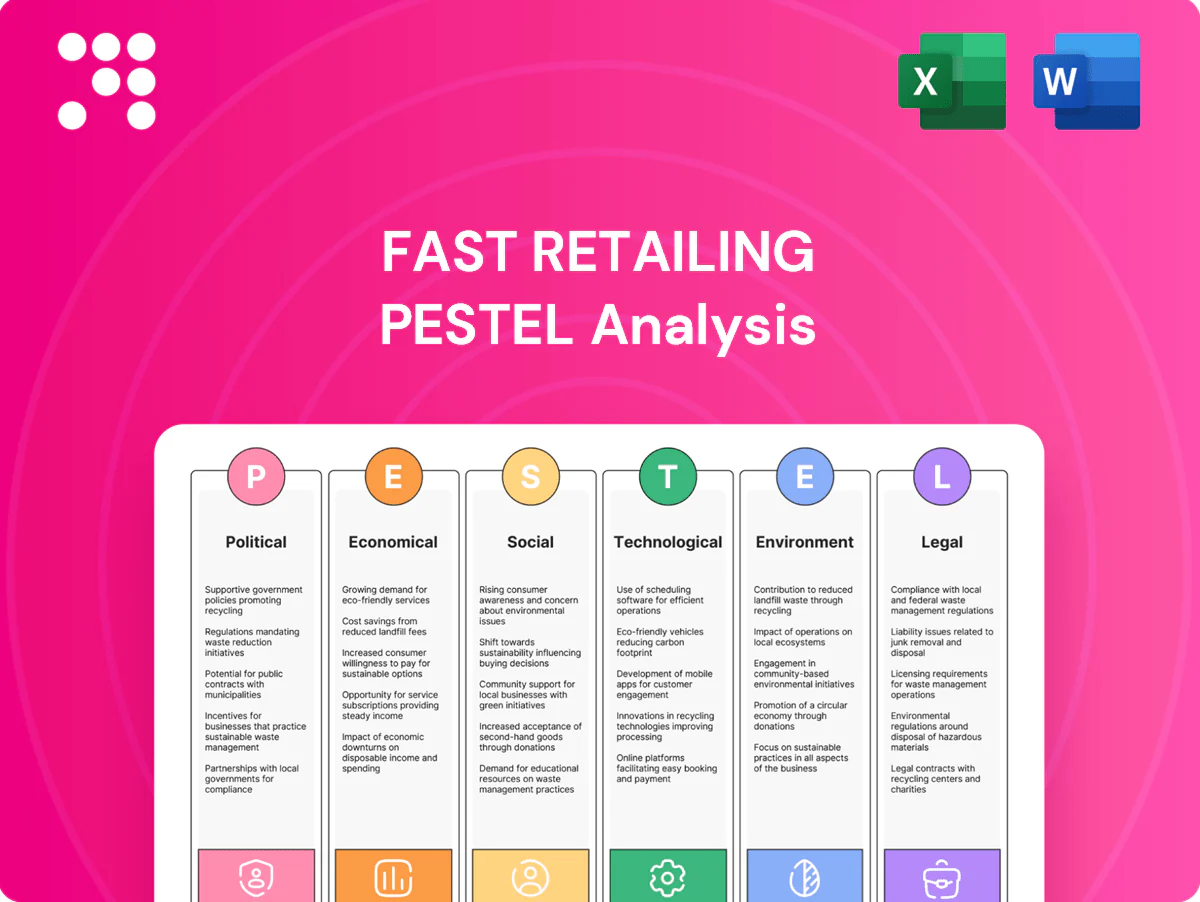
Fast Retailing PESTLE Analysis

Make Smarter Strategic Decisions with a Complete PESTEL View
Discover how political shifts, economic cycles, social trends, technological innovation, legal changes, and environmental pressures converge to shape Fast Retailing’s strategy and performance; our PESTLE distills complex external forces into clear implications. Ideal for investors, strategists, and consultants, the full analysis offers data-driven recommendations and ready-to-use slides. Buy the complete report now to fast-track smarter decisions.
Political factors

Trade policy and tariffs
Shifts in US-China tariffs, including Section 301 levies of up to 25% introduced in 2018–19, and preferential deals like the EU–Vietnam EVFTA (phased tariff cuts since 2020) can materially change landed apparel costs. Tariff spikes or new agreements reshape sourcing economics and retail pricing. Fast Retailing must hedge exposure by diversifying origins and routing. Proactive engagement with trade bodies helps preserve market access.
Geopolitical supply risk
Regional tensions in East and South Asia threaten factories, ports and logistics for Fast Retailing, risking delays to inventory flows that depend on concentrated supplier bases in Vietnam and Bangladesh, the latter employing over 4 million garment workers in its RMG sector.
Political instability or strikes in supplier nations have historically triggered shipment delays and cost spikes, so Fast Retailing emphasizes scenario planning and multi-country sourcing to reduce concentration risk.
Nearshoring options into markets closer to demand hubs (e.g., Southeast Asia to Mexico/Latin America for the Americas) can add resilience for key markets and shorten lead times.

Industrial policy and reshoring
Government incentives such as the US Inflation Reduction Act's roughly $369 billion and the CHIPS Act's $52 billion boost shift cost curves toward domestic, automated advanced manufacturing, favoring higher-value textiles. Subsidies and tax credits in 2024 make near-demand production more cost-competitive, which Fast Retailing can tap to expand automated capacity. This strategy also reduces cross-border friction and tariff exposure.

Minimum wage and labor politics
Rapid minimum-wage hikes in key production hubs raise unit costs for Fast Retailing, with the company reporting consolidated revenue of ¥2.68 trillion in FY2023 while sourcing heavily from Bangladesh, Vietnam and China.
Political campaigns for living wages and unionization — notably in Bangladesh where RMG exports hit about US$48.8 billion in 2023 — push suppliers toward higher pay and compliance costs.
A balanced wage strategy preserves brand equity and supply stability; transparent communication with investors, NGOs and suppliers manages stakeholder expectations and reputational risk.
- Minimum-wage volatility: impacts unit cost
- Living wage/union pressure: supplier compliance
- Balanced wages: brand equity & stability
- Transparency: stakeholder expectation management
Customs and market access
Non-tariff barriers, customs delays and rules-of-origin complexity materially extend lead times for Fast Retailing, forcing buffer inventory and slower replenishment cycles; the company cites supply-chain resilience as a priority. Preferential trade schemes — over 350 RTAs in force globally (WTO, 2024) — demand meticulous documentation to secure tariff relief. Investing in automated trade-compliance systems speeds clearance, protecting margins and replenishment cadence.
- Non-tariff barriers: extend lead times
- 350+ RTAs (WTO, 2024): documentation critical
- Compliance systems: faster clearance
- Outcome: protected margins & steady replenishment
25% US tariffs push nearshoring; $421B IRA/CHIPS spurs automation
Trade-policy shifts (US 25% Section 301, 350+ RTAs) and tariff deals reshape sourcing costs; Fast Retailing (¥2.68T FY2023) diversifies origins and nearshores to cut tariff exposure. Geo-political tensions/strikes in Vietnam/Bangladesh (RMG exports US$48.8B 2023) raise delay and wage risks; IRA/CHIPS subsidies (~$421B) make automated near-demand production more viable.
| Metric | Value |
|---|---|
| Fast Retailing rev FY2023 | ¥2.68T |
| Bangladesh RMG 2023 | US$48.8B |
| RTAs | 350+ |
| US tariffs | up to 25% |
What is included in the product
 Detailed Word Document
Explores how macro-environmental factors uniquely affect Fast Retailing across Political, Economic, Social, Technological, Environmental, and Legal dimensions, with data-backed trends and region-specific examples to identify threats and opportunities for strategy and investment decisions.

 Customizable Excel Spreadsheet
Visually segmented by PESTLE categories for Fast Retailing, enabling rapid interpretation of political, economic, social, technological, legal and environmental impacts on its global operations—ideal for quick decision-making in meetings or slide decks.
Economic factors

FX volatility (JPY, USD, CNY)
FX volatility—USD/JPY around 150 in mid‑2024–2025 and USD/CNY near 7.2–7.4—shapes Fast Retailing’s sourcing costs, overseas revenues and translation effects. A weak yen inflates foreign sales in yen terms but raises yen‑priced import and fabric costs. Dynamic pricing, active hedging and currency clauses in procurement contracts are essential to smooth earnings and protect margins.
Global inflation and input costs
Rising energy, freight and cotton/polyester costs have lifted COGS for Fast Retailing; container freight rates fell over 80% from 2021 peaks by 2024 but remain above pre-pandemic norms, while cotton prices eased roughly 30% from 2022 highs into 2024. Value positioning limits direct cost-pass-through, so Fast Retailing leans on mix optimization and design-to-cost to protect price points. Long-term supplier partnerships and volume contracts help stabilize input pricing and procurement risk.

Consumer spending cycles
Macro slowdowns (IMF 2024 global growth 3.1%) dampen discretionary apparel demand, pressuring premium and fashion-led categories. Essentials and value segments historically show stronger resilience than luxury, allowing Fast Retailing’s basics and functional lines to capture trade-down shoppers. The group cites inventory agility and quick replenishment as tools to preserve cash in downturns and exploit rebounds.

Logistics and freight dynamics
Ocean capacity normalization cut spot rates by roughly 80% from 2021 peaks by 2024, yet port congestion and surcharges still intermittently extend lead times and raise landed costs; Fast Retailing shifts high-turn SKUs to air, where 2024 rates remained about double 2019 levels, protecting sales at margin cost. Improved S&OP and regional DC rollouts reduce premium freight reliance and last-mile costs and delivery times.
- Ocean capacity: spot rates down ~80% vs 2021
- Port congestion/surcharges: intermittent lead-time spikes
- Modal shift: air rates ~2x 2019 in 2024
- S&OP/DCs: lower premium freight and last-mile costs
Emerging market growth
Fast Retailing can capture expanding demand as ASEAN, India and China show strong consumer growth—IMF 2024 GDP forecasts: India ~6.5%, China ~5.2%, ASEAN ~4.8%—supporting larger middle classes and higher apparel spend; store rollouts with localized assortments drive scale, while phased entry mitigates currency and regulatory risk and digital-first channels reduce capital intensity.
- Market growth: IMF 2024 (%): India 6.5, China 5.2, ASEAN 4.8
- Strategy: local assortments + phased rollouts
- Risk: currency & regulatory exposure
- Capex: digital-first lowers store capex
25% US tariffs push nearshoring; $421B IRA/CHIPS spurs automation
FX (USD/JPY ~150; USD/CNY 7.2–7.4) drives translation gains but raises yen costs; hedging and contract clauses mitigate impact. Input inflation (energy, freight, cotton down ~30% from 2022) pressures COGS; high-turn SKUs moved to air (2024 rates ~2x 2019). IMF 2024 growth: Global 3.1%, India 6.5%, China 5.2%, ASEAN 4.8% supports expansion via localized assortments and digital channels.
| Metric | 2024/2025 |
|---|---|
| USD/JPY | ~150 |
| USD/CNY | 7.2–7.4 |
| Global growth (IMF) | 3.1% |
| India / China / ASEAN | 6.5% / 5.2% / 4.8% |
| Container spot vs 2021 | ~-80% |
| Cotton vs 2022 | ~-30% |
| Air freight vs 2019 | ~+100% |
Full Version Awaits
Fast Retailing PESTLE Analysis
The preview shown here is the exact Fast Retailing PESTLE analysis you’ll receive after purchase—fully formatted and ready to use. The content, layout and strategic insights visible are final with no placeholders or teasers. You’ll download this same professional file immediately after payment.

Product Information
Product Information
Shipping & Returns
Shipping & Returns
Description
Make Smarter Strategic Decisions with a Complete PESTEL View
Discover how political shifts, economic cycles, social trends, technological innovation, legal changes, and environmental pressures converge to shape Fast Retailing’s strategy and performance; our PESTLE distills complex external forces into clear implications. Ideal for investors, strategists, and consultants, the full analysis offers data-driven recommendations and ready-to-use slides. Buy the complete report now to fast-track smarter decisions.
Political factors
Trade policy and tariffs
Shifts in US-China tariffs, including Section 301 levies of up to 25% introduced in 2018–19, and preferential deals like the EU–Vietnam EVFTA (phased tariff cuts since 2020) can materially change landed apparel costs. Tariff spikes or new agreements reshape sourcing economics and retail pricing. Fast Retailing must hedge exposure by diversifying origins and routing. Proactive engagement with trade bodies helps preserve market access.
Geopolitical supply risk
Regional tensions in East and South Asia threaten factories, ports and logistics for Fast Retailing, risking delays to inventory flows that depend on concentrated supplier bases in Vietnam and Bangladesh, the latter employing over 4 million garment workers in its RMG sector.
Political instability or strikes in supplier nations have historically triggered shipment delays and cost spikes, so Fast Retailing emphasizes scenario planning and multi-country sourcing to reduce concentration risk.
Nearshoring options into markets closer to demand hubs (e.g., Southeast Asia to Mexico/Latin America for the Americas) can add resilience for key markets and shorten lead times.
Industrial policy and reshoring
Government incentives such as the US Inflation Reduction Act's roughly $369 billion and the CHIPS Act's $52 billion boost shift cost curves toward domestic, automated advanced manufacturing, favoring higher-value textiles. Subsidies and tax credits in 2024 make near-demand production more cost-competitive, which Fast Retailing can tap to expand automated capacity. This strategy also reduces cross-border friction and tariff exposure.
Minimum wage and labor politics
Rapid minimum-wage hikes in key production hubs raise unit costs for Fast Retailing, with the company reporting consolidated revenue of ¥2.68 trillion in FY2023 while sourcing heavily from Bangladesh, Vietnam and China.
Political campaigns for living wages and unionization — notably in Bangladesh where RMG exports hit about US$48.8 billion in 2023 — push suppliers toward higher pay and compliance costs.
A balanced wage strategy preserves brand equity and supply stability; transparent communication with investors, NGOs and suppliers manages stakeholder expectations and reputational risk.
- Minimum-wage volatility: impacts unit cost
- Living wage/union pressure: supplier compliance
- Balanced wages: brand equity & stability
- Transparency: stakeholder expectation management
Customs and market access
Non-tariff barriers, customs delays and rules-of-origin complexity materially extend lead times for Fast Retailing, forcing buffer inventory and slower replenishment cycles; the company cites supply-chain resilience as a priority. Preferential trade schemes — over 350 RTAs in force globally (WTO, 2024) — demand meticulous documentation to secure tariff relief. Investing in automated trade-compliance systems speeds clearance, protecting margins and replenishment cadence.
- Non-tariff barriers: extend lead times
- 350+ RTAs (WTO, 2024): documentation critical
- Compliance systems: faster clearance
- Outcome: protected margins & steady replenishment
25% US tariffs push nearshoring; $421B IRA/CHIPS spurs automation
Trade-policy shifts (US 25% Section 301, 350+ RTAs) and tariff deals reshape sourcing costs; Fast Retailing (¥2.68T FY2023) diversifies origins and nearshores to cut tariff exposure. Geo-political tensions/strikes in Vietnam/Bangladesh (RMG exports US$48.8B 2023) raise delay and wage risks; IRA/CHIPS subsidies (~$421B) make automated near-demand production more viable.
| Metric | Value |
|---|---|
| Fast Retailing rev FY2023 | ¥2.68T |
| Bangladesh RMG 2023 | US$48.8B |
| RTAs | 350+ |
| US tariffs | up to 25% |
What is included in the product
Detailed Word Document
Explores how macro-environmental factors uniquely affect Fast Retailing across Political, Economic, Social, Technological, Environmental, and Legal dimensions, with data-backed trends and region-specific examples to identify threats and opportunities for strategy and investment decisions.
Customizable Excel Spreadsheet
Visually segmented by PESTLE categories for Fast Retailing, enabling rapid interpretation of political, economic, social, technological, legal and environmental impacts on its global operations—ideal for quick decision-making in meetings or slide decks.
Economic factors
FX volatility (JPY, USD, CNY)
FX volatility—USD/JPY around 150 in mid‑2024–2025 and USD/CNY near 7.2–7.4—shapes Fast Retailing’s sourcing costs, overseas revenues and translation effects. A weak yen inflates foreign sales in yen terms but raises yen‑priced import and fabric costs. Dynamic pricing, active hedging and currency clauses in procurement contracts are essential to smooth earnings and protect margins.
Global inflation and input costs
Rising energy, freight and cotton/polyester costs have lifted COGS for Fast Retailing; container freight rates fell over 80% from 2021 peaks by 2024 but remain above pre-pandemic norms, while cotton prices eased roughly 30% from 2022 highs into 2024. Value positioning limits direct cost-pass-through, so Fast Retailing leans on mix optimization and design-to-cost to protect price points. Long-term supplier partnerships and volume contracts help stabilize input pricing and procurement risk.
Consumer spending cycles
Macro slowdowns (IMF 2024 global growth 3.1%) dampen discretionary apparel demand, pressuring premium and fashion-led categories. Essentials and value segments historically show stronger resilience than luxury, allowing Fast Retailing’s basics and functional lines to capture trade-down shoppers. The group cites inventory agility and quick replenishment as tools to preserve cash in downturns and exploit rebounds.
Logistics and freight dynamics
Ocean capacity normalization cut spot rates by roughly 80% from 2021 peaks by 2024, yet port congestion and surcharges still intermittently extend lead times and raise landed costs; Fast Retailing shifts high-turn SKUs to air, where 2024 rates remained about double 2019 levels, protecting sales at margin cost. Improved S&OP and regional DC rollouts reduce premium freight reliance and last-mile costs and delivery times.
- Ocean capacity: spot rates down ~80% vs 2021
- Port congestion/surcharges: intermittent lead-time spikes
- Modal shift: air rates ~2x 2019 in 2024
- S&OP/DCs: lower premium freight and last-mile costs
Emerging market growth
Fast Retailing can capture expanding demand as ASEAN, India and China show strong consumer growth—IMF 2024 GDP forecasts: India ~6.5%, China ~5.2%, ASEAN ~4.8%—supporting larger middle classes and higher apparel spend; store rollouts with localized assortments drive scale, while phased entry mitigates currency and regulatory risk and digital-first channels reduce capital intensity.
- Market growth: IMF 2024 (%): India 6.5, China 5.2, ASEAN 4.8
- Strategy: local assortments + phased rollouts
- Risk: currency & regulatory exposure
- Capex: digital-first lowers store capex
25% US tariffs push nearshoring; $421B IRA/CHIPS spurs automation
FX (USD/JPY ~150; USD/CNY 7.2–7.4) drives translation gains but raises yen costs; hedging and contract clauses mitigate impact. Input inflation (energy, freight, cotton down ~30% from 2022) pressures COGS; high-turn SKUs moved to air (2024 rates ~2x 2019). IMF 2024 growth: Global 3.1%, India 6.5%, China 5.2%, ASEAN 4.8% supports expansion via localized assortments and digital channels.
| Metric | 2024/2025 |
|---|---|
| USD/JPY | ~150 |
| USD/CNY | 7.2–7.4 |
| Global growth (IMF) | 3.1% |
| India / China / ASEAN | 6.5% / 5.2% / 4.8% |
| Container spot vs 2021 | ~-80% |
| Cotton vs 2022 | ~-30% |
| Air freight vs 2019 | ~+100% |
Full Version Awaits
Fast Retailing PESTLE Analysis
The preview shown here is the exact Fast Retailing PESTLE analysis you’ll receive after purchase—fully formatted and ready to use. The content, layout and strategic insights visible are final with no placeholders or teasers. You’ll download this same professional file immediately after payment.