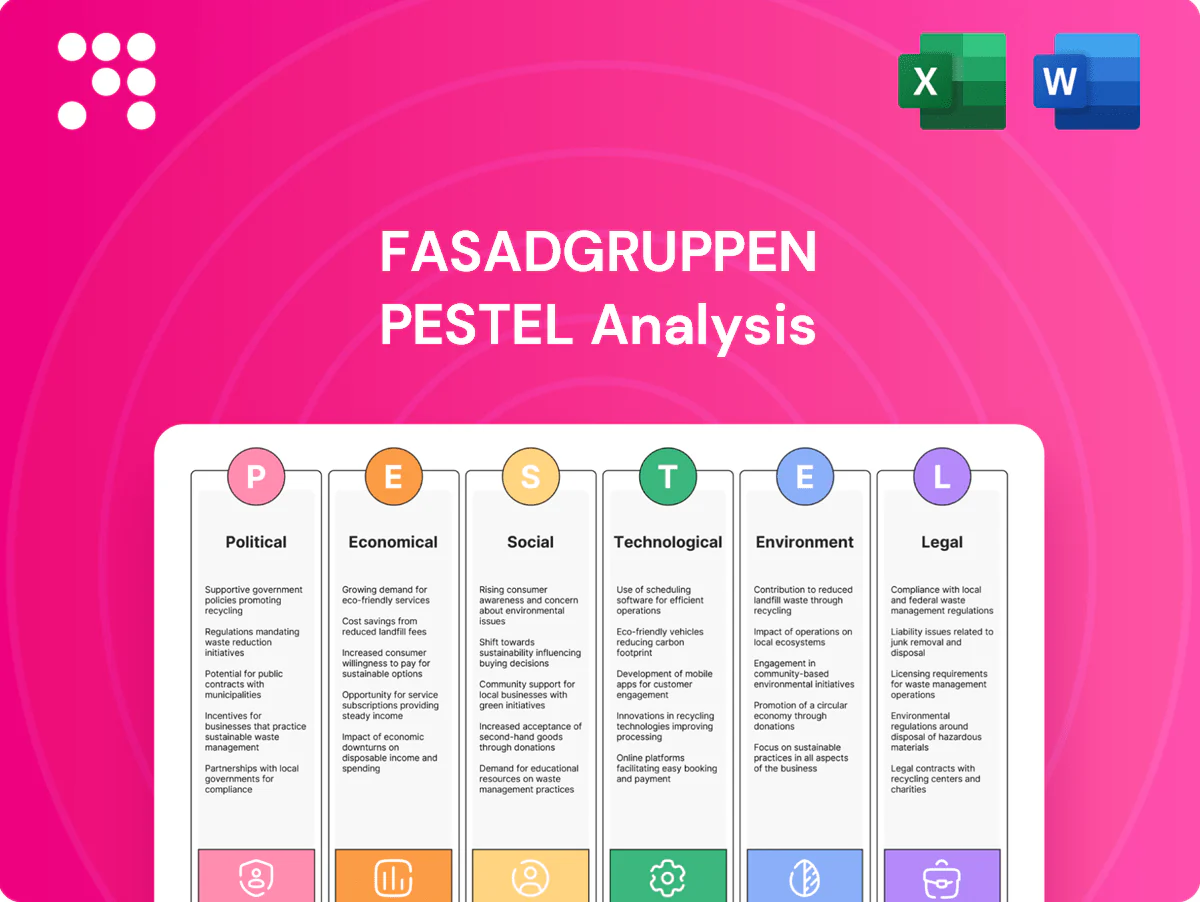
Fasadgruppen PESTLE Analysis

Skip the Research. Get the Strategy.
Discover how political shifts, building regulations, economic cycles and technological advances are shaping Fasadgruppen’s competitive landscape in our concise PESTLE snapshot. This 3–5 sentence overview highlights key external drivers and immediate risks for investors and strategists. Purchase the full PESTLE to access detailed, actionable intelligence and ready-to-use charts for confident decision-making.
Political factors

EU Green Deal shaping retrofits
EU decarbonisation targets (55% GHG reduction by 2030, climate neutrality by 2050) and the Renovation Wave (aiming to double renovation rates) channel funding—including the €723.8bn Recovery and Resilience Facility—into national renovation strategies, expanding demand for energy-efficient facades and deep retrofit packages as buildings account for ~40% of EU energy use; aligning offers with tax incentives/grants speeds orders, while policy volatility or delays can shift project timing across markets.
Public procurement and local content
Large municipal and state building programs in Sweden operate under the Public Procurement Act (2016:1145) implementing EU Directive 2014/24/EU, which explicitly allows weighting for sustainability and life‑cycle cost; public procurement represents roughly 15% of Swedish GDP. Demonstrable local employment, strong references and compliance systems materially lift win rates, and growing use of framework agreements secures multi‑year volumes for contractors.

Housing policy and renovation subsidies
Nordic schemes (eg Enova, Klimasats) and the EU Renovation Wave, which aims to at least double annual renovation rates by 2030, plus NextGenerationEU financing of €723.8 billion (2021–2026) support efficiency upgrades in residential blocks. Subsidy design drives project scope, material choices and acceptable payback thresholds. Clear advisory unlocks funding and reduces administrative friction for clients. Tightening policy can reprioritise social housing and schools.

Energy security and insulation priorities
Geopolitical shocks since 2022 have intensified energy independence drives, pushing governments to prioritize envelope performance; buildings account for about 40% of EU energy use and retrofits can cut heating demand by up to 50%. This drives demand for high-performance façades and insulation, while volatile material costs (spikes ~20% in shock periods) force agile pricing and capacity planning.
- Policy push: EU Renovation Wave to double renovation rates by 2030
- Market impact: retrofits reduce heating demand up to 50%
- Risk: material price volatility ~20%
Regional regulatory fragmentation
Different Nordic and EU-country rules complicate cross-border execution across the EU (27) and five Nordic states. Permit timelines, heritage protections and local environmental standards vary by municipality and country. Local subsidiaries and standardized playbooks reduce compliance risk. Political shifts in 2024–25 have changed permitting speed and requirements.
- Cross-border complexity: varying national/local rules
- Compliance mitigant: local subsidiaries + playbooks
- Key risk: 2024–25 political shifts affect permits
Renovation Wave drives energy-efficient façades; retrofits cut heating up to 50%
EU targets (55% GHG cut by 2030; climate neutrality by 2050) and the Renovation Wave (double renovation rates by 2030) plus NextGenerationEU/ RRF €723.8bn expand demand for energy‑efficient façades; buildings ≈40% of EU energy use and retrofits can cut heating demand up to 50%. Public procurement ≈15% of Swedish GDP; material-price shocks ~20% require agile pricing and local compliance playbooks.
| Metric | Value |
|---|---|
| EU GHG target 2030 | 55% |
| RRF funding | €723.8bn (2021–26) |
| Buildings share EU energy | ≈40% |
| Swedish public procurement | ≈15% GDP |
| Material price shock | ~20% |
What is included in the product
 Detailed Word Document
Explores how Political, Economic, Social, Technological, Environmental and Legal forces uniquely shape Fasadgruppen’s market position, with data‑backed trends and region‑specific examples to identify risks and opportunities; designed for executives and investors to support strategy, scenario planning and funding discussions.

 Customizable Excel Spreadsheet
A concise, visually segmented PESTLE summary for Fasadgruppen that’s easy to drop into presentations and share across teams. Allows note edits for region or business line, simplifying external risk discussions and speeding alignment in planning and client reports.
Economic factors

Construction cycle sensitivity
Façade demand tracks renovation more steadily than new-build, with renovation projects driven by policy pushes such as the EU Renovation Wave aiming to at least double renovation rates by 2030. Downturns in residential starts can be offset by public and commercial retrofits, while counter-cyclical maintenance programs help smooth revenues. A diversified mix across residential, commercial and public sectors reduces volatility for Fasadgruppen.
Interest rates and capex decisions
Higher policy rates (Swedish repo ~4.00% mid‑2025) delay developer projects and compress valuations, slowing new façade contracts. Owners instead prioritize energy‑saving retrofits with typical paybacks under 5 years, shifting capex toward quick ROI. Financing partners and ESCO‑style models (often covering up to 100% of capex) can unlock stalled work. Even modest rate cuts historically revive backlog growth within 6–12 months.

Material and logistics costs
Aluminum, steel, insulation and coatings saw double-digit price swings (roughly 10–30%) in 2022–24; Fasadgruppen uses index-linked contracts and hedging to protect margins, relies on local sourcing and volume agreements to stabilise supply, and improved logistics that cut project overruns and lead times by around 10%.

Labor availability and wage inflation
Skilled façade installers and scaffolders remain scarce across key Nordic and UK markets, with industry job vacancies rising and construction wages accelerating roughly 4–6% y/y in 2024, squeezing margins on fixed-price contracts. Training pipelines, digital productivity tools and modular solutions reduce labour-hours per job and partially offset wage inflation. Tight subcontractor management is essential to preserve delivery certainty and control pass-through costs.
- labour-scarcity: installers/scaffolders scarce
- wage-pressure: ~4–6% y/y (2024)
- mitigation: training + productivity tools
- priority: subcontractor management
Currency exposure across Nordics/EU
SEK, NOK, DKK and EUR fluctuations materially affect Fasadgruppen’s consolidated results through translation and transaction effects; DKK’s peg to EUR limits Danish currency risk while SEK and NOK showed notable volatility in the early 2020s. Natural hedges occur where local revenues match local costs, and FX clauses in cross-border procurements help protect contract margins. Treasury policies must be aligned with the company’s M&A footprint to manage aggregated exposure.
- SEK/NOK: translation and transaction volatility
- DKK: effectively pegged to EUR (limited float)
- Natural hedges: local revenue vs local cost
- FX clauses: protect cross-border pricing
- Treasury: align with M&A geography
Renovation Wave drives energy-efficient façades; retrofits cut heating up to 50%
Renovation-led demand steadies revenue; EU Renovation Wave aims to double renovation rates by 2030, supporting public/commercial retrofits that offset weak residential starts. Swedish repo ~4.00% (mid‑2025) slows new-builds, shifting capex to energy retrofits with sub‑5y paybacks; ESCO/financing can restart projects within 6–12 months of rate cuts. Input prices swung 10–30% (2022–24); index clauses and local sourcing cut cost volatility. Labour shortages raised wages ~4–6% y/y (2024), pushing productivity and subcontractor focus.
| Metric | Value |
|---|---|
| Swedish repo (mid‑2025) | ≈4.00% |
| Input price swing (2022–24) | 10–30% |
| Wage inflation (2024) | 4–6% y/y |
| Renovation target | Double rates by 2030 (EU) |
Same Document Delivered
Fasadgruppen PESTLE Analysis
The Fasadgruppen PESTLE Analysis preview shown here is the exact document you’ll receive after purchase—fully formatted and ready to use. This is the final version with complete content and professional structure, not a teaser or placeholder. What you see is what you’ll download immediately after payment.

Product Information
Product Information
Shipping & Returns
Shipping & Returns
Description
Skip the Research. Get the Strategy.
Discover how political shifts, building regulations, economic cycles and technological advances are shaping Fasadgruppen’s competitive landscape in our concise PESTLE snapshot. This 3–5 sentence overview highlights key external drivers and immediate risks for investors and strategists. Purchase the full PESTLE to access detailed, actionable intelligence and ready-to-use charts for confident decision-making.
Political factors
EU Green Deal shaping retrofits
EU decarbonisation targets (55% GHG reduction by 2030, climate neutrality by 2050) and the Renovation Wave (aiming to double renovation rates) channel funding—including the €723.8bn Recovery and Resilience Facility—into national renovation strategies, expanding demand for energy-efficient facades and deep retrofit packages as buildings account for ~40% of EU energy use; aligning offers with tax incentives/grants speeds orders, while policy volatility or delays can shift project timing across markets.
Public procurement and local content
Large municipal and state building programs in Sweden operate under the Public Procurement Act (2016:1145) implementing EU Directive 2014/24/EU, which explicitly allows weighting for sustainability and life‑cycle cost; public procurement represents roughly 15% of Swedish GDP. Demonstrable local employment, strong references and compliance systems materially lift win rates, and growing use of framework agreements secures multi‑year volumes for contractors.
Housing policy and renovation subsidies
Nordic schemes (eg Enova, Klimasats) and the EU Renovation Wave, which aims to at least double annual renovation rates by 2030, plus NextGenerationEU financing of €723.8 billion (2021–2026) support efficiency upgrades in residential blocks. Subsidy design drives project scope, material choices and acceptable payback thresholds. Clear advisory unlocks funding and reduces administrative friction for clients. Tightening policy can reprioritise social housing and schools.
Energy security and insulation priorities
Geopolitical shocks since 2022 have intensified energy independence drives, pushing governments to prioritize envelope performance; buildings account for about 40% of EU energy use and retrofits can cut heating demand by up to 50%. This drives demand for high-performance façades and insulation, while volatile material costs (spikes ~20% in shock periods) force agile pricing and capacity planning.
- Policy push: EU Renovation Wave to double renovation rates by 2030
- Market impact: retrofits reduce heating demand up to 50%
- Risk: material price volatility ~20%
Regional regulatory fragmentation
Different Nordic and EU-country rules complicate cross-border execution across the EU (27) and five Nordic states. Permit timelines, heritage protections and local environmental standards vary by municipality and country. Local subsidiaries and standardized playbooks reduce compliance risk. Political shifts in 2024–25 have changed permitting speed and requirements.
- Cross-border complexity: varying national/local rules
- Compliance mitigant: local subsidiaries + playbooks
- Key risk: 2024–25 political shifts affect permits
Renovation Wave drives energy-efficient façades; retrofits cut heating up to 50%
EU targets (55% GHG cut by 2030; climate neutrality by 2050) and the Renovation Wave (double renovation rates by 2030) plus NextGenerationEU/ RRF €723.8bn expand demand for energy‑efficient façades; buildings ≈40% of EU energy use and retrofits can cut heating demand up to 50%. Public procurement ≈15% of Swedish GDP; material-price shocks ~20% require agile pricing and local compliance playbooks.
| Metric | Value |
|---|---|
| EU GHG target 2030 | 55% |
| RRF funding | €723.8bn (2021–26) |
| Buildings share EU energy | ≈40% |
| Swedish public procurement | ≈15% GDP |
| Material price shock | ~20% |
What is included in the product
Detailed Word Document
Explores how Political, Economic, Social, Technological, Environmental and Legal forces uniquely shape Fasadgruppen’s market position, with data‑backed trends and region‑specific examples to identify risks and opportunities; designed for executives and investors to support strategy, scenario planning and funding discussions.
Customizable Excel Spreadsheet
A concise, visually segmented PESTLE summary for Fasadgruppen that’s easy to drop into presentations and share across teams. Allows note edits for region or business line, simplifying external risk discussions and speeding alignment in planning and client reports.
Economic factors
Construction cycle sensitivity
Façade demand tracks renovation more steadily than new-build, with renovation projects driven by policy pushes such as the EU Renovation Wave aiming to at least double renovation rates by 2030. Downturns in residential starts can be offset by public and commercial retrofits, while counter-cyclical maintenance programs help smooth revenues. A diversified mix across residential, commercial and public sectors reduces volatility for Fasadgruppen.
Interest rates and capex decisions
Higher policy rates (Swedish repo ~4.00% mid‑2025) delay developer projects and compress valuations, slowing new façade contracts. Owners instead prioritize energy‑saving retrofits with typical paybacks under 5 years, shifting capex toward quick ROI. Financing partners and ESCO‑style models (often covering up to 100% of capex) can unlock stalled work. Even modest rate cuts historically revive backlog growth within 6–12 months.
Material and logistics costs
Aluminum, steel, insulation and coatings saw double-digit price swings (roughly 10–30%) in 2022–24; Fasadgruppen uses index-linked contracts and hedging to protect margins, relies on local sourcing and volume agreements to stabilise supply, and improved logistics that cut project overruns and lead times by around 10%.
Labor availability and wage inflation
Skilled façade installers and scaffolders remain scarce across key Nordic and UK markets, with industry job vacancies rising and construction wages accelerating roughly 4–6% y/y in 2024, squeezing margins on fixed-price contracts. Training pipelines, digital productivity tools and modular solutions reduce labour-hours per job and partially offset wage inflation. Tight subcontractor management is essential to preserve delivery certainty and control pass-through costs.
- labour-scarcity: installers/scaffolders scarce
- wage-pressure: ~4–6% y/y (2024)
- mitigation: training + productivity tools
- priority: subcontractor management
Currency exposure across Nordics/EU
SEK, NOK, DKK and EUR fluctuations materially affect Fasadgruppen’s consolidated results through translation and transaction effects; DKK’s peg to EUR limits Danish currency risk while SEK and NOK showed notable volatility in the early 2020s. Natural hedges occur where local revenues match local costs, and FX clauses in cross-border procurements help protect contract margins. Treasury policies must be aligned with the company’s M&A footprint to manage aggregated exposure.
- SEK/NOK: translation and transaction volatility
- DKK: effectively pegged to EUR (limited float)
- Natural hedges: local revenue vs local cost
- FX clauses: protect cross-border pricing
- Treasury: align with M&A geography
Renovation Wave drives energy-efficient façades; retrofits cut heating up to 50%
Renovation-led demand steadies revenue; EU Renovation Wave aims to double renovation rates by 2030, supporting public/commercial retrofits that offset weak residential starts. Swedish repo ~4.00% (mid‑2025) slows new-builds, shifting capex to energy retrofits with sub‑5y paybacks; ESCO/financing can restart projects within 6–12 months of rate cuts. Input prices swung 10–30% (2022–24); index clauses and local sourcing cut cost volatility. Labour shortages raised wages ~4–6% y/y (2024), pushing productivity and subcontractor focus.
| Metric | Value |
|---|---|
| Swedish repo (mid‑2025) | ≈4.00% |
| Input price swing (2022–24) | 10–30% |
| Wage inflation (2024) | 4–6% y/y |
| Renovation target | Double rates by 2030 (EU) |
Same Document Delivered
Fasadgruppen PESTLE Analysis
The Fasadgruppen PESTLE Analysis preview shown here is the exact document you’ll receive after purchase—fully formatted and ready to use. This is the final version with complete content and professional structure, not a teaser or placeholder. What you see is what you’ll download immediately after payment.