Faith PESTLE Analysis

Skip the Research. Get the Strategy.
Gain strategic clarity with our Faith PESTLE Analysis—concise, insight-driven, and focused on the external forces shaping growth and risk. Ideal for investors, advisors, and strategists, it’s fully researched and ready to use. Purchase the full report now to unlock actionable intelligence and strengthen your decisions.
Political factors

Japan digital policy and support
Japan’s national strategy, anchored by the Digital Agency (established 2021) and Creative Industries Promotion Act (2019), prioritizes digital transformation and creative sectors, creating tailwinds for content distributors and platform growth. Government grants and innovation programs from METI and MIC can materially reduce platform and IT development costs. Election-driven policy shifts may change funding levels or compliance expectations. Faith should align roadmaps with METI and MIC initiatives to capture available incentives.
Telecom regulation and carrier ties
Mobile distribution in Japan is heavily carrier-dependent: 2024 mobile penetration was about 132% and market shares are roughly NTT Docomo 41%, KDDI 30%, SoftBank 28%, with spectrum and billing policy overseen by MIC. Changes in billing rules, app-store policies or carrier revenue shares directly hit margins and unit economics. Regulatory pushes for fee transparency (MIC consultations 2023–24) can compress take-rates, so multi-carrier integrations reduce policy-driven concentration risk.

Cultural export diplomacy
Japan uses cultural export diplomacy—driven by J-pop and anime—to project soft power, with the global anime market ~30 billion USD in 2023 and the Cool Japan Fund launched with ¥50 billion to boost overseas reach. Public-private partnerships and licensing deals reduce market-entry costs and accelerate distribution channels. Diplomatic tensions or protectionism in target markets can delay launches and raise compliance costs. Faith can tap export programs and JV pipelines to scale its catalog internationally.

Trade and data-transfer regimes
Rules governing cross-border data flows—eg CPTPP (11 members) and the EU-Japan adequacy decision (adopted 2019)—directly shape cloud hosting and analytics; divergent standards raise compliance overhead for multi-region services and increase legal risk. Any erosion of adequacy rulings could force costly data localization; architecting for regional data residency mitigates disruption.
- CPTPP: 11 members — limits localization
- EU-Japan adequacy: decision 2019 — enables transfers
- Divergent rules = higher compliance costs
- Regional residency architecture reduces disruption
Content regulation and censorship
Local content standards and age-rating rules differ across ~195 jurisdictions, and political shifts—especially since the 2024 rollout of the EU Digital Services Act—can tighten moderation; DSA allows fines up to 6% of global turnover. Non-compliance risks platform takedowns, fines and revenue disruption. Robust policy engines and immutable audit trails enable scalable, demonstrable compliance.
- 195 jurisdictions: variable age-ratings
- DSA: fines up to 6% turnover
- Non-compliance: takedowns, revenue loss
- Mitigation: policy engines + audit trails
Japan digital push: 132% mobile; anime $30B; DSA 6%
Japan’s pro-digital policy (Digital Agency) and METI/MIC grants lower platform build costs; 2024 mobile penetration ~132% (Docomo 41%, KDDI 30%, SoftBank 28%) concentrates carrier risk. Global anime market ~$30B (2023) and Cool Japan funding (¥50B) fuel exports; CPTPP (11 members) and EU‑Japan adequacy (2019) ease transfers while DSA (2024) can fine up to 6% turnover.
| Metric | Value |
|---|---|
| Mobile penetration (2024) | 132% |
| Carrier shares | Docomo 41% / KDDI 30% / SoftBank 28% |
| Anime market (2023) | $30B |
| Cool Japan fund | ¥50B |
| DSA fine | Up to 6% revenue |
What is included in the product
 Detailed Word Document
Explores how macro-environmental forces affect the Faith across Political, Economic, Social, Technological, Environmental, and Legal dimensions, with data-backed trends and region-specific examples; designed for executives, consultants, and entrepreneurs to identify risks, opportunities and support scenario-driven strategy and investor-ready reporting.

 Customizable Excel Spreadsheet
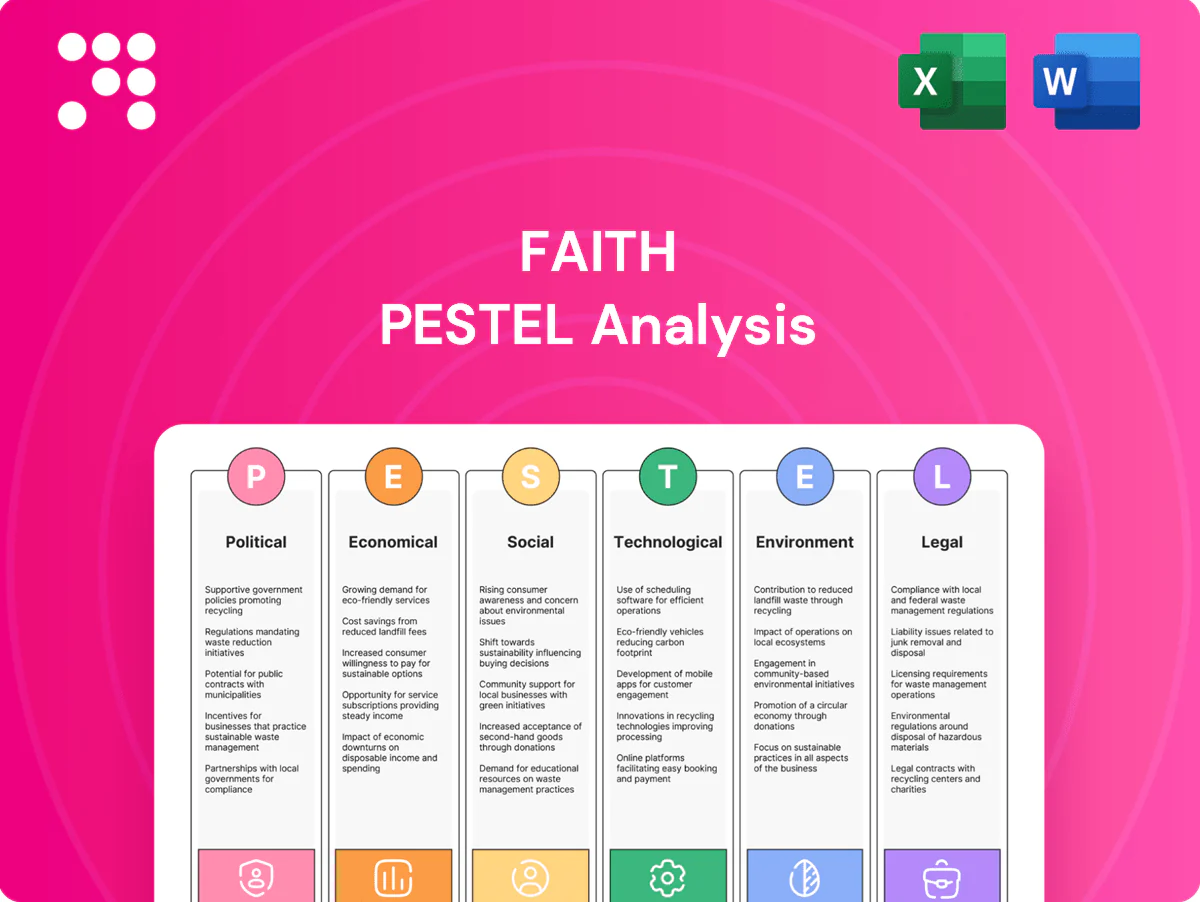
Faith PESTLE Analysis condenses complex external factors into a clean, visually segmented summary that’s easily dropped into presentations or shared across teams, helping stakeholders quickly align on regulatory, social and market risks during planning sessions.
Economic factors

Consumer spending cycles
Digital entertainment demand tracks disposable income cycles: with Japan inflation around 3% in 2024 and household budgets under pressure, users commonly trade subscriptions for ad-supported tiers. The global streaming market exceeded $150 billion in 2024, so premium exclusives remain key to defend ARPU in downturns. Flexible pricing and bundle strategies smooth revenue volatility by retaining users across tiers.
Exchange rate volatility
Yen volatility, with USD/JPY trading around 155–160 in 2024–mid‑2025, raises the yen cost of imported tech and makes overseas revenue translation swing materially; a 10% yen depreciation raises USD‑priced cloud and licensing bills ~10% in yen terms. A weaker yen boosts reported foreign earnings but squeezes margins unless the company hedges FX or uses multi‑currency billing to stabilize cash flows. Localizing costs to revenue regions reduces FX mismatch and preserves margin resilience.

Advertising market health
Ad budgets remain the primary monetization lever for free tiers and promotional services, with digital ads accounting for over 60% of global ad spend in 2024; reduced budgets directly cut ARPU. Macro weakness has depressed CPMs and artist sponsorships—CPMs fell into low double digits in several categories during 2023–24 downturns. Diversifying into B2B IT solutions smooths revenue cyclicality, while first-party data and performance products preserve and often improve yield.

Interest rates and capital access
Higher global policy rates (US fed funds ~5.25–5.50% in mid‑2025) raise financing costs for platform investments and acquisitions, pushing buyers to demand faster returns. Investors increasingly favor profitability over growth, so efficient unit economics and strict payback discipline become decisive. Strategic partnerships and revenue‑share deals are being used to avoid capex‑heavy expansion.
- Higher rates: funding cost up, deal pricing tighter
- Investor tilt: profitability > growth
- Response: focus on unit economics, partnerships vs capex
Labor and tech talent costs
Tight markets for engineers and data scientists push payrolls higher; BLS (May 2023) reports median annual wages of $110,140 for software developers and $131,490 for computer and information research scientists, squeezing margins for system development units. Nearshoring and automation can slow cost growth, while defined career paths boost retention in competitive hubs.
Japan digital push: 132% mobile; anime $30B; DSA 6%
Disposable‑income sensitivity shrinks premium churn as global streaming topped $150B in 2024 while Japan CPI ≈3% (2024); USD/JPY ~155–160 (2024–mid‑2025) amplifies imported tech costs. Digital ads >60% of ad spend (2024), CPMs softened in 2023–24; fed funds ~5.25–5.50% (mid‑2025) raises funding costs; software dev median wage $110,140 (BLS May 2023) pressures margins.
| Metric | Value |
|---|---|
| Global streaming (2024) | $150B+ |
| Japan CPI (2024) | ≈3% |
| USD/JPY (2024–mid‑2025) | 155–160 |
| Digital ad share (2024) | >60% |
| Fed funds (mid‑2025) | 5.25–5.50% |
| Software dev median wage | $110,140 (May 2023) |
What You See Is What You Get
Faith PESTLE Analysis
The preview shown here is the exact Faith PESTLE Analysis you’ll receive after purchase—fully formatted and ready to use. This is the real, finished document with complete content and structure, delivered exactly as displayed. No placeholders or surprises—download the same file immediately after checkout.

Product Information
Product Information
Shipping & Returns
Shipping & Returns
Description
Skip the Research. Get the Strategy.
Gain strategic clarity with our Faith PESTLE Analysis—concise, insight-driven, and focused on the external forces shaping growth and risk. Ideal for investors, advisors, and strategists, it’s fully researched and ready to use. Purchase the full report now to unlock actionable intelligence and strengthen your decisions.
Political factors
Japan digital policy and support
Japan’s national strategy, anchored by the Digital Agency (established 2021) and Creative Industries Promotion Act (2019), prioritizes digital transformation and creative sectors, creating tailwinds for content distributors and platform growth. Government grants and innovation programs from METI and MIC can materially reduce platform and IT development costs. Election-driven policy shifts may change funding levels or compliance expectations. Faith should align roadmaps with METI and MIC initiatives to capture available incentives.
Telecom regulation and carrier ties
Mobile distribution in Japan is heavily carrier-dependent: 2024 mobile penetration was about 132% and market shares are roughly NTT Docomo 41%, KDDI 30%, SoftBank 28%, with spectrum and billing policy overseen by MIC. Changes in billing rules, app-store policies or carrier revenue shares directly hit margins and unit economics. Regulatory pushes for fee transparency (MIC consultations 2023–24) can compress take-rates, so multi-carrier integrations reduce policy-driven concentration risk.
Cultural export diplomacy
Japan uses cultural export diplomacy—driven by J-pop and anime—to project soft power, with the global anime market ~30 billion USD in 2023 and the Cool Japan Fund launched with ¥50 billion to boost overseas reach. Public-private partnerships and licensing deals reduce market-entry costs and accelerate distribution channels. Diplomatic tensions or protectionism in target markets can delay launches and raise compliance costs. Faith can tap export programs and JV pipelines to scale its catalog internationally.
Trade and data-transfer regimes
Rules governing cross-border data flows—eg CPTPP (11 members) and the EU-Japan adequacy decision (adopted 2019)—directly shape cloud hosting and analytics; divergent standards raise compliance overhead for multi-region services and increase legal risk. Any erosion of adequacy rulings could force costly data localization; architecting for regional data residency mitigates disruption.
- CPTPP: 11 members — limits localization
- EU-Japan adequacy: decision 2019 — enables transfers
- Divergent rules = higher compliance costs
- Regional residency architecture reduces disruption
Content regulation and censorship
Local content standards and age-rating rules differ across ~195 jurisdictions, and political shifts—especially since the 2024 rollout of the EU Digital Services Act—can tighten moderation; DSA allows fines up to 6% of global turnover. Non-compliance risks platform takedowns, fines and revenue disruption. Robust policy engines and immutable audit trails enable scalable, demonstrable compliance.
- 195 jurisdictions: variable age-ratings
- DSA: fines up to 6% turnover
- Non-compliance: takedowns, revenue loss
- Mitigation: policy engines + audit trails
Japan digital push: 132% mobile; anime $30B; DSA 6%
Japan’s pro-digital policy (Digital Agency) and METI/MIC grants lower platform build costs; 2024 mobile penetration ~132% (Docomo 41%, KDDI 30%, SoftBank 28%) concentrates carrier risk. Global anime market ~$30B (2023) and Cool Japan funding (¥50B) fuel exports; CPTPP (11 members) and EU‑Japan adequacy (2019) ease transfers while DSA (2024) can fine up to 6% turnover.
| Metric | Value |
|---|---|
| Mobile penetration (2024) | 132% |
| Carrier shares | Docomo 41% / KDDI 30% / SoftBank 28% |
| Anime market (2023) | $30B |
| Cool Japan fund | ¥50B |
| DSA fine | Up to 6% revenue |
What is included in the product
Detailed Word Document
Explores how macro-environmental forces affect the Faith across Political, Economic, Social, Technological, Environmental, and Legal dimensions, with data-backed trends and region-specific examples; designed for executives, consultants, and entrepreneurs to identify risks, opportunities and support scenario-driven strategy and investor-ready reporting.
Customizable Excel Spreadsheet
Faith PESTLE Analysis condenses complex external factors into a clean, visually segmented summary that’s easily dropped into presentations or shared across teams, helping stakeholders quickly align on regulatory, social and market risks during planning sessions.
Economic factors
Consumer spending cycles
Digital entertainment demand tracks disposable income cycles: with Japan inflation around 3% in 2024 and household budgets under pressure, users commonly trade subscriptions for ad-supported tiers. The global streaming market exceeded $150 billion in 2024, so premium exclusives remain key to defend ARPU in downturns. Flexible pricing and bundle strategies smooth revenue volatility by retaining users across tiers.
Exchange rate volatility
Yen volatility, with USD/JPY trading around 155–160 in 2024–mid‑2025, raises the yen cost of imported tech and makes overseas revenue translation swing materially; a 10% yen depreciation raises USD‑priced cloud and licensing bills ~10% in yen terms. A weaker yen boosts reported foreign earnings but squeezes margins unless the company hedges FX or uses multi‑currency billing to stabilize cash flows. Localizing costs to revenue regions reduces FX mismatch and preserves margin resilience.
Advertising market health
Ad budgets remain the primary monetization lever for free tiers and promotional services, with digital ads accounting for over 60% of global ad spend in 2024; reduced budgets directly cut ARPU. Macro weakness has depressed CPMs and artist sponsorships—CPMs fell into low double digits in several categories during 2023–24 downturns. Diversifying into B2B IT solutions smooths revenue cyclicality, while first-party data and performance products preserve and often improve yield.
Interest rates and capital access
Higher global policy rates (US fed funds ~5.25–5.50% in mid‑2025) raise financing costs for platform investments and acquisitions, pushing buyers to demand faster returns. Investors increasingly favor profitability over growth, so efficient unit economics and strict payback discipline become decisive. Strategic partnerships and revenue‑share deals are being used to avoid capex‑heavy expansion.
- Higher rates: funding cost up, deal pricing tighter
- Investor tilt: profitability > growth
- Response: focus on unit economics, partnerships vs capex
Labor and tech talent costs
Tight markets for engineers and data scientists push payrolls higher; BLS (May 2023) reports median annual wages of $110,140 for software developers and $131,490 for computer and information research scientists, squeezing margins for system development units. Nearshoring and automation can slow cost growth, while defined career paths boost retention in competitive hubs.
Japan digital push: 132% mobile; anime $30B; DSA 6%
Disposable‑income sensitivity shrinks premium churn as global streaming topped $150B in 2024 while Japan CPI ≈3% (2024); USD/JPY ~155–160 (2024–mid‑2025) amplifies imported tech costs. Digital ads >60% of ad spend (2024), CPMs softened in 2023–24; fed funds ~5.25–5.50% (mid‑2025) raises funding costs; software dev median wage $110,140 (BLS May 2023) pressures margins.
| Metric | Value |
|---|---|
| Global streaming (2024) | $150B+ |
| Japan CPI (2024) | ≈3% |
| USD/JPY (2024–mid‑2025) | 155–160 |
| Digital ad share (2024) | >60% |
| Fed funds (mid‑2025) | 5.25–5.50% |
| Software dev median wage | $110,140 (May 2023) |
What You See Is What You Get
Faith PESTLE Analysis
The preview shown here is the exact Faith PESTLE Analysis you’ll receive after purchase—fully formatted and ready to use. This is the real, finished document with complete content and structure, delivered exactly as displayed. No placeholders or surprises—download the same file immediately after checkout.