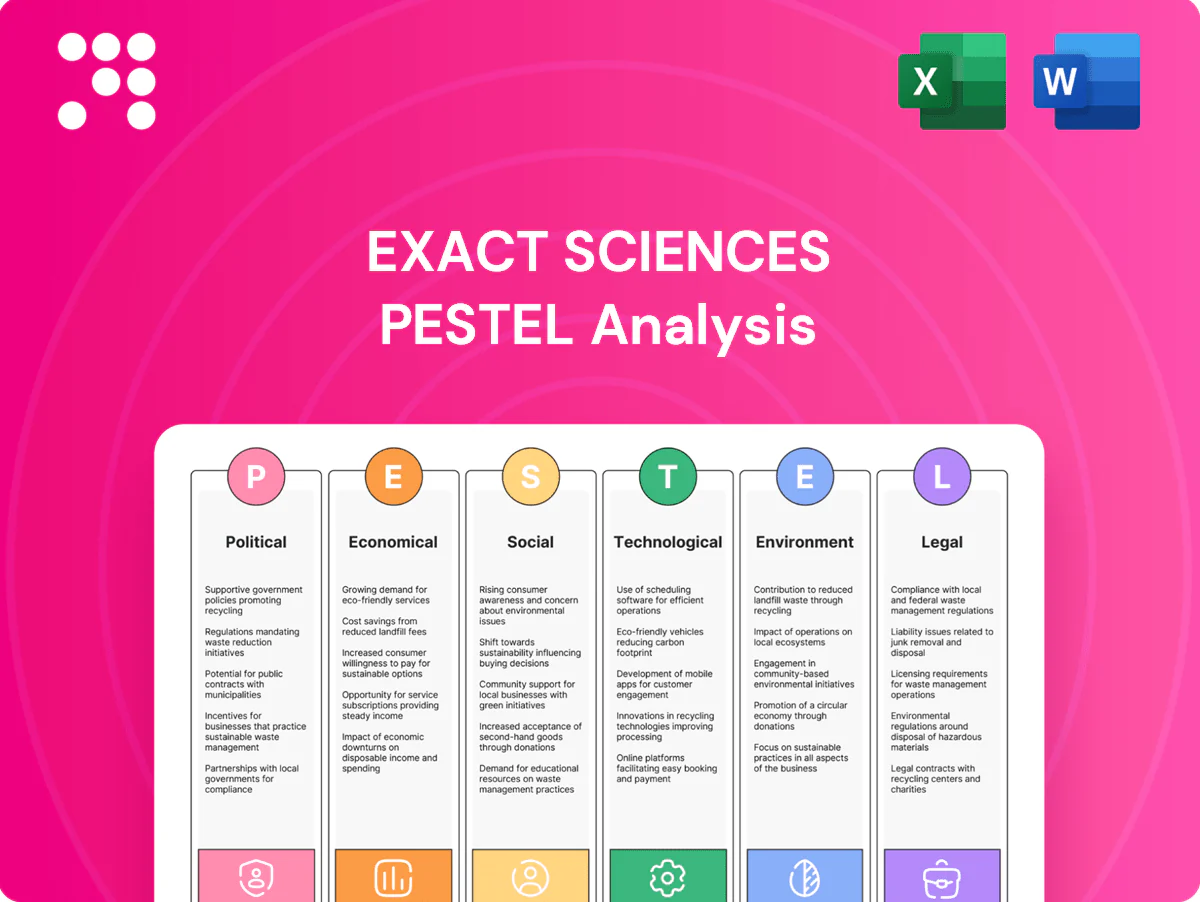
Exact Sciences PESTLE Analysis

Your Competitive Advantage Starts with This Report
Discover how political shifts, reimbursement trends, and rapid biotech innovation shape Exact Sciences’ trajectory in our concise PESTLE snapshot. This 3–5 minute read highlights key risks and opportunities to inform investment or strategy decisions. Buy the full PESTLE for an exhaustive, actionable briefing ready for boardrooms and models.
Political factors

Healthcare policy shifts
Government screening guidelines and funding drive colorectal and breast test volumes: USPSTF's 2021 CRC recommendation lowering start age to 45 expanded the eligible U.S. population by about 22 million, while CDC screening rates hover near 67%, affecting demand. Election cycles and budget pressures can redirect prevention funding; Exact Sciences must sustain proactive policy engagement to protect screening uptake and reimbursement.
Public payer reimbursement dynamics
Medicare sets the baseline for U.S. coverage of colorectal screening tests—CMS covers Cologuard for average‑risk adults 50–85 with a 3‑year interval—and commercial payers often follow CMS determinations. Changes to CMS coverage criteria, frequency limits or payment rates materially affect revenue predictability for Exact Sciences. State Medicaid programs vary in coverage and reimbursement rules, increasing administrative complexity, so robust health‑economic evidence is essential to sustain favorable payer decisions.

Global market access and HTA
Outside the U.S., national HTA bodies such as NICE (UK), HAS (France) and IQWiG (Germany) assess cost-effectiveness before reimbursement, creating heterogeneous evidence thresholds and pricing controls that complicate Exact Sciences launches. Positive HTA outcomes unlock scale and reimbursement, while negative rulings can materially delay adoption. Tailored dossiers and local prospective data generation are crucial to secure favorable HTA decisions.

Trade, geopolitics, and supply chains
Tariffs, export controls, and geopolitical tensions can disrupt reagent and instrument components for Exact Sciences, with tightened US export controls in 2023–24 raising compliance costs. Cross-border logistics for sample kits and lab consumables require resilience as WTO projected global merchandise trade volume to grow about 2.1% in 2024 and freight-rate volatility persisted. Localization policies favor regional manufacturing and diversified suppliers reduce political risk exposure.
- Tariff and export-control compliance raised costs in 2023–24
- WTO: global merchandise trade ~+2.1% in 2024, highlighting logistics pressure
- Localization and supplier diversification mitigate disruption risk
Pandemic preparedness and public health priorities
Government emphasis on early detection in 2024 can lift demand for non-invasive screening like Cologuard as recovery plans prioritize cancer control; screening volumes fell up to 80% at COVID peaks and remained roughly 10–20% below pre‑pandemic baselines into 2023–24. Resource shifts to emergent threats could still suppress routine screening; targeted public campaigns and agency partnerships boost uptake and reach.
- Screening drop: up to 80% (2020 peak)
- Partial recovery: ~10–20% below pre‑pandemic (2023–24)
- Agency partnerships amplify reach and participation
Policy-led CRC screening expansion adds ~22M eligibles; reimbursement and trade costs shape revenues
Policy and reimbursement drive demand: USPSTF 2021 CRC age-lowering added ~22M eligible US adults and CDC screening ~67% impacts volumes. CMS coverage for Cologuard (avg‑risk 50–85, 3‑yr interval) and state Medicaid variability shape revenue predictability. Trade/export controls and 2024 WTO +2.1% trade growth raise logistics and compliance costs; supplier diversification mitigates risk.
| Metric | Value |
|---|---|
| USPSTF expansion | ~22M |
| CDC screening rate | ~67% |
| WTO 2024 trade growth | +2.1% |
What is included in the product
 Detailed Word Document
Explores how external macro-environmental factors uniquely affect Exact Sciences across six dimensions—Political, Economic, Social, Technological, Environmental, and Legal—with data-backed insights and trend analysis. Designed for executives and investors, it highlights threats, opportunities and forward-looking scenarios to guide strategy and funding decisions.

 Customizable Excel Spreadsheet
Concise, visually segmented PESTLE summary of Exact Sciences that speeds risk assessment and market-position discussions, easily dropped into presentations or client reports and editable so teams can add region‑ or product‑specific notes for quick alignment.
Economic factors

Macroeconomic cycles and screening demand
Recessions cut preventive visits and test volumes—cancer screenings fell as much as 86% at the COVID peak (Epic/CDC data), hitting noninvasive screening demand hardest. Rising HDHP enrollment (about 31% of workers in HDHPs, KFF 2023) makes repeat screening price-sensitive. Economic recoveries and broad employer wellness programs (major employers ~80% offer programs) lift uptake. Demand elasticity is higher for noninvasive screening than for precision oncology diagnostics.
Pricing power and payer mix
Exact Sciences' realized prices depend on the payer mix—Medicare, commercial insurers, and self-pay cohorts each set different reimbursement levels, affecting revenue per test. Competitive entrants and reference pricing exert downward pressure on list prices, while value-based contracts can stabilize revenue by aligning payment to outcomes. Active coding and billing optimization preserve yield by maximizing allowable reimbursements and minimizing denials.

Cost structure and scale efficiencies
Exact Sciences central lab operations gain significant per-test cost reductions from higher throughput, while automation and process improvements have progressively enhanced gross margins. High fixed costs in sales, medical affairs, and R&D keep operating leverage dependent on sustained volume growth. Scaling test volumes remains essential to dilute fixed expenses and improve profitability.

R&D investment and ROI
Sustained R&D is essential for Exact Sciences to advance pipeline assays and platform improvements, with pivotal clinical studies in genomics and oncology typically costing >$100 million each as of 2024 and creating durable regulatory and data moats. Capital allocation must balance lower-risk screening (recurrent-revenue diagnostics) versus higher-risk precision oncology, using risk-adjusted return metrics to prioritize projects. Pruning noncore assets and focusing spend improves capital efficiency and frees funds for high-ROI indications.
- R&D focus: pipeline assays + platform upgrades
- Clinical cost reality: pivotal trials >$100M (2024)
- Capital allocation: screening vs precision oncology — risk-adjusted ROI
- Portfolio pruning: improves capital efficiency
M&A and partnership landscape
Consolidation in diagnostics reshapes bargaining power and distribution; the in vitro diagnostics market surpassed $200 billion by 2024, concentrating negotiating leverage among large labs and OEMs. Partnerships with health systems and payers accelerate screening adoption and reimbursement access for Exact Sciences. Acquisitions can add biomarkers or geographies but carry integration and execution risks, so discipline on valuation and synergy capture is essential.
- Consolidation: higher bargaining power
- Partnerships: faster payer/hospital adoption
- Acquisitions: biomarker/geography growth vs integration risk
- Requirement: strict valuation and synergy discipline
Policy-led CRC screening expansion adds ~22M eligibles; reimbursement and trade costs shape revenues
Economic drivers: demand-sensitive screening fell up to 86% at COVID peak, HDHPs cover ~31% of workers (KFF 2023) increasing price sensitivity; in vitro diagnostics market >$200B (2024) concentrates bargaining power. Reimbursement mix (Medicare/commercial/self-pay) and value-based contracts determine realized price. Scaling volumes dilutes high fixed costs; pivotal trials cost >$100M (2024).
| Metric | Value | Source |
|---|---|---|
| Screening drop | up to 86% | Epic/CDC |
| HDHP enrollment | 31% | KFF 2023 |
| IVD market | >$200B (2024) | Industry data 2024 |
Full Version Awaits
Exact Sciences PESTLE Analysis
The preview shown here is the exact Exact Sciences PESTLE analysis you’ll receive after purchase—fully formatted, professionally structured, and ready to use. It contains the same content, layout, and insights displayed now, with no placeholders or teasers. After checkout you’ll instantly download this finished file and can begin applying the strategic findings immediately.

Product Information
Product Information
Shipping & Returns
Shipping & Returns
Description
Your Competitive Advantage Starts with This Report
Discover how political shifts, reimbursement trends, and rapid biotech innovation shape Exact Sciences’ trajectory in our concise PESTLE snapshot. This 3–5 minute read highlights key risks and opportunities to inform investment or strategy decisions. Buy the full PESTLE for an exhaustive, actionable briefing ready for boardrooms and models.
Political factors
Healthcare policy shifts
Government screening guidelines and funding drive colorectal and breast test volumes: USPSTF's 2021 CRC recommendation lowering start age to 45 expanded the eligible U.S. population by about 22 million, while CDC screening rates hover near 67%, affecting demand. Election cycles and budget pressures can redirect prevention funding; Exact Sciences must sustain proactive policy engagement to protect screening uptake and reimbursement.
Public payer reimbursement dynamics
Medicare sets the baseline for U.S. coverage of colorectal screening tests—CMS covers Cologuard for average‑risk adults 50–85 with a 3‑year interval—and commercial payers often follow CMS determinations. Changes to CMS coverage criteria, frequency limits or payment rates materially affect revenue predictability for Exact Sciences. State Medicaid programs vary in coverage and reimbursement rules, increasing administrative complexity, so robust health‑economic evidence is essential to sustain favorable payer decisions.
Global market access and HTA
Outside the U.S., national HTA bodies such as NICE (UK), HAS (France) and IQWiG (Germany) assess cost-effectiveness before reimbursement, creating heterogeneous evidence thresholds and pricing controls that complicate Exact Sciences launches. Positive HTA outcomes unlock scale and reimbursement, while negative rulings can materially delay adoption. Tailored dossiers and local prospective data generation are crucial to secure favorable HTA decisions.
Trade, geopolitics, and supply chains
Tariffs, export controls, and geopolitical tensions can disrupt reagent and instrument components for Exact Sciences, with tightened US export controls in 2023–24 raising compliance costs. Cross-border logistics for sample kits and lab consumables require resilience as WTO projected global merchandise trade volume to grow about 2.1% in 2024 and freight-rate volatility persisted. Localization policies favor regional manufacturing and diversified suppliers reduce political risk exposure.
- Tariff and export-control compliance raised costs in 2023–24
- WTO: global merchandise trade ~+2.1% in 2024, highlighting logistics pressure
- Localization and supplier diversification mitigate disruption risk
Pandemic preparedness and public health priorities
Government emphasis on early detection in 2024 can lift demand for non-invasive screening like Cologuard as recovery plans prioritize cancer control; screening volumes fell up to 80% at COVID peaks and remained roughly 10–20% below pre‑pandemic baselines into 2023–24. Resource shifts to emergent threats could still suppress routine screening; targeted public campaigns and agency partnerships boost uptake and reach.
- Screening drop: up to 80% (2020 peak)
- Partial recovery: ~10–20% below pre‑pandemic (2023–24)
- Agency partnerships amplify reach and participation
Policy-led CRC screening expansion adds ~22M eligibles; reimbursement and trade costs shape revenues
Policy and reimbursement drive demand: USPSTF 2021 CRC age-lowering added ~22M eligible US adults and CDC screening ~67% impacts volumes. CMS coverage for Cologuard (avg‑risk 50–85, 3‑yr interval) and state Medicaid variability shape revenue predictability. Trade/export controls and 2024 WTO +2.1% trade growth raise logistics and compliance costs; supplier diversification mitigates risk.
| Metric | Value |
|---|---|
| USPSTF expansion | ~22M |
| CDC screening rate | ~67% |
| WTO 2024 trade growth | +2.1% |
What is included in the product
Detailed Word Document
Explores how external macro-environmental factors uniquely affect Exact Sciences across six dimensions—Political, Economic, Social, Technological, Environmental, and Legal—with data-backed insights and trend analysis. Designed for executives and investors, it highlights threats, opportunities and forward-looking scenarios to guide strategy and funding decisions.
Customizable Excel Spreadsheet
Concise, visually segmented PESTLE summary of Exact Sciences that speeds risk assessment and market-position discussions, easily dropped into presentations or client reports and editable so teams can add region‑ or product‑specific notes for quick alignment.
Economic factors
Macroeconomic cycles and screening demand
Recessions cut preventive visits and test volumes—cancer screenings fell as much as 86% at the COVID peak (Epic/CDC data), hitting noninvasive screening demand hardest. Rising HDHP enrollment (about 31% of workers in HDHPs, KFF 2023) makes repeat screening price-sensitive. Economic recoveries and broad employer wellness programs (major employers ~80% offer programs) lift uptake. Demand elasticity is higher for noninvasive screening than for precision oncology diagnostics.
Pricing power and payer mix
Exact Sciences' realized prices depend on the payer mix—Medicare, commercial insurers, and self-pay cohorts each set different reimbursement levels, affecting revenue per test. Competitive entrants and reference pricing exert downward pressure on list prices, while value-based contracts can stabilize revenue by aligning payment to outcomes. Active coding and billing optimization preserve yield by maximizing allowable reimbursements and minimizing denials.
Cost structure and scale efficiencies
Exact Sciences central lab operations gain significant per-test cost reductions from higher throughput, while automation and process improvements have progressively enhanced gross margins. High fixed costs in sales, medical affairs, and R&D keep operating leverage dependent on sustained volume growth. Scaling test volumes remains essential to dilute fixed expenses and improve profitability.
R&D investment and ROI
Sustained R&D is essential for Exact Sciences to advance pipeline assays and platform improvements, with pivotal clinical studies in genomics and oncology typically costing >$100 million each as of 2024 and creating durable regulatory and data moats. Capital allocation must balance lower-risk screening (recurrent-revenue diagnostics) versus higher-risk precision oncology, using risk-adjusted return metrics to prioritize projects. Pruning noncore assets and focusing spend improves capital efficiency and frees funds for high-ROI indications.
- R&D focus: pipeline assays + platform upgrades
- Clinical cost reality: pivotal trials >$100M (2024)
- Capital allocation: screening vs precision oncology — risk-adjusted ROI
- Portfolio pruning: improves capital efficiency
M&A and partnership landscape
Consolidation in diagnostics reshapes bargaining power and distribution; the in vitro diagnostics market surpassed $200 billion by 2024, concentrating negotiating leverage among large labs and OEMs. Partnerships with health systems and payers accelerate screening adoption and reimbursement access for Exact Sciences. Acquisitions can add biomarkers or geographies but carry integration and execution risks, so discipline on valuation and synergy capture is essential.
- Consolidation: higher bargaining power
- Partnerships: faster payer/hospital adoption
- Acquisitions: biomarker/geography growth vs integration risk
- Requirement: strict valuation and synergy discipline
Policy-led CRC screening expansion adds ~22M eligibles; reimbursement and trade costs shape revenues
Economic drivers: demand-sensitive screening fell up to 86% at COVID peak, HDHPs cover ~31% of workers (KFF 2023) increasing price sensitivity; in vitro diagnostics market >$200B (2024) concentrates bargaining power. Reimbursement mix (Medicare/commercial/self-pay) and value-based contracts determine realized price. Scaling volumes dilutes high fixed costs; pivotal trials cost >$100M (2024).
| Metric | Value | Source |
|---|---|---|
| Screening drop | up to 86% | Epic/CDC |
| HDHP enrollment | 31% | KFF 2023 |
| IVD market | >$200B (2024) | Industry data 2024 |
Full Version Awaits
Exact Sciences PESTLE Analysis
The preview shown here is the exact Exact Sciences PESTLE analysis you’ll receive after purchase—fully formatted, professionally structured, and ready to use. It contains the same content, layout, and insights displayed now, with no placeholders or teasers. After checkout you’ll instantly download this finished file and can begin applying the strategic findings immediately.