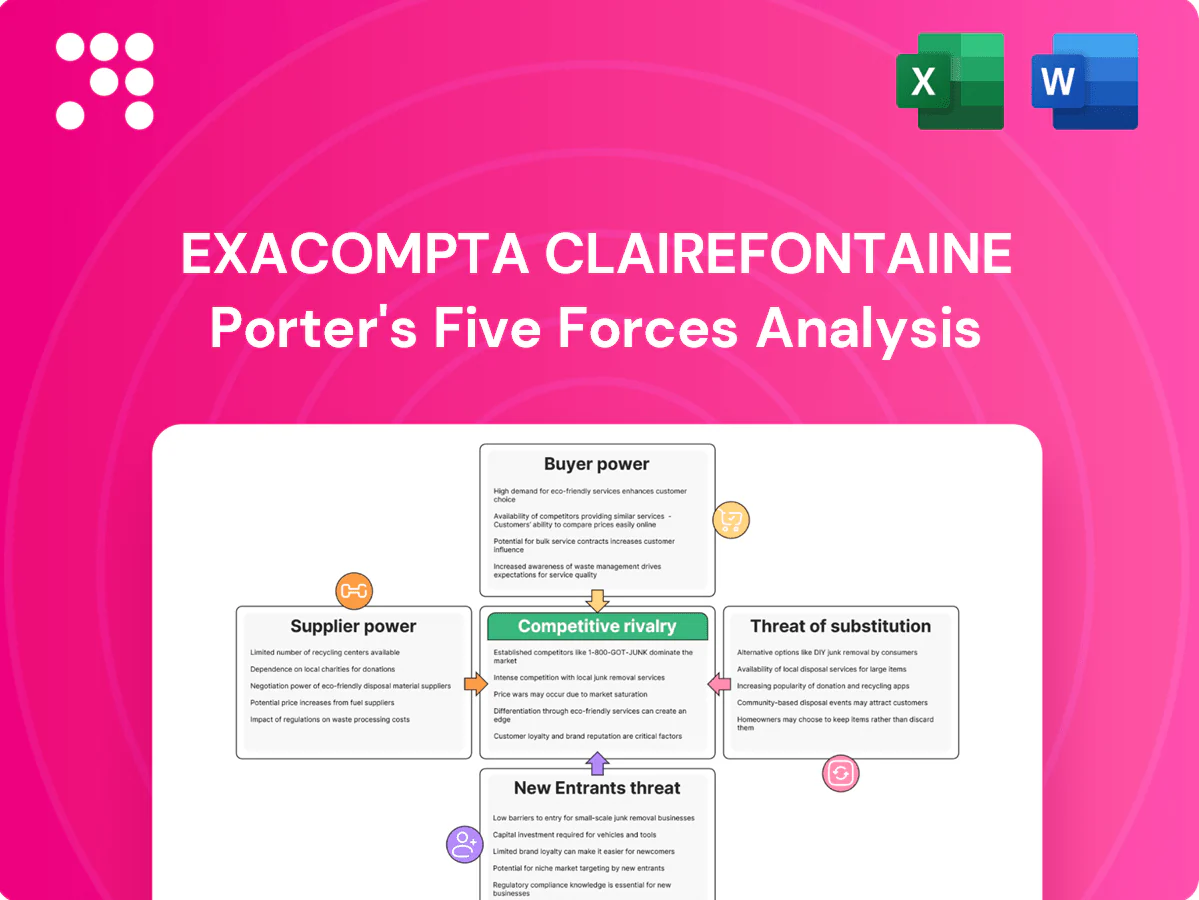
Exacompta Clairefontaine Porter's Five Forces Analysis

Go Beyond the Preview—Access the Full Strategic Report
Exacompta Clairefontaine faces moderate supplier power, fragmented buyers, and steady threat from private-label and digital substitutes, with barriers to entry shaped by brand and distribution strengths; competitive rivalry is intense in stationery and paper markets. This brief snapshot only scratches the surface—unlock the full Porter's Five Forces Analysis for force-by-force ratings, visuals, and actionable strategy.
Suppliers Bargaining Power

Concentration in pulp and fiber
Wood pulp markets remain concentrated: global pulp production was about 200 million tonnes in 2023, with the top five producers controlling roughly 35% of capacity, giving large forestry groups pricing leverage; FSC and PEFC together certify ~553 million hectares, narrowing eligible suppliers; Exacompta Clairefontaine’s strict quality specs limit substitution; multiyear contracts (typically 3–7 years) curb spot volatility but reduce sourcing flexibility.
Energy and chemicals exposure
Paper manufacturing is highly energy-intensive and reliant on chemicals, inks and pigments, giving those suppliers leverage in pricing and availability. Volatile energy markets and specialized chemical inputs strengthen supplier bargaining power and can compress margins. Hedging and energy-efficiency investments reduce exposure but do not remove it. EU carbon allowance prices averaged near €90/tonne in 2024, a cost that suppliers can pass through.

Capital equipment and maintenance
Paper machines and converting lines are dominated by three OEMs—Voith, Valmet and ANDRITZ—creating high switching costs due to proprietary parts and tied service contracts, increasing supplier power. Planned maintenance windows (annual or multi-year shutdowns) constrain scheduling and raise downtime risk. Multi-plant scale and adoption of standardized platforms improve Exacompta Clairefontaine’s negotiation leverage with these OEMs.

Vertical integration offsets
Exacompta Clairefontaine’s vertical integration into paper production reduces reliance on external pulp/paper supply in key segments, strengthens its bargaining position with upstream vendors, and delivers tighter quality control and cost visibility; in 2024 the group maintained in-house paper capacity while remaining exposed to volatile energy and fiber markets.
- Less supplier dependence
- Stronger negotiating leverage
- Improved quality & cost transparency
- Continued exposure to energy/fiber volatility (2024)
Logistics and regional constraints
Bulk inputs for Exacompta Clairefontaine require reliable regional logistics at scale; in 2024 Europe saw container transit delays remain elevated, roughly 20–30% above pre‑pandemic norms, amplifying supplier leverage during tight markets. Nearshoring raised regional sourcing share to about 25% for paperboard in 2024, improving resilience but narrowing supplier choice. Multi‑sourcing and 60–90 day inventory buffers are key countermeasures.
- logistics scale sensitivity
- 20–30% higher transit delays (2024)
- ~25% regional sourcing (2024)
- multi‑sourcing + 60–90d buffers
Supplier leverage rises: concentrated pulp, OEM dominance and logistics strains boost costs
Supplier power is moderate-to-high: pulp concentration (≈200 Mt global, top‑5 ≈35% in 2023) and specialty chemicals/energy (EU carbon ≈€90/t in 2024) allow cost pass‑through. OEM dominance (Voith/Valmet/ANDRITZ) raises switching costs; vertical integration and multi‑sourcing (≈25% regional paperboard sourcing in 2024) mitigate risk. Logistics delays (20–30% above pre‑pandemic) sustain supplier leverage.
| Metric | 2024 |
|---|---|
| Global pulp production | ~200 Mt |
| Top‑5 capacity share | ~35% |
| EU carbon price | €90/t |
| Regional sourcing (paperboard) | ~25% |
| Transit delays vs pre‑COVID | +20–30% |
What is included in the product
 Detailed Word Document
Tailored Porter's Five Forces analysis for Exacompta Clairefontaine that uncovers competitive drivers, supplier and buyer influence, threats from substitutes and entrants, and strategic levers to protect market share.

 Customizable Excel Spreadsheet
A clear, one-sheet Porter’s Five Forces summary for Exacompta Clairefontaine—perfect for quick decision-making and boardroom-ready slides.
Customers Bargaining Power

Concentrated retail and B2B channels
Large European retailers, hypermarkets and office distributors concentrate purchasing power, with private labels representing about one-third of European office-supplies sales in 2024, forcing manufacturers into lower-margin agreements and promotional funding commitments. Tender-based B2B procurement amplifies price pressure and service demands, while promotional funding requests can exceed several percent of gross sales. Losing a single national account can cut volumes by double-digit percentages and materially dent profitability.
Low switching costs, many alternatives
Stationery buyers can switch across brands and private labels easily, with product specs largely standardized and limited lock-in; over 60% of buyers compared prices online in 2024, increasing churn. E-commerce platforms broaden choice and price transparency, expanding available alternatives and compressing margins. As a result, service level and reliability—fulfillment speed, B2B supply continuity—become decisive differentiators.

Brand and quality buffer
Clairefontaine’s reputation for very smooth 90 g/m2 paper and premium notebooks sustains willingness to pay in select segments. Strong brand equity from origins in 1858 reduces pure price comparisons. Broad design and color ranges plus FSC and PEFC-certified sourcing add perceived value. This moderates but does not eliminate buyer power.

Customization and private label
Large retail accounts demand custom formats, colors and co-branded/private-label SKUs, which secures volume but increases Exacompta Clairefontaine’s operational complexity and dependence on few buyers; customization shifts bargaining leverage toward the buyer and forces pricing to reflect higher setup and assortment costs.
- Customization raises dependency and OPEX
- Secures volumes but weakens pricing power
- Price must cover setup and assortment costs
Sustainability and compliance demands
Buyers increasingly demand certified fibers, recycled content and full traceability, and regulatory pressure has risen with the EU CSRD bringing sustainability reporting to over 50,000 companies from 2024, raising compliance costs and narrowing qualified suppliers; meeting ESG criteria is now a market access prerequisite and non-compliance can lead to delisting.
- Certified fibers required
- Recycled content & traceability
- CSRD: >50,000 firms (2024)
- ESG = market access
- Non-compliance risks delisting
Concentrated European buyers force margin concessions as private labels expand
Large European buyers (private labels ~33% of office-supplies sales in 2024) concentrate purchasing power, forcing margin concessions and promotional funding (commonly 2–5% of gross sales). Easy switching (60%+ buyers compared prices online in 2024) and tender-based B2B procurement heighten price/service pressure. Clairefontaine brand and certified sourcing (CSRD covers >50,000 firms in 2024) moderate but do not negate buyer leverage.
| Metric | 2024 |
|---|---|
| Private label share | ~33% |
| Buyers price-checked online | 60%+ |
| Promotional funding | 2–5% sales |
| CSRD scope | >50,000 firms |
| Loss from national account | Double-digit % volume |
Full Version Awaits
Exacompta Clairefontaine Porter's Five Forces Analysis
This preview shows the exact Exacompta Clairefontaine Porter’s Five Forces analysis you’ll receive after purchase—no placeholders or samples. It’s the full, professionally formatted document ready for download and immediate use. Purchase grants instant access to this identical file.

Original: $10.00
-65%$10.00
$3.50Product Information
Product Information
Shipping & Returns
Shipping & Returns
Description
Go Beyond the Preview—Access the Full Strategic Report
Exacompta Clairefontaine faces moderate supplier power, fragmented buyers, and steady threat from private-label and digital substitutes, with barriers to entry shaped by brand and distribution strengths; competitive rivalry is intense in stationery and paper markets. This brief snapshot only scratches the surface—unlock the full Porter's Five Forces Analysis for force-by-force ratings, visuals, and actionable strategy.
Suppliers Bargaining Power
Concentration in pulp and fiber
Wood pulp markets remain concentrated: global pulp production was about 200 million tonnes in 2023, with the top five producers controlling roughly 35% of capacity, giving large forestry groups pricing leverage; FSC and PEFC together certify ~553 million hectares, narrowing eligible suppliers; Exacompta Clairefontaine’s strict quality specs limit substitution; multiyear contracts (typically 3–7 years) curb spot volatility but reduce sourcing flexibility.
Energy and chemicals exposure
Paper manufacturing is highly energy-intensive and reliant on chemicals, inks and pigments, giving those suppliers leverage in pricing and availability. Volatile energy markets and specialized chemical inputs strengthen supplier bargaining power and can compress margins. Hedging and energy-efficiency investments reduce exposure but do not remove it. EU carbon allowance prices averaged near €90/tonne in 2024, a cost that suppliers can pass through.
Capital equipment and maintenance
Paper machines and converting lines are dominated by three OEMs—Voith, Valmet and ANDRITZ—creating high switching costs due to proprietary parts and tied service contracts, increasing supplier power. Planned maintenance windows (annual or multi-year shutdowns) constrain scheduling and raise downtime risk. Multi-plant scale and adoption of standardized platforms improve Exacompta Clairefontaine’s negotiation leverage with these OEMs.
Vertical integration offsets
Exacompta Clairefontaine’s vertical integration into paper production reduces reliance on external pulp/paper supply in key segments, strengthens its bargaining position with upstream vendors, and delivers tighter quality control and cost visibility; in 2024 the group maintained in-house paper capacity while remaining exposed to volatile energy and fiber markets.
- Less supplier dependence
- Stronger negotiating leverage
- Improved quality & cost transparency
- Continued exposure to energy/fiber volatility (2024)
Logistics and regional constraints
Bulk inputs for Exacompta Clairefontaine require reliable regional logistics at scale; in 2024 Europe saw container transit delays remain elevated, roughly 20–30% above pre‑pandemic norms, amplifying supplier leverage during tight markets. Nearshoring raised regional sourcing share to about 25% for paperboard in 2024, improving resilience but narrowing supplier choice. Multi‑sourcing and 60–90 day inventory buffers are key countermeasures.
- logistics scale sensitivity
- 20–30% higher transit delays (2024)
- ~25% regional sourcing (2024)
- multi‑sourcing + 60–90d buffers
Supplier leverage rises: concentrated pulp, OEM dominance and logistics strains boost costs
Supplier power is moderate-to-high: pulp concentration (≈200 Mt global, top‑5 ≈35% in 2023) and specialty chemicals/energy (EU carbon ≈€90/t in 2024) allow cost pass‑through. OEM dominance (Voith/Valmet/ANDRITZ) raises switching costs; vertical integration and multi‑sourcing (≈25% regional paperboard sourcing in 2024) mitigate risk. Logistics delays (20–30% above pre‑pandemic) sustain supplier leverage.
| Metric | 2024 |
|---|---|
| Global pulp production | ~200 Mt |
| Top‑5 capacity share | ~35% |
| EU carbon price | €90/t |
| Regional sourcing (paperboard) | ~25% |
| Transit delays vs pre‑COVID | +20–30% |
What is included in the product
Detailed Word Document
Tailored Porter's Five Forces analysis for Exacompta Clairefontaine that uncovers competitive drivers, supplier and buyer influence, threats from substitutes and entrants, and strategic levers to protect market share.
Customizable Excel Spreadsheet
A clear, one-sheet Porter’s Five Forces summary for Exacompta Clairefontaine—perfect for quick decision-making and boardroom-ready slides.
Customers Bargaining Power
Concentrated retail and B2B channels
Large European retailers, hypermarkets and office distributors concentrate purchasing power, with private labels representing about one-third of European office-supplies sales in 2024, forcing manufacturers into lower-margin agreements and promotional funding commitments. Tender-based B2B procurement amplifies price pressure and service demands, while promotional funding requests can exceed several percent of gross sales. Losing a single national account can cut volumes by double-digit percentages and materially dent profitability.
Low switching costs, many alternatives
Stationery buyers can switch across brands and private labels easily, with product specs largely standardized and limited lock-in; over 60% of buyers compared prices online in 2024, increasing churn. E-commerce platforms broaden choice and price transparency, expanding available alternatives and compressing margins. As a result, service level and reliability—fulfillment speed, B2B supply continuity—become decisive differentiators.
Brand and quality buffer
Clairefontaine’s reputation for very smooth 90 g/m2 paper and premium notebooks sustains willingness to pay in select segments. Strong brand equity from origins in 1858 reduces pure price comparisons. Broad design and color ranges plus FSC and PEFC-certified sourcing add perceived value. This moderates but does not eliminate buyer power.
Customization and private label
Large retail accounts demand custom formats, colors and co-branded/private-label SKUs, which secures volume but increases Exacompta Clairefontaine’s operational complexity and dependence on few buyers; customization shifts bargaining leverage toward the buyer and forces pricing to reflect higher setup and assortment costs.
- Customization raises dependency and OPEX
- Secures volumes but weakens pricing power
- Price must cover setup and assortment costs
Sustainability and compliance demands
Buyers increasingly demand certified fibers, recycled content and full traceability, and regulatory pressure has risen with the EU CSRD bringing sustainability reporting to over 50,000 companies from 2024, raising compliance costs and narrowing qualified suppliers; meeting ESG criteria is now a market access prerequisite and non-compliance can lead to delisting.
- Certified fibers required
- Recycled content & traceability
- CSRD: >50,000 firms (2024)
- ESG = market access
- Non-compliance risks delisting
Concentrated European buyers force margin concessions as private labels expand
Large European buyers (private labels ~33% of office-supplies sales in 2024) concentrate purchasing power, forcing margin concessions and promotional funding (commonly 2–5% of gross sales). Easy switching (60%+ buyers compared prices online in 2024) and tender-based B2B procurement heighten price/service pressure. Clairefontaine brand and certified sourcing (CSRD covers >50,000 firms in 2024) moderate but do not negate buyer leverage.
| Metric | 2024 |
|---|---|
| Private label share | ~33% |
| Buyers price-checked online | 60%+ |
| Promotional funding | 2–5% sales |
| CSRD scope | >50,000 firms |
| Loss from national account | Double-digit % volume |
Full Version Awaits
Exacompta Clairefontaine Porter's Five Forces Analysis
This preview shows the exact Exacompta Clairefontaine Porter’s Five Forces analysis you’ll receive after purchase—no placeholders or samples. It’s the full, professionally formatted document ready for download and immediate use. Purchase grants instant access to this identical file.