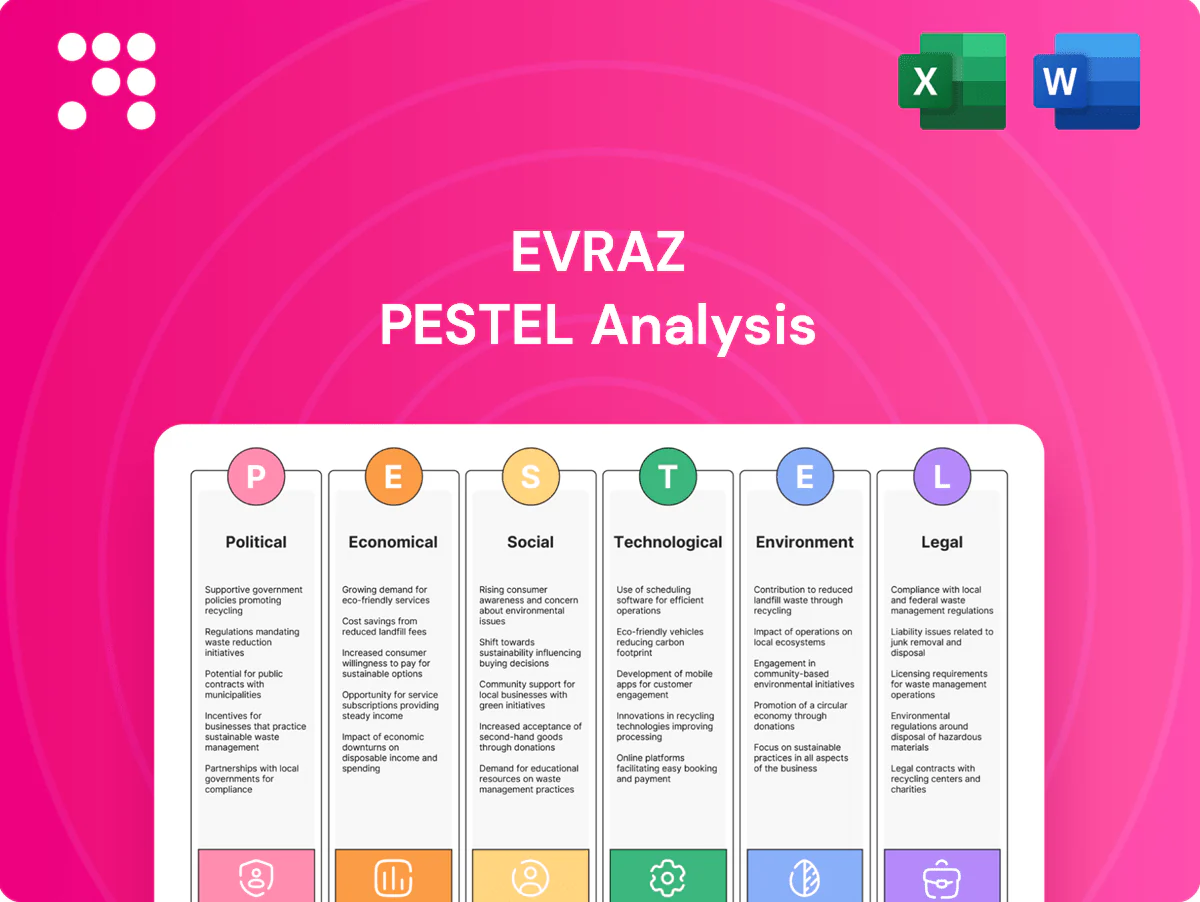
Evraz PESTLE Analysis

Skip the Research. Get the Strategy.
Discover how political shifts, economic cycles, and technological trends are shaping Evraz’s strategic landscape in our concise PESTLE snapshot. Packed with actionable takeaways for investors and strategists, it highlights risks and growth levers you can act on now. Purchase the full PESTLE for the complete, editable analysis and make smarter decisions faster.
Political factors

Geopolitical sanctions exposure
Sanctions on Russian-linked entities since February–March 2022, including UK measures that targeted EVRAZ and its affiliates and the company’s 2022 delisting from the LSE, elevate counterparty risk, restrict access to Western finance and limit market channels. EVRAZ faces heightened scrutiny across supply chains and banking relationships, with correspondent banking links and export permits subject to abrupt policy shifts. Scenario planning for prolonged restrictions is critical as export permissions and asset mobility can be changed rapidly by regulators.
Trade barriers and tariffs
Steel is frequently targeted by antidumping duties, quotas and Buy-America provisions; the 2018 Section 232 steel tariffs remain set at 25%, reshaping supply economics. EVRAZ’s North American sales mix can be reshaped by federal procurement rules tied to the $1.2 trillion Bipartisan Infrastructure Law and any Section 232-like measures. Eurasian exports may face new barriers or preferential treatment, and margin volatility stems from uncertain tariff pass-through.

State influence in core markets
Russia and Kazakhstan feature material state roles in mining and infrastructure, with Russian Railways 100% state-owned and Kazakhstan's sovereign fund Samruk‑Kazyna controlling key mining and transport assets. State-led rail and energy projects can boost steel and ore demand while enabling policy-driven pricing and allocation. Political directives often prioritize domestic supply over exports. Contract stability for Evraz therefore hinges on strong government relationships.

Logistics corridors and regional security
Resource nationalism risk
Resource nationalism risk: Evraz faces licence and royalty tightening during commodity upcycles, with rising local content mandates and possible renegotiation of terms or windfall taxes that can compress cash flows; diversified jurisdictional exposure across Russia, Kazakhstan and other markets helps mitigate unilateral policy shocks.
- Licences/royalties vulnerable
- Local content mandates can rise
- Renegotiation/windfall taxes impact cash flow
- Diversified jurisdictions offset risk
Sanctions, LSE delist, 25% tariffs raise financing and demand volatility
Sanctions since Feb–Mar 2022, including EVRAZ UK targeting and 2022 LSE delisting, raise counterparty and financing risk. 25% Section 232 tariffs and the $1.2tn US Bipartisan Infrastructure Law reshape North American demand and procurement. State control in Russia/Kazakhstan and Black Sea transit disruptions increase policy and transport volatility.
| Factor | Impact | Metric (2024) |
|---|---|---|
| Sanctions/LSE delist | Finance, markets | Delisted 2022; UK sanctions 2022 |
| Tariffs/procurement | Demand shift | Section 232 =25%; $1.2tn infra law |
What is included in the product
 Detailed Word Document
Explores how macro-environmental factors uniquely affect Evraz across Political, Economic, Social, Technological, Environmental, and Legal dimensions, with each category expanded into specific subpoints and examples relevant to its regions and industry. Every section is data-backed, forward-looking, and formatted for executives, consultants, and investors to identify threats, opportunities, and actionable strategies.

 Customizable Excel Spreadsheet
A concise, visually segmented Evraz PESTLE summary that relieves meeting-prep pain by highlighting key political, economic, social, technological, legal and environmental risks for quick decision-making and easy insertion into presentations.
Economic factors

Steel cycle sensitivity
Steel cycle sensitivity for EVRAZ is driven by construction, energy pipeline and rail capex that set volume and pricing, while global crude steel output reached 1,873.1 Mt in 2023 with China producing 1,051.6 Mt (~56%), so Chinese demand swings quickly propagate price shocks. Persistent global overcapacity amplifies volatility; EVRAZ’s vertical integration helps sustain margins but cannot fully protect volumes. Active pricing and order-book management remain vital to navigate cyclical swings.
FX and inflation volatility
RUB (around 95–100/USD in H1 2025) and KZT (~450–470/USD) swings materially change Evraz input costs, revenue translation and USD-denominated debt service, while USD strength raises local-currency debt burdens. Elevated inflation—Russia mid-single digits and Kazakhstan in the high teens in 2024—pushes wages, consumables and maintenance capex higher. Currency controls can limit free cash flow; hedging and natural offsets (export revenues vs local costs) dampen earnings volatility.

Energy and fuel cost intensity
Steelmaking and mining are energy- and fuel-intensive: BF-BOF steel uses about 20 GJ/tonne and diesel for mining adds materially, so electricity, gas and diesel price spikes compress EBITDA, with energy often representing roughly 15–25% of cash costs. Long-term power contracts and onsite generation (cogeneration/solar) are used to stabilize input prices. Targeted efficiency and waste-heat projects often pay back in 1–3 years in high-energy-price regimes.

Capital access and cost of funds
Sanctions on Russia (broadened in 2022) and Evraz's LSE suspension/delisting in 2022 have curtailed access to Western capital, raising risk premia and forcing reliance on domestic liquidity; borrowing from international markets is largely restricted. Internal cash generation and phased project execution drive investment pacing, with vendor financing and local banks substituting external capital and capex shifting to quick-return, de-risked projects.
- Sanctions expanded 2022 — international markets limited
- Evraz LSE suspension/delisting 2022
- Internal cash + phased projects prioritized
- Vendor finance/local banks fill funding gaps
- Capex: quick-return, low-risk projects
Demand mix in North America
Demand mix in North America shows pipeline, OCTG and rail cycles diverging from construction steels; US IIJA at 1.2 trillion and Canada Investing in Canada at ~180 billion support medium-term construction-linked volumes. Energy upcycles lift OCTG and tubular demand but remain volatile — WTI averaged roughly 77 USD/bbl in 2024, driving episodic 20–40% tubular swings. Monitor customer concentration risk, especially large oilfield and pipeline accounts.
- Cycle divergence: pipeline/OCTG/rail vs construction
- US IIJA 1.2 trillion; Canada ~180 billion
- WTI ~77 USD/bbl (2024) — volatile tubular demand
- Customer concentration risk: high for oilfield/pipeline buyers
Sanctions, LSE delist, 25% tariffs raise financing and demand volatility
Steel cycle sensitivity remains primary: global crude steel 1,873.1 Mt (2023) with China 1,051.6 Mt (~56%), amplifying price swings; EVRAZ vertical integration cushions but not immune. FX (RUB ~95–100/USD H1 2025; KZT ~450–470/USD) and inflation (Russia mid-single, Kazakhstan high teens 2024) shift costs and debt service. Energy input share ~15–25% of cash costs; WTI ~77 USD/bbl (2024) drives tubular demand; sanctions since 2022 restrict Western capital.
| Metric | Value |
|---|---|
| Global steel (2023) | 1,873.1 Mt |
| China (2023) | 1,051.6 Mt (~56%) |
| RUB (H1 2025) | 95–100/USD |
| KZT (H1 2025) | 450–470/USD |
| WTI (2024) | ~77 USD/bbl |
| Energy share | 15–25% cash costs |
Full Version Awaits
Evraz PESTLE Analysis
The preview shown here is the exact Evraz PESTLE Analysis you’ll receive after purchase—fully formatted and ready to use. The content and structure visible reflect the final document, with political, economic, social, technological, legal, and environmental insights clearly presented. No placeholders or teasers; this is the real, finished file you’ll download immediately after payment.

Product Information
Product Information
Shipping & Returns
Shipping & Returns
Description
Skip the Research. Get the Strategy.
Discover how political shifts, economic cycles, and technological trends are shaping Evraz’s strategic landscape in our concise PESTLE snapshot. Packed with actionable takeaways for investors and strategists, it highlights risks and growth levers you can act on now. Purchase the full PESTLE for the complete, editable analysis and make smarter decisions faster.
Political factors
Geopolitical sanctions exposure
Sanctions on Russian-linked entities since February–March 2022, including UK measures that targeted EVRAZ and its affiliates and the company’s 2022 delisting from the LSE, elevate counterparty risk, restrict access to Western finance and limit market channels. EVRAZ faces heightened scrutiny across supply chains and banking relationships, with correspondent banking links and export permits subject to abrupt policy shifts. Scenario planning for prolonged restrictions is critical as export permissions and asset mobility can be changed rapidly by regulators.
Trade barriers and tariffs
Steel is frequently targeted by antidumping duties, quotas and Buy-America provisions; the 2018 Section 232 steel tariffs remain set at 25%, reshaping supply economics. EVRAZ’s North American sales mix can be reshaped by federal procurement rules tied to the $1.2 trillion Bipartisan Infrastructure Law and any Section 232-like measures. Eurasian exports may face new barriers or preferential treatment, and margin volatility stems from uncertain tariff pass-through.
State influence in core markets
Russia and Kazakhstan feature material state roles in mining and infrastructure, with Russian Railways 100% state-owned and Kazakhstan's sovereign fund Samruk‑Kazyna controlling key mining and transport assets. State-led rail and energy projects can boost steel and ore demand while enabling policy-driven pricing and allocation. Political directives often prioritize domestic supply over exports. Contract stability for Evraz therefore hinges on strong government relationships.
Logistics corridors and regional security
Resource nationalism risk
Resource nationalism risk: Evraz faces licence and royalty tightening during commodity upcycles, with rising local content mandates and possible renegotiation of terms or windfall taxes that can compress cash flows; diversified jurisdictional exposure across Russia, Kazakhstan and other markets helps mitigate unilateral policy shocks.
- Licences/royalties vulnerable
- Local content mandates can rise
- Renegotiation/windfall taxes impact cash flow
- Diversified jurisdictions offset risk
Sanctions, LSE delist, 25% tariffs raise financing and demand volatility
Sanctions since Feb–Mar 2022, including EVRAZ UK targeting and 2022 LSE delisting, raise counterparty and financing risk. 25% Section 232 tariffs and the $1.2tn US Bipartisan Infrastructure Law reshape North American demand and procurement. State control in Russia/Kazakhstan and Black Sea transit disruptions increase policy and transport volatility.
| Factor | Impact | Metric (2024) |
|---|---|---|
| Sanctions/LSE delist | Finance, markets | Delisted 2022; UK sanctions 2022 |
| Tariffs/procurement | Demand shift | Section 232 =25%; $1.2tn infra law |
What is included in the product
Detailed Word Document
Explores how macro-environmental factors uniquely affect Evraz across Political, Economic, Social, Technological, Environmental, and Legal dimensions, with each category expanded into specific subpoints and examples relevant to its regions and industry. Every section is data-backed, forward-looking, and formatted for executives, consultants, and investors to identify threats, opportunities, and actionable strategies.
Customizable Excel Spreadsheet
A concise, visually segmented Evraz PESTLE summary that relieves meeting-prep pain by highlighting key political, economic, social, technological, legal and environmental risks for quick decision-making and easy insertion into presentations.
Economic factors
Steel cycle sensitivity
Steel cycle sensitivity for EVRAZ is driven by construction, energy pipeline and rail capex that set volume and pricing, while global crude steel output reached 1,873.1 Mt in 2023 with China producing 1,051.6 Mt (~56%), so Chinese demand swings quickly propagate price shocks. Persistent global overcapacity amplifies volatility; EVRAZ’s vertical integration helps sustain margins but cannot fully protect volumes. Active pricing and order-book management remain vital to navigate cyclical swings.
FX and inflation volatility
RUB (around 95–100/USD in H1 2025) and KZT (~450–470/USD) swings materially change Evraz input costs, revenue translation and USD-denominated debt service, while USD strength raises local-currency debt burdens. Elevated inflation—Russia mid-single digits and Kazakhstan in the high teens in 2024—pushes wages, consumables and maintenance capex higher. Currency controls can limit free cash flow; hedging and natural offsets (export revenues vs local costs) dampen earnings volatility.
Energy and fuel cost intensity
Steelmaking and mining are energy- and fuel-intensive: BF-BOF steel uses about 20 GJ/tonne and diesel for mining adds materially, so electricity, gas and diesel price spikes compress EBITDA, with energy often representing roughly 15–25% of cash costs. Long-term power contracts and onsite generation (cogeneration/solar) are used to stabilize input prices. Targeted efficiency and waste-heat projects often pay back in 1–3 years in high-energy-price regimes.
Capital access and cost of funds
Sanctions on Russia (broadened in 2022) and Evraz's LSE suspension/delisting in 2022 have curtailed access to Western capital, raising risk premia and forcing reliance on domestic liquidity; borrowing from international markets is largely restricted. Internal cash generation and phased project execution drive investment pacing, with vendor financing and local banks substituting external capital and capex shifting to quick-return, de-risked projects.
- Sanctions expanded 2022 — international markets limited
- Evraz LSE suspension/delisting 2022
- Internal cash + phased projects prioritized
- Vendor finance/local banks fill funding gaps
- Capex: quick-return, low-risk projects
Demand mix in North America
Demand mix in North America shows pipeline, OCTG and rail cycles diverging from construction steels; US IIJA at 1.2 trillion and Canada Investing in Canada at ~180 billion support medium-term construction-linked volumes. Energy upcycles lift OCTG and tubular demand but remain volatile — WTI averaged roughly 77 USD/bbl in 2024, driving episodic 20–40% tubular swings. Monitor customer concentration risk, especially large oilfield and pipeline accounts.
- Cycle divergence: pipeline/OCTG/rail vs construction
- US IIJA 1.2 trillion; Canada ~180 billion
- WTI ~77 USD/bbl (2024) — volatile tubular demand
- Customer concentration risk: high for oilfield/pipeline buyers
Sanctions, LSE delist, 25% tariffs raise financing and demand volatility
Steel cycle sensitivity remains primary: global crude steel 1,873.1 Mt (2023) with China 1,051.6 Mt (~56%), amplifying price swings; EVRAZ vertical integration cushions but not immune. FX (RUB ~95–100/USD H1 2025; KZT ~450–470/USD) and inflation (Russia mid-single, Kazakhstan high teens 2024) shift costs and debt service. Energy input share ~15–25% of cash costs; WTI ~77 USD/bbl (2024) drives tubular demand; sanctions since 2022 restrict Western capital.
| Metric | Value |
|---|---|
| Global steel (2023) | 1,873.1 Mt |
| China (2023) | 1,051.6 Mt (~56%) |
| RUB (H1 2025) | 95–100/USD |
| KZT (H1 2025) | 450–470/USD |
| WTI (2024) | ~77 USD/bbl |
| Energy share | 15–25% cash costs |
Full Version Awaits
Evraz PESTLE Analysis
The preview shown here is the exact Evraz PESTLE Analysis you’ll receive after purchase—fully formatted and ready to use. The content and structure visible reflect the final document, with political, economic, social, technological, legal, and environmental insights clearly presented. No placeholders or teasers; this is the real, finished file you’ll download immediately after payment.