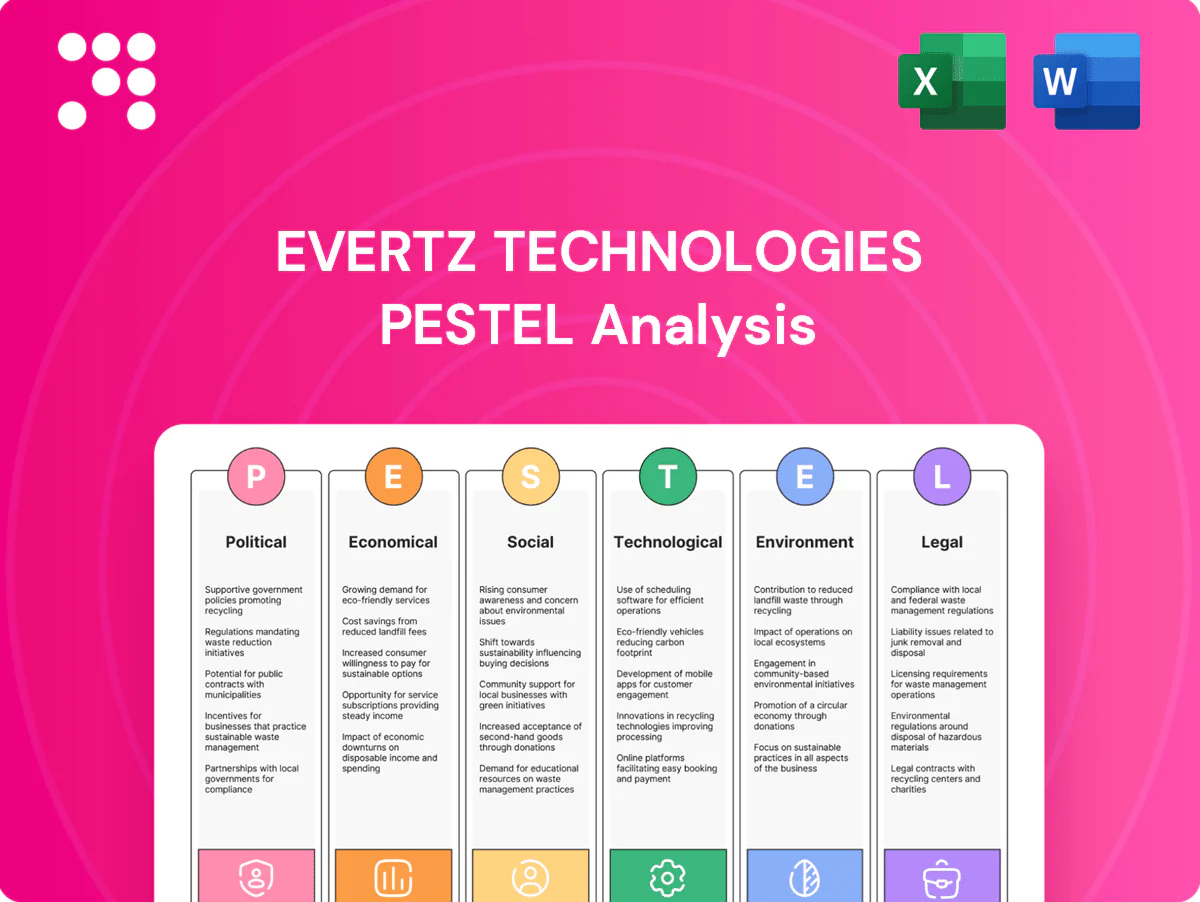
Evertz Technologies PESTLE Analysis

Skip the Research. Get the Strategy.
Discover how political shifts, economic cycles, and fast-moving technology trends are shaping Evertz Technologies’ strategic outlook in our concise PESTLE snapshot; this 3–5 sentence preview highlights key external risks and opportunities. For the full, actionable PESTLE analysis—ready to use in strategy decks and investment reports—purchase and download the complete report now.
Political factors

Trade and tariff exposure
Hardware supply chains face Section 301 US tariffs of up to 25%, which can raise landed costs and compress margins for equipment makers like Evertz. Shifts in US–China and EU trade policies disrupt availability of components, subassemblies and finished goods, forcing multi-country sourcing and tariff engineering to preserve pricing. Government incentives such as the US CHIPS Act (roughly US$52 billion) can tilt plant-location and sourcing decisions.
Broadcast policy and public funding
National policies toward public broadcasters shape capex cycles, with election-year budgets and cultural funding often accelerating or deferring infrastructure upgrades.
Public broadcasters commonly award multi-year tenders (3–5 years) that anchor Evertz’s sales pipeline and backlog.
Policy stability supports predictable demand planning for Evertz, while funding volatility compresses procurement timing and can shift quarterly bookings.

Export controls and sanctions
Advanced video, IP, and encryption features in Evertz products frequently fall under US EAR and allied export controls, requiring controlled-technology classification and licensing; sanctions regimes bar sales to designated state media and telecoms in sanctioned jurisdictions such as Russia, Iran, and North Korea. Robust compliance screening is essential to maintain deal velocity, as non-compliance risks heavy fines and severe reputational damage.

Standards-setting and lobbying
Outcomes at bodies like SMPTE (ST 2110 published 2017), AMWA (NMOS suites from 2017+) and ITU directly shape interoperability; Evertz participation accelerates customer acceptance of ST 2110, NMOS and compression standards, shortening sales cycles and lowering integration costs, while misalignment raises customization and support burdens.
- Standards influence interoperability
- Participation = faster adoption
- Alignment cuts integration costs
- Misalignment ups support/custom work
Geopolitical supply-chain risk
Regional tensions in 2024–25 threaten semiconductor, FPGA and optics flows—US CHIPS Act subsidies of about 52 billion USD shift production incentives, while shipping insurance spikes (Red Sea premiums rose up to 400% in 2023) and logistics lanes face recurrent disruptions that raise lead times and costs.
- Dual-sourcing: lowers outage risk
- Inventory buffers: 3–6 months common target
- Reshoring incentives: alter unit costs, capex
- Insurance/logistics: significant volatility
Tariffs, CHIPS Act and export controls reshape 2024-25 sourcing, capex and compliance
Trade tariffs (US Section 301 up to 25%) and US–China/EU policy shifts raise landed costs and force multi-country sourcing; US CHIPS Act ~52 billion USD redirects semiconductor supply decisions in 2024–25. Election-driven public-broadcast budgets alter capex timing and multi-year tenders (3–5 yrs) that anchor backlog. Export controls and sanctions restrict markets and require tight compliance.
| Item | 2024/25 Fact |
|---|---|
| US tariffs | up to 25% |
| CHIPS Act | ~52 bn USD |
| Red Sea insurance | premiums spiked up to 400% (2023) |
What is included in the product
 Detailed Word Document
Explores how external macro-environmental factors uniquely affect Evertz Technologies across Political, Economic, Social, Technological, Environmental and Legal dimensions, with data-driven examples tied to broadcast/media tech and global supply chains. Designed for executives and investors, each section delivers forward-looking insights, risks and opportunities to inform strategy, funding and scenario planning.

 Customizable Excel Spreadsheet
A concise, shareable PESTLE snapshot for Evertz Technologies that highlights external risks and opportunities, enabling quick alignment in meetings or presentations and easy customization for regional or product-specific notes.
Economic factors

Customer capex cycles
Broadcasters, streamers and telcos buy in multi-year waves aligned to rights cycles and marquee events such as UEFA Euro 2024 and the Paris 2024 Olympics, creating concentrated capex windows.
Live sports and spectrum refarms (eg US C-band reallocation 2020–21) produce sharp spending spikes as operators upgrade infrastructure for capacity and low latency.
Recessions typically push refresh cycles out and lengthen approval timelines, while vendor pipelines hinge on timing of major event rights renewals and network rollouts.
Currency volatility (CAD/USD/EUR)
Revenue for Evertz is largely realized in USD and EUR while a portion of production and SG&A costs are in CAD, so CAD/USD/EUR volatility directly alters reported CAD results and gross margins.
Quarterly FX swings have historically produced noticeable EPS and margin variance despite company hedging programs that reduce but do not eliminate translation and transaction risk.
Targeted local pricing and contract currency clauses help stabilize deal outcomes and protect competitiveness in price-sensitive markets.

Interest rates and financing
Higher interest rates raise customer WACC and tighten capex, with the US federal funds rate at 5.25–5.50% and the Bank of Canada policy rate near 5.00% in mid‑2025, pressuring buyer budgets for broadcast infrastructure. Leasing, subscription and opex models can preserve deal flow by shifting capex to predictable operating spend. Vendor financing and installment structures can unlock stalled projects, while balance‑sheet flexibility enables opportunistic M&A or continued R&D investment.

Industry consolidation
Industry consolidation concentrates purchasing power among large media owners, with global media M&A deal value near US$72bn in 2024, pushing Evertz to compete for larger RFPs that favor end-to-end portfolios and integration scale.
Cross-selling after deals can raise wallet share but drives higher customization and integration services; post-merger integration often pauses capital expenditure for 3–9 months, slowing vendor revenues temporarily.
- Larger RFPs: favor integrated vendors
- Cross-sell: increases lifetime value, raises customization needs
- Capex pause: typical 3–9 month spend slowdown post-merger
Advertising and subscription trends
Ad markets remain the primary broadcaster cash source while DTC churn and 1.5 billion global SVOD subs in 2024 squeeze streamer margins, shifting budgets toward efficient live production, playout and archive solutions; ROI cases that cut opex or enable new monetization win procurement. Elastic, usage-based pricing aligns vendor revenue with broadcaster volatility.
- Ad-driven cash flow
- DTC churn pressure
- Budget shifts to live/archives
- Opex-cutting ROI wins
- Elastic pricing fits volatility
Tariffs, CHIPS Act and export controls reshape 2024-25 sourcing, capex and compliance
Event-driven, multi-year broadcaster capex (UEFA Euro 2024, Paris 2024) and spectrum refarms create lumpy upgrade spikes.
USD/EUR revenue vs CAD costs and FX swings materially affect margins; US rates 5.25–5.50% and BoC ~5.00% (mid‑2025) tighten buyer capex.
Industry M&A ~US$72bn (2024) and 1.5bn SVOD subs (2024) favor integrated, opex-friendly solutions; elastic pricing and vendor financing mitigate demand risk.
| Metric | Value |
|---|---|
| Media M&A | ~US$72bn (2024) |
| SVOD subs | 1.5bn (2024) |
| US rate | 5.25–5.50% (mid‑2025) |
| BoC rate | ~5.00% (mid‑2025) |
Preview Before You Purchase
Evertz Technologies PESTLE Analysis
The preview shown here is the exact document you’ll receive after purchase—fully formatted and ready to use. This Evertz Technologies PESTLE Analysis provides concise political, economic, sociocultural, technological, legal, and environmental insights tailored for strategic decision-making. No placeholders or teasers—what you see is the final, downloadable file.

Product Information
Product Information
Shipping & Returns
Shipping & Returns
Description
Skip the Research. Get the Strategy.
Discover how political shifts, economic cycles, and fast-moving technology trends are shaping Evertz Technologies’ strategic outlook in our concise PESTLE snapshot; this 3–5 sentence preview highlights key external risks and opportunities. For the full, actionable PESTLE analysis—ready to use in strategy decks and investment reports—purchase and download the complete report now.
Political factors
Trade and tariff exposure
Hardware supply chains face Section 301 US tariffs of up to 25%, which can raise landed costs and compress margins for equipment makers like Evertz. Shifts in US–China and EU trade policies disrupt availability of components, subassemblies and finished goods, forcing multi-country sourcing and tariff engineering to preserve pricing. Government incentives such as the US CHIPS Act (roughly US$52 billion) can tilt plant-location and sourcing decisions.
Broadcast policy and public funding
National policies toward public broadcasters shape capex cycles, with election-year budgets and cultural funding often accelerating or deferring infrastructure upgrades.
Public broadcasters commonly award multi-year tenders (3–5 years) that anchor Evertz’s sales pipeline and backlog.
Policy stability supports predictable demand planning for Evertz, while funding volatility compresses procurement timing and can shift quarterly bookings.
Export controls and sanctions
Advanced video, IP, and encryption features in Evertz products frequently fall under US EAR and allied export controls, requiring controlled-technology classification and licensing; sanctions regimes bar sales to designated state media and telecoms in sanctioned jurisdictions such as Russia, Iran, and North Korea. Robust compliance screening is essential to maintain deal velocity, as non-compliance risks heavy fines and severe reputational damage.
Standards-setting and lobbying
Outcomes at bodies like SMPTE (ST 2110 published 2017), AMWA (NMOS suites from 2017+) and ITU directly shape interoperability; Evertz participation accelerates customer acceptance of ST 2110, NMOS and compression standards, shortening sales cycles and lowering integration costs, while misalignment raises customization and support burdens.
- Standards influence interoperability
- Participation = faster adoption
- Alignment cuts integration costs
- Misalignment ups support/custom work
Geopolitical supply-chain risk
Regional tensions in 2024–25 threaten semiconductor, FPGA and optics flows—US CHIPS Act subsidies of about 52 billion USD shift production incentives, while shipping insurance spikes (Red Sea premiums rose up to 400% in 2023) and logistics lanes face recurrent disruptions that raise lead times and costs.
- Dual-sourcing: lowers outage risk
- Inventory buffers: 3–6 months common target
- Reshoring incentives: alter unit costs, capex
- Insurance/logistics: significant volatility
Tariffs, CHIPS Act and export controls reshape 2024-25 sourcing, capex and compliance
Trade tariffs (US Section 301 up to 25%) and US–China/EU policy shifts raise landed costs and force multi-country sourcing; US CHIPS Act ~52 billion USD redirects semiconductor supply decisions in 2024–25. Election-driven public-broadcast budgets alter capex timing and multi-year tenders (3–5 yrs) that anchor backlog. Export controls and sanctions restrict markets and require tight compliance.
| Item | 2024/25 Fact |
|---|---|
| US tariffs | up to 25% |
| CHIPS Act | ~52 bn USD |
| Red Sea insurance | premiums spiked up to 400% (2023) |
What is included in the product
Detailed Word Document
Explores how external macro-environmental factors uniquely affect Evertz Technologies across Political, Economic, Social, Technological, Environmental and Legal dimensions, with data-driven examples tied to broadcast/media tech and global supply chains. Designed for executives and investors, each section delivers forward-looking insights, risks and opportunities to inform strategy, funding and scenario planning.
Customizable Excel Spreadsheet
A concise, shareable PESTLE snapshot for Evertz Technologies that highlights external risks and opportunities, enabling quick alignment in meetings or presentations and easy customization for regional or product-specific notes.
Economic factors
Customer capex cycles
Broadcasters, streamers and telcos buy in multi-year waves aligned to rights cycles and marquee events such as UEFA Euro 2024 and the Paris 2024 Olympics, creating concentrated capex windows.
Live sports and spectrum refarms (eg US C-band reallocation 2020–21) produce sharp spending spikes as operators upgrade infrastructure for capacity and low latency.
Recessions typically push refresh cycles out and lengthen approval timelines, while vendor pipelines hinge on timing of major event rights renewals and network rollouts.
Currency volatility (CAD/USD/EUR)
Revenue for Evertz is largely realized in USD and EUR while a portion of production and SG&A costs are in CAD, so CAD/USD/EUR volatility directly alters reported CAD results and gross margins.
Quarterly FX swings have historically produced noticeable EPS and margin variance despite company hedging programs that reduce but do not eliminate translation and transaction risk.
Targeted local pricing and contract currency clauses help stabilize deal outcomes and protect competitiveness in price-sensitive markets.
Interest rates and financing
Higher interest rates raise customer WACC and tighten capex, with the US federal funds rate at 5.25–5.50% and the Bank of Canada policy rate near 5.00% in mid‑2025, pressuring buyer budgets for broadcast infrastructure. Leasing, subscription and opex models can preserve deal flow by shifting capex to predictable operating spend. Vendor financing and installment structures can unlock stalled projects, while balance‑sheet flexibility enables opportunistic M&A or continued R&D investment.
Industry consolidation
Industry consolidation concentrates purchasing power among large media owners, with global media M&A deal value near US$72bn in 2024, pushing Evertz to compete for larger RFPs that favor end-to-end portfolios and integration scale.
Cross-selling after deals can raise wallet share but drives higher customization and integration services; post-merger integration often pauses capital expenditure for 3–9 months, slowing vendor revenues temporarily.
- Larger RFPs: favor integrated vendors
- Cross-sell: increases lifetime value, raises customization needs
- Capex pause: typical 3–9 month spend slowdown post-merger
Advertising and subscription trends
Ad markets remain the primary broadcaster cash source while DTC churn and 1.5 billion global SVOD subs in 2024 squeeze streamer margins, shifting budgets toward efficient live production, playout and archive solutions; ROI cases that cut opex or enable new monetization win procurement. Elastic, usage-based pricing aligns vendor revenue with broadcaster volatility.
- Ad-driven cash flow
- DTC churn pressure
- Budget shifts to live/archives
- Opex-cutting ROI wins
- Elastic pricing fits volatility
Tariffs, CHIPS Act and export controls reshape 2024-25 sourcing, capex and compliance
Event-driven, multi-year broadcaster capex (UEFA Euro 2024, Paris 2024) and spectrum refarms create lumpy upgrade spikes.
USD/EUR revenue vs CAD costs and FX swings materially affect margins; US rates 5.25–5.50% and BoC ~5.00% (mid‑2025) tighten buyer capex.
Industry M&A ~US$72bn (2024) and 1.5bn SVOD subs (2024) favor integrated, opex-friendly solutions; elastic pricing and vendor financing mitigate demand risk.
| Metric | Value |
|---|---|
| Media M&A | ~US$72bn (2024) |
| SVOD subs | 1.5bn (2024) |
| US rate | 5.25–5.50% (mid‑2025) |
| BoC rate | ~5.00% (mid‑2025) |
Preview Before You Purchase
Evertz Technologies PESTLE Analysis
The preview shown here is the exact document you’ll receive after purchase—fully formatted and ready to use. This Evertz Technologies PESTLE Analysis provides concise political, economic, sociocultural, technological, legal, and environmental insights tailored for strategic decision-making. No placeholders or teasers—what you see is the final, downloadable file.