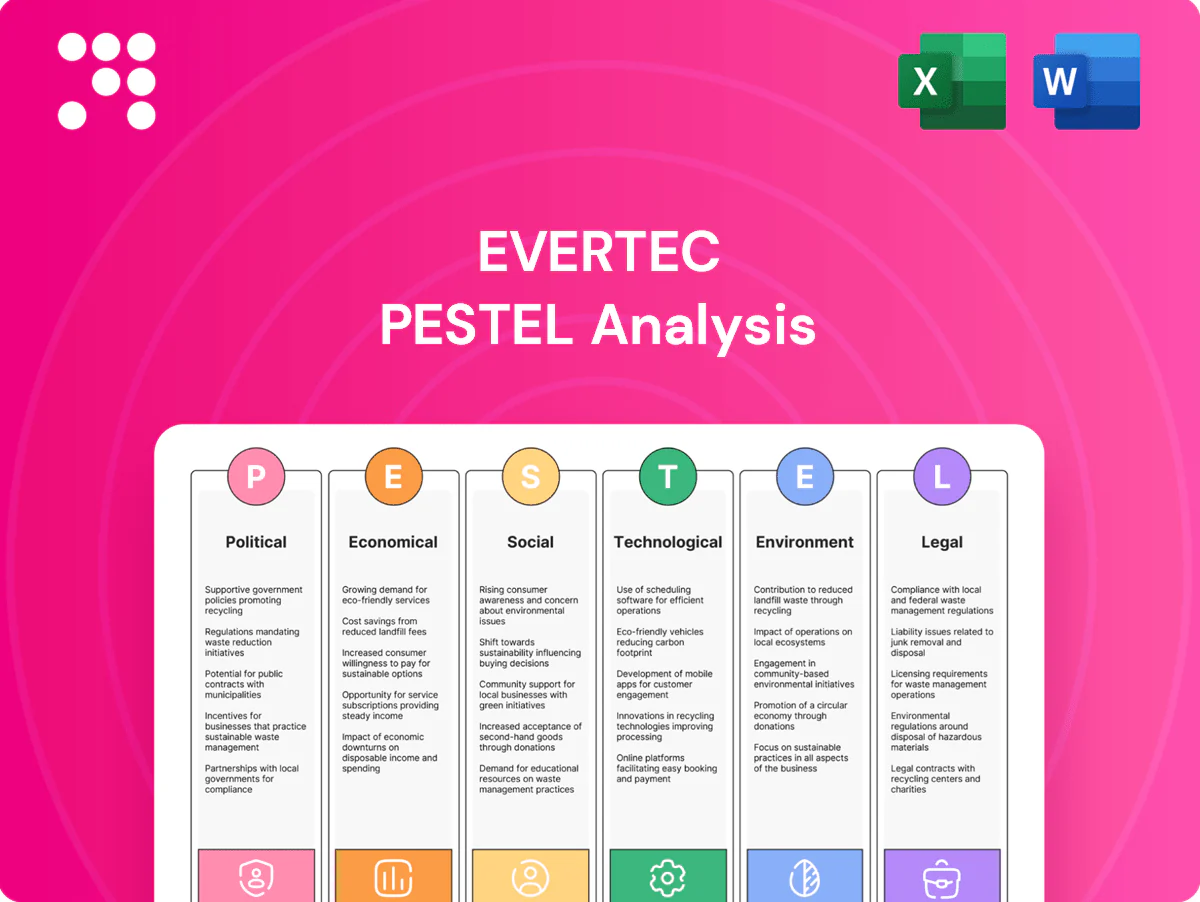
EVERTEC PESTLE Analysis

Make Smarter Strategic Decisions with a Complete PESTEL View
Unlock how political, economic, social, technological, legal and environmental forces are reshaping EVERTEC’s growth prospects and risk profile. This concise PESTLE distills external trends into actionable insights for investors, advisors and strategists. Purchase the full, fully editable report to access deep-dive data, scenario implications and ready-to-use recommendations.
Political factors

Regulatory stability variance
Operating across Puerto Rico, the Caribbean and Latin America exposes EVERTEC to uneven policy stability across 30+ markets; sudden changes in payment rules can alter fees, settlement timing or licensing, impacting a company with annual revenues above $1B. Political turnover in the region often delays approvals and public-sector projects. Scenario planning and multi-market compliance mapping are used to mitigate regulatory shocks.
Government digitalization agendas
Many governments are mandating e-payments for taxes, transit and benefits, creating large processing opportunities that EVERTEC can capture via public-private partnerships and expanded acceptance networks. Winning mandates depends on procurement transparency and partner IT readiness; early engagement lets EVERTEC influence standards and timelines. Successful bids can scale to millions of monthly transactions, expanding revenue and switch volumes.

Public sector client concentration
Contracts with government agencies give EVERTEC scale but raise political exposure, as public-sector deals in Latin America often involve multi-year contracts worth millions and can dominate client portfolios. Budget cycles, austerity or administration changes have in past cycles led to contract repricing or non-renewal, with renewals sometimes delayed by quarters. Payment timing risk rises in fiscal stress—public payments have been observed to run 60–90+ days late in crisis periods. Diversification across private clients and tight SLAs reduce dependency and cash-flow vulnerability.

Geopolitical and sanctions exposure
Regional clients may touch sanctioned entities or high‑risk corridors, increasing exposure as OFAC and other regimes expand listings; OFAC maintained over 7,000 SDNs by mid‑2025, raising screening scope. Non‑compliance risks multi‑million-dollar fines and de‑banking by correspondent banks, so continuous list updates and adverse‑media monitoring are critical.
- Screening: mandatory OFAC/UN/EU checks
- Scope: >7,000 SDNs (mid‑2025)
- Risks: fines, de‑banking
- Controls: real‑time list updates + adverse media
Infrastructure and telecom policy
Payment uptime depends on reliable connectivity and power; outages directly disrupt card, POS and mobile acceptance. Policy-driven investments in broadband and grid resilience affect service levels—global mobile broadband subscriptions reached about 7.9 billion in 2024 and Latin America smartphone adoption ~67% (GSMA 2024). Subsidies, spectrum allocation and advocacy for critical infrastructure prioritization accelerate POS and mobile adoption and sustain transaction continuity.
- Connectivity reliance: impacts uptime
- 7.9B mobile broadband subs (2024)
- 67% LatAm smartphone adoption (GSMA 2024)
- Subsidies/spectrum speed POS/mobile uptake
Payments firm in 30+ PR/LatAm markets with >$1B revenue — policy, OFAC, receivable risk
Operating across 30+ Puerto Rico, Caribbean and LatAm markets exposes EVERTEC to policy shifts affecting fees, licensing and procurement; annual revenue >$1B raises political sensitivity. E-pay mandates and government contracts can scale to millions of tx/month but increase budget, renewal and payment-timing risk (public payments 60–90+ days). OFAC >7,000 SDNs (mid‑2025); 7.9B mobile broadband (2024); LatAm smartphone 67% (GSMA 2024).
| Metric | Value |
|---|---|
| Markets | 30+ |
| Revenue | >$1B |
| OFAC SDNs | >7,000 (mid‑2025) |
| Mobile broadband | 7.9B (2024) |
| LatAm smartphone | 67% (GSMA 2024) |
What is included in the product
 Detailed Word Document
Explores how Political, Economic, Social, Technological, Environmental, and Legal factors uniquely impact EVERTEC, with data-driven examples and region‑specific regulatory context. Designed for executives and investors, the analysis offers forward‑looking insights to spot risks, opportunities, and guide strategic decisions.

 Customizable Excel Spreadsheet
Concise, PESTLE-segmented summary of EVERTEC’s external landscape for quick interpretation in meetings or presentations, easily editable for regional or line-specific notes and formatted for seamless sharing across teams and slides.
Economic factors

GDP and consumption cycles
Transaction volumes for EVERTEC track retail sales and services activity; global GDP grew 3.1% in 2024 (IMF), and slower GDP compresses merchant acquiring revenues through lower card spend. Tourism recovery—international arrivals reached 88% of 2019 levels in 2023 (UNWTO)—boosts card-present volumes in Caribbean markets. Elastic cost structures help defend margins during downturns by scaling operating costs with volumes.
Inflation and interest rates
High inflation (US CPI ~3.4% in 2024) lifts nominal ticket sizes for EVERTEC but can dampen real transaction demand as household purchasing power falls. Rate hikes (federal funds 5.25–5.50% mid‑2025) raise financing costs for capex and working capital, pressuring margins. Pricing models may require indexation to preserve take rates, while merchants increasingly seek lower‑cost acceptance and route shifting under tighter conditions.

FX volatility across currencies
Multi-currency settlement exposes EVERTEC and its merchant clients to FX swings, a risk noted in EVERTEC’s 2024 Form 10-K; hedging, currency clauses and local pricing strategies are used to protect margins. FX volatility also alters cross-border e-commerce flows and settlement timing. Strict treasury discipline and centralized hedging are cited internally as competitive differentiators.

Remittances and tourism flows
Caribbean and LATAM economies rely heavily on remittances (roughly $140B to the region in 2023) and tourism receipts; growth in these inflows raises payment throughput across retail and services, while pronounced seasonality forces capacity planning and liquidity management; rising cross-border card acceptance increases ticket capture for EVERTEC clients.
- Remittances drive retail volumes
- Tourism seasonality → capacity spikes
- Liquidity needs during peak months
- Cross-border acceptance boosts capture
Financial inclusion momentum
- Banking penetration: 76% (Global Findex 2021)
- Mobile money: >1.2B accounts (GSMA 2023)
- Strategy: low-cost acceptance for SMEs
- Levers: tiered pricing; lightweight onboarding
Payments firm in 30+ PR/LatAm markets with >$1B revenue — policy, OFAC, receivable risk
Slower 2024 global GDP (3.1% IMF) and mid‑2025 fed funds (5.25–5.50%) compress merchant spend and raise funding costs, while tourism recovery (88% of 2019 arrivals, UNWTO 2023) and remittances (~$140B to LATAM/Caribbean 2023) lift card volumes; FX volatility and uneven banking penetration (76% Global Findex 2021) shape pricing, hedging and digital wallet adoption.
| Metric | Value |
|---|---|
| Global GDP 2024 | 3.1% (IMF) |
| Fed funds mid‑2025 | 5.25–5.50% |
| Tourism 2023 | 88% of 2019 (UNWTO) |
| Remittances 2023 | $140B |
| Banking pen. | 76% (2021) |
| Mobile money | >1.2B (2023) |
Same Document Delivered
EVERTEC PESTLE Analysis
The preview shown here is the exact EVERTEC PESTLE Analysis document you’ll receive after purchase—fully formatted and ready to use. The layout, content, and structure visible are the final version with no placeholders or surprises. After checkout you’ll instantly be able to download this same professionally structured file.

Original: $10.00
-65%$10.00
$3.50Product Information
Product Information
Shipping & Returns
Shipping & Returns
Description
Make Smarter Strategic Decisions with a Complete PESTEL View
Unlock how political, economic, social, technological, legal and environmental forces are reshaping EVERTEC’s growth prospects and risk profile. This concise PESTLE distills external trends into actionable insights for investors, advisors and strategists. Purchase the full, fully editable report to access deep-dive data, scenario implications and ready-to-use recommendations.
Political factors
Regulatory stability variance
Operating across Puerto Rico, the Caribbean and Latin America exposes EVERTEC to uneven policy stability across 30+ markets; sudden changes in payment rules can alter fees, settlement timing or licensing, impacting a company with annual revenues above $1B. Political turnover in the region often delays approvals and public-sector projects. Scenario planning and multi-market compliance mapping are used to mitigate regulatory shocks.
Government digitalization agendas
Many governments are mandating e-payments for taxes, transit and benefits, creating large processing opportunities that EVERTEC can capture via public-private partnerships and expanded acceptance networks. Winning mandates depends on procurement transparency and partner IT readiness; early engagement lets EVERTEC influence standards and timelines. Successful bids can scale to millions of monthly transactions, expanding revenue and switch volumes.
Public sector client concentration
Contracts with government agencies give EVERTEC scale but raise political exposure, as public-sector deals in Latin America often involve multi-year contracts worth millions and can dominate client portfolios. Budget cycles, austerity or administration changes have in past cycles led to contract repricing or non-renewal, with renewals sometimes delayed by quarters. Payment timing risk rises in fiscal stress—public payments have been observed to run 60–90+ days late in crisis periods. Diversification across private clients and tight SLAs reduce dependency and cash-flow vulnerability.
Geopolitical and sanctions exposure
Regional clients may touch sanctioned entities or high‑risk corridors, increasing exposure as OFAC and other regimes expand listings; OFAC maintained over 7,000 SDNs by mid‑2025, raising screening scope. Non‑compliance risks multi‑million-dollar fines and de‑banking by correspondent banks, so continuous list updates and adverse‑media monitoring are critical.
- Screening: mandatory OFAC/UN/EU checks
- Scope: >7,000 SDNs (mid‑2025)
- Risks: fines, de‑banking
- Controls: real‑time list updates + adverse media
Infrastructure and telecom policy
Payment uptime depends on reliable connectivity and power; outages directly disrupt card, POS and mobile acceptance. Policy-driven investments in broadband and grid resilience affect service levels—global mobile broadband subscriptions reached about 7.9 billion in 2024 and Latin America smartphone adoption ~67% (GSMA 2024). Subsidies, spectrum allocation and advocacy for critical infrastructure prioritization accelerate POS and mobile adoption and sustain transaction continuity.
- Connectivity reliance: impacts uptime
- 7.9B mobile broadband subs (2024)
- 67% LatAm smartphone adoption (GSMA 2024)
- Subsidies/spectrum speed POS/mobile uptake
Payments firm in 30+ PR/LatAm markets with >$1B revenue — policy, OFAC, receivable risk
Operating across 30+ Puerto Rico, Caribbean and LatAm markets exposes EVERTEC to policy shifts affecting fees, licensing and procurement; annual revenue >$1B raises political sensitivity. E-pay mandates and government contracts can scale to millions of tx/month but increase budget, renewal and payment-timing risk (public payments 60–90+ days). OFAC >7,000 SDNs (mid‑2025); 7.9B mobile broadband (2024); LatAm smartphone 67% (GSMA 2024).
| Metric | Value |
|---|---|
| Markets | 30+ |
| Revenue | >$1B |
| OFAC SDNs | >7,000 (mid‑2025) |
| Mobile broadband | 7.9B (2024) |
| LatAm smartphone | 67% (GSMA 2024) |
What is included in the product
Detailed Word Document
Explores how Political, Economic, Social, Technological, Environmental, and Legal factors uniquely impact EVERTEC, with data-driven examples and region‑specific regulatory context. Designed for executives and investors, the analysis offers forward‑looking insights to spot risks, opportunities, and guide strategic decisions.
Customizable Excel Spreadsheet
Concise, PESTLE-segmented summary of EVERTEC’s external landscape for quick interpretation in meetings or presentations, easily editable for regional or line-specific notes and formatted for seamless sharing across teams and slides.
Economic factors
GDP and consumption cycles
Transaction volumes for EVERTEC track retail sales and services activity; global GDP grew 3.1% in 2024 (IMF), and slower GDP compresses merchant acquiring revenues through lower card spend. Tourism recovery—international arrivals reached 88% of 2019 levels in 2023 (UNWTO)—boosts card-present volumes in Caribbean markets. Elastic cost structures help defend margins during downturns by scaling operating costs with volumes.
Inflation and interest rates
High inflation (US CPI ~3.4% in 2024) lifts nominal ticket sizes for EVERTEC but can dampen real transaction demand as household purchasing power falls. Rate hikes (federal funds 5.25–5.50% mid‑2025) raise financing costs for capex and working capital, pressuring margins. Pricing models may require indexation to preserve take rates, while merchants increasingly seek lower‑cost acceptance and route shifting under tighter conditions.
FX volatility across currencies
Multi-currency settlement exposes EVERTEC and its merchant clients to FX swings, a risk noted in EVERTEC’s 2024 Form 10-K; hedging, currency clauses and local pricing strategies are used to protect margins. FX volatility also alters cross-border e-commerce flows and settlement timing. Strict treasury discipline and centralized hedging are cited internally as competitive differentiators.
Remittances and tourism flows
Caribbean and LATAM economies rely heavily on remittances (roughly $140B to the region in 2023) and tourism receipts; growth in these inflows raises payment throughput across retail and services, while pronounced seasonality forces capacity planning and liquidity management; rising cross-border card acceptance increases ticket capture for EVERTEC clients.
- Remittances drive retail volumes
- Tourism seasonality → capacity spikes
- Liquidity needs during peak months
- Cross-border acceptance boosts capture
Financial inclusion momentum
- Banking penetration: 76% (Global Findex 2021)
- Mobile money: >1.2B accounts (GSMA 2023)
- Strategy: low-cost acceptance for SMEs
- Levers: tiered pricing; lightweight onboarding
Payments firm in 30+ PR/LatAm markets with >$1B revenue — policy, OFAC, receivable risk
Slower 2024 global GDP (3.1% IMF) and mid‑2025 fed funds (5.25–5.50%) compress merchant spend and raise funding costs, while tourism recovery (88% of 2019 arrivals, UNWTO 2023) and remittances (~$140B to LATAM/Caribbean 2023) lift card volumes; FX volatility and uneven banking penetration (76% Global Findex 2021) shape pricing, hedging and digital wallet adoption.
| Metric | Value |
|---|---|
| Global GDP 2024 | 3.1% (IMF) |
| Fed funds mid‑2025 | 5.25–5.50% |
| Tourism 2023 | 88% of 2019 (UNWTO) |
| Remittances 2023 | $140B |
| Banking pen. | 76% (2021) |
| Mobile money | >1.2B (2023) |
Same Document Delivered
EVERTEC PESTLE Analysis
The preview shown here is the exact EVERTEC PESTLE Analysis document you’ll receive after purchase—fully formatted and ready to use. The layout, content, and structure visible are the final version with no placeholders or surprises. After checkout you’ll instantly be able to download this same professionally structured file.











