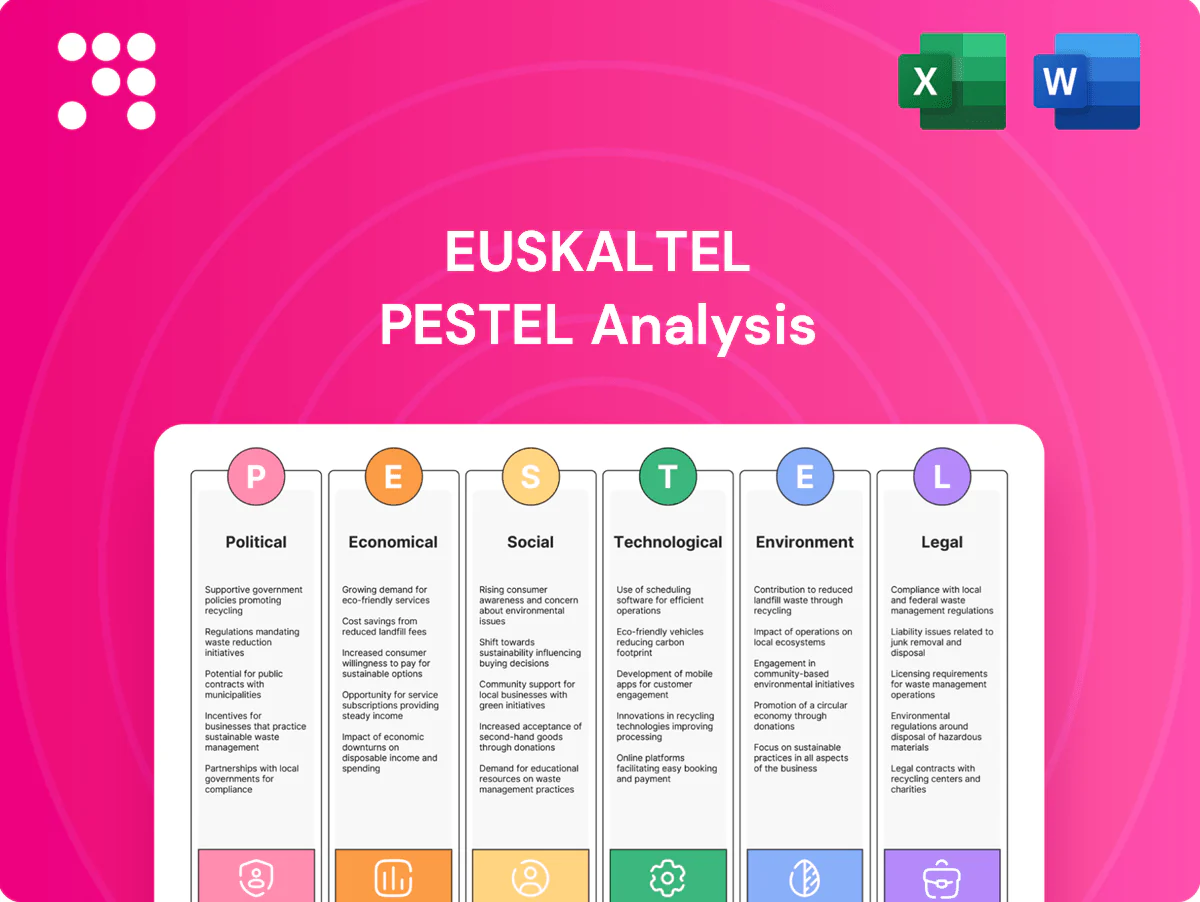
Euskaltel PESTLE Analysis

Your Shortcut to Market Insight Starts Here
Discover how political shifts, regulatory pressures, economic trends and technology adoption are shaping Euskaltel’s competitive outlook in our concise PESTLE summary; these insights reveal risks and new market opportunities. Investors and strategists can use this analysis to refine forecasts and allocate resources more confidently. Purchase the full PESTLE report to access the complete, actionable breakdown and editable charts for immediate use.
Political factors

EU and Spanish digital policy alignment
EU Digital Decade mandates 1 Gbps for all households and 5G coverage for all populated areas by 2030, which Spain has integrated into its national plans and NextGenerationEU deployment, forcing telecoms like Euskaltel to accelerate fiber and 5G investments.
Spain is a major NextGenerationEU recipient (around €140 billion total), and EU connectivity funds can co-finance rural build-outs but require strict milestones and reporting.
Policy shifts can reallocate subsidies between fixed and mobile priorities, directly affecting capex allocation; staying aligned secures funding and avoids regulatory friction.
Regional autonomy and Basque policy
Basque Government priorities on digitalization, Basque language promotion, and support for local industry shape procurement and partnership opportunities for Euskaltel in a region of about 2.2 million people; regional permits, municipal wayleaves and public co-investment programs can materially accelerate or delay rollouts, while Basque-language localization and local content strengthen brand preference in public and SME tenders.

Spectrum allocation and auction design
Auction pricing, coverage obligations and renewal terms shape Euskaltel’s 5G economics: high reserve prices or caps can squeeze smaller operators versus incumbents, while mandated rural coverage forces rollout sequencing and raises opex. EU Digital Decade targets require 5G for urban/major routes by 2025 and all populated areas by 2030, increasing compliance pressure. EECC-enabled secondary trading and sharing rules can create efficiency options for spectrum access.

Public-private rural connectivity drives
Government initiatives to close the digital divide can create subsidized fiber and 5G projects financed partly via the EU Recovery and Resilience Facility (RRF total €672.5bn; Spain allocation ~€69.5bn), offering scale and reputational gains for Euskaltel while increasing execution risk and compliance overhead. Political cycles can delay disbursements or change criteria midstream, and competitive bidding often compresses margins.
- Subsidy access: large RRF funds
- Risk: higher execution/compliance burden
- Timing: political delays/change of criteria
- Margin pressure: competitive tenders
Geopolitical supply chain exposure
- EU 2024 guidance: vendor diversification/security
- Sanctions/export controls: multi-month lead-time delays
- Higher compliance/audit activity and costs
- Need for multi-vendor, inventory and supplier-geography hedges
EU targets spur fiber/5G capex; Spain €69.5bn fund; Basque rules add costs
EU Digital Decade (1 Gbps by 2030; 5G urban by 2025) + Spain’s NextGenerationEU/RRF (Spain ~€69.5bn of EU recovery; RRF €672.5bn) force accelerated fiber/5G capex for Euskaltel and create subsidy opportunities with strict milestones. Basque Government (pop ~2.2M) local policies and procurement favor regional suppliers but add localization/compliance costs. EU 2024 vendor-security guidance and sanctions since 2022 raise sourcing lead times and audit burdens.
| Political Factor | Key Data | Impact |
|---|---|---|
| EU targets | 1 Gbps/2030; 5G urban/2025 | Accelerated capex |
| Funding | Spain ~€69.5bn | Co‑funded rural builds |
| Region | Basque pop 2.2M | Procurement advantage |
What is included in the product
 Detailed Word Document
Explores how Political, Economic, Social, Technological, Environmental and Legal forces uniquely affect Euskaltel, combining data-driven trends and regional regulatory context to identify risks, opportunities and forward-looking scenarios for executives, investors and strategists.

 Customizable Excel Spreadsheet
Concise, visually segmented Euskaltel PESTLE that distills external risks and opportunities into a shareable, slide-ready summary—easy to annotate for regional or business-line context and to align teams rapidly.
Economic factors

Consumer spending and inflation
Spanish inflation eased to about 3.3% in 2024 (INE), and modest wage gains have made ARPU and churn sensitive as households trade down or seek bundled savings. Energy and equipment cost pressures—after spikes in 2022—remain a margin risk unless tariffs and pass-through adjust. Indexation and tighter promo management are critical in price-sensitive segments, while value-added services (cloud, OTT bundles) can help offset discounting.
Market competition and consolidation
Intense pricing from Telefónica, Orange, Vodafone and MásMóvil pressures Euskaltel’s retention costs and net adds, with Spanish market shares (CNMC 2023) roughly Telefónica 28%, Orange 25%, Vodafone 17% and MásMóvil 18% shaping competitive dynamics.
Consolidation waves (Orange agreed 2023 to acquire MásMóvil for €18.7bn) shift wholesale and infrastructure negotiating power, making convergent bundles essential to defend share while regional brand and service quality support pricing premiums.

Interest rates and capex financing
Elevated ECB rates near 4% raise financing costs for Euskaltel's fiber and 5G rollouts, stretching payback periods and tightening ROI gating on new sites. Longer horizons push consideration of sale-and-leaseback and network-sharing to reduce upfront capex intensity. With reported net leverage around 2.5x (end-2024) and solid cash conversion, Euskaltel retains scope to deleverage and absorb higher funding costs.

SME and industrial demand cycles
The Basque and northern Spain industrial base, which accounts for about 25% of Basque GDP (2023), drives strong demand for connectivity, IoT and cloud services, but cyclicality means slowdowns trim project budgets and shift spend to maintenance. Reshoring and factory automation lift demand for advanced managed services and edge compute, where tailored SLAs and enhanced security can command premium margins. Public-sector digitization tenders, supported by NextGenerationEU funding, provide countercyclical revenue opportunities into 2024–25.
- Industrial concentration: ~25% of Basque GDP (2023)
- Cyclical risk: reduced capex in downturns
- Growth drivers: reshoring, automation, edge/IoT
- Margin levers: bespoke SLAs + security
- Countercyclical: public digitization tenders (NG‑EU funds)
Tourism and regional seasonality
Seasonal population shifts in the Basque coast drive sharp mobile-traffic spikes; Spain received about 71.7 million international tourists in 2023 and tourism accounts for roughly 11% of national GDP, so peak-season capacity needs are material for Euskaltel. Flexible network planning and roaming agreements let Euskaltel capture higher seasonal ARPU, while prepaid and short-term bundles monetize tourists; accurate demand forecasts cut overprovisioning costs.
- Seasonal traffic spikes → temporary capacity
- 71.7M tourists (2023) → material ARPU upside
- Flexible planning + roaming → capture peak revenue
- Prepaid/short-term bundles → monetize tourists
- Accurate forecasting → lower overprovisioning costs
EU targets spur fiber/5G capex; Spain €69.5bn fund; Basque rules add costs
Spanish CPI eased to 3.3% in 2024, squeezing ARPU as households trade down; energy/equipment costs remain margin risks. Fierce pricing from Telefónica/Orange/Vodafone/MásMóvil compresses retention costs; Orange/MásMóvil consolidation shifts wholesale power. ECB rates ~4% lift funding costs, extending fiber/5G paybacks; net leverage ~2.5x (end‑2024) retains deleveraging scope.
| Metric | Value |
|---|---|
| Spain CPI 2024 | 3.3% |
| ECB rate | ~4.0% |
| Euskaltel net leverage | 2.5x |
| Tourists 2023 | 71.7M |
Same Document Delivered
Euskaltel PESTLE Analysis
The Euskaltel PESTLE Analysis preview shown here is the exact document you’ll receive after purchase—fully formatted and ready to use. It covers political, economic, social, technological, legal, and environmental factors with actionable insights. No placeholders, no teasers—this is the real, ready-to-use file you’ll get upon purchase.

Original: $10.00
-65%$10.00
$3.50Product Information
Product Information
Shipping & Returns
Shipping & Returns
Description
Your Shortcut to Market Insight Starts Here
Discover how political shifts, regulatory pressures, economic trends and technology adoption are shaping Euskaltel’s competitive outlook in our concise PESTLE summary; these insights reveal risks and new market opportunities. Investors and strategists can use this analysis to refine forecasts and allocate resources more confidently. Purchase the full PESTLE report to access the complete, actionable breakdown and editable charts for immediate use.
Political factors
EU and Spanish digital policy alignment
EU Digital Decade mandates 1 Gbps for all households and 5G coverage for all populated areas by 2030, which Spain has integrated into its national plans and NextGenerationEU deployment, forcing telecoms like Euskaltel to accelerate fiber and 5G investments.
Spain is a major NextGenerationEU recipient (around €140 billion total), and EU connectivity funds can co-finance rural build-outs but require strict milestones and reporting.
Policy shifts can reallocate subsidies between fixed and mobile priorities, directly affecting capex allocation; staying aligned secures funding and avoids regulatory friction.
Regional autonomy and Basque policy
Basque Government priorities on digitalization, Basque language promotion, and support for local industry shape procurement and partnership opportunities for Euskaltel in a region of about 2.2 million people; regional permits, municipal wayleaves and public co-investment programs can materially accelerate or delay rollouts, while Basque-language localization and local content strengthen brand preference in public and SME tenders.
Spectrum allocation and auction design
Auction pricing, coverage obligations and renewal terms shape Euskaltel’s 5G economics: high reserve prices or caps can squeeze smaller operators versus incumbents, while mandated rural coverage forces rollout sequencing and raises opex. EU Digital Decade targets require 5G for urban/major routes by 2025 and all populated areas by 2030, increasing compliance pressure. EECC-enabled secondary trading and sharing rules can create efficiency options for spectrum access.
Public-private rural connectivity drives
Government initiatives to close the digital divide can create subsidized fiber and 5G projects financed partly via the EU Recovery and Resilience Facility (RRF total €672.5bn; Spain allocation ~€69.5bn), offering scale and reputational gains for Euskaltel while increasing execution risk and compliance overhead. Political cycles can delay disbursements or change criteria midstream, and competitive bidding often compresses margins.
- Subsidy access: large RRF funds
- Risk: higher execution/compliance burden
- Timing: political delays/change of criteria
- Margin pressure: competitive tenders
Geopolitical supply chain exposure
- EU 2024 guidance: vendor diversification/security
- Sanctions/export controls: multi-month lead-time delays
- Higher compliance/audit activity and costs
- Need for multi-vendor, inventory and supplier-geography hedges
EU targets spur fiber/5G capex; Spain €69.5bn fund; Basque rules add costs
EU Digital Decade (1 Gbps by 2030; 5G urban by 2025) + Spain’s NextGenerationEU/RRF (Spain ~€69.5bn of EU recovery; RRF €672.5bn) force accelerated fiber/5G capex for Euskaltel and create subsidy opportunities with strict milestones. Basque Government (pop ~2.2M) local policies and procurement favor regional suppliers but add localization/compliance costs. EU 2024 vendor-security guidance and sanctions since 2022 raise sourcing lead times and audit burdens.
| Political Factor | Key Data | Impact |
|---|---|---|
| EU targets | 1 Gbps/2030; 5G urban/2025 | Accelerated capex |
| Funding | Spain ~€69.5bn | Co‑funded rural builds |
| Region | Basque pop 2.2M | Procurement advantage |
What is included in the product
Detailed Word Document
Explores how Political, Economic, Social, Technological, Environmental and Legal forces uniquely affect Euskaltel, combining data-driven trends and regional regulatory context to identify risks, opportunities and forward-looking scenarios for executives, investors and strategists.
Customizable Excel Spreadsheet
Concise, visually segmented Euskaltel PESTLE that distills external risks and opportunities into a shareable, slide-ready summary—easy to annotate for regional or business-line context and to align teams rapidly.
Economic factors
Consumer spending and inflation
Spanish inflation eased to about 3.3% in 2024 (INE), and modest wage gains have made ARPU and churn sensitive as households trade down or seek bundled savings. Energy and equipment cost pressures—after spikes in 2022—remain a margin risk unless tariffs and pass-through adjust. Indexation and tighter promo management are critical in price-sensitive segments, while value-added services (cloud, OTT bundles) can help offset discounting.
Market competition and consolidation
Intense pricing from Telefónica, Orange, Vodafone and MásMóvil pressures Euskaltel’s retention costs and net adds, with Spanish market shares (CNMC 2023) roughly Telefónica 28%, Orange 25%, Vodafone 17% and MásMóvil 18% shaping competitive dynamics.
Consolidation waves (Orange agreed 2023 to acquire MásMóvil for €18.7bn) shift wholesale and infrastructure negotiating power, making convergent bundles essential to defend share while regional brand and service quality support pricing premiums.
Interest rates and capex financing
Elevated ECB rates near 4% raise financing costs for Euskaltel's fiber and 5G rollouts, stretching payback periods and tightening ROI gating on new sites. Longer horizons push consideration of sale-and-leaseback and network-sharing to reduce upfront capex intensity. With reported net leverage around 2.5x (end-2024) and solid cash conversion, Euskaltel retains scope to deleverage and absorb higher funding costs.
SME and industrial demand cycles
The Basque and northern Spain industrial base, which accounts for about 25% of Basque GDP (2023), drives strong demand for connectivity, IoT and cloud services, but cyclicality means slowdowns trim project budgets and shift spend to maintenance. Reshoring and factory automation lift demand for advanced managed services and edge compute, where tailored SLAs and enhanced security can command premium margins. Public-sector digitization tenders, supported by NextGenerationEU funding, provide countercyclical revenue opportunities into 2024–25.
- Industrial concentration: ~25% of Basque GDP (2023)
- Cyclical risk: reduced capex in downturns
- Growth drivers: reshoring, automation, edge/IoT
- Margin levers: bespoke SLAs + security
- Countercyclical: public digitization tenders (NG‑EU funds)
Tourism and regional seasonality
Seasonal population shifts in the Basque coast drive sharp mobile-traffic spikes; Spain received about 71.7 million international tourists in 2023 and tourism accounts for roughly 11% of national GDP, so peak-season capacity needs are material for Euskaltel. Flexible network planning and roaming agreements let Euskaltel capture higher seasonal ARPU, while prepaid and short-term bundles monetize tourists; accurate demand forecasts cut overprovisioning costs.
- Seasonal traffic spikes → temporary capacity
- 71.7M tourists (2023) → material ARPU upside
- Flexible planning + roaming → capture peak revenue
- Prepaid/short-term bundles → monetize tourists
- Accurate forecasting → lower overprovisioning costs
EU targets spur fiber/5G capex; Spain €69.5bn fund; Basque rules add costs
Spanish CPI eased to 3.3% in 2024, squeezing ARPU as households trade down; energy/equipment costs remain margin risks. Fierce pricing from Telefónica/Orange/Vodafone/MásMóvil compresses retention costs; Orange/MásMóvil consolidation shifts wholesale power. ECB rates ~4% lift funding costs, extending fiber/5G paybacks; net leverage ~2.5x (end‑2024) retains deleveraging scope.
| Metric | Value |
|---|---|
| Spain CPI 2024 | 3.3% |
| ECB rate | ~4.0% |
| Euskaltel net leverage | 2.5x |
| Tourists 2023 | 71.7M |
Same Document Delivered
Euskaltel PESTLE Analysis
The Euskaltel PESTLE Analysis preview shown here is the exact document you’ll receive after purchase—fully formatted and ready to use. It covers political, economic, social, technological, legal, and environmental factors with actionable insights. No placeholders, no teasers—this is the real, ready-to-use file you’ll get upon purchase.