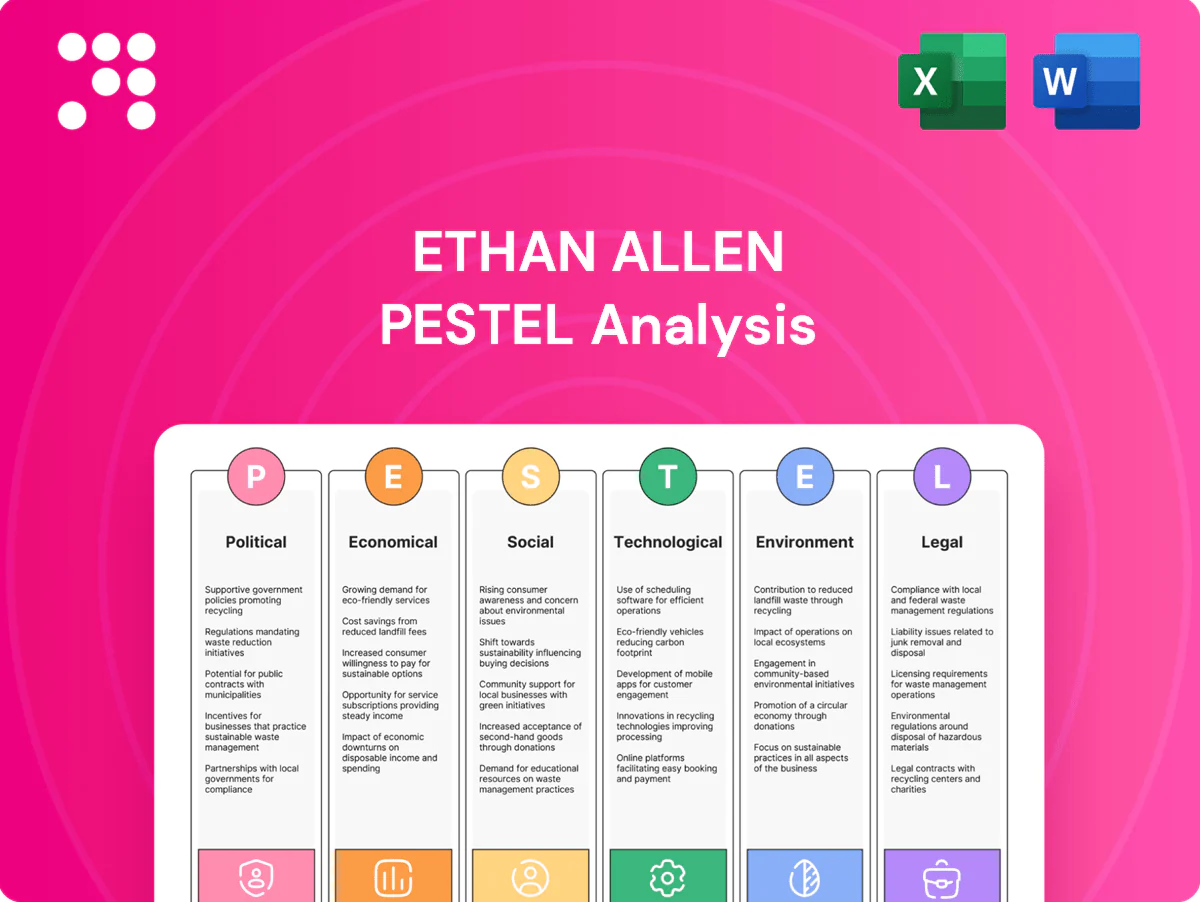
Ethan Allen PESTLE Analysis

Your Competitive Advantage Starts with This Report
Uncover how political shifts, economic trends, social preferences, and regulatory pressures are shaping Ethan Allen’s prospects in our concise PESTLE snapshot. This analysis highlights risks and opportunities that matter to investors and strategists. Want the full, actionable breakdown with data-driven recommendations? Purchase the complete PESTLE now for instant download and ready-to-use insights.
Political factors

Trade policy & tariffs
Shifts in U.S.-China and other trade relations can change duties on furniture, fabrics and hardware; U.S. Section 301 tariffs currently cover roughly $370 billion of Chinese goods with many rates between 7.5% and 25%, raising landed costs and pressuring margins. Tariffs may force price hikes or supplier re-sourcing, while preferential agreements such as USMCA can lower input duties and improve margins. Ethan Allen must hedge exposure via diversified sourcing and scaled domestic manufacturing where feasible.
Buy-American incentives
Buy-American incentives and the 2021 executive orders plus Bipartisan Infrastructure Law (the $1.2 trillion infrastructure package) strengthen preference for U.S.-made goods, tapping a federal procurement market exceeding $600 billion annually (FY2023). Tax credits and state grants for domestic manufacturing can materially raise ROI on plant investments. Ethan Allen’s North American production footprint is a competitive edge in bids and marketing. Policy reversals could dilute these benefits, requiring agile messaging.

Geopolitical supply shocks
Geopolitical shocks—sanctions and conflicts since 2022 have disrupted timber, metals and textile flows and, because seaborne trade carries about 80% of global cargo by volume (UNCTAD), pushed shipping rates and war‑risk insurance sharply higher (industry reports noted up to tenfold spikes on some Black Sea routes). Ethan Allen must expand multi‑region sourcing, hold buffer inventory for core SKUs, and invest in contingency routing and nearshoring to lower geopolitical beta.

Infrastructure & logistics policy
Port modernization under the Bipartisan Infrastructure Law committed roughly 17 billion USD to ports and waterways, while trucking regulations and Class I rail policy directly drive delivery costs and reliability for Ethan Allen. Hours-of-service rules (major federal HOS last updated 2013) constrain last-mile scheduling and labor planning. Public road and port investments can cut import cycle times and inventory days, so Ethan Allen should map its distribution network to anticipated policy bottlenecks.
Labor & immigration rules
Changes to visa policy, including the H-2B annual cap of 66,000, constrain access to seasonal manufacturing and skilled design labor; Ethan Allen faces recruitment pressure in costly markets. Federal minimum wage remains $7.25 (2009), while state increases push retail and warehouse costs higher, raising operating margins. Government apprenticeship support through DOL programs aids upholstery and woodworking skill pipelines; rigorous compliance planning reduces wage-and-hour dispute risk.
- Visa constraint: H-2B cap 66,000
- Wage baseline: federal $7.25, state variances raise costs
- Apprenticeships: DOL-supported skill funding
- Compliance: avoid wage-and-hour litigation
Supply-chain shift: Tariffs, Buy-American, ports funding & H-2B cap reshape sourcing
U.S.-China tariffs (covering ~$370B of goods, rates 7.5–25%) and trade policy raise landed costs and force re-sourcing. Buy-American and BIL-driven procurement (federal buys >$600B FY2023; BIL $1.2T) favor domestic production. Ports funding ($17B) and H-2B cap 66,000 plus federal $7.25 wage affect logistics and labor strategy.
| Factor | Key figure |
|---|---|
| Tariffs | $370B; 7.5–25% |
| Procurement | >$600B FY2023 |
| Ports | $17B |
| H-2B | 66,000 cap |
| Fed min wage | $7.25 |
What is included in the product
 Detailed Word Document
Explores how external macro-environmental factors uniquely affect Ethan Allen across Political, Economic, Social, Technological, Environmental and Legal dimensions, with each section backed by current data and market trends to reveal risks and opportunities; designed for executives, consultants and investors and formatted for direct use in plans, decks and reports.

 Customizable Excel Spreadsheet
A concise, visually segmented PESTLE summary for Ethan Allen that’s easy to drop into presentations, editable for regional or business-line notes, and ideal for quick alignment across teams during strategy and risk discussions.
Economic factors

Housing cycle sensitivity
Furniture demand tracks new-home sales, existing-home turnover and remodeling cycles; tight inventory (about 2.9 months supply nationally in 2024) can dampen refresh purchases while household moves spur full-room projects. Ethan Allen’s design services can upsell during renovation booms, capturing higher AOVs. Expanding into commercial and hospitality helps smooth residential cyclicality.
Interest rates & credit
Higher 30-year mortgage rates, which averaged about 7% in 2024, and credit card APRs near 20% dampen discretionary big-ticket furniture purchases and slow average ticket growth. Dealer financing and 0% offers can restore demand but compress Ethan Allen’s margins. When rates fall, traffic and ticket size typically rebound. Ethan Allen should align promotions and inventory with rate inflection signals.

Cost inflation & FX
In 2024 Ethan Allen reported supply-cost pressure from lumber, foam, fabrics and freight that swung gross margins, prompting surcharges and dynamic pricing to pass through spikes and protect conversion.

Consumer confidence & wealth
Equity and home-price gains drive perceived household wealth and spur redecorating; Case-Shiller 20-city prices were up about 3% year-over-year in early 2025 while Conference Board consumer confidence hovered near 100, supporting discretionary spending. During recessions consumers shift to value lines and smaller accents, but premium timeless designs help defend margins when foot traffic softens. Ethan Allen’s curated assortment can focus on affluent, resilient buyers less sensitive to cyclical dips.
- Home prices ~+3% YoY (Case-Shiller 20-city, early 2025)
- Consumer confidence ~100 (Conference Board, mid-2025)
- Recession effect: shift to value/smaller items
- Defensive strategy: premium/timeless SKUs targeting affluent segment
E-commerce channel mix
E-commerce carries lower store overhead but higher fulfillment and return costs, compressing contribution margin; U.S. furniture e-commerce penetration rose to about 20.6% in 2024 (Statista), while online return rates averaged ~16% (Coresight), both pressuring last-mile economics. Omnichannel lifts close rates and AOV; Ethan Allen can boost margins by SKU packaging optimization and targeted white-glove upsells.
Supply-chain shift: Tariffs, Buy-American, ports funding & H-2B cap reshape sourcing
Furniture demand ties to housing turnover and remodeling; tight housing inventory (~2.9 months, 2024) limits refreshes while moves spur full-room sales. High 30-year mortgage rates (~7% in 2024) and credit APRs (~20%) depress big-ticket buys; dealer finance/0% offers lift demand but cut margins. Supply-cost volatility (lumber, foam, freight) squeezed 2024 gross margins; e-commerce (20.6% share, 2024) and ~16% online returns pressure last-mile economics.
| Metric | Value |
|---|---|
| 30-yr mortgage (2024) | ~7% |
| Case-Shiller 20-city (early 2025) | +3% YoY |
| Consumer Confidence (mid-2025) | ~100 |
| Furniture e-commerce (2024) | 20.6% |
| Online return rate | ~16% |
Preview the Actual Deliverable
Ethan Allen PESTLE Analysis
The Ethan Allen PESTLE Analysis preview shown here is the exact document you’ll receive after purchase. It’s fully formatted, professionally structured, and ready to use. The report examines political, economic, social, technological, legal and environmental factors with concise, actionable insights for strategy and investment decisions.

Product Information
Product Information
Shipping & Returns
Shipping & Returns
Description
Your Competitive Advantage Starts with This Report
Uncover how political shifts, economic trends, social preferences, and regulatory pressures are shaping Ethan Allen’s prospects in our concise PESTLE snapshot. This analysis highlights risks and opportunities that matter to investors and strategists. Want the full, actionable breakdown with data-driven recommendations? Purchase the complete PESTLE now for instant download and ready-to-use insights.
Political factors
Trade policy & tariffs
Shifts in U.S.-China and other trade relations can change duties on furniture, fabrics and hardware; U.S. Section 301 tariffs currently cover roughly $370 billion of Chinese goods with many rates between 7.5% and 25%, raising landed costs and pressuring margins. Tariffs may force price hikes or supplier re-sourcing, while preferential agreements such as USMCA can lower input duties and improve margins. Ethan Allen must hedge exposure via diversified sourcing and scaled domestic manufacturing where feasible.
Buy-American incentives
Buy-American incentives and the 2021 executive orders plus Bipartisan Infrastructure Law (the $1.2 trillion infrastructure package) strengthen preference for U.S.-made goods, tapping a federal procurement market exceeding $600 billion annually (FY2023). Tax credits and state grants for domestic manufacturing can materially raise ROI on plant investments. Ethan Allen’s North American production footprint is a competitive edge in bids and marketing. Policy reversals could dilute these benefits, requiring agile messaging.
Geopolitical supply shocks
Geopolitical shocks—sanctions and conflicts since 2022 have disrupted timber, metals and textile flows and, because seaborne trade carries about 80% of global cargo by volume (UNCTAD), pushed shipping rates and war‑risk insurance sharply higher (industry reports noted up to tenfold spikes on some Black Sea routes). Ethan Allen must expand multi‑region sourcing, hold buffer inventory for core SKUs, and invest in contingency routing and nearshoring to lower geopolitical beta.
Infrastructure & logistics policy
Port modernization under the Bipartisan Infrastructure Law committed roughly 17 billion USD to ports and waterways, while trucking regulations and Class I rail policy directly drive delivery costs and reliability for Ethan Allen. Hours-of-service rules (major federal HOS last updated 2013) constrain last-mile scheduling and labor planning. Public road and port investments can cut import cycle times and inventory days, so Ethan Allen should map its distribution network to anticipated policy bottlenecks.
Labor & immigration rules
Changes to visa policy, including the H-2B annual cap of 66,000, constrain access to seasonal manufacturing and skilled design labor; Ethan Allen faces recruitment pressure in costly markets. Federal minimum wage remains $7.25 (2009), while state increases push retail and warehouse costs higher, raising operating margins. Government apprenticeship support through DOL programs aids upholstery and woodworking skill pipelines; rigorous compliance planning reduces wage-and-hour dispute risk.
- Visa constraint: H-2B cap 66,000
- Wage baseline: federal $7.25, state variances raise costs
- Apprenticeships: DOL-supported skill funding
- Compliance: avoid wage-and-hour litigation
Supply-chain shift: Tariffs, Buy-American, ports funding & H-2B cap reshape sourcing
U.S.-China tariffs (covering ~$370B of goods, rates 7.5–25%) and trade policy raise landed costs and force re-sourcing. Buy-American and BIL-driven procurement (federal buys >$600B FY2023; BIL $1.2T) favor domestic production. Ports funding ($17B) and H-2B cap 66,000 plus federal $7.25 wage affect logistics and labor strategy.
| Factor | Key figure |
|---|---|
| Tariffs | $370B; 7.5–25% |
| Procurement | >$600B FY2023 |
| Ports | $17B |
| H-2B | 66,000 cap |
| Fed min wage | $7.25 |
What is included in the product
Detailed Word Document
Explores how external macro-environmental factors uniquely affect Ethan Allen across Political, Economic, Social, Technological, Environmental and Legal dimensions, with each section backed by current data and market trends to reveal risks and opportunities; designed for executives, consultants and investors and formatted for direct use in plans, decks and reports.
Customizable Excel Spreadsheet
A concise, visually segmented PESTLE summary for Ethan Allen that’s easy to drop into presentations, editable for regional or business-line notes, and ideal for quick alignment across teams during strategy and risk discussions.
Economic factors
Housing cycle sensitivity
Furniture demand tracks new-home sales, existing-home turnover and remodeling cycles; tight inventory (about 2.9 months supply nationally in 2024) can dampen refresh purchases while household moves spur full-room projects. Ethan Allen’s design services can upsell during renovation booms, capturing higher AOVs. Expanding into commercial and hospitality helps smooth residential cyclicality.
Interest rates & credit
Higher 30-year mortgage rates, which averaged about 7% in 2024, and credit card APRs near 20% dampen discretionary big-ticket furniture purchases and slow average ticket growth. Dealer financing and 0% offers can restore demand but compress Ethan Allen’s margins. When rates fall, traffic and ticket size typically rebound. Ethan Allen should align promotions and inventory with rate inflection signals.
Cost inflation & FX
In 2024 Ethan Allen reported supply-cost pressure from lumber, foam, fabrics and freight that swung gross margins, prompting surcharges and dynamic pricing to pass through spikes and protect conversion.
Consumer confidence & wealth
Equity and home-price gains drive perceived household wealth and spur redecorating; Case-Shiller 20-city prices were up about 3% year-over-year in early 2025 while Conference Board consumer confidence hovered near 100, supporting discretionary spending. During recessions consumers shift to value lines and smaller accents, but premium timeless designs help defend margins when foot traffic softens. Ethan Allen’s curated assortment can focus on affluent, resilient buyers less sensitive to cyclical dips.
- Home prices ~+3% YoY (Case-Shiller 20-city, early 2025)
- Consumer confidence ~100 (Conference Board, mid-2025)
- Recession effect: shift to value/smaller items
- Defensive strategy: premium/timeless SKUs targeting affluent segment
E-commerce channel mix
E-commerce carries lower store overhead but higher fulfillment and return costs, compressing contribution margin; U.S. furniture e-commerce penetration rose to about 20.6% in 2024 (Statista), while online return rates averaged ~16% (Coresight), both pressuring last-mile economics. Omnichannel lifts close rates and AOV; Ethan Allen can boost margins by SKU packaging optimization and targeted white-glove upsells.
Supply-chain shift: Tariffs, Buy-American, ports funding & H-2B cap reshape sourcing
Furniture demand ties to housing turnover and remodeling; tight housing inventory (~2.9 months, 2024) limits refreshes while moves spur full-room sales. High 30-year mortgage rates (~7% in 2024) and credit APRs (~20%) depress big-ticket buys; dealer finance/0% offers lift demand but cut margins. Supply-cost volatility (lumber, foam, freight) squeezed 2024 gross margins; e-commerce (20.6% share, 2024) and ~16% online returns pressure last-mile economics.
| Metric | Value |
|---|---|
| 30-yr mortgage (2024) | ~7% |
| Case-Shiller 20-city (early 2025) | +3% YoY |
| Consumer Confidence (mid-2025) | ~100 |
| Furniture e-commerce (2024) | 20.6% |
| Online return rate | ~16% |
Preview the Actual Deliverable
Ethan Allen PESTLE Analysis
The Ethan Allen PESTLE Analysis preview shown here is the exact document you’ll receive after purchase. It’s fully formatted, professionally structured, and ready to use. The report examines political, economic, social, technological, legal and environmental factors with concise, actionable insights for strategy and investment decisions.











