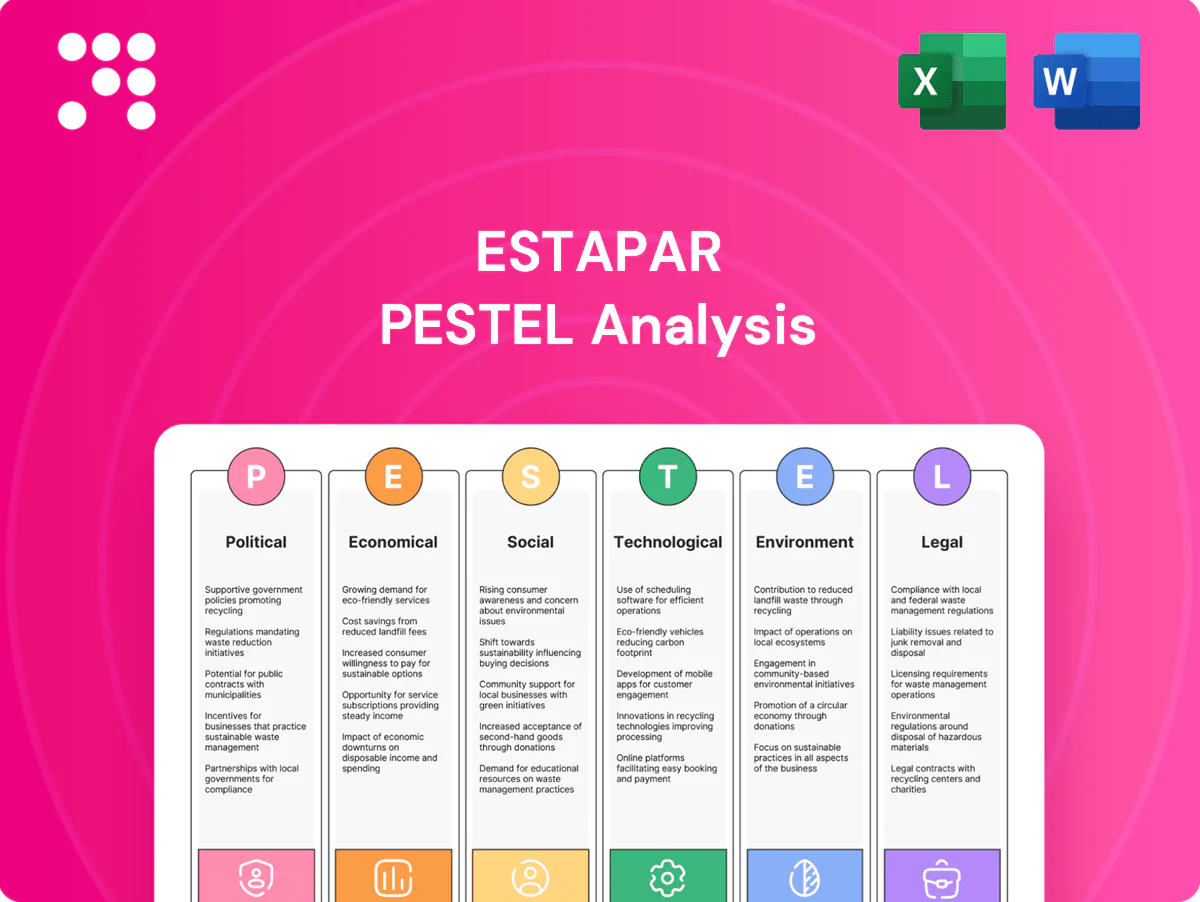
Estapar PESTLE Analysis

Make Smarter Strategic Decisions with a Complete PESTEL View
Unlock strategic clarity with our focused PESTLE analysis of Estapar—three to five expert-level insights reveal how political shifts, economic cycles, and tech trends will shape parking and mobility services. Ideal for investors, consultants, and executives, this concise briefing pinpoints risks and opportunities you can act on now. Purchase the full analysis to get the complete, editable report and make informed decisions fast.
Political factors

Urban mobility agendas
Brazilian municipal plans, guided by the National Urban Mobility Policy (Law 12.587/2012), increasingly prioritize public transit and micromobility, reducing parking supply and pressuring pricing near transit corridors.
Curbside management concessions create openings for digital enforcement and dynamic pricing models; changes in city hall leadership frequently alter concession terms and priorities.
Estapar must align bids with integrated mobility goals and policy benchmarks to remain competitive in tenders.
Public–private partnerships
Parking concessions in airports, hospitals and downtown zones typically run 10–30 years and in Brazil often include tariff indexation to IPCA under Brazils Federal PPP Law (Lei 11.079/2004). Political backing shapes concession length, capex recovery formulas and allowed tariff adjustments. Transparent bidding and stakeholder engagement reduce renegotiation risk. Estapar’s concession track record can be leveraged to win PPP pipelines.

Infrastructure investment programs
Federal and state infrastructure agendas in Brazil, serving a population of about 214 million, direct funding to airports and hospitals and thus raise structured parking demand near those assets; Priority projects can fast-track permits and utility connections, shortening project timelines. Budget cuts or reshuffles—common in multiannual plans—delay openings and ramp-up. Diversifying across regions cushions political timing risks.

Security and policing policies
Urban security initiatives shift demand toward supervised off-street parking; Estapar, which operates roughly 600 facilities in Brazil, sees higher occupancy where municipal guards increase street enforcement.
Cooperation with municipal guards for ticketing and patrols has been linked to up to 15–20% uplift in off-street occupancy in city pilots, reducing informal parking and leakage.
Political will to crack down on informal operators constrains revenue leakage; Estapar can advocate data-sharing with municipalities to quantify impacts and support enforcement policy.
- operations_count: ~600 facilities
- occupancy_uplift_estimate: 15–20% in pilot areas
- priority_action: data-sharing agreements with municipalities
Tax and fiscal policy direction
Changes in municipal service taxes (ISS typically 2–5% in Brazil) and shifts in fiscal incentives materially affect Estapar’s cash flows; higher ISS or removal of rebates can reduce free cash flow. Political pressure to cap parking tariffs in publicly controlled assets, seen around the 2024 municipal elections, could compress margins. Conversely, incentives for digital payments and ESG programs can lower effective tax burdens; scenario planning should reflect election cycles (municipal 2024, general 2026).
- ISS range 2–5%: direct cash-flow impact
- Tariff caps risk: margin compression
- Digital/ESG incentives: potential tax relief
- Scenario planning: include 2024 municipal and 2026 general cycles
Curb concessions and tariff politics tighten street supply, boosting competition near transit
Municipal mobility policies and curbside concessions push reduced street supply and higher competition near transit corridors, pressuring pricing and occupancy mixes.
Concession terms (10–30 years) and tariff indexation to IPCA under PPP law determine revenue predictability; Estapar’s 600-facility scale is a competitive asset.
Municipal ISS (2–5%) and tariff-cap politics around elections (municipal 2024, general 2026) can compress FCF; digital/ESG incentives may offset taxes.
City enforcement pilots report 15–20% off-street occupancy uplift, aiding revenue recovery from informal leakage.
| Metric | Value |
|---|---|
| Facilities | ~600 |
| Occupancy uplift (pilots) | 15–20% |
| Concession length | 10–30 yrs |
| ISS range | 2–5% |
What is included in the product
 Detailed Word Document
Explores how macro-environmental factors uniquely affect Estapar across Political, Economic, Social, Technological, Environmental and Legal dimensions, with data‑backed trends and region-specific regulatory context to help executives, investors and strategists spot risks, opportunities and inform forward‑looking scenario planning.

 Customizable Excel Spreadsheet
A concise, shareable PESTLE summary for Estapar that's visually segmented by category, uses plain language, and can be dropped into presentations or annotated for local context—helping teams quickly align on external risks and strategic positioning.
Economic factors

Macroeconomic volatility
Macroeconomic volatility—Brazil GDP growth ~3.1% in 2024 and IPCA inflation ~4.6%—directly drives travel, retail footfall and parking demand; weaker GDP or higher inflation reduces visits and occupancy. Selic at ~10.75% (July 2025) raises financing costs for new garages and tech rollouts, squeezing capex. Persistent inflation forces dynamic tariff indexing to protect margins, while a diversified client mix hedges exposure to cyclical sectors.
Consumer spending and mobility
Household income levels drive discretionary mall and leisure trips; Google Mobility data showed retail & recreation visits returned near 2019 baselines by 2024, supporting parking demand. Ride-hailing growth and hybrid work shifted peak patterns and ticket mix, while IATA reported 2023 global passenger traffic around 88% of 2019, and hospitals/airports show more resilient volumes. Estapar should refine location-specific yield management.

Real estate and mall performance
Anchor tenant turnover and mall occupancy directly drive vehicle inflows; Estapar’s network of ~2,500 assets and >150,000 bays shows weekly mall-linked volumes can swing 10–20% with major tenant changes. Redevelopments often depress volumes short-term but raise long-term yield per bay via reconfiguration and higher tariffs, improving RPM (revenue per minute) and yield metrics. Revenue-sharing leases with landlords align incentives but add variability to cashflows, while portfolio analytics enable re-pricing of minimum guarantees using site-level elasticities and historical bay utilization.

Fuel prices and transport costs
Higher fuel costs (Brent ~82 USD/bbl mid-2025) tend to reduce short car trips and extend dwell times as drivers consolidate errands, while modal shifts to public transit redistribute off-street demand; global EV sales reached ~14% of new car sales in 2024, altering customer profiles. Estapar can stabilize frequency via dynamic pricing and loyalty programs and capture premium spenders through partnerships with EV charging and mobility services.
- Fuel: Brent ~82 USD/bbl (mid-2025)
- EV share: ~14% of new sales (2024)
- Response: dynamic pricing, loyalty
- Opportunity: EV charging partnerships
Currency and import exposure
FX swings materially affect Estapar’s imported-capex: gates, sensors and EV chargers can represent 15–30% of rollout costs and 2024 saw the Brazilian real average ~5.14 BRL/USD, amplifying price exposure; hedging and increased local sourcing have been used to mitigate one-off capex spikes. Software subscriptions and cloud costs are often dollar-linked, making Opex sensitive to FX; structured procurement cycles and forward contracts are used to lock prices during volatility.
- Imported capex exposure: 15–30% of rollout costs
- BRL average ~5.14 BRL/USD in 2024 — higher volatility 2024–25
- Mitigants: hedging, local sourcing, structured procurement
- Opex FX risk: dollar-linked software/cloud subscriptions
Curb concessions and tariff politics tighten street supply, boosting competition near transit
Macroeconomic volatility (Brazil GDP ~3.1% 2024; IPCA ~4.6%) and Selic ~10.75% (Jul 2025) shape parking demand and financing costs; FX and imported capex exposure (BRL ~5.14/USD 2024; gates/chargers 15–30% rollout) raise capex risk. Fuel/Brent ~82 USD/bbl (mid-2025) and EVs ~14% (2024) shift trip patterns; portfolio analytics and dynamic pricing mitigate.
| Metric | Value |
|---|---|
| GDP (2024) | 3.1% |
| IPCA (2024) | 4.6% |
| Selic (Jul 2025) | 10.75% |
| BRL avg (2024) | 5.14 BRL/USD |
| Brent (mid-2025) | ~82 USD/bbl |
| EV share (2024) | ~14% |
| Estapar network | ~2,500 assets / >150,000 bays |
Same Document Delivered
Estapar PESTLE Analysis
The preview shown here is the exact Estapar PESTLE Analysis you’ll receive after purchase—fully formatted, professionally structured, and ready to use. This is the real file, not a teaser or placeholder, so the content and layout visible now are what you’ll download. After payment you’ll instantly get this same finished document with no surprises.

Product Information
Product Information
Shipping & Returns
Shipping & Returns
Description
Make Smarter Strategic Decisions with a Complete PESTEL View
Unlock strategic clarity with our focused PESTLE analysis of Estapar—three to five expert-level insights reveal how political shifts, economic cycles, and tech trends will shape parking and mobility services. Ideal for investors, consultants, and executives, this concise briefing pinpoints risks and opportunities you can act on now. Purchase the full analysis to get the complete, editable report and make informed decisions fast.
Political factors
Urban mobility agendas
Brazilian municipal plans, guided by the National Urban Mobility Policy (Law 12.587/2012), increasingly prioritize public transit and micromobility, reducing parking supply and pressuring pricing near transit corridors.
Curbside management concessions create openings for digital enforcement and dynamic pricing models; changes in city hall leadership frequently alter concession terms and priorities.
Estapar must align bids with integrated mobility goals and policy benchmarks to remain competitive in tenders.
Public–private partnerships
Parking concessions in airports, hospitals and downtown zones typically run 10–30 years and in Brazil often include tariff indexation to IPCA under Brazils Federal PPP Law (Lei 11.079/2004). Political backing shapes concession length, capex recovery formulas and allowed tariff adjustments. Transparent bidding and stakeholder engagement reduce renegotiation risk. Estapar’s concession track record can be leveraged to win PPP pipelines.
Infrastructure investment programs
Federal and state infrastructure agendas in Brazil, serving a population of about 214 million, direct funding to airports and hospitals and thus raise structured parking demand near those assets; Priority projects can fast-track permits and utility connections, shortening project timelines. Budget cuts or reshuffles—common in multiannual plans—delay openings and ramp-up. Diversifying across regions cushions political timing risks.
Security and policing policies
Urban security initiatives shift demand toward supervised off-street parking; Estapar, which operates roughly 600 facilities in Brazil, sees higher occupancy where municipal guards increase street enforcement.
Cooperation with municipal guards for ticketing and patrols has been linked to up to 15–20% uplift in off-street occupancy in city pilots, reducing informal parking and leakage.
Political will to crack down on informal operators constrains revenue leakage; Estapar can advocate data-sharing with municipalities to quantify impacts and support enforcement policy.
- operations_count: ~600 facilities
- occupancy_uplift_estimate: 15–20% in pilot areas
- priority_action: data-sharing agreements with municipalities
Tax and fiscal policy direction
Changes in municipal service taxes (ISS typically 2–5% in Brazil) and shifts in fiscal incentives materially affect Estapar’s cash flows; higher ISS or removal of rebates can reduce free cash flow. Political pressure to cap parking tariffs in publicly controlled assets, seen around the 2024 municipal elections, could compress margins. Conversely, incentives for digital payments and ESG programs can lower effective tax burdens; scenario planning should reflect election cycles (municipal 2024, general 2026).
- ISS range 2–5%: direct cash-flow impact
- Tariff caps risk: margin compression
- Digital/ESG incentives: potential tax relief
- Scenario planning: include 2024 municipal and 2026 general cycles
Curb concessions and tariff politics tighten street supply, boosting competition near transit
Municipal mobility policies and curbside concessions push reduced street supply and higher competition near transit corridors, pressuring pricing and occupancy mixes.
Concession terms (10–30 years) and tariff indexation to IPCA under PPP law determine revenue predictability; Estapar’s 600-facility scale is a competitive asset.
Municipal ISS (2–5%) and tariff-cap politics around elections (municipal 2024, general 2026) can compress FCF; digital/ESG incentives may offset taxes.
City enforcement pilots report 15–20% off-street occupancy uplift, aiding revenue recovery from informal leakage.
| Metric | Value |
|---|---|
| Facilities | ~600 |
| Occupancy uplift (pilots) | 15–20% |
| Concession length | 10–30 yrs |
| ISS range | 2–5% |
What is included in the product
Detailed Word Document
Explores how macro-environmental factors uniquely affect Estapar across Political, Economic, Social, Technological, Environmental and Legal dimensions, with data‑backed trends and region-specific regulatory context to help executives, investors and strategists spot risks, opportunities and inform forward‑looking scenario planning.
Customizable Excel Spreadsheet
A concise, shareable PESTLE summary for Estapar that's visually segmented by category, uses plain language, and can be dropped into presentations or annotated for local context—helping teams quickly align on external risks and strategic positioning.
Economic factors
Macroeconomic volatility
Macroeconomic volatility—Brazil GDP growth ~3.1% in 2024 and IPCA inflation ~4.6%—directly drives travel, retail footfall and parking demand; weaker GDP or higher inflation reduces visits and occupancy. Selic at ~10.75% (July 2025) raises financing costs for new garages and tech rollouts, squeezing capex. Persistent inflation forces dynamic tariff indexing to protect margins, while a diversified client mix hedges exposure to cyclical sectors.
Consumer spending and mobility
Household income levels drive discretionary mall and leisure trips; Google Mobility data showed retail & recreation visits returned near 2019 baselines by 2024, supporting parking demand. Ride-hailing growth and hybrid work shifted peak patterns and ticket mix, while IATA reported 2023 global passenger traffic around 88% of 2019, and hospitals/airports show more resilient volumes. Estapar should refine location-specific yield management.
Real estate and mall performance
Anchor tenant turnover and mall occupancy directly drive vehicle inflows; Estapar’s network of ~2,500 assets and >150,000 bays shows weekly mall-linked volumes can swing 10–20% with major tenant changes. Redevelopments often depress volumes short-term but raise long-term yield per bay via reconfiguration and higher tariffs, improving RPM (revenue per minute) and yield metrics. Revenue-sharing leases with landlords align incentives but add variability to cashflows, while portfolio analytics enable re-pricing of minimum guarantees using site-level elasticities and historical bay utilization.
Fuel prices and transport costs
Higher fuel costs (Brent ~82 USD/bbl mid-2025) tend to reduce short car trips and extend dwell times as drivers consolidate errands, while modal shifts to public transit redistribute off-street demand; global EV sales reached ~14% of new car sales in 2024, altering customer profiles. Estapar can stabilize frequency via dynamic pricing and loyalty programs and capture premium spenders through partnerships with EV charging and mobility services.
- Fuel: Brent ~82 USD/bbl (mid-2025)
- EV share: ~14% of new sales (2024)
- Response: dynamic pricing, loyalty
- Opportunity: EV charging partnerships
Currency and import exposure
FX swings materially affect Estapar’s imported-capex: gates, sensors and EV chargers can represent 15–30% of rollout costs and 2024 saw the Brazilian real average ~5.14 BRL/USD, amplifying price exposure; hedging and increased local sourcing have been used to mitigate one-off capex spikes. Software subscriptions and cloud costs are often dollar-linked, making Opex sensitive to FX; structured procurement cycles and forward contracts are used to lock prices during volatility.
- Imported capex exposure: 15–30% of rollout costs
- BRL average ~5.14 BRL/USD in 2024 — higher volatility 2024–25
- Mitigants: hedging, local sourcing, structured procurement
- Opex FX risk: dollar-linked software/cloud subscriptions
Curb concessions and tariff politics tighten street supply, boosting competition near transit
Macroeconomic volatility (Brazil GDP ~3.1% 2024; IPCA ~4.6%) and Selic ~10.75% (Jul 2025) shape parking demand and financing costs; FX and imported capex exposure (BRL ~5.14/USD 2024; gates/chargers 15–30% rollout) raise capex risk. Fuel/Brent ~82 USD/bbl (mid-2025) and EVs ~14% (2024) shift trip patterns; portfolio analytics and dynamic pricing mitigate.
| Metric | Value |
|---|---|
| GDP (2024) | 3.1% |
| IPCA (2024) | 4.6% |
| Selic (Jul 2025) | 10.75% |
| BRL avg (2024) | 5.14 BRL/USD |
| Brent (mid-2025) | ~82 USD/bbl |
| EV share (2024) | ~14% |
| Estapar network | ~2,500 assets / >150,000 bays |
Same Document Delivered
Estapar PESTLE Analysis
The preview shown here is the exact Estapar PESTLE Analysis you’ll receive after purchase—fully formatted, professionally structured, and ready to use. This is the real file, not a teaser or placeholder, so the content and layout visible now are what you’ll download. After payment you’ll instantly get this same finished document with no surprises.











