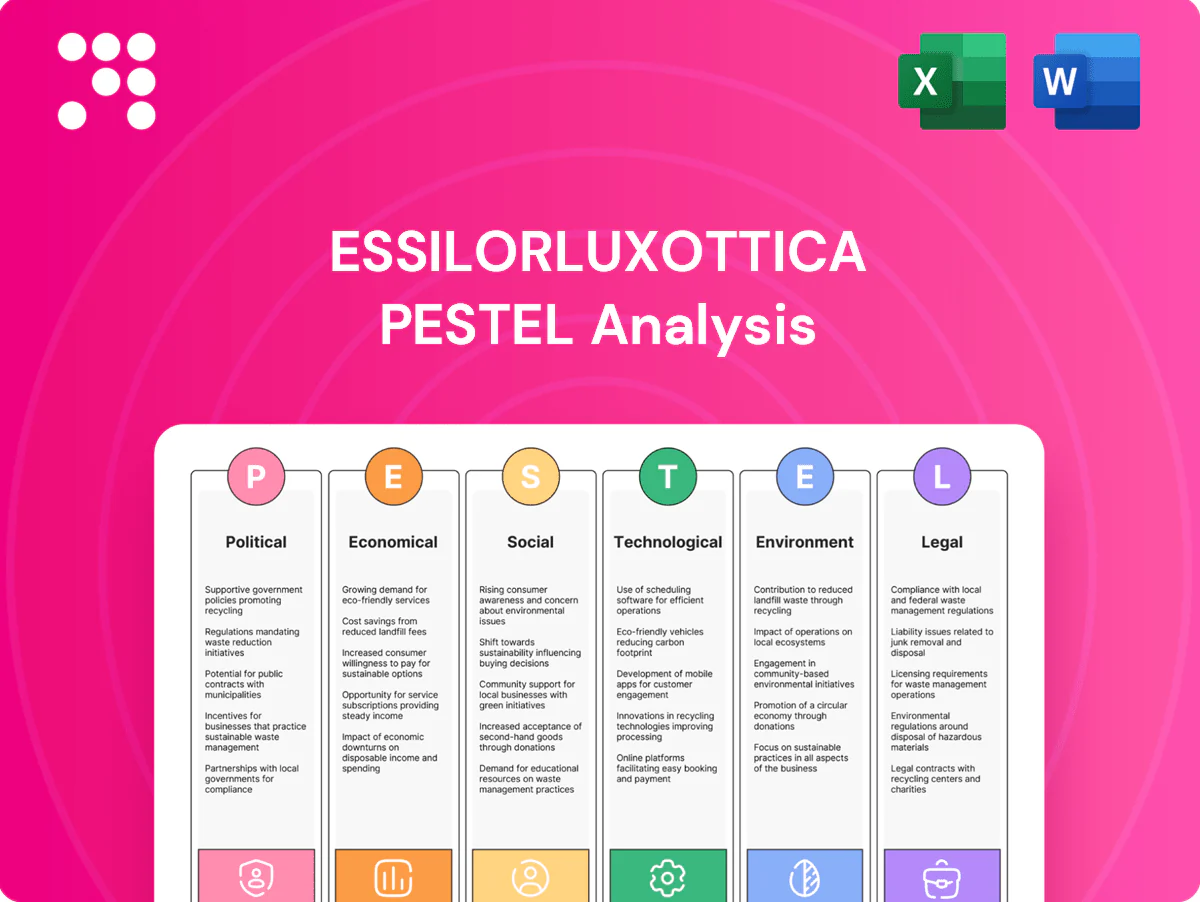
EssilorLuxottica PESTLE Analysis

Plan Smarter. Present Sharper. Compete Stronger.
Unlock how political shifts, economic cycles, social trends, and tech advances are shaping EssilorLuxottica's strategic outlook in our concise PESTLE snapshot. Ideal for investors and strategists, this analysis highlights key risks and growth levers. Purchase the full report for the complete, actionable breakdown ready for immediate use.
Political factors

Trade policy and tariffs
Border tariffs on lenses, frames and sunglasses can materially shift EssilorLuxottica’s cost structure and retail pricing by raising landed costs across retail and wholesale channels. US–EU–China trade dynamics influence sourcing of acetate, metals and finished goods, so proactive tariff engineering and diversified origins help protect margins. Policy shifts demand agile supply chain reconfiguration to reroute volumes and optimize duty exposure.
Healthcare and reimbursement policy
Public and private vision benefits shape demand for prescription lenses and exams, with WHO estimating at least 2.2 billion people have vision impairment or blindness globally, driving product and service needs. Changes in reimbursement or coverage—notably routine vision largely excluded from US Medicare—can shift mix between premium and value tiers. National screening priorities affect optical access and referral volumes. Policy stability underpins multi-year investments in clinics and labs.

Geopolitical supply-chain risk
Regional tensions can disrupt supplies of acetate, titanium and precision components for EssilorLuxottica, which manufactures across hubs in Italy, China and the US and operates in over 150 countries. Export controls and logistics bottlenecks have extended lead times for eyewear components, forcing longer procurement cycles. Dual sourcing and nearshoring reduce single-country exposure, while calibrated inventory buffers preserve service levels without unduly inflating working capital.

Localization and industrial policy
Governments increasingly tie subsidies and public tenders to local manufacturing and job creation, so meeting local content rules unlocks tax breaks and procurement opportunities for EssilorLuxottica while requiring trade-offs between incentives and scale economics when siting facilities.
- Local incentives: unlock tenders/tax benefits
- Facility trade-off: incentives vs scale
- Local lab partnerships: policy alignment
Public health initiatives
School myopia screening and road-safety vision checks broaden EssilorLuxottica’s addressable market amid rising need: WHO reports 2.2 billion people with vision impairment (2020) and myopia prevalence ~34% in 2020, rising toward 50% by 2050. Partnerships with health ministries speed mass screenings and lens adoption; strict compliance with public procurement rules is essential to access government contracts. Demonstrable outcomes data drives sustained public funding and program scale-up.
- Market expansion: school & road programs
- Partnerships: ministries accelerate adoption
- Regulatory: public procurement compliance
- Funding: outcomes data secures continuation
Political risks force nearshoring as 2.2B need vision care
Political risks—tariffs, trade wars and local content rules—can raise landed costs and force nearshoring for EssilorLuxottica, which sells in 150+ countries. Public vision coverage and WHO-estimated 2.2 billion with vision impairment drive demand; myopia ~34% (2020), projected ~50% by 2050. Procurement rules and subsidies shape clinic/lab siting and margin trade-offs.
| Metric | Value |
|---|---|
| Countries | 150+ |
| Vision impaired | 2.2B (WHO) |
| Myopia | 34% (2020) → 50% (2050) |
What is included in the product
 Detailed Word Document
Explores how Political, Economic, Social, Technological, Environmental and Legal forces uniquely affect EssilorLuxottica, with each category supported by current data and industry trends to reveal specific threats and opportunities. Designed for executives, consultants and investors, the analysis reflects real market and regulatory dynamics, offers forward‑looking scenario insights, and is formatted for direct inclusion in reports or pitch decks.

 Customizable Excel Spreadsheet
A concise, visually segmented EssilorLuxottica PESTLE summary that can be dropped into presentations, edited with region-specific notes, and shared across teams to streamline external risk discussions and strategic planning.
Economic factors

Consumer cycle sensitivity
Non-prescription eyewear is highly discretionary and cyclical, exposed to consumer spending swings in a global eyewear market valued at about $185 billion in 2023 (Grand View Research). Rx lenses are more resilient as medical purchases. During downturns consumers shift toward entry tiers and private labels, pressuring ASPs. Premium brands often defend pricing but face volume elasticity; diversified price ladders smooth revenue volatility.
FX and cost inflation
EUR/USD volatility (averaging ~1.09 in 2024) and emerging market currency swings materially affect consolidated results and imported input costs for EssilorLuxottica. Energy, labor and materials inflation—Euro area CPI ~2.4% and US CPI ~3.4% in 2024—compress gross margin. Effective hedging and timing of price pass-through are critical, while regional pricing power varies with local brand strength.

Retail footprint economics
EssilorLuxottica’s large owned retail network—over 9,000 stores—boosts vertical capture and contributed to group sales of €22.2 billion in 2023, but it also raises fixed costs tied to rent and wages. Rent, labor and individual store productivity drive break-even resilience, making underperforming sites economically sensitive. The omnichannel shift is reallocating footfall and marketing ROI toward online-led funnels. Portfolio pruning and targeted remodels have been used to lift unit economics.

Emerging market growth
Rising middle classes across Asia, LATAM and Africa are boosting vision-care penetration; WHO estimates over 2.2 billion people have vision impairment, many correctable, expanding addressable markets.
- Affordability & distribution drive adoption
- Local partnerships & financing speed uptake
- IMF: sub-Saharan growth ~3.4% (2024) — currency/political risk needs disciplined exposure
Scale and M&A synergies
Integrated lens–frame–retail model gives purchasing and logistics leverage across ~10,000 stores and ~138,000 employees, supporting margin resilience. Shared R&D and brand platforms spread fixed costs across lens and eyewear segments, enabling scale-driven innovation. Bolt-on deals keep adding capabilities and geographies, while EU and US antitrust scrutiny moderates pace and deal size.
- Purchasing leverage: ~10,000 stores
- Fixed-cost spread: shared R&D/brands
- Constraints: active EU/US regulatory reviews
Political risks force nearshoring as 2.2B need vision care
Global eyewear cyclical vs resilient Rx demand; market ~$185bn (2023) and EL sales €22.2bn (2023). FX (EUR/USD ~1.09 in 2024), Euro CPI 2.4% and US CPI 3.4% (2024) squeeze margins; retail fixed costs across ~10,000 stores and 138,000 employees amplify leverage. Emerging middle classes boost addressable market (WHO: 2.2bn with vision impairment).
| Metric | Value |
|---|---|
| Global market (2023) | $185bn |
| EssilorLuxottica sales (2023) | €22.2bn |
| Stores / Employees | ~10,000 / 138,000 |
| EUR/USD (2024) | ~1.09 |
| Euro / US CPI (2024) | 2.4% / 3.4% |
Preview Before You Purchase
EssilorLuxottica PESTLE Analysis
The EssilorLuxottica PESTLE Analysis provides a concise evaluation of political, economic, social, technological, legal, and environmental factors affecting the company. The content and structure shown in the preview is the same document you’ll download after payment. It is fully formatted and ready to use for strategic planning.

Product Information
Product Information
Shipping & Returns
Shipping & Returns
Description
Plan Smarter. Present Sharper. Compete Stronger.
Unlock how political shifts, economic cycles, social trends, and tech advances are shaping EssilorLuxottica's strategic outlook in our concise PESTLE snapshot. Ideal for investors and strategists, this analysis highlights key risks and growth levers. Purchase the full report for the complete, actionable breakdown ready for immediate use.
Political factors
Trade policy and tariffs
Border tariffs on lenses, frames and sunglasses can materially shift EssilorLuxottica’s cost structure and retail pricing by raising landed costs across retail and wholesale channels. US–EU–China trade dynamics influence sourcing of acetate, metals and finished goods, so proactive tariff engineering and diversified origins help protect margins. Policy shifts demand agile supply chain reconfiguration to reroute volumes and optimize duty exposure.
Healthcare and reimbursement policy
Public and private vision benefits shape demand for prescription lenses and exams, with WHO estimating at least 2.2 billion people have vision impairment or blindness globally, driving product and service needs. Changes in reimbursement or coverage—notably routine vision largely excluded from US Medicare—can shift mix between premium and value tiers. National screening priorities affect optical access and referral volumes. Policy stability underpins multi-year investments in clinics and labs.
Geopolitical supply-chain risk
Regional tensions can disrupt supplies of acetate, titanium and precision components for EssilorLuxottica, which manufactures across hubs in Italy, China and the US and operates in over 150 countries. Export controls and logistics bottlenecks have extended lead times for eyewear components, forcing longer procurement cycles. Dual sourcing and nearshoring reduce single-country exposure, while calibrated inventory buffers preserve service levels without unduly inflating working capital.
Localization and industrial policy
Governments increasingly tie subsidies and public tenders to local manufacturing and job creation, so meeting local content rules unlocks tax breaks and procurement opportunities for EssilorLuxottica while requiring trade-offs between incentives and scale economics when siting facilities.
- Local incentives: unlock tenders/tax benefits
- Facility trade-off: incentives vs scale
- Local lab partnerships: policy alignment
Public health initiatives
School myopia screening and road-safety vision checks broaden EssilorLuxottica’s addressable market amid rising need: WHO reports 2.2 billion people with vision impairment (2020) and myopia prevalence ~34% in 2020, rising toward 50% by 2050. Partnerships with health ministries speed mass screenings and lens adoption; strict compliance with public procurement rules is essential to access government contracts. Demonstrable outcomes data drives sustained public funding and program scale-up.
- Market expansion: school & road programs
- Partnerships: ministries accelerate adoption
- Regulatory: public procurement compliance
- Funding: outcomes data secures continuation
Political risks force nearshoring as 2.2B need vision care
Political risks—tariffs, trade wars and local content rules—can raise landed costs and force nearshoring for EssilorLuxottica, which sells in 150+ countries. Public vision coverage and WHO-estimated 2.2 billion with vision impairment drive demand; myopia ~34% (2020), projected ~50% by 2050. Procurement rules and subsidies shape clinic/lab siting and margin trade-offs.
| Metric | Value |
|---|---|
| Countries | 150+ |
| Vision impaired | 2.2B (WHO) |
| Myopia | 34% (2020) → 50% (2050) |
What is included in the product
Detailed Word Document
Explores how Political, Economic, Social, Technological, Environmental and Legal forces uniquely affect EssilorLuxottica, with each category supported by current data and industry trends to reveal specific threats and opportunities. Designed for executives, consultants and investors, the analysis reflects real market and regulatory dynamics, offers forward‑looking scenario insights, and is formatted for direct inclusion in reports or pitch decks.
Customizable Excel Spreadsheet
A concise, visually segmented EssilorLuxottica PESTLE summary that can be dropped into presentations, edited with region-specific notes, and shared across teams to streamline external risk discussions and strategic planning.
Economic factors
Consumer cycle sensitivity
Non-prescription eyewear is highly discretionary and cyclical, exposed to consumer spending swings in a global eyewear market valued at about $185 billion in 2023 (Grand View Research). Rx lenses are more resilient as medical purchases. During downturns consumers shift toward entry tiers and private labels, pressuring ASPs. Premium brands often defend pricing but face volume elasticity; diversified price ladders smooth revenue volatility.
FX and cost inflation
EUR/USD volatility (averaging ~1.09 in 2024) and emerging market currency swings materially affect consolidated results and imported input costs for EssilorLuxottica. Energy, labor and materials inflation—Euro area CPI ~2.4% and US CPI ~3.4% in 2024—compress gross margin. Effective hedging and timing of price pass-through are critical, while regional pricing power varies with local brand strength.
Retail footprint economics
EssilorLuxottica’s large owned retail network—over 9,000 stores—boosts vertical capture and contributed to group sales of €22.2 billion in 2023, but it also raises fixed costs tied to rent and wages. Rent, labor and individual store productivity drive break-even resilience, making underperforming sites economically sensitive. The omnichannel shift is reallocating footfall and marketing ROI toward online-led funnels. Portfolio pruning and targeted remodels have been used to lift unit economics.
Emerging market growth
Rising middle classes across Asia, LATAM and Africa are boosting vision-care penetration; WHO estimates over 2.2 billion people have vision impairment, many correctable, expanding addressable markets.
- Affordability & distribution drive adoption
- Local partnerships & financing speed uptake
- IMF: sub-Saharan growth ~3.4% (2024) — currency/political risk needs disciplined exposure
Scale and M&A synergies
Integrated lens–frame–retail model gives purchasing and logistics leverage across ~10,000 stores and ~138,000 employees, supporting margin resilience. Shared R&D and brand platforms spread fixed costs across lens and eyewear segments, enabling scale-driven innovation. Bolt-on deals keep adding capabilities and geographies, while EU and US antitrust scrutiny moderates pace and deal size.
- Purchasing leverage: ~10,000 stores
- Fixed-cost spread: shared R&D/brands
- Constraints: active EU/US regulatory reviews
Political risks force nearshoring as 2.2B need vision care
Global eyewear cyclical vs resilient Rx demand; market ~$185bn (2023) and EL sales €22.2bn (2023). FX (EUR/USD ~1.09 in 2024), Euro CPI 2.4% and US CPI 3.4% (2024) squeeze margins; retail fixed costs across ~10,000 stores and 138,000 employees amplify leverage. Emerging middle classes boost addressable market (WHO: 2.2bn with vision impairment).
| Metric | Value |
|---|---|
| Global market (2023) | $185bn |
| EssilorLuxottica sales (2023) | €22.2bn |
| Stores / Employees | ~10,000 / 138,000 |
| EUR/USD (2024) | ~1.09 |
| Euro / US CPI (2024) | 2.4% / 3.4% |
Preview Before You Purchase
EssilorLuxottica PESTLE Analysis
The EssilorLuxottica PESTLE Analysis provides a concise evaluation of political, economic, social, technological, legal, and environmental factors affecting the company. The content and structure shown in the preview is the same document you’ll download after payment. It is fully formatted and ready to use for strategic planning.