Eros Media World PESTLE Analysis

Make Smarter Strategic Decisions with a Complete PESTEL View
Our PESTLE analysis of Eros Media World reveals how political regulation, economic cycles, social trends, and tech disruption are reshaping its growth prospects. We pinpoint legal and environmental risks alongside strategic opportunities for content and distribution. Ideal for investors and strategists, this concise report translates external forces into actionable steps. Purchase the full analysis to access the complete, editable insights immediately.
Political factors

India media policy stability
Shifts in India’s media and broadcasting policy can change licensing, distribution windows and foreign investment caps, directly affecting Eros Media World’s content distribution and capital structure in a market of roughly 1.43 billion people and 28 states. Policy moves on satellite carriage and digital content moderation influence Eros Now’s platform rules, monetization and cross-border rights enforcement. Coalition and state-level variations across 28 states can complicate nationwide theatrical and digital release strategies, increasing legal and timing risks and underscoring the need for continuous policy monitoring and industry lobbying.
Censorship and content regulation
The Central Board of Film Certification controls theatrical certificates while the IT Rules 2021 and subsequent OTT self-classification norms require platforms to classify content and maintain grievance redressal, affecting creative timelines and release windows. Mandated edits, takedowns or age-gating can materially reduce reach to India’s online audience of hundreds of millions and dent revenue. Given acute sensitivity around religion, politics and social issues, robust legal pre-clearance and independent sensitivity reviews are essential to mitigate regulatory and reputational risk.

Tax incentives and subsidies
State and national incentives cut production budgets and attract co-productions: UK film tax relief offers up to 25% of qualifying spend and US hubs like Georgia provide credits up to 30%, while Maharashtra and Gujarat provide cash rebates and location subsidies to boost shoots.
GST materially impacts margins: digital subscriptions face 18% GST, cinema tickets are broadly taxed in 12%/18% bands and input tax credit eligibility affects cashflow and net margins.
Lock incentives at greenlight—structure co-productions, qualifying spend and shooting windows to maximize rebates and protect margin forecasts.

Geopolitics and diaspora markets
India’s diplomatic ties materially shape Eros Media World’s theatrical reach: Indian-origin populations of roughly 4.9 million in the US, ~1.5 million in the UK and ~8.6 million across the Gulf drive box-office and OTT demand, while US/UK visa backlogs (O/P processing often 4–8 months in 2024) and festival access (Sundance/TIFF slots) affect talent mobility and marketing windows; US export controls on advanced semiconductors and sanctions-related payment frictions since 2022 can impede tech imports and cross-border receipts, underscoring the need for a diversified market hedge across regions.
- Diaspora reach: US 4.9M, UK 1.5M, Gulf 8.6M
- Visa impact: O/P average 4–8 month processing (2024)
- Sanctions/controls: 2022–24 US export controls risk tech imports, sanctions risk payments
- Strategy: diversify territories to hedge geopolitical shocks
Public co-production treaties
Bilateral audiovisual co-production treaties can unlock financing, access to national tax reliefs (eg UK Film Tax Relief up to 25%) and distribution priority in treaty partners; France’s Tax Rebate for International Production offers up to 30% on eligible spend. Eligibility hinges on cultural tests, qualified national personnel and local spend thresholds (commonly 20–50%), while scheduling and certification create compliance overheads and audit risk. Aligning Eros Media World’s pipeline to meet local spend windows and cultural points maximizes treaty capture and incentive cashflow.
- Incentives: UK 25% tax credit, France up to 30%
- Criteria: cultural tests, national personnel, certified spend
- Thresholds: typical local spend 20–50%
- Operational: scheduling, audits, certification overheads
- Strategy: pipeline timing and co‑pro partner selection to secure benefits
India rule changes reshape film financing, OTT monetization and global release strategy
Regulatory shifts in India (1.43B population, 28 states) affect licensing, distribution windows and foreign investment caps, altering Eros Media World’s capital and release strategy. OTT rules (IT Rules 2021) and GST (digital 18%, cinema 12/18%) impact monetization and margins. Diplomatic/visa delays (O/P 4–8 months 2024) and diaspora markets (US 4.9M, UK 1.5M, Gulf 8.6M) shape theatrical/OTT reach; incentives (UK 25%, France up to 30%) guide co‑pro decisions.
| Item | Key data |
|---|---|
| India | Pop 1.43B; 28 states |
| GST | Digital 18%; Cinema 12/18% |
| Diaspora | US 4.9M; UK 1.5M; Gulf 8.6M |
| Visas | O/P 4–8m (2024) |
| Incentives | UK 25%; France ≤30% |
What is included in the product
 Detailed Word Document
Explores how macro-environmental forces uniquely impact Eros Media World across Political, Economic, Social, Technological, Environmental, and Legal dimensions, with data-driven subpoints and examples tailored to media, streaming, and regional regulations. Designed for executives and investors to identify strategic risks, opportunities, and forward-looking scenarios.

 Customizable Excel Spreadsheet
A concise, visually segmented PESTLE summary for Eros Media World that saves time in meetings, is easily dropped into presentations, editable for local context, and designed to align teams quickly while clarifying external risks and market positioning.
Economic factors

Box office and ad cycle volatility
Eros Media World faces high sensitivity to macro cycles as discretionary spending and ad budgets shift, with opening weekends typically accounting for 30–50% of a film’s lifetime box office. Theatrical revenues are weekend- and holiday-dependent, concentrating sales around Diwali/Christmas windows. Inflation pressures ticket and concession affordability, squeezing margins and attendance. Balancing a slate across genres and staggered release windows mitigates revenue and ad-cycle volatility.
Streaming ARPU and churn pressure
Eros faces low streaming ARPU in price-sensitive markets (India/APAC ARPU commonly below $3/month vs US/Canada >$10/month in 2024), intensifying competition for limited wallet share. High churn—often 2–5% monthly in emerging markets—pushes reliance on telco bundling and prepaid partnerships to stabilize subs. Content-cost inflation from talent premiums squeezes margins. Recommend data-driven retention (cohort LTV analysis) and tiered pricing with ad-supported and premium tiers.

Currency and financing risks
Eros faces USD/INR and GBP/INR exposure as international receipts and dollar/sterling debt move; USD/INR near 83.0 and GBP/INR ~103 in mid‑2025 magnify translation risk. Hedging via forwards/options costs roughly 1–3% annually, while release-to-window revenue timing creates mismatches. Higher RBI policy rate ~6.5% raises production working capital costs; disciplined cash‑flow scheduling and systematic hedge rules are essential.

Piracy erosion of revenues
Piracy erodes Eros Media World revenues by leaking pre-release cam-rips and screeners that analysts link to double-digit reductions in conversion from awareness to paid box office and SVOD trials; MUSO reported ~193 billion visits to piracy sites in 2022, spotlighting broad demand leakage that undermines marketing ROI and compresses international pre-sale pricing power.
Day-and-date releases, forensic watermarking and rapid takedown partnerships have been shown to reduce illicit circulation windows and protect conversion and pre-sale premiums.
- Revenue hit: double-digit conversion losses reported
- Scale: ~193 billion piracy visits (MUSO 2022)
- Channels: cam-rips + Telegram accelerate spread
- Mitigants: day-and-date, watermarking, takedowns
Talent and production cost inflation
Post-2023 labor actions (WGA May–Sep 2023, SAG‑AFTRA Jul–Nov 2023) intensified upward pressure on actor fees, crew rates and post‑production studio pricing, while bidding wars among streamers for marquee IP have compressed margins and peak‑season capacity constraints push day‑rates higher; long‑term talent deals and in‑house development are effective cost controls.
- actor-fee inflation
- crew & post-costs
- bidding-war margin squeeze
- peak-season capacity limits
- long-term deals & in-house dev
India rule changes reshape film financing, OTT monetization and global release strategy
Eros is highly cyclic: opening weekends drive 30–50% of box office, Diwali/Christmas concentration raises seasonality risk, and RBI rate ~6.5% (mid‑2025) increases working capital costs. Streaming ARPU: India/APAC < $3/month vs US/CA > $10 (2024); monthly churn 2–5%. FX: USD/INR ~83, GBP/INR ~103 (mid‑2025); hedging costs ~1–3% annually. Piracy (MUSO 193bn visits 2022) and talent inflation compress margins.
| Metric | Value |
|---|---|
| Opening weekend share | 30–50% |
| RBI policy rate | ~6.5% (mid‑2025) |
| ARPU India/APAC | < $3/mo (2024) |
| ARPU US/CA | > $10/mo (2024) |
| Monthly churn | 2–5% |
| USD/INR | ~83 (mid‑2025) |
| GBP/INR | ~103 (mid‑2025) |
| Hedging cost | ~1–3% pa |
| Piracy scale | 193bn visits (MUSO 2022) |
What You See Is What You Get
Eros Media World PESTLE Analysis
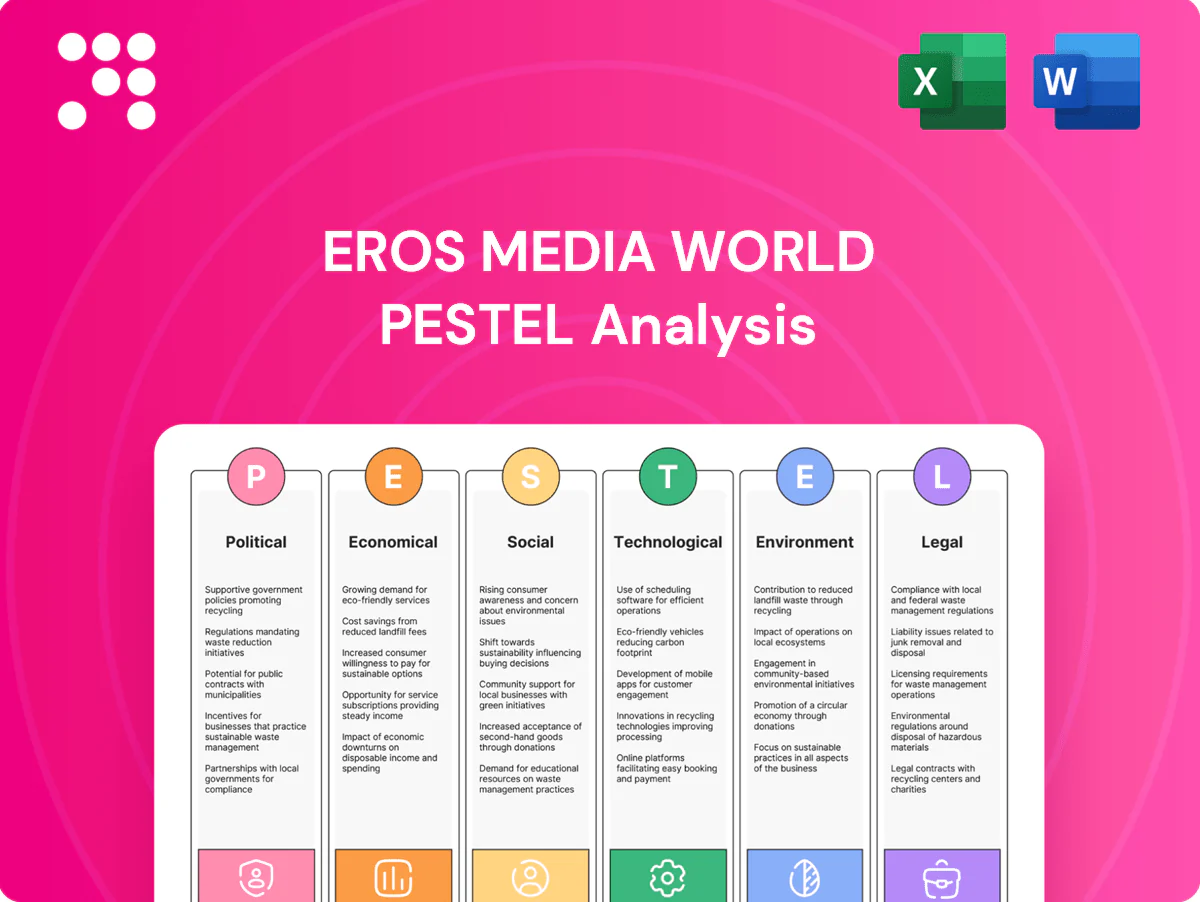
The preview shown here is the exact, fully formatted Eros Media World PESTLE Analysis you’ll receive after purchase. It includes complete PESTLE sections—Political, Economic, Social, Technological, Legal, and Environmental—organized and ready to use. No placeholders or teasers: this is the final downloadable file delivered immediately upon payment.

Original: $10.00
-65%$10.00
$3.50Product Information
Product Information
Shipping & Returns
Shipping & Returns
Description
Make Smarter Strategic Decisions with a Complete PESTEL View
Our PESTLE analysis of Eros Media World reveals how political regulation, economic cycles, social trends, and tech disruption are reshaping its growth prospects. We pinpoint legal and environmental risks alongside strategic opportunities for content and distribution. Ideal for investors and strategists, this concise report translates external forces into actionable steps. Purchase the full analysis to access the complete, editable insights immediately.
Political factors
India media policy stability
Shifts in India’s media and broadcasting policy can change licensing, distribution windows and foreign investment caps, directly affecting Eros Media World’s content distribution and capital structure in a market of roughly 1.43 billion people and 28 states. Policy moves on satellite carriage and digital content moderation influence Eros Now’s platform rules, monetization and cross-border rights enforcement. Coalition and state-level variations across 28 states can complicate nationwide theatrical and digital release strategies, increasing legal and timing risks and underscoring the need for continuous policy monitoring and industry lobbying.
Censorship and content regulation
The Central Board of Film Certification controls theatrical certificates while the IT Rules 2021 and subsequent OTT self-classification norms require platforms to classify content and maintain grievance redressal, affecting creative timelines and release windows. Mandated edits, takedowns or age-gating can materially reduce reach to India’s online audience of hundreds of millions and dent revenue. Given acute sensitivity around religion, politics and social issues, robust legal pre-clearance and independent sensitivity reviews are essential to mitigate regulatory and reputational risk.
Tax incentives and subsidies
State and national incentives cut production budgets and attract co-productions: UK film tax relief offers up to 25% of qualifying spend and US hubs like Georgia provide credits up to 30%, while Maharashtra and Gujarat provide cash rebates and location subsidies to boost shoots.
GST materially impacts margins: digital subscriptions face 18% GST, cinema tickets are broadly taxed in 12%/18% bands and input tax credit eligibility affects cashflow and net margins.
Lock incentives at greenlight—structure co-productions, qualifying spend and shooting windows to maximize rebates and protect margin forecasts.
Geopolitics and diaspora markets
India’s diplomatic ties materially shape Eros Media World’s theatrical reach: Indian-origin populations of roughly 4.9 million in the US, ~1.5 million in the UK and ~8.6 million across the Gulf drive box-office and OTT demand, while US/UK visa backlogs (O/P processing often 4–8 months in 2024) and festival access (Sundance/TIFF slots) affect talent mobility and marketing windows; US export controls on advanced semiconductors and sanctions-related payment frictions since 2022 can impede tech imports and cross-border receipts, underscoring the need for a diversified market hedge across regions.
- Diaspora reach: US 4.9M, UK 1.5M, Gulf 8.6M
- Visa impact: O/P average 4–8 month processing (2024)
- Sanctions/controls: 2022–24 US export controls risk tech imports, sanctions risk payments
- Strategy: diversify territories to hedge geopolitical shocks
Public co-production treaties
Bilateral audiovisual co-production treaties can unlock financing, access to national tax reliefs (eg UK Film Tax Relief up to 25%) and distribution priority in treaty partners; France’s Tax Rebate for International Production offers up to 30% on eligible spend. Eligibility hinges on cultural tests, qualified national personnel and local spend thresholds (commonly 20–50%), while scheduling and certification create compliance overheads and audit risk. Aligning Eros Media World’s pipeline to meet local spend windows and cultural points maximizes treaty capture and incentive cashflow.
- Incentives: UK 25% tax credit, France up to 30%
- Criteria: cultural tests, national personnel, certified spend
- Thresholds: typical local spend 20–50%
- Operational: scheduling, audits, certification overheads
- Strategy: pipeline timing and co‑pro partner selection to secure benefits
India rule changes reshape film financing, OTT monetization and global release strategy
Regulatory shifts in India (1.43B population, 28 states) affect licensing, distribution windows and foreign investment caps, altering Eros Media World’s capital and release strategy. OTT rules (IT Rules 2021) and GST (digital 18%, cinema 12/18%) impact monetization and margins. Diplomatic/visa delays (O/P 4–8 months 2024) and diaspora markets (US 4.9M, UK 1.5M, Gulf 8.6M) shape theatrical/OTT reach; incentives (UK 25%, France up to 30%) guide co‑pro decisions.
| Item | Key data |
|---|---|
| India | Pop 1.43B; 28 states |
| GST | Digital 18%; Cinema 12/18% |
| Diaspora | US 4.9M; UK 1.5M; Gulf 8.6M |
| Visas | O/P 4–8m (2024) |
| Incentives | UK 25%; France ≤30% |
What is included in the product
Detailed Word Document
Explores how macro-environmental forces uniquely impact Eros Media World across Political, Economic, Social, Technological, Environmental, and Legal dimensions, with data-driven subpoints and examples tailored to media, streaming, and regional regulations. Designed for executives and investors to identify strategic risks, opportunities, and forward-looking scenarios.
Customizable Excel Spreadsheet
A concise, visually segmented PESTLE summary for Eros Media World that saves time in meetings, is easily dropped into presentations, editable for local context, and designed to align teams quickly while clarifying external risks and market positioning.
Economic factors
Box office and ad cycle volatility
Eros Media World faces high sensitivity to macro cycles as discretionary spending and ad budgets shift, with opening weekends typically accounting for 30–50% of a film’s lifetime box office. Theatrical revenues are weekend- and holiday-dependent, concentrating sales around Diwali/Christmas windows. Inflation pressures ticket and concession affordability, squeezing margins and attendance. Balancing a slate across genres and staggered release windows mitigates revenue and ad-cycle volatility.
Streaming ARPU and churn pressure
Eros faces low streaming ARPU in price-sensitive markets (India/APAC ARPU commonly below $3/month vs US/Canada >$10/month in 2024), intensifying competition for limited wallet share. High churn—often 2–5% monthly in emerging markets—pushes reliance on telco bundling and prepaid partnerships to stabilize subs. Content-cost inflation from talent premiums squeezes margins. Recommend data-driven retention (cohort LTV analysis) and tiered pricing with ad-supported and premium tiers.
Currency and financing risks
Eros faces USD/INR and GBP/INR exposure as international receipts and dollar/sterling debt move; USD/INR near 83.0 and GBP/INR ~103 in mid‑2025 magnify translation risk. Hedging via forwards/options costs roughly 1–3% annually, while release-to-window revenue timing creates mismatches. Higher RBI policy rate ~6.5% raises production working capital costs; disciplined cash‑flow scheduling and systematic hedge rules are essential.
Piracy erosion of revenues
Piracy erodes Eros Media World revenues by leaking pre-release cam-rips and screeners that analysts link to double-digit reductions in conversion from awareness to paid box office and SVOD trials; MUSO reported ~193 billion visits to piracy sites in 2022, spotlighting broad demand leakage that undermines marketing ROI and compresses international pre-sale pricing power.
Day-and-date releases, forensic watermarking and rapid takedown partnerships have been shown to reduce illicit circulation windows and protect conversion and pre-sale premiums.
- Revenue hit: double-digit conversion losses reported
- Scale: ~193 billion piracy visits (MUSO 2022)
- Channels: cam-rips + Telegram accelerate spread
- Mitigants: day-and-date, watermarking, takedowns
Talent and production cost inflation
Post-2023 labor actions (WGA May–Sep 2023, SAG‑AFTRA Jul–Nov 2023) intensified upward pressure on actor fees, crew rates and post‑production studio pricing, while bidding wars among streamers for marquee IP have compressed margins and peak‑season capacity constraints push day‑rates higher; long‑term talent deals and in‑house development are effective cost controls.
- actor-fee inflation
- crew & post-costs
- bidding-war margin squeeze
- peak-season capacity limits
- long-term deals & in-house dev
India rule changes reshape film financing, OTT monetization and global release strategy
Eros is highly cyclic: opening weekends drive 30–50% of box office, Diwali/Christmas concentration raises seasonality risk, and RBI rate ~6.5% (mid‑2025) increases working capital costs. Streaming ARPU: India/APAC < $3/month vs US/CA > $10 (2024); monthly churn 2–5%. FX: USD/INR ~83, GBP/INR ~103 (mid‑2025); hedging costs ~1–3% annually. Piracy (MUSO 193bn visits 2022) and talent inflation compress margins.
| Metric | Value |
|---|---|
| Opening weekend share | 30–50% |
| RBI policy rate | ~6.5% (mid‑2025) |
| ARPU India/APAC | < $3/mo (2024) |
| ARPU US/CA | > $10/mo (2024) |
| Monthly churn | 2–5% |
| USD/INR | ~83 (mid‑2025) |
| GBP/INR | ~103 (mid‑2025) |
| Hedging cost | ~1–3% pa |
| Piracy scale | 193bn visits (MUSO 2022) |
What You See Is What You Get
Eros Media World PESTLE Analysis
The preview shown here is the exact, fully formatted Eros Media World PESTLE Analysis you’ll receive after purchase. It includes complete PESTLE sections—Political, Economic, Social, Technological, Legal, and Environmental—organized and ready to use. No placeholders or teasers: this is the final downloadable file delivered immediately upon payment.