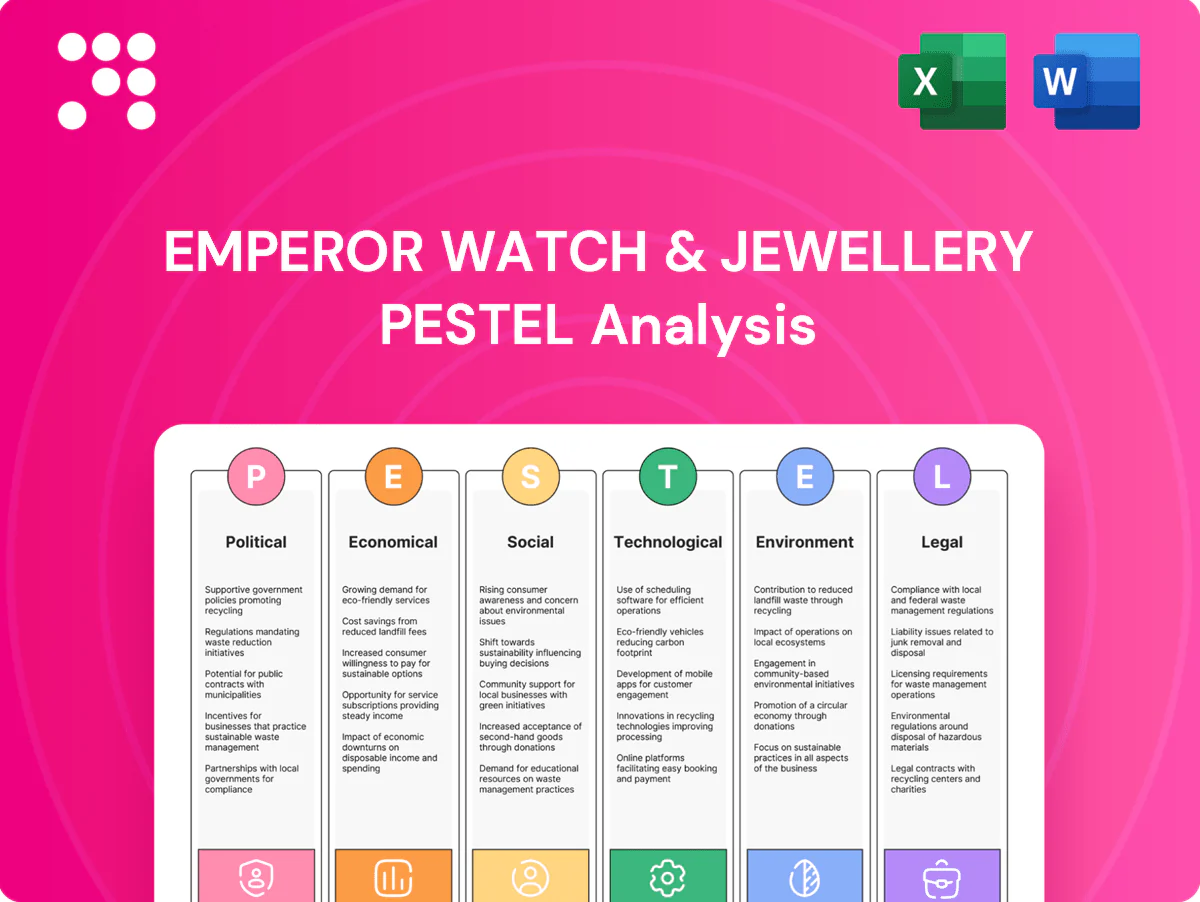
Emperor Watch & Jewellery PESTLE Analysis

Skip the Research. Get the Strategy.
Explore how political shifts, economic cycles, social trends, technology advances, legal changes and environmental pressures shape Emperor Watch & Jewellery’s strategic path in our concise PESTLE snapshot. This analysis highlights risks and growth levers for investors and planners. Purchase the full PESTLE for actionable, exportable insights now.
Political factors

Mainland policy shifts
Mainland policy shifts matter: China accounted for about one-third of global personal luxury demand (Bain, 2024), while Hainan duty-free sales topped RMB100 billion in 2023, diverting spend from Hong Kong and Macau; tighter customs and cross‑border retail rules and periodic anti‑extravagance campaigns have intermittently compressed gifting-driven volumes; continuous monitoring enables rapid assortment and pricing agility across channels to protect margins.
Geopolitical supply exposure
European-made watches face elevated risk from EU–China tensions and export controls introduced since 2023, with Swiss watch exports representing over 50% of global export value, so any Swiss logistics or certification delays can postpone flagship launches. Currency-linked pricing policies against EUR/CHF volatility compress margins. Diversified sourcing and 3–6 month inventory buffers can mitigate shocks.

Import tariffs & duties
Hong Kong and Macau levy zero import duties (2024), while Mainland China applies import duties plus VAT, creating persistent price differentials across Greater China. ASEAN applied tariffs are typically low, often 0–5% under regional agreements (2024), shaping relative pricing and parallel trade flows. Sudden duty changes can quickly shift store competitiveness vs duty-free and grey markets; efficient bonded logistics and tax planning improve sell-through. Clear, transparent pricing strengthens consumer trust and reduces arbitrage.

Local governance & permits
Local store opening approvals, signage rules and luxury security standards differ by city, affecting fit-out timelines and operating costs; World Bank political stability index ranges from -2.5 to 2.5, influencing lease negotiation leverage and store uptime. Policy incentives in premium districts can materially improve store IRR, while strong government relations accelerate expansion cadence.
- Permits: city-specific timelines
- Signage: zoning & design rules
- Security: luxury standards vary
- Stability: WB index impacts leases
- Incentives: premium-district tax/permits
Public health & travel policy
Tourism-dependent luxury sales at Emperor Watch & Jewellery are sensitive to visa regimes and airline seat capacity; UNWTO reported international tourist arrivals reached about 85% of 2019 levels in 2023, leaving recovery exposed to policy shifts.
Any resurgence of travel restrictions would disproportionately pressure high-traffic flagships in gateway cities, reducing in-store transactions and average transaction values.
Regional coordination on health protocols—testing, quarantine exemptions and digital health passes—directly influences cross-border footfall recovery and event-driven demand.
Diversified market presence and omni-channel sales, with online luxury accounting for roughly 30% of sales in recent industry reports, reduce revenue volatility from travel shocks.
Mainland policy, export controls reshape China luxury — 33% demand
Mainland policy shifts, trade controls and duty-free divergence materially affect Emperor Watch & Jewellery: China ≈33% of global personal luxury demand (Bain 2024); Hainan sales >RMB100bn (2023). EU–China export controls since 2023 and Swiss watches >50% of global export value risk supply delays. Tourism recovery at ~85% of 2019 (UNWTO 2023) and online luxury ≈30% of sales lower travel dependency.
| Factor | Impact | Key data |
|---|---|---|
| Mainland policy | Price/channel shifts | 33% demand (Bain 2024) |
| Duty/export | Supply/pricing risk | Hainan >RMB100bn; Swiss >50% exports |
| Tourism | Footfall volatility | 85% arrivals (UNWTO 2023) |
| Digital | Revenue hedge | ~30% online luxury |
What is included in the product
 Detailed Word Document
Explores how Political, Economic, Social, Technological, Environmental and Legal forces uniquely impact Emperor Watch & Jewellery, with data-driven subpoints and region-specific examples to reveal risks and opportunities. Designed for executives and investors, the analysis offers forward-looking insights, scenario-ready recommendations and clean formatting for reports, decks or strategic planning.

 Customizable Excel Spreadsheet
A concise, visually segmented PESTLE summary for Emperor Watch & Jewellery that clarifies external risks and market positioning, easily dropped into presentations, shared across teams, and customizable with region- or product-specific notes for faster decision-making.
Economic factors

Luxury demand cyclicality
High-end discretionary spend tracks GDP and wealth effects—China GDP grew 5.2% in 2023 and Hong Kong about 3.9% (World Bank), so equity/property swings in those markets materially sway ticket sizes; China/HK together account for roughly one-third of global luxury demand (Bain 2024). Macro slowdowns push consumers toward entry-level luxury and classics, while flexible inventory management and clienteling sustain margins and conversion rates.
FX and pricing power
HKD peg to USD (7.75–7.85) stabilizes base pricing, but RMB moves versus CHF/EUR — RMB around 7.25 per USD in H1 2025 — shift landed costs and RRPs for Emperor; FX volatility historically provokes brand-led price harmonization, squeezing retailer margins (brands report 2–5pp FX-driven margin swings). Active hedging and dynamic pricing mitigate losses, while 10–30% cross-border price gaps fuel store traffic and grey-market leakage.

Tourism & retail rents
Mainland visitors accounted for about 70% of arrivals in Hong Kong and Macau in 2024, underpinning flagship sales and footfall. Prime retail rents in luxury corridors remain a major fixed-cost lever for Emperor Watch & Jewellery. Turnover-based leases can align landlord-tenant incentives amid volatile demand, while network optimisation—store rationalisation and product-mix shifts—improves store-level profitability.

Wealth creation in Asia
- HNW/UHNW growth: regional luxury share ~48% (Bain 2024)
- Southeast Asia middle class ~250m by 2030 (ADB projection)
- Customer strategies: private appointments, VICs, exclusive allocations
Interest rates & liquidity
- Higher rates: US fed 5.25–5.50% (Jul 2025)
- Working capital: higher carrying cost on luxury inventory
- Financing terms: critical with brands/distributors
- Demand: BNPL smooths conversion
- Resilience: cash discipline
Mainland policy, export controls reshape China luxury — 33% demand
Luxury demand tracks GDP/wealth: China GDP +5.2% (2023), HK +3.9%; APAC ~48% of global luxury (Bain 2024). Mainland visitors ~70% of HK/Macau arrivals (2024), RMB ~7.25/USD (H1 2025) shifts landed costs. HKD peg stabilises pricing; US Fed 5.25–5.50% (Jul 2025) raises inventory carrying costs, boosting need for financing, dynamic pricing and store optimisation.
| Metric | Value |
|---|---|
| China GDP (2023) | +5.2% |
| APAC luxury share | 48% (Bain 2024) |
| RMB/USD (H1 2025) | ~7.25 |
| US Fed | 5.25–5.50% (Jul 2025) |
Full Version Awaits
Emperor Watch & Jewellery PESTLE Analysis
This PESTLE analysis examines political, economic, social, technological, legal and environmental factors affecting Emperor Watch & Jewellery to inform strategy and risk management. It highlights macro trends, regulatory risks, and market opportunities. The preview shown here is the exact document you’ll receive after purchase—fully formatted and ready to use.

Product Information
Product Information
Shipping & Returns
Shipping & Returns
Description
Skip the Research. Get the Strategy.
Explore how political shifts, economic cycles, social trends, technology advances, legal changes and environmental pressures shape Emperor Watch & Jewellery’s strategic path in our concise PESTLE snapshot. This analysis highlights risks and growth levers for investors and planners. Purchase the full PESTLE for actionable, exportable insights now.
Political factors
Mainland policy shifts
Mainland policy shifts matter: China accounted for about one-third of global personal luxury demand (Bain, 2024), while Hainan duty-free sales topped RMB100 billion in 2023, diverting spend from Hong Kong and Macau; tighter customs and cross‑border retail rules and periodic anti‑extravagance campaigns have intermittently compressed gifting-driven volumes; continuous monitoring enables rapid assortment and pricing agility across channels to protect margins.
Geopolitical supply exposure
European-made watches face elevated risk from EU–China tensions and export controls introduced since 2023, with Swiss watch exports representing over 50% of global export value, so any Swiss logistics or certification delays can postpone flagship launches. Currency-linked pricing policies against EUR/CHF volatility compress margins. Diversified sourcing and 3–6 month inventory buffers can mitigate shocks.
Import tariffs & duties
Hong Kong and Macau levy zero import duties (2024), while Mainland China applies import duties plus VAT, creating persistent price differentials across Greater China. ASEAN applied tariffs are typically low, often 0–5% under regional agreements (2024), shaping relative pricing and parallel trade flows. Sudden duty changes can quickly shift store competitiveness vs duty-free and grey markets; efficient bonded logistics and tax planning improve sell-through. Clear, transparent pricing strengthens consumer trust and reduces arbitrage.
Local governance & permits
Local store opening approvals, signage rules and luxury security standards differ by city, affecting fit-out timelines and operating costs; World Bank political stability index ranges from -2.5 to 2.5, influencing lease negotiation leverage and store uptime. Policy incentives in premium districts can materially improve store IRR, while strong government relations accelerate expansion cadence.
- Permits: city-specific timelines
- Signage: zoning & design rules
- Security: luxury standards vary
- Stability: WB index impacts leases
- Incentives: premium-district tax/permits
Public health & travel policy
Tourism-dependent luxury sales at Emperor Watch & Jewellery are sensitive to visa regimes and airline seat capacity; UNWTO reported international tourist arrivals reached about 85% of 2019 levels in 2023, leaving recovery exposed to policy shifts.
Any resurgence of travel restrictions would disproportionately pressure high-traffic flagships in gateway cities, reducing in-store transactions and average transaction values.
Regional coordination on health protocols—testing, quarantine exemptions and digital health passes—directly influences cross-border footfall recovery and event-driven demand.
Diversified market presence and omni-channel sales, with online luxury accounting for roughly 30% of sales in recent industry reports, reduce revenue volatility from travel shocks.
Mainland policy, export controls reshape China luxury — 33% demand
Mainland policy shifts, trade controls and duty-free divergence materially affect Emperor Watch & Jewellery: China ≈33% of global personal luxury demand (Bain 2024); Hainan sales >RMB100bn (2023). EU–China export controls since 2023 and Swiss watches >50% of global export value risk supply delays. Tourism recovery at ~85% of 2019 (UNWTO 2023) and online luxury ≈30% of sales lower travel dependency.
| Factor | Impact | Key data |
|---|---|---|
| Mainland policy | Price/channel shifts | 33% demand (Bain 2024) |
| Duty/export | Supply/pricing risk | Hainan >RMB100bn; Swiss >50% exports |
| Tourism | Footfall volatility | 85% arrivals (UNWTO 2023) |
| Digital | Revenue hedge | ~30% online luxury |
What is included in the product
Detailed Word Document
Explores how Political, Economic, Social, Technological, Environmental and Legal forces uniquely impact Emperor Watch & Jewellery, with data-driven subpoints and region-specific examples to reveal risks and opportunities. Designed for executives and investors, the analysis offers forward-looking insights, scenario-ready recommendations and clean formatting for reports, decks or strategic planning.
Customizable Excel Spreadsheet
A concise, visually segmented PESTLE summary for Emperor Watch & Jewellery that clarifies external risks and market positioning, easily dropped into presentations, shared across teams, and customizable with region- or product-specific notes for faster decision-making.
Economic factors
Luxury demand cyclicality
High-end discretionary spend tracks GDP and wealth effects—China GDP grew 5.2% in 2023 and Hong Kong about 3.9% (World Bank), so equity/property swings in those markets materially sway ticket sizes; China/HK together account for roughly one-third of global luxury demand (Bain 2024). Macro slowdowns push consumers toward entry-level luxury and classics, while flexible inventory management and clienteling sustain margins and conversion rates.
FX and pricing power
HKD peg to USD (7.75–7.85) stabilizes base pricing, but RMB moves versus CHF/EUR — RMB around 7.25 per USD in H1 2025 — shift landed costs and RRPs for Emperor; FX volatility historically provokes brand-led price harmonization, squeezing retailer margins (brands report 2–5pp FX-driven margin swings). Active hedging and dynamic pricing mitigate losses, while 10–30% cross-border price gaps fuel store traffic and grey-market leakage.
Tourism & retail rents
Mainland visitors accounted for about 70% of arrivals in Hong Kong and Macau in 2024, underpinning flagship sales and footfall. Prime retail rents in luxury corridors remain a major fixed-cost lever for Emperor Watch & Jewellery. Turnover-based leases can align landlord-tenant incentives amid volatile demand, while network optimisation—store rationalisation and product-mix shifts—improves store-level profitability.
Wealth creation in Asia
- HNW/UHNW growth: regional luxury share ~48% (Bain 2024)
- Southeast Asia middle class ~250m by 2030 (ADB projection)
- Customer strategies: private appointments, VICs, exclusive allocations
Interest rates & liquidity
- Higher rates: US fed 5.25–5.50% (Jul 2025)
- Working capital: higher carrying cost on luxury inventory
- Financing terms: critical with brands/distributors
- Demand: BNPL smooths conversion
- Resilience: cash discipline
Mainland policy, export controls reshape China luxury — 33% demand
Luxury demand tracks GDP/wealth: China GDP +5.2% (2023), HK +3.9%; APAC ~48% of global luxury (Bain 2024). Mainland visitors ~70% of HK/Macau arrivals (2024), RMB ~7.25/USD (H1 2025) shifts landed costs. HKD peg stabilises pricing; US Fed 5.25–5.50% (Jul 2025) raises inventory carrying costs, boosting need for financing, dynamic pricing and store optimisation.
| Metric | Value |
|---|---|
| China GDP (2023) | +5.2% |
| APAC luxury share | 48% (Bain 2024) |
| RMB/USD (H1 2025) | ~7.25 |
| US Fed | 5.25–5.50% (Jul 2025) |
Full Version Awaits
Emperor Watch & Jewellery PESTLE Analysis
This PESTLE analysis examines political, economic, social, technological, legal and environmental factors affecting Emperor Watch & Jewellery to inform strategy and risk management. It highlights macro trends, regulatory risks, and market opportunities. The preview shown here is the exact document you’ll receive after purchase—fully formatted and ready to use.