Emami PESTLE Analysis

Make Smarter Strategic Decisions with a Complete PESTEL View
Gain strategic clarity with our concise PESTLE Analysis of Emami—three actionable insights into political, economic, and technological forces shaping its growth. Ideal for investors and strategists, it’s research-ready and fully editable. Buy the full report to unlock the complete, up-to-date external landscape and make confident decisions.
Political factors

Regulatory stability in India
Policy continuity shapes FMCG pricing, labeling and distribution permissions for firms like Emami, directly affecting shelf prices and go-to-market timelines. GST, rolled out in 2017 and remaining India’s primary indirect tax, continues to levy many personal-care products at 18% as of 2025, aiding predictable cost modeling. Sudden duty or consumer-protection changes can compress margins and raise compliance costs, so Emami must sustain active government relations to anticipate shifts.
Import duties on inputs
Customs tariffs on oils, fragrances and packaging resins directly raise Emami’s input costs and can incentivize local sourcing or backward integration; in 2024 India continued to use tariff and safeguard measures to protect domestic processors. Duty concessions and exemptions for specified essential health and hygiene products under CBIC notifications improve affordability. Emami’s diversified global sourcing reduces single-market exposure and supply risk.

Public health priorities
Government campaigns on hygiene, wellness and AYUSH promotion lift demand for personal and healthcare products; PM-JAY covers about 500 million beneficiaries and the AYUSH market was ~USD 18 billion in 2024, supporting channel growth. NPPA/DPCO price controls on essential/OTC items (covering ~800+ formulations) may cap upside. Public procurement via PM-JAY and state tenders offers scale; alignment with AYUSH policy strengthens brand credibility.

Federal-state compliance
India’s federal structure (28 states, 8 union territories) forces Emami to secure multi-state licenses, maintain GST compliance since 2017 and obtain local labor permits; state-level incentives and subsidies drive plant-location decisions while varied enforcement intensity raises operational risk, so robust compliance systems materially reduce disruptions.
- multi-state licenses
- GST compliance
- local labor permits
- state incentives
- enforcement variability
- robust compliance
Geopolitical supply risks
Geopolitical supply risks—with Brent oil volatility (averaging ~83 USD/bbl in 2024) and recurrent global logistics disruptions—raise costs for edible oil and packaging inputs; India imported ~14.7 million tonnes of edible oil in 2023–24, exposing processors like Emami to trade shocks. Diversifying suppliers across regions and scenario planning help preserve service levels during shocks.
- Risk: oil-price-impact
- Risk: logistics-disruption
- Mitigation: supplier-diversification
- Mitigation: scenario-planning
GST 18% and PM-JAY 500M reshape margins
Policy continuity (GST 18% on many personal-care goods in 2025) and NPPA/DPCO controls shape pricing, margins and compliance timelines for Emami. Customs tariffs and duty concessions influence input costs; India imported 14.7 MT edible oil in 2023–24 and Brent averaged $83/bbl in 2024, raising packaging/oil risks. PM-JAY (≈500M beneficiaries) and AYUSH (~USD18bn 2024) expand demand but federal variances require multi-state permits and strong compliance.
| Political Factor | 2024/25 Data |
|---|---|
| GST rate | 18% |
| Brent oil | $83/bbl (2024) |
| Edible oil imports | 14.7 MT (2023–24) |
| PM-JAY beneficiaries | ~500M |
| AYUSH market | ~$18bn (2024) |
What is included in the product
 Detailed Word Document
Explores how macro-environmental factors uniquely affect Emami across Political, Economic, Social, Technological, Environmental and Legal dimensions, each backed by data, trend analysis and forward-looking insights to help executives, consultants and investors identify risks, opportunities and actionable strategies.

 Customizable Excel Spreadsheet
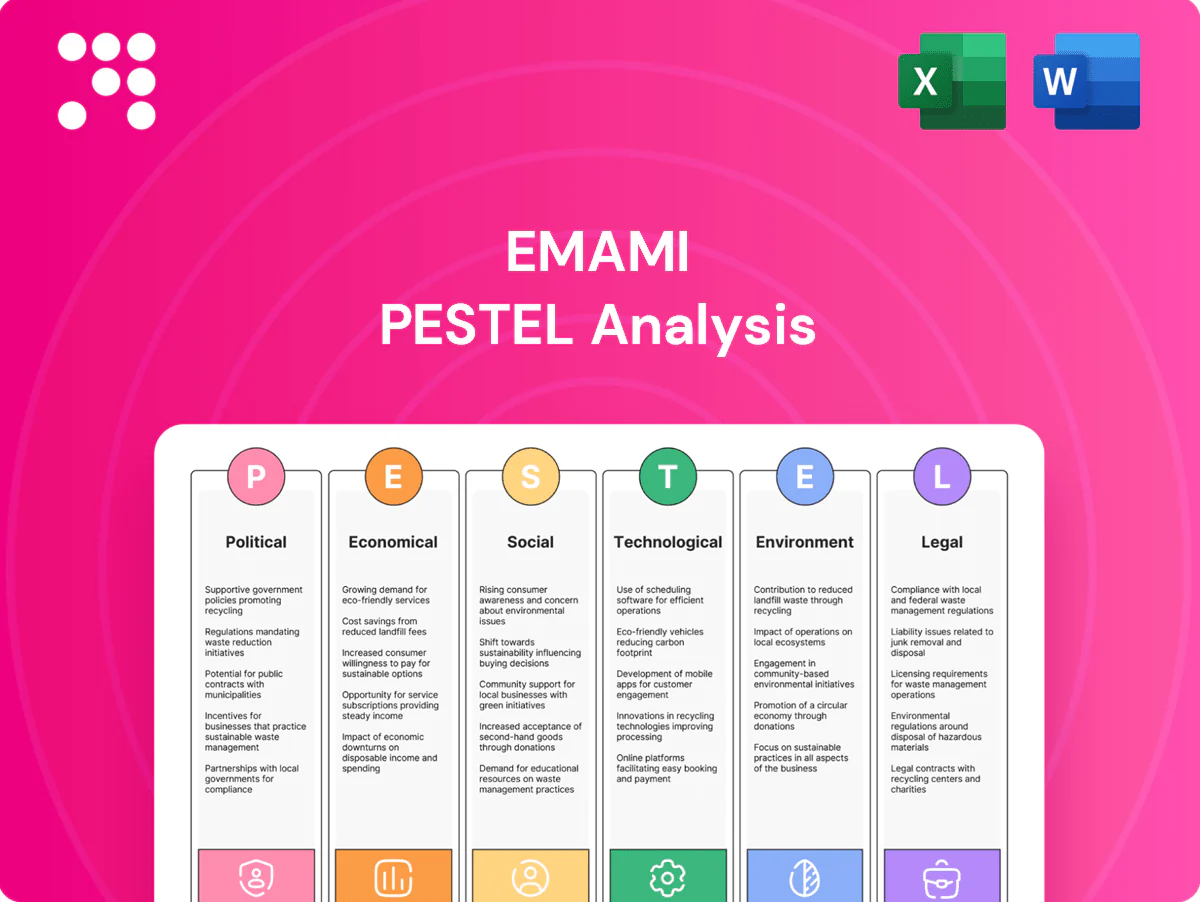
A concise, visually segmented Emami PESTLE summary that’s easy to drop into presentations, editable for region- or product-specific notes, and instantly shareable to align teams and streamline external risk and market-positioning discussions.
Economic factors

Rural demand cycles
Monsoon outcomes and MSP moves remain key drivers of rural incomes and FMCG offtake, with rural India accounting for roughly 45% of FMCG volumes (NielsenIQ 2023). Strong rural liquidity in good seasons fuels mass personal care growth, while weak seasons compress volumes and force higher promotional intensity. Emami’s deep rural distribution network positions it to capture upside when rural demand recovers.
Inflation and pricing power
Input inflation in palm oil, menthol and plastics squeezed Emami’s gross margins as commodity costs rose sharply in 2024—crude palm oil averaged about MYR 3,900/ton in 2024 and global resin prices were up ~12% YoY—forcing staggered pack-price increases that helped defend EBIT through portfolio premiumization and pack-price architecture. Frequent price resets risk volume elasticity in mass segments, where value-price sensitivity remains high after India’s 2024 CPI of ~5%. Ongoing cost optimization, SKU rationalization and hedging programs reduced margin volatility and helped stabilize profitability in FY24–25.

GDP growth and consumption
Higher GDP per capita and robust GDP growth (IMF 2024 projection: India 6.8%) correlate with rising grooming and wellness spend; slowdowns shift consumers to value packs and essentials, which Emami services through economy SKUs. Emami’s diverse portfolio across personal care, healthcare and toiletries buffers cyclical swings. Channel expansion—modern trade and e-commerce (online beauty share ~15–18% in 2024)—supports growth even in tepid cycles.

Currency fluctuations
INR volatility (near 83.5 per USD in mid-2025) raises costs for imported inputs and creates translation exposure for foreign subsidiaries; disciplined hedging (forwards/options) can smooth EBITDA volatility and protect margins. A weaker INR increases COGS but can boost competitiveness in SAARC/Africa markets, so pricing cadence must allow timely FX pass-through to trade working capital and preserve margins.
- FX rate mid-2025: INR ~83.5/USD
- Hedging smooths EBITDA swings
- Weaker INR: higher COGS, better export demand
- Pricing cadence essential for FX pass-through
Capital costs and investment
- Repo rate: 6.5% (2024)
- Focus: automation & capacity when rates fall
- High-rate response: tighten working capital
- Leverage: preserve flexibility
GST 18% and PM-JAY 500M reshape margins
Rural demand (≈45% FMCG volumes, NielsenIQ 2023) and MSP-driven monsoon swings dictate volumes; Emami’s rural reach and economy SKUs mitigate downside. Commodity inflation (CPO ~MYR 3,900/ton 2024) and INR volatility (≈83.5/USD mid‑2025) pressure COGS; hedging and SKU premiumization defend margins. GDP strength (IMF 2024: 6.8%) and falling rates (repo 6.5% 2024) support premium grooming and capex.
| Metric | Value |
|---|---|
| Rural FMCG share | 45% (NielsenIQ 2023) |
| India GDP | 6.8% (IMF 2024) |
| INR | ~83.5/USD (mid‑2025) |
| Repo | 6.5% (2024) |
| CPO | MYR 3,900/ton (2024) |
Preview the Actual Deliverable
Emami PESTLE Analysis
The Emami PESTLE Analysis preview shown here is the exact document you’ll receive after purchase—fully formatted and ready to use. The layout, content, and structure visible in this sample are identical to the final file you’ll download immediately after payment. No placeholders or teasers—this is the real, professionally structured report on Emami.

Product Information
Product Information
Shipping & Returns
Shipping & Returns
Description
Make Smarter Strategic Decisions with a Complete PESTEL View
Gain strategic clarity with our concise PESTLE Analysis of Emami—three actionable insights into political, economic, and technological forces shaping its growth. Ideal for investors and strategists, it’s research-ready and fully editable. Buy the full report to unlock the complete, up-to-date external landscape and make confident decisions.
Political factors
Regulatory stability in India
Policy continuity shapes FMCG pricing, labeling and distribution permissions for firms like Emami, directly affecting shelf prices and go-to-market timelines. GST, rolled out in 2017 and remaining India’s primary indirect tax, continues to levy many personal-care products at 18% as of 2025, aiding predictable cost modeling. Sudden duty or consumer-protection changes can compress margins and raise compliance costs, so Emami must sustain active government relations to anticipate shifts.
Import duties on inputs
Customs tariffs on oils, fragrances and packaging resins directly raise Emami’s input costs and can incentivize local sourcing or backward integration; in 2024 India continued to use tariff and safeguard measures to protect domestic processors. Duty concessions and exemptions for specified essential health and hygiene products under CBIC notifications improve affordability. Emami’s diversified global sourcing reduces single-market exposure and supply risk.
Public health priorities
Government campaigns on hygiene, wellness and AYUSH promotion lift demand for personal and healthcare products; PM-JAY covers about 500 million beneficiaries and the AYUSH market was ~USD 18 billion in 2024, supporting channel growth. NPPA/DPCO price controls on essential/OTC items (covering ~800+ formulations) may cap upside. Public procurement via PM-JAY and state tenders offers scale; alignment with AYUSH policy strengthens brand credibility.
Federal-state compliance
India’s federal structure (28 states, 8 union territories) forces Emami to secure multi-state licenses, maintain GST compliance since 2017 and obtain local labor permits; state-level incentives and subsidies drive plant-location decisions while varied enforcement intensity raises operational risk, so robust compliance systems materially reduce disruptions.
- multi-state licenses
- GST compliance
- local labor permits
- state incentives
- enforcement variability
- robust compliance
Geopolitical supply risks
Geopolitical supply risks—with Brent oil volatility (averaging ~83 USD/bbl in 2024) and recurrent global logistics disruptions—raise costs for edible oil and packaging inputs; India imported ~14.7 million tonnes of edible oil in 2023–24, exposing processors like Emami to trade shocks. Diversifying suppliers across regions and scenario planning help preserve service levels during shocks.
- Risk: oil-price-impact
- Risk: logistics-disruption
- Mitigation: supplier-diversification
- Mitigation: scenario-planning
GST 18% and PM-JAY 500M reshape margins
Policy continuity (GST 18% on many personal-care goods in 2025) and NPPA/DPCO controls shape pricing, margins and compliance timelines for Emami. Customs tariffs and duty concessions influence input costs; India imported 14.7 MT edible oil in 2023–24 and Brent averaged $83/bbl in 2024, raising packaging/oil risks. PM-JAY (≈500M beneficiaries) and AYUSH (~USD18bn 2024) expand demand but federal variances require multi-state permits and strong compliance.
| Political Factor | 2024/25 Data |
|---|---|
| GST rate | 18% |
| Brent oil | $83/bbl (2024) |
| Edible oil imports | 14.7 MT (2023–24) |
| PM-JAY beneficiaries | ~500M |
| AYUSH market | ~$18bn (2024) |
What is included in the product
Detailed Word Document
Explores how macro-environmental factors uniquely affect Emami across Political, Economic, Social, Technological, Environmental and Legal dimensions, each backed by data, trend analysis and forward-looking insights to help executives, consultants and investors identify risks, opportunities and actionable strategies.
Customizable Excel Spreadsheet
A concise, visually segmented Emami PESTLE summary that’s easy to drop into presentations, editable for region- or product-specific notes, and instantly shareable to align teams and streamline external risk and market-positioning discussions.
Economic factors
Rural demand cycles
Monsoon outcomes and MSP moves remain key drivers of rural incomes and FMCG offtake, with rural India accounting for roughly 45% of FMCG volumes (NielsenIQ 2023). Strong rural liquidity in good seasons fuels mass personal care growth, while weak seasons compress volumes and force higher promotional intensity. Emami’s deep rural distribution network positions it to capture upside when rural demand recovers.
Inflation and pricing power
Input inflation in palm oil, menthol and plastics squeezed Emami’s gross margins as commodity costs rose sharply in 2024—crude palm oil averaged about MYR 3,900/ton in 2024 and global resin prices were up ~12% YoY—forcing staggered pack-price increases that helped defend EBIT through portfolio premiumization and pack-price architecture. Frequent price resets risk volume elasticity in mass segments, where value-price sensitivity remains high after India’s 2024 CPI of ~5%. Ongoing cost optimization, SKU rationalization and hedging programs reduced margin volatility and helped stabilize profitability in FY24–25.
GDP growth and consumption
Higher GDP per capita and robust GDP growth (IMF 2024 projection: India 6.8%) correlate with rising grooming and wellness spend; slowdowns shift consumers to value packs and essentials, which Emami services through economy SKUs. Emami’s diverse portfolio across personal care, healthcare and toiletries buffers cyclical swings. Channel expansion—modern trade and e-commerce (online beauty share ~15–18% in 2024)—supports growth even in tepid cycles.
Currency fluctuations
INR volatility (near 83.5 per USD in mid-2025) raises costs for imported inputs and creates translation exposure for foreign subsidiaries; disciplined hedging (forwards/options) can smooth EBITDA volatility and protect margins. A weaker INR increases COGS but can boost competitiveness in SAARC/Africa markets, so pricing cadence must allow timely FX pass-through to trade working capital and preserve margins.
- FX rate mid-2025: INR ~83.5/USD
- Hedging smooths EBITDA swings
- Weaker INR: higher COGS, better export demand
- Pricing cadence essential for FX pass-through
Capital costs and investment
- Repo rate: 6.5% (2024)
- Focus: automation & capacity when rates fall
- High-rate response: tighten working capital
- Leverage: preserve flexibility
GST 18% and PM-JAY 500M reshape margins
Rural demand (≈45% FMCG volumes, NielsenIQ 2023) and MSP-driven monsoon swings dictate volumes; Emami’s rural reach and economy SKUs mitigate downside. Commodity inflation (CPO ~MYR 3,900/ton 2024) and INR volatility (≈83.5/USD mid‑2025) pressure COGS; hedging and SKU premiumization defend margins. GDP strength (IMF 2024: 6.8%) and falling rates (repo 6.5% 2024) support premium grooming and capex.
| Metric | Value |
|---|---|
| Rural FMCG share | 45% (NielsenIQ 2023) |
| India GDP | 6.8% (IMF 2024) |
| INR | ~83.5/USD (mid‑2025) |
| Repo | 6.5% (2024) |
| CPO | MYR 3,900/ton (2024) |
Preview the Actual Deliverable
Emami PESTLE Analysis
The Emami PESTLE Analysis preview shown here is the exact document you’ll receive after purchase—fully formatted and ready to use. The layout, content, and structure visible in this sample are identical to the final file you’ll download immediately after payment. No placeholders or teasers—this is the real, professionally structured report on Emami.