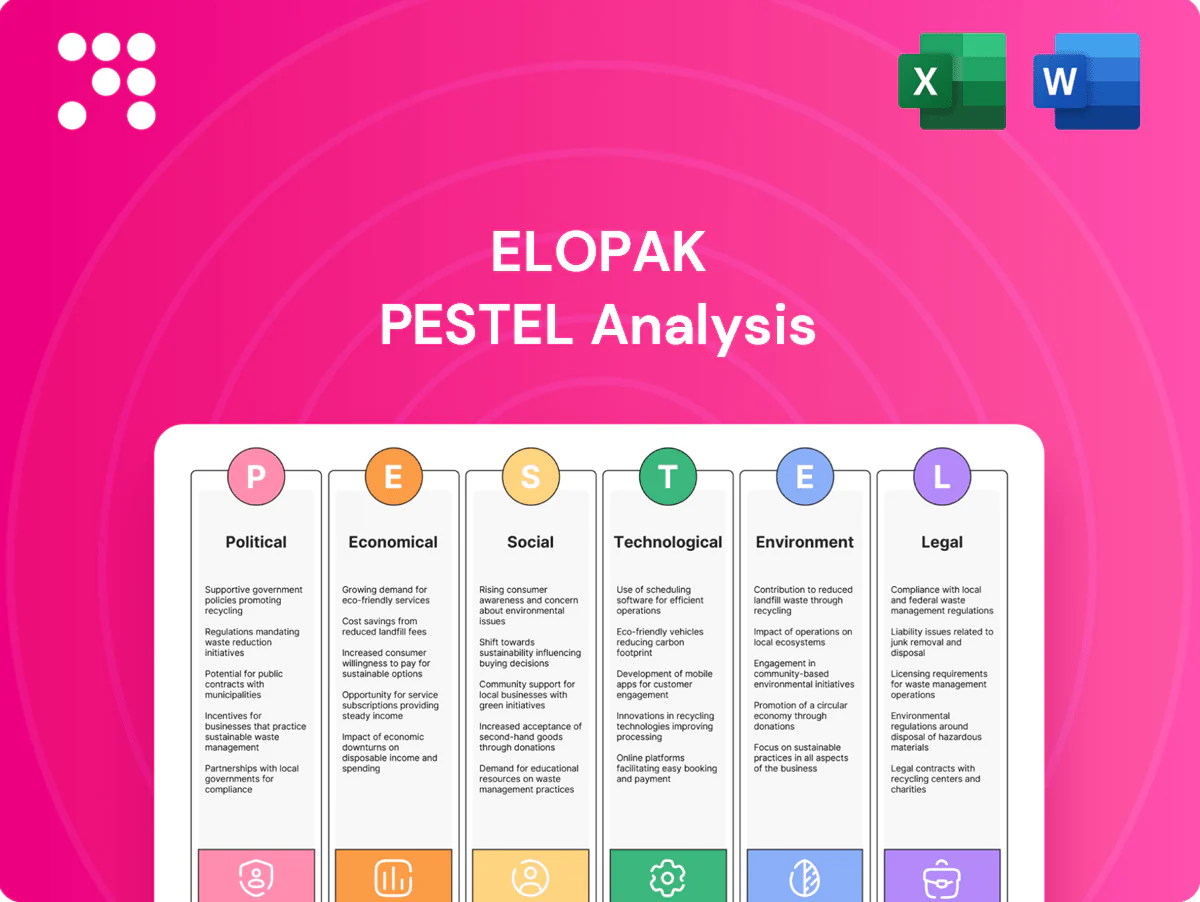
Elopak PESTLE Analysis

Make Smarter Strategic Decisions with a Complete PESTEL View
Unlock how political shifts, environmental regulation, and packaging innovation are reshaping Elopak’s outlook. This concise PESTLE preview highlights risks and opportunities that matter to investors and strategists. Purchase the full analysis for a complete, editable dossier you can use immediately to inform decisions and gain a competitive edge.
Political factors

Trade policy and tariffs
Changes in tariffs on pulp, paper and machinery can swing input costs—pulp price volatility (bleached softwood kraft up ~12% in 2024) compressed margins for packagers like Elopak. Regional trade agreements in Europe and USMCA lower barriers and eased cross-border movement of cartons and filling equipment, reducing lead times by weeks. Geopolitical tensions raised freight and insurance costs (sea freight index spikes +30% in 2022–24), so diversified sourcing and local production footprint mitigate exposure.
Government sustainability agendas
Public policies promoting the circular economy shift procurement toward fiber-based packaging, benefiting Elopak as regulators favor renewable, recyclable materials. EU climate targets (55% GHG cut by 2030) and the Innovation Fund (up to EUR 38bn 2020–30) create subsidies and tax incentives that speed equipment upgrades. Post-election priority shifts can change funding and standards, so advocacy and policy alignment secure strategic advantage.

Public procurement preferences
Government buyers across the EU and Norway—public procurement representing about 14% of EU GDP, roughly €2 trillion annually—are increasingly specifying recyclable and renewable packaging under Green Public Procurement and Circular Economy policies. Meeting eco-criteria opens institutional channels in education, healthcare and public catering where tenders favor sustainable supply. Documentation of lifecycle impacts is now commonly required by GPP guidance and national tender rules. Early compliance measurably improves bid competitiveness.

Energy and carbon policy
- Carbon price: tag:EU‑ETS ≈ €95/t
- Energy taxes: tag:operating‑costs
- RECs/GO: tag:product‑footprint
- Grid variance: tag:site‑selection
- PPAs 10–15y: tag:risk‑hedge
Political stability in key markets
Political instability in key markets delays customer investments in filling lines and plant expansions, lengthening project timelines and reducing near-term equipment orders; UNCTAD reported global FDI fell 12% to about 1.3 trillion USD in 2023, underscoring capex sensitivity. Policy continuity supports long-horizon capex decisions and predictable ROI horizons. Currency controls and capital restrictions complicate spare-parts flows and after-sales service; active country-risk monitoring guides hedging and inventory buffers.
- Instability: delays equipment orders
- Policy continuity: enables long-term capex
- Currency controls: disrupt spares/service
- Monitoring: informs hedging & inventory
Tariff, pulp and freight shocks raise input risk; EU ETS €95/t boosts fiber demand
Tariff and pulp-price swings (bleached softwood kraft +12% in 2024) and freight shocks (+30% sea‑freight 2022–24) raise input and logistics risk for Elopak. EU ETS ≈ €95/t (mid‑2025) and circular-economy procurement (EU public buying ≈14% GDP, €2tn) favor fiber-based cartons. Geopolitical and FDI volatility (global FDI −12% to $1.3tn in 2023) lengthen capex cycles and push local sourcing.
| Indicator | Value | Tag |
|---|---|---|
| Pulp price | +12% (2024) | input‑cost |
| EU ETS | €95/t (mid‑2025) | carbon‑cost |
| Sea freight | +30% (2022–24) | logistics |
What is included in the product
 Detailed Word Document
Explores how macro-environmental factors uniquely affect Elopak across Political, Economic, Social, Technological, Environmental and Legal dimensions, with data-driven subpoints and industry-specific examples. Designed for executives and investors, it delivers forward-looking insights to inform strategy, risk mitigation and funding discussions.

 Customizable Excel Spreadsheet
A concise, visually segmented Elopak PESTLE summary that can be dropped into presentations or shared across teams for quick alignment on external risks and market positioning; editable notes let users tailor insights by region or business line for immediate use in planning sessions.
Economic factors

Commodity price volatility
Commodity inputs such as pulp, paper and LME aluminum (averaging about US$2,300/t in 2024) are highly cyclical and saw benchmark pulp prices swing roughly 25% across 2023–24, compressing packager margins when contracts lack pass-through clauses. Elopak and peers use hedging and multi-sourcing to blunt spikes, while design-to-cost and lightweighting programs help offset input volatility and protect margins.
Interest rates and capex cycles
Higher rates raise financing costs for customers buying filling machines — Fed funds at 5.25–5.50% and ECB deposit rate around 4.00% (mid‑2025) increase borrowing hurdles. Deferred capex can slow installed base growth while boosting maintenance and spare‑parts revenue. Leasing, servitization and flexible financing (rental, pay‑per‑use) can sustain demand and enhance competitiveness.

Consumer demand for liquid foods
Dairy, plant-based beverages and juices remain primary drivers of carton volumes, with the plant-based beverage segment growing roughly 10% CAGR into the early 2020s. Economic slowdowns shift consumer spend toward value brands and private label, which hold about a 30% share in European grocery sales (2023). Emerging-market expansion supplies the bulk of per-capita consumption gains, and Elopak’s broad portfolio supports resilience across categories.

Exchange rate movements
Exchange rate movements create both translation and transaction risk for Elopak as revenues and costs are invoiced in NOK, EUR and USD, affecting reported margins and cash flow timing; FX volatility can materially alter competitiveness of exported filling equipment and carton supplies across Europe and North America. Elopak reduces exposure via local production and sourcing in key markets and employs financial hedges to smooth earnings and protect margins.
- translation risk: multi-currency reporting
- transaction risk: invoicing in EUR/USD vs NOK
- operational hedge: local production/sourcing
- financial hedge: forward contracts/options to stabilise earnings
Logistics and energy costs
Freight rates and fuel (Brent averaged ~$86/bbl in 2024; EU diesel ~€1.65/L) materially affect delivered carton and machinery costs, with container rates near $2,000/FEU in 2024 increasing landed costs. Nearshoring shortens lead times—often 30–50%—reducing inventory and working capital. Efficient palletization and lightweighting cut distribution spend; network optimization protects margins.
- Freight/fuel: higher landed cost
- Nearshoring: lower lead times & WC
- Palletization/lightweighting: lower distribution spend
- Network optimization: margin protection
Tariff, pulp and freight shocks raise input risk; EU ETS €95/t boosts fiber demand
Input-cost volatility (pulp ~US$2,300/t in 2024; pulp ±25% across 2023–24) compresses margins without pass‑through; hedging/lightweighting mitigate. Higher rates (Fed 5.25–5.50% mid‑2025) raise capex/financing costs; leasing supports demand. Freight/fuel (Brent ~$86/bbl; container ~$2,000/FEU in 2024) lifts landed costs; nearshoring cuts WC.
| Metric | Value | Impact |
|---|---|---|
| Pulp | ~US$2,300/t (2024) | Margin pressure |
| Fed rate | 5.25–5.50% (mid‑2025) | Higher capex cost |
| Brent | ~$86/bbl (2024) | Higher freight/fuel |
| Container | ~$2,000/FEU (2024) | Higher landed cost |
Full Version Awaits
Elopak PESTLE Analysis
The preview shown here is the exact Elopak PESTLE Analysis document you’ll receive after purchase—fully formatted and ready to use. It presents clear Political, Economic, Social, Technological, Legal and Environmental insights tailored to Elopak. No placeholders or surprises; download the same file shown instantly after checkout.

Product Information
Product Information
Shipping & Returns
Shipping & Returns
Description
Make Smarter Strategic Decisions with a Complete PESTEL View
Unlock how political shifts, environmental regulation, and packaging innovation are reshaping Elopak’s outlook. This concise PESTLE preview highlights risks and opportunities that matter to investors and strategists. Purchase the full analysis for a complete, editable dossier you can use immediately to inform decisions and gain a competitive edge.
Political factors
Trade policy and tariffs
Changes in tariffs on pulp, paper and machinery can swing input costs—pulp price volatility (bleached softwood kraft up ~12% in 2024) compressed margins for packagers like Elopak. Regional trade agreements in Europe and USMCA lower barriers and eased cross-border movement of cartons and filling equipment, reducing lead times by weeks. Geopolitical tensions raised freight and insurance costs (sea freight index spikes +30% in 2022–24), so diversified sourcing and local production footprint mitigate exposure.
Government sustainability agendas
Public policies promoting the circular economy shift procurement toward fiber-based packaging, benefiting Elopak as regulators favor renewable, recyclable materials. EU climate targets (55% GHG cut by 2030) and the Innovation Fund (up to EUR 38bn 2020–30) create subsidies and tax incentives that speed equipment upgrades. Post-election priority shifts can change funding and standards, so advocacy and policy alignment secure strategic advantage.
Public procurement preferences
Government buyers across the EU and Norway—public procurement representing about 14% of EU GDP, roughly €2 trillion annually—are increasingly specifying recyclable and renewable packaging under Green Public Procurement and Circular Economy policies. Meeting eco-criteria opens institutional channels in education, healthcare and public catering where tenders favor sustainable supply. Documentation of lifecycle impacts is now commonly required by GPP guidance and national tender rules. Early compliance measurably improves bid competitiveness.
Energy and carbon policy
- Carbon price: tag:EU‑ETS ≈ €95/t
- Energy taxes: tag:operating‑costs
- RECs/GO: tag:product‑footprint
- Grid variance: tag:site‑selection
- PPAs 10–15y: tag:risk‑hedge
Political stability in key markets
Political instability in key markets delays customer investments in filling lines and plant expansions, lengthening project timelines and reducing near-term equipment orders; UNCTAD reported global FDI fell 12% to about 1.3 trillion USD in 2023, underscoring capex sensitivity. Policy continuity supports long-horizon capex decisions and predictable ROI horizons. Currency controls and capital restrictions complicate spare-parts flows and after-sales service; active country-risk monitoring guides hedging and inventory buffers.
- Instability: delays equipment orders
- Policy continuity: enables long-term capex
- Currency controls: disrupt spares/service
- Monitoring: informs hedging & inventory
Tariff, pulp and freight shocks raise input risk; EU ETS €95/t boosts fiber demand
Tariff and pulp-price swings (bleached softwood kraft +12% in 2024) and freight shocks (+30% sea‑freight 2022–24) raise input and logistics risk for Elopak. EU ETS ≈ €95/t (mid‑2025) and circular-economy procurement (EU public buying ≈14% GDP, €2tn) favor fiber-based cartons. Geopolitical and FDI volatility (global FDI −12% to $1.3tn in 2023) lengthen capex cycles and push local sourcing.
| Indicator | Value | Tag |
|---|---|---|
| Pulp price | +12% (2024) | input‑cost |
| EU ETS | €95/t (mid‑2025) | carbon‑cost |
| Sea freight | +30% (2022–24) | logistics |
What is included in the product
Detailed Word Document
Explores how macro-environmental factors uniquely affect Elopak across Political, Economic, Social, Technological, Environmental and Legal dimensions, with data-driven subpoints and industry-specific examples. Designed for executives and investors, it delivers forward-looking insights to inform strategy, risk mitigation and funding discussions.
Customizable Excel Spreadsheet
A concise, visually segmented Elopak PESTLE summary that can be dropped into presentations or shared across teams for quick alignment on external risks and market positioning; editable notes let users tailor insights by region or business line for immediate use in planning sessions.
Economic factors
Commodity price volatility
Commodity inputs such as pulp, paper and LME aluminum (averaging about US$2,300/t in 2024) are highly cyclical and saw benchmark pulp prices swing roughly 25% across 2023–24, compressing packager margins when contracts lack pass-through clauses. Elopak and peers use hedging and multi-sourcing to blunt spikes, while design-to-cost and lightweighting programs help offset input volatility and protect margins.
Interest rates and capex cycles
Higher rates raise financing costs for customers buying filling machines — Fed funds at 5.25–5.50% and ECB deposit rate around 4.00% (mid‑2025) increase borrowing hurdles. Deferred capex can slow installed base growth while boosting maintenance and spare‑parts revenue. Leasing, servitization and flexible financing (rental, pay‑per‑use) can sustain demand and enhance competitiveness.
Consumer demand for liquid foods
Dairy, plant-based beverages and juices remain primary drivers of carton volumes, with the plant-based beverage segment growing roughly 10% CAGR into the early 2020s. Economic slowdowns shift consumer spend toward value brands and private label, which hold about a 30% share in European grocery sales (2023). Emerging-market expansion supplies the bulk of per-capita consumption gains, and Elopak’s broad portfolio supports resilience across categories.
Exchange rate movements
Exchange rate movements create both translation and transaction risk for Elopak as revenues and costs are invoiced in NOK, EUR and USD, affecting reported margins and cash flow timing; FX volatility can materially alter competitiveness of exported filling equipment and carton supplies across Europe and North America. Elopak reduces exposure via local production and sourcing in key markets and employs financial hedges to smooth earnings and protect margins.
- translation risk: multi-currency reporting
- transaction risk: invoicing in EUR/USD vs NOK
- operational hedge: local production/sourcing
- financial hedge: forward contracts/options to stabilise earnings
Logistics and energy costs
Freight rates and fuel (Brent averaged ~$86/bbl in 2024; EU diesel ~€1.65/L) materially affect delivered carton and machinery costs, with container rates near $2,000/FEU in 2024 increasing landed costs. Nearshoring shortens lead times—often 30–50%—reducing inventory and working capital. Efficient palletization and lightweighting cut distribution spend; network optimization protects margins.
- Freight/fuel: higher landed cost
- Nearshoring: lower lead times & WC
- Palletization/lightweighting: lower distribution spend
- Network optimization: margin protection
Tariff, pulp and freight shocks raise input risk; EU ETS €95/t boosts fiber demand
Input-cost volatility (pulp ~US$2,300/t in 2024; pulp ±25% across 2023–24) compresses margins without pass‑through; hedging/lightweighting mitigate. Higher rates (Fed 5.25–5.50% mid‑2025) raise capex/financing costs; leasing supports demand. Freight/fuel (Brent ~$86/bbl; container ~$2,000/FEU in 2024) lifts landed costs; nearshoring cuts WC.
| Metric | Value | Impact |
|---|---|---|
| Pulp | ~US$2,300/t (2024) | Margin pressure |
| Fed rate | 5.25–5.50% (mid‑2025) | Higher capex cost |
| Brent | ~$86/bbl (2024) | Higher freight/fuel |
| Container | ~$2,000/FEU (2024) | Higher landed cost |
Full Version Awaits
Elopak PESTLE Analysis
The preview shown here is the exact Elopak PESTLE Analysis document you’ll receive after purchase—fully formatted and ready to use. It presents clear Political, Economic, Social, Technological, Legal and Environmental insights tailored to Elopak. No placeholders or surprises; download the same file shown instantly after checkout.