Shenzhen Ellassay Fashion Co. SWOT Analysis

Elevate Your Analysis with the Complete SWOT Report
Shenzhen Ellassay Fashion Co. combines strong brand recognition in China and premium retail partnerships with design-driven product lines, but faces margin pressure from rising costs and intense fast-fashion competition. Growth opportunities include overseas expansion and digital channels, while supply-chain risks and evolving consumer tastes are threats. Discover the full SWOT analysis to access a professionally written, editable report and Excel matrix for strategic planning and investment decisions.
Strengths

Multi-brand premium portfolio
Managing ELLASSAY alongside acquired labels Laurel, IRO and Vivienne Tam diversifies aesthetics and price points, broadening appeal across multiple affluent female segments. The multi‑brand mix smooths brand‑specific sales cycles and seasonal volatility. Cross‑brand know‑how drives shared design, merchandising and marketing synergies that improve unit economics and speed-to-market.
Strong brand management
Ellassay’s clear positioning in sophisticated, contemporary womenswear supports pricing power in China’s apparel market, which exceeded US$280bn in 2023. Consistent storytelling elevates perceived value and drives loyalty, reflected in higher repeat-rate channels. Localized campaigns adapt global cues to Chinese tastes, boosting conversion. End-to-end brand stewardship improves sell-through and margin mix through tighter inventory control.

Integrated design-to-retail model
Integrated design-to-retail control at Shenzhen Ellassay compresses product development, sourcing and retail cycles, shortening time-to-market and enabling rapid replenishment. Vertical integration gives tighter quality assurance and clearer cost visibility across the value chain. Faster feedback loops from stores support capsule drops and trend-right assortments, improving responsiveness to consumer demand.

Omnichannel retail footprint
Omnichannel retail footprint spans boutiques, department store counters and digital channels, meeting customers where they shop and boosting conversion through unified inventory that lowers stockouts and shortens fulfillment time. Integrated online-offline services like click-and-collect and VIP styling enhance retention, while multi-touchpoint data strengthens CRM and personalization.
- Presence across boutiques, counters, digital
- Unified inventory improves availability
- Click-and-collect and VIP styling
- Multi-touch data fuels CRM
China market insight
Deep operating experience in China shapes fit, sizing and occasionwear for domestic consumers, leveraging the world’s largest apparel market; local supply ecosystems enable rapid festival and promotion responsiveness, and brand equity is reinforced by domestic fashion influence with online apparel share near 30% in 2024.
- Fit & assortment tuned to China
- Local supply = agility for festivals
- Domestic brand equity boost
- Optimize partnerships by city tier
Multi-brand womenswear portfolio in China leverages vertical integration and omnichannel margins
Multi-brand portfolio (Ellassay, Laurel, IRO, Vivienne Tam) broadens appeal and smooths seasonality, driving cross-brand synergies. Strong positioning in contemporary womenswear supports pricing power in China’s >US$280bn apparel market (2023) and benefits from ~30% online apparel share (2024). Vertical integration and omnichannel retail shorten lead times and improve margins.
| Metric | Value |
|---|---|
| China apparel market (2023) | US$280bn+ |
| Online apparel share (2024) | ~30% |
| Owned brands | 4 |
What is included in the product
 Detailed Word Document
Provides a concise SWOT overview of Shenzhen Ellassay Fashion Co., highlighting its core strengths and weaknesses, identifying market opportunities and external threats, and framing strategic priorities to support competitive positioning and sustainable growth.

 Customizable Excel Spreadsheet
Provides a concise SWOT matrix tailored to Shenzhen Ellassay Fashion Co., enabling rapid alignment of strategy to address supply-chain bottlenecks and brand positioning pain points.
Weaknesses

High China exposure
Revenue is concentrated in mainland China—per the 2024 annual report international sales remained a single-digit share—heightening sensitivity to local demand swings. Pandemic aftereffects and periodic footfall dips have pressured same-store comps. Shifts in local licensing or retail policy can disrupt store operations. International diversification is still nascent.
Fashion and inventory risk
Trend volatility raises markdown risk and inventory obsolescence, with frequent style churn forcing deeper discounts and write-downs across seasons.
Managing a wider brand slate complicates buy depths and size curves, increasing the chance of missed reads that cascade through subsequent collections.
Missed demand signals and slow movers can tie up working capital, pressuring cash flow and margin recovery during peak replenishment periods.

Integration complexity
Acquired international brands require tight alignment on design calendars and sourcing, yet differing brand DNAs complicate assortment planning and inventory turn. Marketing tone needs careful localization to avoid diluting brand equity while preserving premium positioning. Systems integration adds measurable cost and execution risk—Harvard Business Review estimates roughly 70% of M&A fail to capture expected synergies due to integration challenges.

Cost-intensive retail model
Premium flagship stores, high-end visual merchandising and elevated service standards drive substantial fixed costs, squeezing margins when traffic softens; lease escalations and ongoing staff training intensify cash-flow pressure during downturns. Maintaining a polished brand image restricts discounting flexibility, forcing reliance on steady same-store sales to spread SG&A and protect profitability.
- High fixed costs from premium retail
- Lease escalation and training burden in down cycles
- Limited discounting to preserve brand
- SG&A leverage needs steady same-store growth
Narrow category focus
Shenzhen Ellassay remains heavily concentrated in women’s apparel and accessories, with the 2024 annual report indicating the segment drives the bulk of group revenue; this limits cross-category hedging and leaves it behind peers with menswear or kidswear adjacencies. Heavy exposure to occasion and officewear raises sensitivity to cyclical demand, while moves into beauty and lifestyle are still nascent.
- Concentration: women's apparel dominates 2024 revenue mix
- Adjacency gap: limited menswear/kidswear vs peers
- Cyclicality: office/occasion exposure amplifies swings
- Diversification: beauty/lifestyle at early stage
China-dependent apparel group faces margin squeeze, category concentration and M&A risk
Revenue remains China‑centric with international sales a single‑digit share in 2024, raising demand concentration risk. High fixed retail and premium service costs compress margins when traffic falls, limiting discount flexibility. Product and category concentration in women's apparel drives most 2024 revenue and constrains cross‑category hedging; M&A integration risk (~70% failure cited by HBR) adds execution exposure.
| Weakness | 2024 metric/fact |
|---|---|
| Geographic concentration | International sales: single‑digit share (2024 annual report) |
| Category concentration | Women's apparel drives majority of group revenue (2024 annual report) |
| M&A/integration risk | ~70% fail to capture expected synergies (HBR) |
What You See Is What You Get
Shenzhen Ellassay Fashion Co. SWOT Analysis
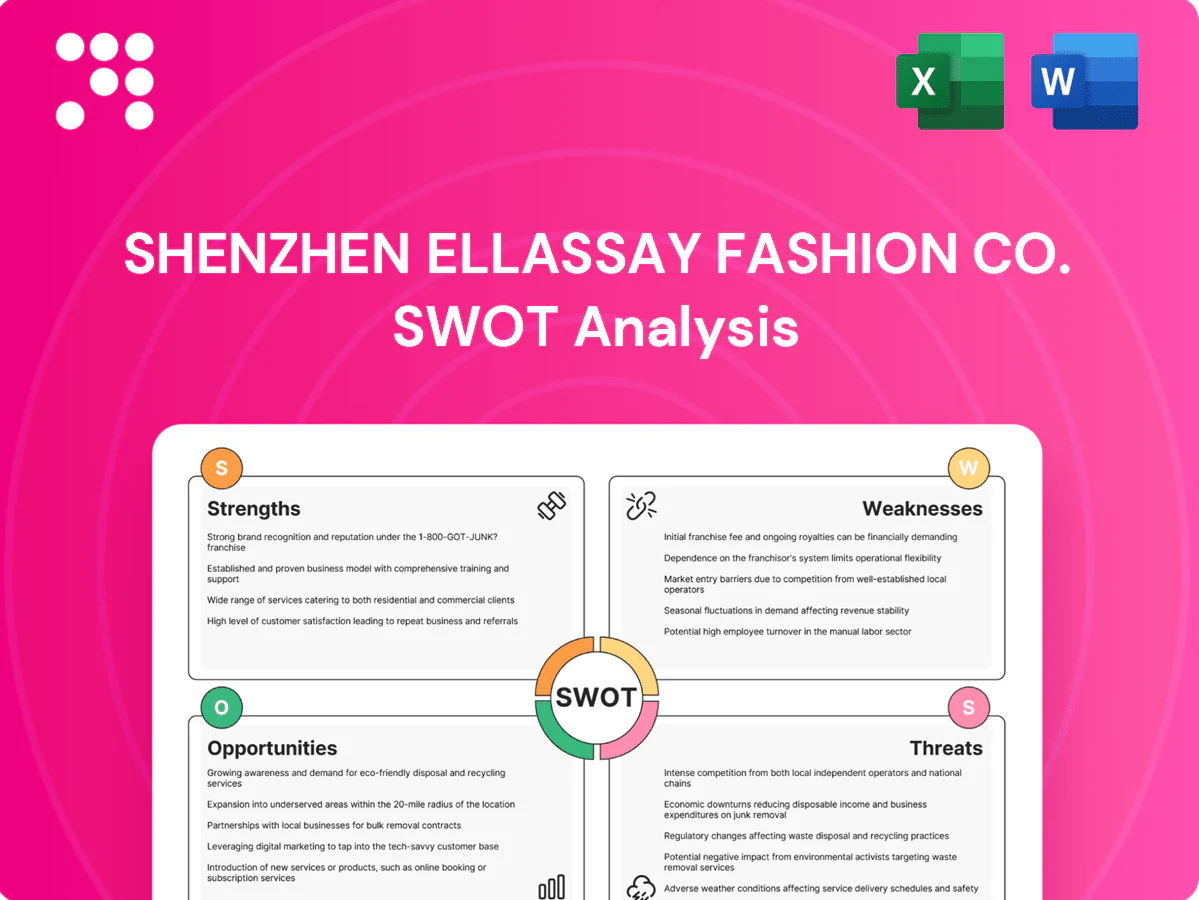
This is a real excerpt from the complete Shenzhen Ellassay Fashion Co. SWOT analysis you'll receive upon purchase—no surprises, just professional quality. The preview below is taken directly from the full report; buy now to unlock the entire, editable version. The complete document is structured, detailed, and ready for immediate download after payment.

Original: $10.00
-65%$10.00
$3.50Product Information
Product Information
Shipping & Returns
Shipping & Returns
Description
Elevate Your Analysis with the Complete SWOT Report
Shenzhen Ellassay Fashion Co. combines strong brand recognition in China and premium retail partnerships with design-driven product lines, but faces margin pressure from rising costs and intense fast-fashion competition. Growth opportunities include overseas expansion and digital channels, while supply-chain risks and evolving consumer tastes are threats. Discover the full SWOT analysis to access a professionally written, editable report and Excel matrix for strategic planning and investment decisions.
Strengths
Multi-brand premium portfolio
Managing ELLASSAY alongside acquired labels Laurel, IRO and Vivienne Tam diversifies aesthetics and price points, broadening appeal across multiple affluent female segments. The multi‑brand mix smooths brand‑specific sales cycles and seasonal volatility. Cross‑brand know‑how drives shared design, merchandising and marketing synergies that improve unit economics and speed-to-market.
Strong brand management
Ellassay’s clear positioning in sophisticated, contemporary womenswear supports pricing power in China’s apparel market, which exceeded US$280bn in 2023. Consistent storytelling elevates perceived value and drives loyalty, reflected in higher repeat-rate channels. Localized campaigns adapt global cues to Chinese tastes, boosting conversion. End-to-end brand stewardship improves sell-through and margin mix through tighter inventory control.
Integrated design-to-retail model
Integrated design-to-retail control at Shenzhen Ellassay compresses product development, sourcing and retail cycles, shortening time-to-market and enabling rapid replenishment. Vertical integration gives tighter quality assurance and clearer cost visibility across the value chain. Faster feedback loops from stores support capsule drops and trend-right assortments, improving responsiveness to consumer demand.
Omnichannel retail footprint
Omnichannel retail footprint spans boutiques, department store counters and digital channels, meeting customers where they shop and boosting conversion through unified inventory that lowers stockouts and shortens fulfillment time. Integrated online-offline services like click-and-collect and VIP styling enhance retention, while multi-touchpoint data strengthens CRM and personalization.
- Presence across boutiques, counters, digital
- Unified inventory improves availability
- Click-and-collect and VIP styling
- Multi-touch data fuels CRM
China market insight
Deep operating experience in China shapes fit, sizing and occasionwear for domestic consumers, leveraging the world’s largest apparel market; local supply ecosystems enable rapid festival and promotion responsiveness, and brand equity is reinforced by domestic fashion influence with online apparel share near 30% in 2024.
- Fit & assortment tuned to China
- Local supply = agility for festivals
- Domestic brand equity boost
- Optimize partnerships by city tier
Multi-brand womenswear portfolio in China leverages vertical integration and omnichannel margins
Multi-brand portfolio (Ellassay, Laurel, IRO, Vivienne Tam) broadens appeal and smooths seasonality, driving cross-brand synergies. Strong positioning in contemporary womenswear supports pricing power in China’s >US$280bn apparel market (2023) and benefits from ~30% online apparel share (2024). Vertical integration and omnichannel retail shorten lead times and improve margins.
| Metric | Value |
|---|---|
| China apparel market (2023) | US$280bn+ |
| Online apparel share (2024) | ~30% |
| Owned brands | 4 |
What is included in the product
Detailed Word Document
Provides a concise SWOT overview of Shenzhen Ellassay Fashion Co., highlighting its core strengths and weaknesses, identifying market opportunities and external threats, and framing strategic priorities to support competitive positioning and sustainable growth.
Customizable Excel Spreadsheet
Provides a concise SWOT matrix tailored to Shenzhen Ellassay Fashion Co., enabling rapid alignment of strategy to address supply-chain bottlenecks and brand positioning pain points.
Weaknesses
High China exposure
Revenue is concentrated in mainland China—per the 2024 annual report international sales remained a single-digit share—heightening sensitivity to local demand swings. Pandemic aftereffects and periodic footfall dips have pressured same-store comps. Shifts in local licensing or retail policy can disrupt store operations. International diversification is still nascent.
Fashion and inventory risk
Trend volatility raises markdown risk and inventory obsolescence, with frequent style churn forcing deeper discounts and write-downs across seasons.
Managing a wider brand slate complicates buy depths and size curves, increasing the chance of missed reads that cascade through subsequent collections.
Missed demand signals and slow movers can tie up working capital, pressuring cash flow and margin recovery during peak replenishment periods.
Integration complexity
Acquired international brands require tight alignment on design calendars and sourcing, yet differing brand DNAs complicate assortment planning and inventory turn. Marketing tone needs careful localization to avoid diluting brand equity while preserving premium positioning. Systems integration adds measurable cost and execution risk—Harvard Business Review estimates roughly 70% of M&A fail to capture expected synergies due to integration challenges.
Cost-intensive retail model
Premium flagship stores, high-end visual merchandising and elevated service standards drive substantial fixed costs, squeezing margins when traffic softens; lease escalations and ongoing staff training intensify cash-flow pressure during downturns. Maintaining a polished brand image restricts discounting flexibility, forcing reliance on steady same-store sales to spread SG&A and protect profitability.
- High fixed costs from premium retail
- Lease escalation and training burden in down cycles
- Limited discounting to preserve brand
- SG&A leverage needs steady same-store growth
Narrow category focus
Shenzhen Ellassay remains heavily concentrated in women’s apparel and accessories, with the 2024 annual report indicating the segment drives the bulk of group revenue; this limits cross-category hedging and leaves it behind peers with menswear or kidswear adjacencies. Heavy exposure to occasion and officewear raises sensitivity to cyclical demand, while moves into beauty and lifestyle are still nascent.
- Concentration: women's apparel dominates 2024 revenue mix
- Adjacency gap: limited menswear/kidswear vs peers
- Cyclicality: office/occasion exposure amplifies swings
- Diversification: beauty/lifestyle at early stage
China-dependent apparel group faces margin squeeze, category concentration and M&A risk
Revenue remains China‑centric with international sales a single‑digit share in 2024, raising demand concentration risk. High fixed retail and premium service costs compress margins when traffic falls, limiting discount flexibility. Product and category concentration in women's apparel drives most 2024 revenue and constrains cross‑category hedging; M&A integration risk (~70% failure cited by HBR) adds execution exposure.
| Weakness | 2024 metric/fact |
|---|---|
| Geographic concentration | International sales: single‑digit share (2024 annual report) |
| Category concentration | Women's apparel drives majority of group revenue (2024 annual report) |
| M&A/integration risk | ~70% fail to capture expected synergies (HBR) |
What You See Is What You Get
Shenzhen Ellassay Fashion Co. SWOT Analysis
This is a real excerpt from the complete Shenzhen Ellassay Fashion Co. SWOT analysis you'll receive upon purchase—no surprises, just professional quality. The preview below is taken directly from the full report; buy now to unlock the entire, editable version. The complete document is structured, detailed, and ready for immediate download after payment.