Elekta SWOT Analysis

Dive Deeper Into the Company’s Strategic Blueprint
Elekta's SWOT reveals strengths in precision oncology technology, a global installed base and strong R&D, alongside weaknesses like pricing pressure and regulatory exposure. Opportunities include AI-guided therapy and emerging markets, while competition and supply-chain risks threaten growth. Purchase the full SWOT for a downloadable, editable report with actionable strategic recommendations.
Strengths

Comprehensive oncology portfolio
Elekta’s comprehensive oncology portfolio spans linacs, MR-guided therapy, radiosurgery (Gamma Knife), brachytherapy and oncology software, enabling end-to-end workflow integration from planning to delivery. This breadth increases account stickiness and cross-sell potential, diversifying revenue across hardware, software and services; Elekta reported SEK 21.1 billion in net sales in 2024, reflecting mixed growth across segments.
Precision and clinical outcomes focus
Technologies like the Unity MR‑Linac and Versa linacs are optimized for accuracy and conformity, enhancing tumor targeting while sparing healthy tissue. Elekta reports over 6,000 systems installed worldwide, and Unity enables online adaptive stereotactic treatments. A strong clinical evidence base underpins adoption, aligning outcomes focus with value‑based care priorities.

Large installed base and service revenues
With a global footprint in over 120 countries, Elekta generates recurring revenue from service, maintenance and software licenses tied to an installed base of thousands of radiotherapy and radiosurgery systems. These installed systems drive periodic upgrades and replacements across multi-year cycles, enhancing revenue visibility and improving margin mix by shifting toward higher-margin service streams. Lifecycle support deepens customer relationships and supports renewal rates.

Integrated oncology software ecosystem
- Coverage: 120+ countries
- Benefit: fewer manual handoffs, lower error rates
- Outcome: enables adaptive therapy and analytics
- Risk: higher switching costs due to software lock-in
Innovation in MR-guided radiotherapy
Elekta’s MR-guided radiotherapy (Unity, FDA-cleared 2018) uniquely combines MRI with linear accelerators to enable soft-tissue visualization during treatment, supporting adaptive planning and tighter margins for dose escalation. Clinical partnerships with major cancer centers have broadened indications and generated growing peer-reviewed evidence, positioning Elekta at the premium end of the market.
- Distinctive MRI+linac platform
- Real-time adaptive planning, tighter margins
- Strong clinical partnerships and evidence
Oncology portfolio drives SEK21.1bn, 6,000+ systems
Elekta’s broad oncology portfolio and integrated software drive cross‑sell and stickiness, supporting SEK 21.1 billion net sales in 2024 and ~6,000 installed systems globally. Unity MR‑Linac and Versa linacs provide adaptive, high‑precision therapy with growing clinical evidence and FDA clearance for Unity (2018). Global presence in 120+ countries yields recurring service/software revenue and higher-margin lifecycle streams.
| Metric | Value |
|---|---|
| Net sales 2024 | SEK 21.1 bn |
| Installed systems | ~6,000+ |
| Geographic reach | 120+ countries |
| Unity FDA clearance | 2018 |
What is included in the product
 Detailed Word Document
Delivers a strategic overview of Elekta’s internal and external business factors, outlining strengths, weaknesses, opportunities and threats to assess competitive position and growth drivers amid regulatory, technological, and market risks.

 Customizable Excel Spreadsheet
Provides a concise Elekta SWOT matrix for rapid alignment of strategy and stakeholder communication. Editable format enables quick updates to reflect regulatory, technological, or market shifts for faster decision-making.
Weaknesses

High capital intensity, long sales cycles
Large Elekta systems have typical ASPs of $1–5 million, so sales require lengthy budgeting, tenders and approvals. Revenue timing becomes lumpy and highly sensitive to macro swings and healthcare capital spending. Working capital needs can spike around multi‑million deliveries, pressuring cash conversion and leverage. These dynamics complicate forecasting for management and investors.
Product complexity and training burden
Advanced Elekta systems require extensive commissioning (commonly 2–6 weeks per site) and clinician training, creating steep learning curves that can delay adoption and reduce realized throughput by weeks to months; published industry data show implementation timelines often exceed initial estimates. Post-sale support costs rise with system complexity, with service and consumables representing up to ~40% of medtech aftermarket revenue, and workflow disruptions during transitions can materially risk customer satisfaction and retention.

Software interoperability and legacy constraints
Hospitals commonly operate mixed-vendor radiotherapy ecosystems, complicating integration and making standardization of legacy OIS/TPS deployments across sites difficult. Interface incompatibilities reduce data liquidity and automation, impeding AI-enabled and adaptive workflows. These interoperability constraints can lengthen deployment cycles and raise implementation costs for advanced features.

Exposure to reimbursement and tender pricing
RT equipment purchases hinge on reimbursement stability and tariff structures, and changes in national reimbursement have in 2024 delayed several hospital orders, squeezing Elekta revenue timing. Competitive tenders often force discounts of 10–25%, pressuring margins and driving recurring discounting. Public procurement rules limit pricing flexibility and can defer or cancel orders when criteria shift.
- Reimbursement-dependent sales
- Tender-driven margin erosion
- Public procurement limits pricing
Supply chain and installation dependencies
Complex, precision components and global logistics create bottleneck risks for Elekta, with component lead times commonly stretching 3–9 months and rare parts causing project holds; site readiness and specialized shielding frequently add weeks to months, driving cost variability. Any installation delay cascades into deferred revenue recognition and margin pressure, while service quality hinges on availability of trained field engineers in local markets.
High ASPs $1-5M, long lead times 3-9 months and ~40% aftermarket squeeze margins
High ASPs ($1–5M) make revenue lumpy and sensitive to 2024 reimbursement delays. Commissioning/training (2–6 weeks) and complex service raise post-sale costs (aftermarket ~40%) and slow adoption. Tender-driven discounts (10–25%) and component lead times (3–9 months) pressure margins and cash conversion.
| Metric | Value |
|---|---|
| ASP | $1–5M |
| Commissioning | 2–6 weeks |
| Aftermarket | ~40% |
| Discounts | 10–25% |
| Lead times | 3–9 months |
Same Document Delivered
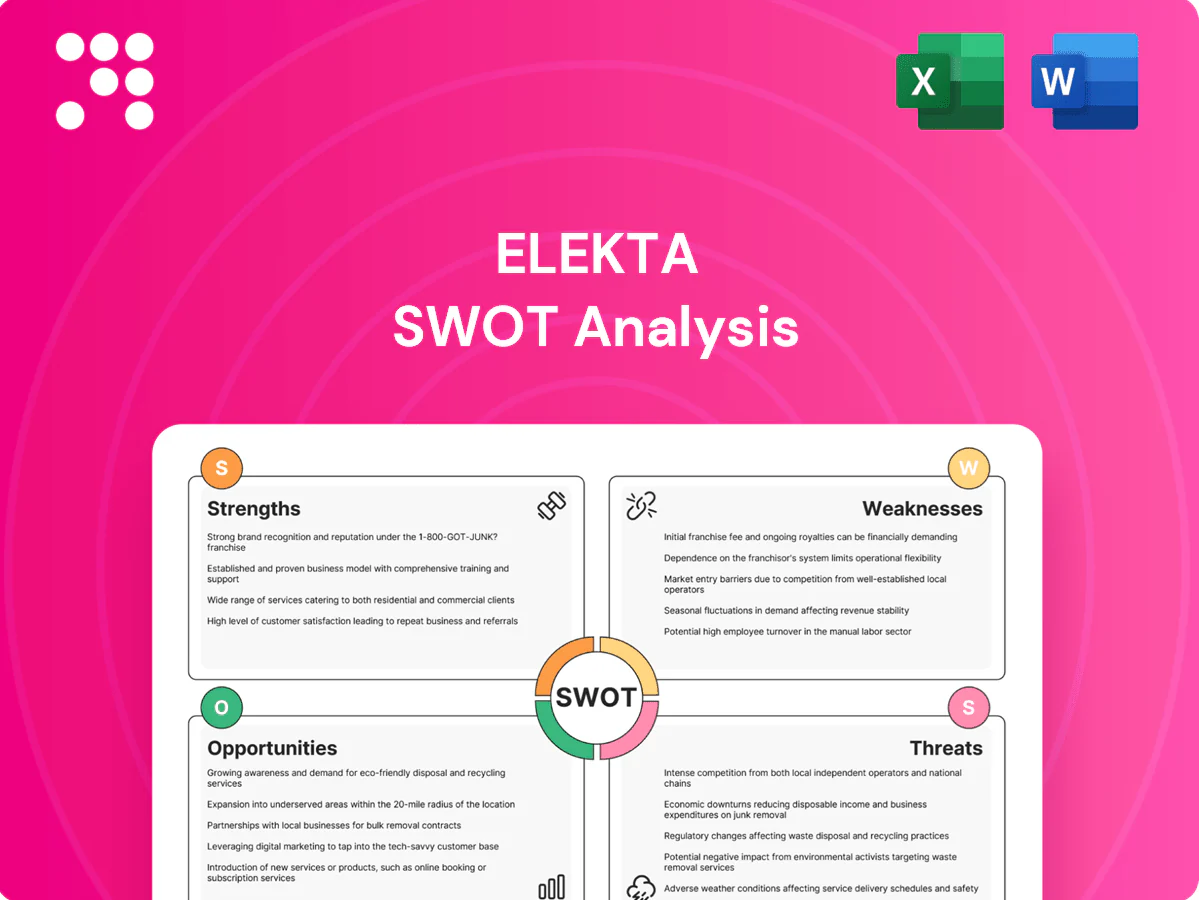
Elekta SWOT Analysis
This is the actual Elekta SWOT analysis document you’ll receive upon purchase—no surprises, just professional quality. The preview below is taken directly from the full report you'll get; purchase unlocks the entire in-depth and editable version. You’re viewing the real analysis file; the complete, ready-to-use document becomes available immediately after checkout.

Original: $10.00
-65%$10.00
$3.50Product Information
Product Information
Shipping & Returns
Shipping & Returns
Description
Dive Deeper Into the Company’s Strategic Blueprint
Elekta's SWOT reveals strengths in precision oncology technology, a global installed base and strong R&D, alongside weaknesses like pricing pressure and regulatory exposure. Opportunities include AI-guided therapy and emerging markets, while competition and supply-chain risks threaten growth. Purchase the full SWOT for a downloadable, editable report with actionable strategic recommendations.
Strengths
Comprehensive oncology portfolio
Elekta’s comprehensive oncology portfolio spans linacs, MR-guided therapy, radiosurgery (Gamma Knife), brachytherapy and oncology software, enabling end-to-end workflow integration from planning to delivery. This breadth increases account stickiness and cross-sell potential, diversifying revenue across hardware, software and services; Elekta reported SEK 21.1 billion in net sales in 2024, reflecting mixed growth across segments.
Precision and clinical outcomes focus
Technologies like the Unity MR‑Linac and Versa linacs are optimized for accuracy and conformity, enhancing tumor targeting while sparing healthy tissue. Elekta reports over 6,000 systems installed worldwide, and Unity enables online adaptive stereotactic treatments. A strong clinical evidence base underpins adoption, aligning outcomes focus with value‑based care priorities.
Large installed base and service revenues
With a global footprint in over 120 countries, Elekta generates recurring revenue from service, maintenance and software licenses tied to an installed base of thousands of radiotherapy and radiosurgery systems. These installed systems drive periodic upgrades and replacements across multi-year cycles, enhancing revenue visibility and improving margin mix by shifting toward higher-margin service streams. Lifecycle support deepens customer relationships and supports renewal rates.
Integrated oncology software ecosystem
- Coverage: 120+ countries
- Benefit: fewer manual handoffs, lower error rates
- Outcome: enables adaptive therapy and analytics
- Risk: higher switching costs due to software lock-in
Innovation in MR-guided radiotherapy
Elekta’s MR-guided radiotherapy (Unity, FDA-cleared 2018) uniquely combines MRI with linear accelerators to enable soft-tissue visualization during treatment, supporting adaptive planning and tighter margins for dose escalation. Clinical partnerships with major cancer centers have broadened indications and generated growing peer-reviewed evidence, positioning Elekta at the premium end of the market.
- Distinctive MRI+linac platform
- Real-time adaptive planning, tighter margins
- Strong clinical partnerships and evidence
Oncology portfolio drives SEK21.1bn, 6,000+ systems
Elekta’s broad oncology portfolio and integrated software drive cross‑sell and stickiness, supporting SEK 21.1 billion net sales in 2024 and ~6,000 installed systems globally. Unity MR‑Linac and Versa linacs provide adaptive, high‑precision therapy with growing clinical evidence and FDA clearance for Unity (2018). Global presence in 120+ countries yields recurring service/software revenue and higher-margin lifecycle streams.
| Metric | Value |
|---|---|
| Net sales 2024 | SEK 21.1 bn |
| Installed systems | ~6,000+ |
| Geographic reach | 120+ countries |
| Unity FDA clearance | 2018 |
What is included in the product
Detailed Word Document
Delivers a strategic overview of Elekta’s internal and external business factors, outlining strengths, weaknesses, opportunities and threats to assess competitive position and growth drivers amid regulatory, technological, and market risks.
Customizable Excel Spreadsheet
Provides a concise Elekta SWOT matrix for rapid alignment of strategy and stakeholder communication. Editable format enables quick updates to reflect regulatory, technological, or market shifts for faster decision-making.
Weaknesses
High capital intensity, long sales cycles
Large Elekta systems have typical ASPs of $1–5 million, so sales require lengthy budgeting, tenders and approvals. Revenue timing becomes lumpy and highly sensitive to macro swings and healthcare capital spending. Working capital needs can spike around multi‑million deliveries, pressuring cash conversion and leverage. These dynamics complicate forecasting for management and investors.
Product complexity and training burden
Advanced Elekta systems require extensive commissioning (commonly 2–6 weeks per site) and clinician training, creating steep learning curves that can delay adoption and reduce realized throughput by weeks to months; published industry data show implementation timelines often exceed initial estimates. Post-sale support costs rise with system complexity, with service and consumables representing up to ~40% of medtech aftermarket revenue, and workflow disruptions during transitions can materially risk customer satisfaction and retention.
Software interoperability and legacy constraints
Hospitals commonly operate mixed-vendor radiotherapy ecosystems, complicating integration and making standardization of legacy OIS/TPS deployments across sites difficult. Interface incompatibilities reduce data liquidity and automation, impeding AI-enabled and adaptive workflows. These interoperability constraints can lengthen deployment cycles and raise implementation costs for advanced features.
Exposure to reimbursement and tender pricing
RT equipment purchases hinge on reimbursement stability and tariff structures, and changes in national reimbursement have in 2024 delayed several hospital orders, squeezing Elekta revenue timing. Competitive tenders often force discounts of 10–25%, pressuring margins and driving recurring discounting. Public procurement rules limit pricing flexibility and can defer or cancel orders when criteria shift.
- Reimbursement-dependent sales
- Tender-driven margin erosion
- Public procurement limits pricing
Supply chain and installation dependencies
Complex, precision components and global logistics create bottleneck risks for Elekta, with component lead times commonly stretching 3–9 months and rare parts causing project holds; site readiness and specialized shielding frequently add weeks to months, driving cost variability. Any installation delay cascades into deferred revenue recognition and margin pressure, while service quality hinges on availability of trained field engineers in local markets.
High ASPs $1-5M, long lead times 3-9 months and ~40% aftermarket squeeze margins
High ASPs ($1–5M) make revenue lumpy and sensitive to 2024 reimbursement delays. Commissioning/training (2–6 weeks) and complex service raise post-sale costs (aftermarket ~40%) and slow adoption. Tender-driven discounts (10–25%) and component lead times (3–9 months) pressure margins and cash conversion.
| Metric | Value |
|---|---|
| ASP | $1–5M |
| Commissioning | 2–6 weeks |
| Aftermarket | ~40% |
| Discounts | 10–25% |
| Lead times | 3–9 months |
Same Document Delivered
Elekta SWOT Analysis
This is the actual Elekta SWOT analysis document you’ll receive upon purchase—no surprises, just professional quality. The preview below is taken directly from the full report you'll get; purchase unlocks the entire in-depth and editable version. You’re viewing the real analysis file; the complete, ready-to-use document becomes available immediately after checkout.