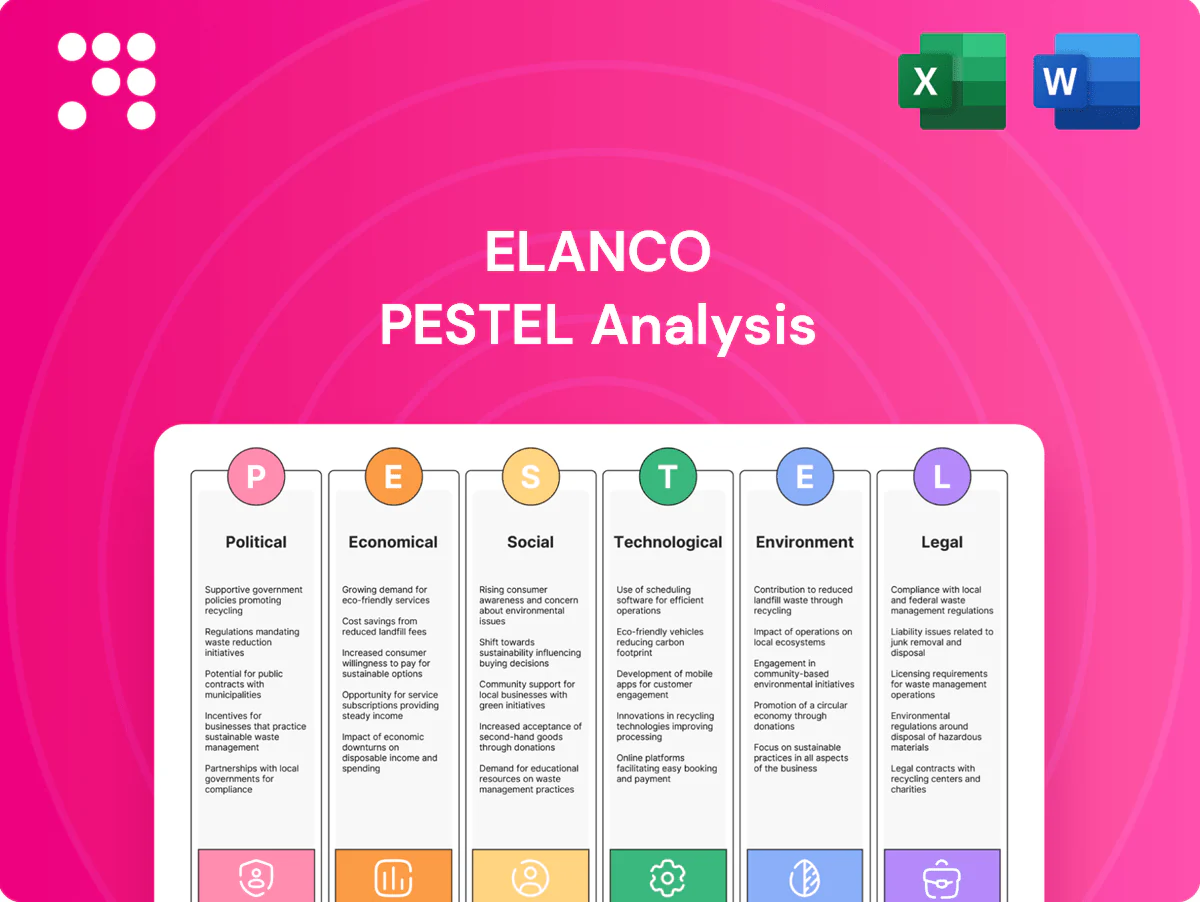
Elanco PESTLE Analysis

Make Smarter Strategic Decisions with a Complete PESTEL View
Unlock how political shifts, economic trends, and technological advances are shaping Elanco’s future in our concise PESTLE snapshot. This analysis highlights risks and growth levers to inform your investment or strategic plan. Buy the full PESTLE for the complete, actionable breakdown—ready to download now.
Political factors

Regulatory oversight of animal medicines
National agencies such as FDA-CVM and EMA dictate approval timelines, trial design, and pharmacovigilance for vaccines, parasiticides and antimicrobials, and shifts toward precautionary standards or tighter residue limits increase development costs and time-to-market. Harmonization efforts via VICH can streamline multi-country launches, while stalled cooperation fragments access. Elanco must allocate lobbying and compliance resources to monitor and adapt to policy shifts.
Antimicrobial resistance (AMR) policies
Global AMR action plans are tightening veterinary oversight—notably EU Regulation 2019/6 (in force Jan 2022) banning routine prophylactic group treatments and the US Veterinary Feed Directive since 2017—reducing antibiotic volumes in some categories. Restrictions favor innovation: the animal vaccines and diagnostics segment has seen mid-single-digit CAGR recently, opening revenue upside for non-antibiotic solutions. Demonstrating stewardship and outcomes data strengthens regulator and customer trust, aligning firms with the FAO/WHO/OIE One Health Joint Plan of Action 2022–2026.

Agricultural subsidies and food security agendas
Government subsidies and food‑security agendas shape livestock herd sizes, vaccination rollout and national disease‑control budgets; OECD/WTO estimates show global agricultural support exceeded roughly 700 billion USD annually in the early 2020s, which sustains farm purchasing power. Food security priorities speed uptake of productivity‑enhancing health solutions, benefiting Elanco through greater demand for vaccines and therapeutics. Conversely, subsidy cuts or political instability can sharply reduce farm spending. Elanco gains from alignment with national herd‑health initiatives and public–private partnerships that expand market access.

Trade policies and biosecurity controls
Trade barriers—tariffs, import rules and disease-related movement bans—affect Elanco’s cross-border sales and logistics, with some agri tariffs reported up to 25% in key markets. Outbreaks trigger government-funded vaccination drives while disrupting distribution and causing volatile demand. Localization incentives have accelerated regional manufacturing; complying with trade blocs and sanitary/phytosanitary standards is essential for market continuity.
- Tariffs can reach 25% in select markets
- Disease outbreaks drive government vaccination spending and supply shocks
- Localization incentives expand regional production
- SPS compliance critical for uninterrupted trade
Public procurement and development programs
Donor-backed and government tenders for zoonotic disease prevention boost demand in emerging markets, with Elanco leveraging public programs to complement its ~USD 4.2B FY 2024 revenue drive into lower-margin tenders. Inclusion on national formularies scales volume but compresses pricing and margins, pressuring commercial portfolios.
Collaborations with ministries and NGOs extend access to smallholder farmers; transparent engagement and robust proof-of-impact data improve tender eligibility and reputational standing.
- Donor tenders: drive volume, pressure pricing
- National formularies: scale vs margin compression
- Ministry/NGO partnerships: access for smallholders
- Transparent data: improves eligibility and reputation
Stricter AMR rules and tariffs raise costs, favor vaccines/diagnostics, compress margins
Regulatory tightening (FDA‑CVM, EMA, VICH) and AMR rules (EU 2019/6, US VFD 2017) raise development/compliance costs while favoring vaccines/diagnostics; Elanco FY2024 revenue ~USD 4.2B; global ag support ~USD 700B (early 2020s); tariffs up to 25% disrupt trade. Donor tenders boost volume but compress margins; public partnerships expand smallholder reach.
| Metric | Value |
|---|---|
| Elanco FY2024 rev | ~USD 4.2B |
| Global ag support | ~USD 700B |
| Max tariffs | ~25% |
What is included in the product
 Detailed Word Document
Explores how Political, Economic, Social, Technological, Environmental and Legal factors specifically impact Elanco, combining current data and industry trends to identify risks and opportunities. Designed for executives and investors, it offers forward-looking insights and ready-to-use findings for strategy and funding decisions.

 Customizable Excel Spreadsheet
A concise Elanco PESTLE summary that isolates key external risks and opportunities for quick reference in meetings, easily dropped into slides or shared across teams to align strategy. Editable notes per region or business line make it a practical tool for planners and consultants to relieve research bottlenecks and accelerate decision-making.
Economic factors

Livestock cycles and commodity prices
Producer profitability, driven by feed costs (which eased roughly 15% from 2022 peaks by 2024) and meat/milk prices (beef prices rose about 10% in 2024), strongly dictates spend on health interventions; when margins tighten, elective treatments are often deferred. High input costs suppress uptake of premium parasiticides, while vaccines—lower elasticity—hold steadier demand. Elanco’s portfolio balance across species and value tiers smooths revenue through these cycles.
Pet ownership and premiumization
With 70% of US households owning pets and rising global humanization, demand for chronic care, vaccines and parasiticides is expanding; the global pet care market is forecast to grow at roughly 6% CAGR to 2030, supporting higher-margin products. Economic slowdowns push some owners toward generics or extended-dosing options, while subscription and wellness plans—increasingly adopted by clinics—help stabilize revenue across cycles. Geographic exposure to faster-growing markets such as China (near-double-digit growth in recent years) and Latin America provides structural uplift.

Inflation, FX, and interest rates
Input inflation (US CPI 3.4% in 2024) raises COGS for APIs, biologics media and packaging, squeezing margins. FX volatility—strong dollar in 2024–25—pressures reported revenue and import costs across Elanco’s global footprint. Higher policy rates (Fed funds 5.25–5.50% through 2024–25) elevate working capital and refinancing costs. Pricing power, hedging and efficiency programs become pivotal.

Channel consolidation and pricing pressure
Large distributors such as Patterson and Covetrus, plus corporate vet chains (Mars/VCA, NVA) and retailers (Petco, Walmart), exert strong bargaining power, squeezing Elanco on rebates, formulary placement and private-label competition that compress net pricing and margins.
- Channel concentration: top distributors and chains drive purchasing power
- Pricing pressure: rebates and formularies reduce net ASPs
- E-commerce/DTC: expands reach but lowers gross margin
- Defense: differentiated innovation and data-enabled services preserve value
Emerging markets growth and risk
Rising protein demand in Asia and Africa is driving livestock-health spend; IMF projects emerging-market growth ~4.0% in 2024, supporting volume gains, while HPAI outbreaks led to over 100 million poultry culled in 2022–23, creating episodic spikes and logistics strain. Credit constraints, currency volatility and political risk hinder collections and planning; tiered portfolios and localized manufacturing improve affordability and resilience.
- Demand: Asia/Africa protein growth
- Risk: credit, FX, political volatility
- Shock: >100M poultry culled (HPAI 2022–23)
- Mitigation: tiered portfolio + local manufacturing
Stricter AMR rules and tariffs raise costs, favor vaccines/diagnostics, compress margins
Producer margins (feed -15% vs 2022, beef +10% in 2024) drive spend; pet market CAGR ~6% to 2030 supports higher-margin care. Input inflation (US CPI 3.4% in 2024) and USD strength pressure COGS/revenue; Fed funds 5.25–5.50% raises financing costs. Emerging markets growth ~4% (2024) and HPAI >100M poultry culled (2022–23) create volume upside and episodic shocks.
| Metric | Value |
|---|---|
| Feed costs | -15% vs 2022 |
| Beef price 2024 | +10% |
| US CPI 2024 | 3.4% |
| Fed funds | 5.25–5.50% |
| Pet market CAGR | ~6% to 2030 |
| EM GDP 2024 | ~4% |
| HPAI impact | >100M culled |
Full Version Awaits
Elanco PESTLE Analysis
The preview shown here is the exact Elanco PESTLE Analysis you’ll receive after purchase—fully formatted and ready to use. This file contains the same content, structure, and professional layout visible in the preview, with no placeholders or teasers. After payment you’ll instantly download this finished, ready-to-apply document.

Original: $10.00
-65%$10.00
$3.50Product Information
Product Information
Shipping & Returns
Shipping & Returns
Description
Make Smarter Strategic Decisions with a Complete PESTEL View
Unlock how political shifts, economic trends, and technological advances are shaping Elanco’s future in our concise PESTLE snapshot. This analysis highlights risks and growth levers to inform your investment or strategic plan. Buy the full PESTLE for the complete, actionable breakdown—ready to download now.
Political factors
Regulatory oversight of animal medicines
National agencies such as FDA-CVM and EMA dictate approval timelines, trial design, and pharmacovigilance for vaccines, parasiticides and antimicrobials, and shifts toward precautionary standards or tighter residue limits increase development costs and time-to-market. Harmonization efforts via VICH can streamline multi-country launches, while stalled cooperation fragments access. Elanco must allocate lobbying and compliance resources to monitor and adapt to policy shifts.
Antimicrobial resistance (AMR) policies
Global AMR action plans are tightening veterinary oversight—notably EU Regulation 2019/6 (in force Jan 2022) banning routine prophylactic group treatments and the US Veterinary Feed Directive since 2017—reducing antibiotic volumes in some categories. Restrictions favor innovation: the animal vaccines and diagnostics segment has seen mid-single-digit CAGR recently, opening revenue upside for non-antibiotic solutions. Demonstrating stewardship and outcomes data strengthens regulator and customer trust, aligning firms with the FAO/WHO/OIE One Health Joint Plan of Action 2022–2026.
Agricultural subsidies and food security agendas
Government subsidies and food‑security agendas shape livestock herd sizes, vaccination rollout and national disease‑control budgets; OECD/WTO estimates show global agricultural support exceeded roughly 700 billion USD annually in the early 2020s, which sustains farm purchasing power. Food security priorities speed uptake of productivity‑enhancing health solutions, benefiting Elanco through greater demand for vaccines and therapeutics. Conversely, subsidy cuts or political instability can sharply reduce farm spending. Elanco gains from alignment with national herd‑health initiatives and public–private partnerships that expand market access.
Trade policies and biosecurity controls
Trade barriers—tariffs, import rules and disease-related movement bans—affect Elanco’s cross-border sales and logistics, with some agri tariffs reported up to 25% in key markets. Outbreaks trigger government-funded vaccination drives while disrupting distribution and causing volatile demand. Localization incentives have accelerated regional manufacturing; complying with trade blocs and sanitary/phytosanitary standards is essential for market continuity.
- Tariffs can reach 25% in select markets
- Disease outbreaks drive government vaccination spending and supply shocks
- Localization incentives expand regional production
- SPS compliance critical for uninterrupted trade
Public procurement and development programs
Donor-backed and government tenders for zoonotic disease prevention boost demand in emerging markets, with Elanco leveraging public programs to complement its ~USD 4.2B FY 2024 revenue drive into lower-margin tenders. Inclusion on national formularies scales volume but compresses pricing and margins, pressuring commercial portfolios.
Collaborations with ministries and NGOs extend access to smallholder farmers; transparent engagement and robust proof-of-impact data improve tender eligibility and reputational standing.
- Donor tenders: drive volume, pressure pricing
- National formularies: scale vs margin compression
- Ministry/NGO partnerships: access for smallholders
- Transparent data: improves eligibility and reputation
Stricter AMR rules and tariffs raise costs, favor vaccines/diagnostics, compress margins
Regulatory tightening (FDA‑CVM, EMA, VICH) and AMR rules (EU 2019/6, US VFD 2017) raise development/compliance costs while favoring vaccines/diagnostics; Elanco FY2024 revenue ~USD 4.2B; global ag support ~USD 700B (early 2020s); tariffs up to 25% disrupt trade. Donor tenders boost volume but compress margins; public partnerships expand smallholder reach.
| Metric | Value |
|---|---|
| Elanco FY2024 rev | ~USD 4.2B |
| Global ag support | ~USD 700B |
| Max tariffs | ~25% |
What is included in the product
Detailed Word Document
Explores how Political, Economic, Social, Technological, Environmental and Legal factors specifically impact Elanco, combining current data and industry trends to identify risks and opportunities. Designed for executives and investors, it offers forward-looking insights and ready-to-use findings for strategy and funding decisions.
Customizable Excel Spreadsheet
A concise Elanco PESTLE summary that isolates key external risks and opportunities for quick reference in meetings, easily dropped into slides or shared across teams to align strategy. Editable notes per region or business line make it a practical tool for planners and consultants to relieve research bottlenecks and accelerate decision-making.
Economic factors
Livestock cycles and commodity prices
Producer profitability, driven by feed costs (which eased roughly 15% from 2022 peaks by 2024) and meat/milk prices (beef prices rose about 10% in 2024), strongly dictates spend on health interventions; when margins tighten, elective treatments are often deferred. High input costs suppress uptake of premium parasiticides, while vaccines—lower elasticity—hold steadier demand. Elanco’s portfolio balance across species and value tiers smooths revenue through these cycles.
Pet ownership and premiumization
With 70% of US households owning pets and rising global humanization, demand for chronic care, vaccines and parasiticides is expanding; the global pet care market is forecast to grow at roughly 6% CAGR to 2030, supporting higher-margin products. Economic slowdowns push some owners toward generics or extended-dosing options, while subscription and wellness plans—increasingly adopted by clinics—help stabilize revenue across cycles. Geographic exposure to faster-growing markets such as China (near-double-digit growth in recent years) and Latin America provides structural uplift.
Inflation, FX, and interest rates
Input inflation (US CPI 3.4% in 2024) raises COGS for APIs, biologics media and packaging, squeezing margins. FX volatility—strong dollar in 2024–25—pressures reported revenue and import costs across Elanco’s global footprint. Higher policy rates (Fed funds 5.25–5.50% through 2024–25) elevate working capital and refinancing costs. Pricing power, hedging and efficiency programs become pivotal.
Channel consolidation and pricing pressure
Large distributors such as Patterson and Covetrus, plus corporate vet chains (Mars/VCA, NVA) and retailers (Petco, Walmart), exert strong bargaining power, squeezing Elanco on rebates, formulary placement and private-label competition that compress net pricing and margins.
- Channel concentration: top distributors and chains drive purchasing power
- Pricing pressure: rebates and formularies reduce net ASPs
- E-commerce/DTC: expands reach but lowers gross margin
- Defense: differentiated innovation and data-enabled services preserve value
Emerging markets growth and risk
Rising protein demand in Asia and Africa is driving livestock-health spend; IMF projects emerging-market growth ~4.0% in 2024, supporting volume gains, while HPAI outbreaks led to over 100 million poultry culled in 2022–23, creating episodic spikes and logistics strain. Credit constraints, currency volatility and political risk hinder collections and planning; tiered portfolios and localized manufacturing improve affordability and resilience.
- Demand: Asia/Africa protein growth
- Risk: credit, FX, political volatility
- Shock: >100M poultry culled (HPAI 2022–23)
- Mitigation: tiered portfolio + local manufacturing
Stricter AMR rules and tariffs raise costs, favor vaccines/diagnostics, compress margins
Producer margins (feed -15% vs 2022, beef +10% in 2024) drive spend; pet market CAGR ~6% to 2030 supports higher-margin care. Input inflation (US CPI 3.4% in 2024) and USD strength pressure COGS/revenue; Fed funds 5.25–5.50% raises financing costs. Emerging markets growth ~4% (2024) and HPAI >100M poultry culled (2022–23) create volume upside and episodic shocks.
| Metric | Value |
|---|---|
| Feed costs | -15% vs 2022 |
| Beef price 2024 | +10% |
| US CPI 2024 | 3.4% |
| Fed funds | 5.25–5.50% |
| Pet market CAGR | ~6% to 2030 |
| EM GDP 2024 | ~4% |
| HPAI impact | >100M culled |
Full Version Awaits
Elanco PESTLE Analysis
The preview shown here is the exact Elanco PESTLE Analysis you’ll receive after purchase—fully formatted and ready to use. This file contains the same content, structure, and professional layout visible in the preview, with no placeholders or teasers. After payment you’ll instantly download this finished, ready-to-apply document.