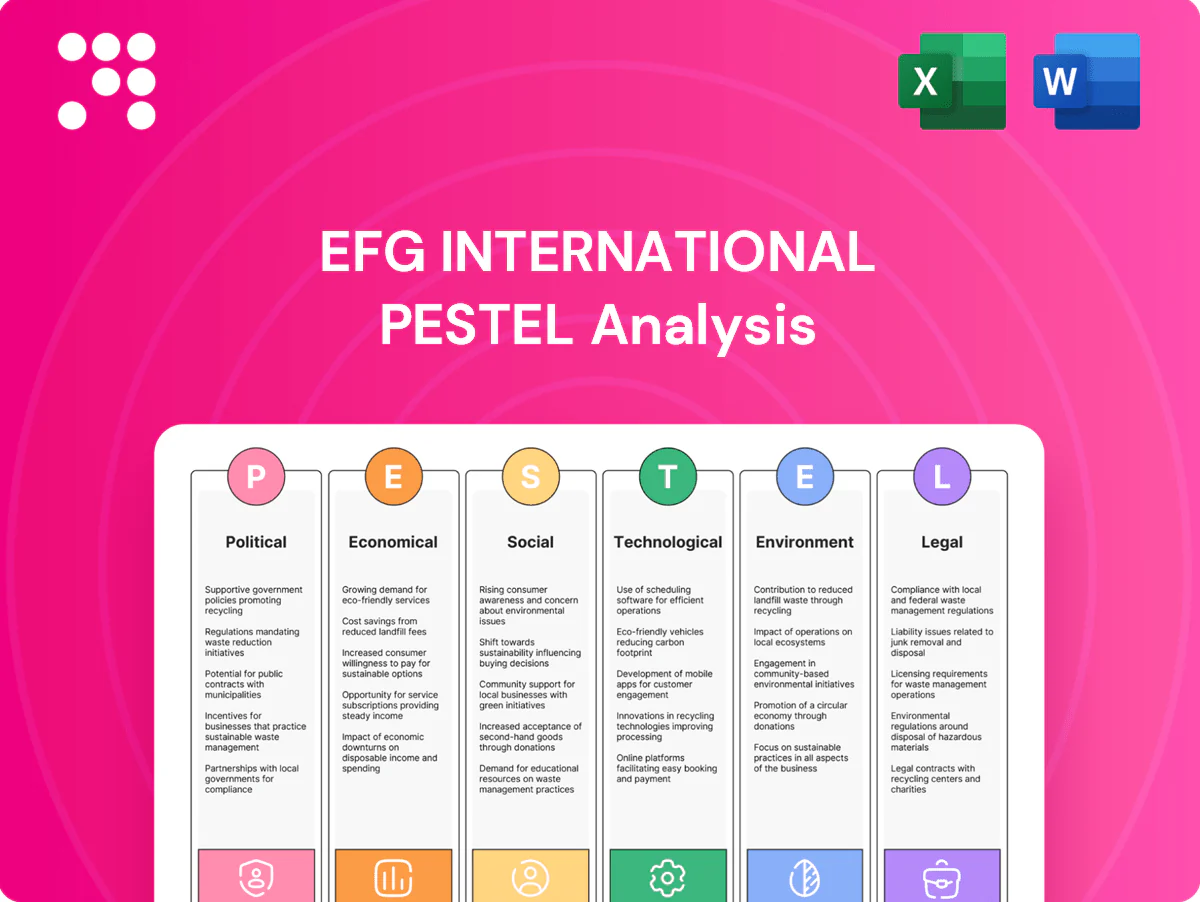
EFG International PESTLE Analysis

Make Smarter Strategic Decisions with a Complete PESTEL View
Gain a strategic edge with our PESTLE analysis of EFG International — uncover how political shifts, economic cycles, regulatory pressures and technological change will shape its trajectory. Ideal for investors and advisors, this concise briefing highlights key risks and opportunities. Purchase the full report for the complete, actionable breakdown.
Political factors

Swiss political stability
EFG benefits from Switzerland’s stable governance and strong institutions—Moody’s rated Switzerland Aa2 (stable) in 2024—while prudent fiscal policy keeps general government gross debt near 40% of GDP (2024), supporting long-term private banking strategies. Predictable policymaking aids multi-year wealth management plans, yet shifts in Swiss–EU relations can affect market access and regulatory alignment; active dialogue with policymakers helps anticipate change.
Sanctions and geopolitics
Expanding sanctions regimes since 2022 have increased onboarding, asset-servicing and transaction-screening burdens, with global consolidated sanctions lists numbering in the thousands. Exposure to clients in sanctioned or high-risk jurisdictions raises compliance complexity and cost, often requiring enhanced due diligence. Rapid policy shifts in 2022–2025 demand agile sanctions governance and investigative capacity to avoid severe penalties and reputational damage.

Cross-border tax diplomacy
Bilateral tax treaties and over 3,000 bilateral agreements plus 164 Global Forum members for automatic information exchange shape client booking and structuring, while the OECD Pillar Two adoption by 136 jurisdictions narrows tax-rate gaps. Transparency reduces secrecy advantages but boosts legitimacy and compliance costs; EFG must align with these standards and innovate advisory services as jurisdictional arbitrage shrinks.

Political scrutiny of wealth
Populist narratives have intensified scrutiny of offshore wealth and private banks, with policymakers in several EU states proposing wealth-tax and stricter disclosure measures during 2023–24; the OECD Common Reporting Standard now covers 120+ jurisdictions, increasing cross-border transparency. Heightened oversight is raising compliance workloads and costs for private banks, so proactive communication on societal contributions can mitigate reputational backlash.
- Populist scrutiny up → policy proposals (2023–24)
- CRS: 120+ jurisdictions
- Higher compliance burden → increased costs
- Proactive societal reporting mitigates risk
EM political risk exposure
Many HNW clients of EFG originate from emerging markets where policy volatility can trigger capital controls, expropriation or regime shifts that disrupt cross‑border flows; diversified booking centers and contingency planning reduce concentration risk.
- Diversified booking centers
- Contingency planning & onboarding
- Political risk insurance & client protection
Swiss stability vs rising compliance: banks face higher KYC, sanctions and global tax rules
Switzerland's stable governance (Moody's Aa2 stable, 2024) and ~40% government debt (2024) support EFG's private-banking model.
Rising sanctions (consolidated lists in the thousands) and CRS coverage (120+ jurisdictions) increase compliance costs and KYC burdens.
OECD Pillar Two (136 jurisdictions) and 164 Global Forum members reduce tax arbitrage; emerging-market capital-controls risk mandates diversified booking centers.
| Metric | 2024/25 |
|---|---|
| Switzerland rating | Aa2 (Moody's, 2024) |
| Govt debt | ~40% GDP (2024) |
| CRS coverage | 120+ jurisdictions |
| Pillar Two adopters | 136 jurisdictions |
| Global Forum members | 164 |
What is included in the product
 Detailed Word Document
Provides a concise PESTLE review of EFG International—assessing Political, Economic, Social, Technological, Environmental and Legal forces—with data-backed trends and region-specific examples to identify risks and opportunities for executives, investors and strategists. Forward-looking insights support scenario planning and investor-facing reports.

 Customizable Excel Spreadsheet
A concise, visually segmented PESTLE summary of EFG International for quick reference during meetings or presentations, easily shared and dropped into decks to align teams and support external risk discussions.
Economic factors

Rate cycle drives NII
Global interest-rate levels directly drive EFG International’s net interest income as the Fed funds rate sits at 5.25–5.50% (mid-2025) and the ECB deposit rate near 4.0%, while SNB policy rate is around 1.75%; rapid central-bank pivots can compress margins or lift earnings within quarters. Balance-sheet duration and disciplined hedging determine rate-sensitivity and capital volatility. Client credit demand falls as borrowing costs rise, reducing loan growth and fee opportunities.
Market levels shape AUM fees
Equity and bond market performance directly moves AUM and management fees; after the S&P 500 rallied about 26% in 2023, fee pools expanded materially for wealth managers. Volatility spikes (VIX surges) can boost trading revenues while dampening client risk appetite and withdrawals. Diversified mandates smooth fee volatility across cycles, and disciplined rebalancing plus proactive client communication are key to retaining assets.

FX swings and CHF strength
CHF appreciation (about 8% vs EUR and 10% vs USD since 2022) can materially reduce reported AUM in foreign currencies and deter euro/dollar inflows, compressing fee pools. FX volatility raises client hedging demand and can shift fee mix toward advisory, custody and hedging services. Revenue diversification across USD and EUR balances currency exposure, while active FX risk management and hedging protect capital and stabilize reported earnings.

HNWI wealth creation
Entrepreneurial exits, IPOs and family business expansions remain key drivers of HNWI wealth creation, feeding demand for EFG International’s advisory services and bespoke financing.
Slower global growth and tighter liquidity since 2022 have delayed some monetization events, pressuring deal timelines and shifting timing of mandates toward later-stage and cross-border exits.
Targeting technology, healthcare and renewable energy captures fresh mandates; tailored lending and holistic wealth planning deepen share of wallet and recurring revenue.
- Entrepreneurial exits: fuels new mandates
- Macro/tight liquidity: delays monetization
- Sector focus: tech, healthcare, renewables
- Bespoke lending: increases wallet share
Credit and counterparty cycles
Credit quality in client lending and structured products is cyclical, with the post-2022 rate shock increasing sensitivity to credit losses; stress in real estate and private markets has driven higher impairments across banks in recent quarters. Conservative underwriting and strict collateral discipline remain essential to limit losses, while counterparty diversification reduces tail risk from concentrated exposures.
- Conservative underwriting
- Collateral discipline
- Counterparty diversification
- Monitor real estate/private market stress
Swiss stability vs rising compliance: banks face higher KYC, sanctions and global tax rules
Global rates (Fed 5.25–5.50% mid‑2025; ECB deposit ~4.0%; SNB ~1.75%) directly drive net interest income and margin volatility. Equity rebound (S&P 500 +26% in 2023) and bond moves shape AUM/fees while VIX spikes alter trading revenue. CHF up ~8% vs EUR since 2022 compresses reported AUM and shifts fee mix; tighter liquidity and higher rates elevate credit stress in real estate/private markets.
| Factor | Metric | Immediate Impact |
|---|---|---|
| Rates | Fed 5.25–5.50% | Margin sensitivity |
| Markets | S&P +26% (2023) | Fee expansion |
| FX | CHF +8% vs EUR | AUM translation hit |
Preview the Actual Deliverable
EFG International PESTLE Analysis
The preview shown here is the exact EFG International PESTLE Analysis you’ll receive after purchase—fully formatted and ready to use. This is a real screenshot of the product you’re buying, delivered exactly as shown with no placeholders. The layout, content, and structure visible here are exactly what you’ll download immediately after payment.

Original: $10.00
-65%$10.00
$3.50Product Information
Product Information
Shipping & Returns
Shipping & Returns
Description
Make Smarter Strategic Decisions with a Complete PESTEL View
Gain a strategic edge with our PESTLE analysis of EFG International — uncover how political shifts, economic cycles, regulatory pressures and technological change will shape its trajectory. Ideal for investors and advisors, this concise briefing highlights key risks and opportunities. Purchase the full report for the complete, actionable breakdown.
Political factors
Swiss political stability
EFG benefits from Switzerland’s stable governance and strong institutions—Moody’s rated Switzerland Aa2 (stable) in 2024—while prudent fiscal policy keeps general government gross debt near 40% of GDP (2024), supporting long-term private banking strategies. Predictable policymaking aids multi-year wealth management plans, yet shifts in Swiss–EU relations can affect market access and regulatory alignment; active dialogue with policymakers helps anticipate change.
Sanctions and geopolitics
Expanding sanctions regimes since 2022 have increased onboarding, asset-servicing and transaction-screening burdens, with global consolidated sanctions lists numbering in the thousands. Exposure to clients in sanctioned or high-risk jurisdictions raises compliance complexity and cost, often requiring enhanced due diligence. Rapid policy shifts in 2022–2025 demand agile sanctions governance and investigative capacity to avoid severe penalties and reputational damage.
Cross-border tax diplomacy
Bilateral tax treaties and over 3,000 bilateral agreements plus 164 Global Forum members for automatic information exchange shape client booking and structuring, while the OECD Pillar Two adoption by 136 jurisdictions narrows tax-rate gaps. Transparency reduces secrecy advantages but boosts legitimacy and compliance costs; EFG must align with these standards and innovate advisory services as jurisdictional arbitrage shrinks.
Political scrutiny of wealth
Populist narratives have intensified scrutiny of offshore wealth and private banks, with policymakers in several EU states proposing wealth-tax and stricter disclosure measures during 2023–24; the OECD Common Reporting Standard now covers 120+ jurisdictions, increasing cross-border transparency. Heightened oversight is raising compliance workloads and costs for private banks, so proactive communication on societal contributions can mitigate reputational backlash.
- Populist scrutiny up → policy proposals (2023–24)
- CRS: 120+ jurisdictions
- Higher compliance burden → increased costs
- Proactive societal reporting mitigates risk
EM political risk exposure
Many HNW clients of EFG originate from emerging markets where policy volatility can trigger capital controls, expropriation or regime shifts that disrupt cross‑border flows; diversified booking centers and contingency planning reduce concentration risk.
- Diversified booking centers
- Contingency planning & onboarding
- Political risk insurance & client protection
Swiss stability vs rising compliance: banks face higher KYC, sanctions and global tax rules
Switzerland's stable governance (Moody's Aa2 stable, 2024) and ~40% government debt (2024) support EFG's private-banking model.
Rising sanctions (consolidated lists in the thousands) and CRS coverage (120+ jurisdictions) increase compliance costs and KYC burdens.
OECD Pillar Two (136 jurisdictions) and 164 Global Forum members reduce tax arbitrage; emerging-market capital-controls risk mandates diversified booking centers.
| Metric | 2024/25 |
|---|---|
| Switzerland rating | Aa2 (Moody's, 2024) |
| Govt debt | ~40% GDP (2024) |
| CRS coverage | 120+ jurisdictions |
| Pillar Two adopters | 136 jurisdictions |
| Global Forum members | 164 |
What is included in the product
Detailed Word Document
Provides a concise PESTLE review of EFG International—assessing Political, Economic, Social, Technological, Environmental and Legal forces—with data-backed trends and region-specific examples to identify risks and opportunities for executives, investors and strategists. Forward-looking insights support scenario planning and investor-facing reports.
Customizable Excel Spreadsheet
A concise, visually segmented PESTLE summary of EFG International for quick reference during meetings or presentations, easily shared and dropped into decks to align teams and support external risk discussions.
Economic factors
Rate cycle drives NII
Global interest-rate levels directly drive EFG International’s net interest income as the Fed funds rate sits at 5.25–5.50% (mid-2025) and the ECB deposit rate near 4.0%, while SNB policy rate is around 1.75%; rapid central-bank pivots can compress margins or lift earnings within quarters. Balance-sheet duration and disciplined hedging determine rate-sensitivity and capital volatility. Client credit demand falls as borrowing costs rise, reducing loan growth and fee opportunities.
Market levels shape AUM fees
Equity and bond market performance directly moves AUM and management fees; after the S&P 500 rallied about 26% in 2023, fee pools expanded materially for wealth managers. Volatility spikes (VIX surges) can boost trading revenues while dampening client risk appetite and withdrawals. Diversified mandates smooth fee volatility across cycles, and disciplined rebalancing plus proactive client communication are key to retaining assets.
FX swings and CHF strength
CHF appreciation (about 8% vs EUR and 10% vs USD since 2022) can materially reduce reported AUM in foreign currencies and deter euro/dollar inflows, compressing fee pools. FX volatility raises client hedging demand and can shift fee mix toward advisory, custody and hedging services. Revenue diversification across USD and EUR balances currency exposure, while active FX risk management and hedging protect capital and stabilize reported earnings.
HNWI wealth creation
Entrepreneurial exits, IPOs and family business expansions remain key drivers of HNWI wealth creation, feeding demand for EFG International’s advisory services and bespoke financing.
Slower global growth and tighter liquidity since 2022 have delayed some monetization events, pressuring deal timelines and shifting timing of mandates toward later-stage and cross-border exits.
Targeting technology, healthcare and renewable energy captures fresh mandates; tailored lending and holistic wealth planning deepen share of wallet and recurring revenue.
- Entrepreneurial exits: fuels new mandates
- Macro/tight liquidity: delays monetization
- Sector focus: tech, healthcare, renewables
- Bespoke lending: increases wallet share
Credit and counterparty cycles
Credit quality in client lending and structured products is cyclical, with the post-2022 rate shock increasing sensitivity to credit losses; stress in real estate and private markets has driven higher impairments across banks in recent quarters. Conservative underwriting and strict collateral discipline remain essential to limit losses, while counterparty diversification reduces tail risk from concentrated exposures.
- Conservative underwriting
- Collateral discipline
- Counterparty diversification
- Monitor real estate/private market stress
Swiss stability vs rising compliance: banks face higher KYC, sanctions and global tax rules
Global rates (Fed 5.25–5.50% mid‑2025; ECB deposit ~4.0%; SNB ~1.75%) directly drive net interest income and margin volatility. Equity rebound (S&P 500 +26% in 2023) and bond moves shape AUM/fees while VIX spikes alter trading revenue. CHF up ~8% vs EUR since 2022 compresses reported AUM and shifts fee mix; tighter liquidity and higher rates elevate credit stress in real estate/private markets.
| Factor | Metric | Immediate Impact |
|---|---|---|
| Rates | Fed 5.25–5.50% | Margin sensitivity |
| Markets | S&P +26% (2023) | Fee expansion |
| FX | CHF +8% vs EUR | AUM translation hit |
Preview the Actual Deliverable
EFG International PESTLE Analysis
The preview shown here is the exact EFG International PESTLE Analysis you’ll receive after purchase—fully formatted and ready to use. This is a real screenshot of the product you’re buying, delivered exactly as shown with no placeholders. The layout, content, and structure visible here are exactly what you’ll download immediately after payment.











