Edenred PESTLE Analysis

Your Competitive Advantage Starts with This Report
Get a concise PESTLE snapshot of Edenred—uncover the political, economic, social, technological, legal, and environmental forces shaping its trajectory. Use these insights to refine investment theses or strategic plans. Purchase the full PESTLE for the complete, editable analysis and actionable recommendations.
Political factors

Public benefits policy shifts
Government stances on employee welfare, food vouchers and mobility subsidies directly shape demand for Edenred’s solutions across its 46-country footprint, where it serves about 50 million users and 2 million corporate clients. Expansion of social support or meal programs typically increases issuance volumes and transaction activity. Conversely, austerity measures or policy reversals can quickly curtail benefits budgets and revenue. Close public-sector engagement helps hedge volatility across jurisdictions.
Regulatory fragmentation
Operating across 46 countries and serving over 50 million users and 2 million corporate clients, Edenred faces divergent rules on prepaid, vouchers and corporate payments that fragment its compliance landscape. This regulatory fragmentation raises operating costs and extends time-to-market as local licensing and supervision can add months to product rollouts. Strong regional partnerships have proven to smooth market entry and reduce rollout delays.

Central bank and CBDC direction
Monetary authorities worldwide—over 100 jurisdictions exploring CBDCs with roughly 20 in advanced pilot or launch stages—could reshape payment rails used by Edenred, making alignment with real-time schemes likely to lower transaction costs and settlement risk. CBDCs offer programmable benefit delivery for vouchers and payroll, but introduce new regulatory oversight and compliance burdens. Early pilots give Edenred opportunities to influence standards and interoperability.

Trade and geopolitical risk
Sanctions, political instability and currency controls disrupt cross-border supplier payments and merchant networks, forcing Edenred—present in 46 countries—to reroute transactions and absorb FX frictions; multinational clients can reallocate spend within days during crises. Geopolitical shocks also elevate fraud and compliance risks, increasing KYC and monitoring costs. Edenred must keep contingency routing, diversified geographies and near-real-time compliance.
- Sanctions impact: rapid payment rerouting
- Client behavior: spend shifts in days
- Operational need: contingency routing + geographic diversification
- Risk rise: higher fraud/compliance vigilance
Public procurement and lobbying
Winning public tenders for employee programs drives scale in key markets where Edenred operates in 46 countries, enabling network effects and higher merchant acceptance; transparent lobbying helps secure favorable definitions of specific-purpose payments that protect voucher/ticket models. Policy dialogues on financial inclusion position Edenred as a public-sector partner, while lobbying or procurement missteps risk reputational damage and contract loss.
- public-tenders: scale in 46-country network
- lobbying: protect specific-purpose payment definitions
- policy-dialogue: financial inclusion partner
- risk: reputational damage → contract loss
Govt welfare & voucher policies, CBDC pilots reshape prepaid networks across 46 countries
Government welfare and voucher policies across Edenred’s 46-country footprint directly drive issuance and transaction volumes for ~50 million users and 2 million corporate clients. Divergent local prepaid and payments rules raise compliance costs and slow rollouts, while CBDC pilots in ~100 jurisdictions (≈20 advanced) could lower settlement costs but add oversight. Sanctions and instability force routing contingencies and raise fraud/KYC spend.
| Metric | Value |
|---|---|
| Countries | 46 |
| Users | ~50 million |
| Corporate clients | ~2 million |
| CBDC jurisdictions | ~100 (≈20 advanced) |
What is included in the product
 Detailed Word Document
Provides a concise PESTLE evaluation of Edenred across Political, Economic, Social, Technological, Environmental and Legal dimensions, using current data and trends to reveal threats, opportunities and forward-looking scenarios; formatted for easy insertion into business plans, investor materials and strategic reports.

 Customizable Excel Spreadsheet
A compact, visually segmented Edenred PESTLE summary that clarifies external risks and market positioning for meetings and planning sessions, easily dropped into slides or shared across teams and editable for region- or business-line-specific notes.
Economic factors

Employment cycles
Employment cycles drive Edenred: each headcount expansion at client firms lifts card issuance and spend, historically correlating with double-digit growth in payment volumes during hiring surges (Edenred reported payment volumes up ~12% in expansion phases). Recessions trim benefits budgets and transactions; 2023–24 downturns saw sectoral spend dips. Counter-cyclical public support (e.g., wage subsidies) partially offset declines, while diversification across sectors steadies revenue.
Inflation and food prices
Rising food and transport costs — food +≈5% y/y and transport +≈8% y/y in 2024 H1 — push nominal ticket sizes for Edenred benefits higher, prompting employers to adjust benefit levels to preserve purchasing power. Margin impact hinges on Edenred fee structures and merchant agreements; indexation features can sustain usage but compress take rates if fees are fixed per voucher.

Interest rates and float income
Higher global policy rates (US fed funds ~5.25–5.50% and ECB deposit ~4.0% in 2024) boost yield on stored balances and settlement float for card-based platforms like Edenred, while subsequent rate cuts compress this ancillary income. Robust treasury risk management across USD, EUR and GBP is critical to hedge duration and FX exposure. Stable float improves cash conversion cycles and raises short-term investment capacity.

FX volatility
FX volatility affects Edenred through multi-currency flows across 46 countries, creating translation and transaction risk; Edenred reported processing over 3 billion transactions in 2024, amplifying exposure. Hedging programs and natural hedges mitigate earnings swings while pricing in local currencies preserves merchant acceptance. Volatility complicates cross-border corporate payments, increasing settlement time and FX costs.
- Translation risk: global footprint (46 countries)
- Transaction risk: 3+ billion transactions in 2024
- Mitigation: active hedging and local-currency pricing
- Impact: higher cross-border payment friction and FX costs
SME health and merchant density
Edenred’s platform performance hinges on a dense, healthy network of local merchants; World Bank data show SMEs represent about 90% of businesses and roughly 50% of global employment, making merchant health systemic to acceptance density. SME closures shrink acceptance points and hurt user satisfaction; targeted merchant incentives and fee relief have proven to sustain coverage. Data-driven onboarding and churn analytics speed network recovery after shocks.
- SME share: ~90% of firms, ~50% of employment (World Bank)
- Risk: SME closures reduce acceptance density and NPS
- Mitigant: targeted incentives, onboarding acceleration via data
Govt welfare & voucher policies, CBDC pilots reshape prepaid networks across 46 countries
Employment cycles drive volumes—hiring spikes lifted payment volumes ~12% in expansion phases while 2023–24 downturns cut sector spend. 2024 H1 inflation raised food ~5% and transport ~8%, increasing nominal ticket sizes and compressing fixed-fee take rates. Higher policy rates in 2024 (Fed 5.25–5.50%, ECB ~4.0%) boosted float income, while FX volatility across 46 countries and 3+ billion transactions raised hedging costs.
| Metric | 2024 |
|---|---|
| Payment volumes growth (expansion) | ~12% |
| Food inflation H1 | ~5% |
| Transport inflation H1 | ~8% |
| Fed / ECB rates | 5.25–5.50% / ~4.0% |
| Countries / txns | 46 / 3+ billion |
What You See Is What You Get
Edenred PESTLE Analysis
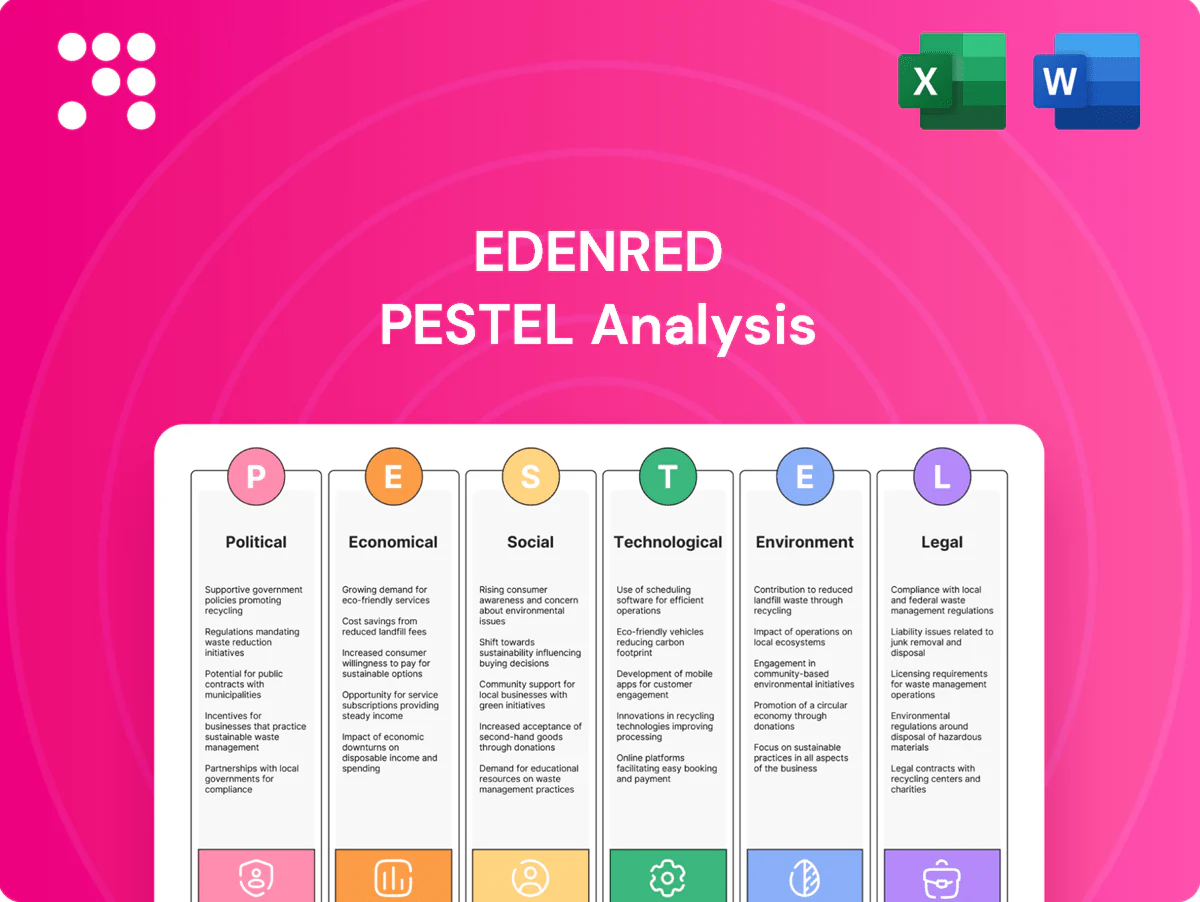
The preview shown here is the exact Edenred PESTLE Analysis report you’ll receive after purchase—fully formatted and ready to use. It contains the complete political, economic, social, technological, legal and environmental assessment with actionable insights for investors and strategists. No placeholders or teasers—this is the final file available for instant download.

Product Information
Product Information
Shipping & Returns
Shipping & Returns
Description
Your Competitive Advantage Starts with This Report
Get a concise PESTLE snapshot of Edenred—uncover the political, economic, social, technological, legal, and environmental forces shaping its trajectory. Use these insights to refine investment theses or strategic plans. Purchase the full PESTLE for the complete, editable analysis and actionable recommendations.
Political factors
Public benefits policy shifts
Government stances on employee welfare, food vouchers and mobility subsidies directly shape demand for Edenred’s solutions across its 46-country footprint, where it serves about 50 million users and 2 million corporate clients. Expansion of social support or meal programs typically increases issuance volumes and transaction activity. Conversely, austerity measures or policy reversals can quickly curtail benefits budgets and revenue. Close public-sector engagement helps hedge volatility across jurisdictions.
Regulatory fragmentation
Operating across 46 countries and serving over 50 million users and 2 million corporate clients, Edenred faces divergent rules on prepaid, vouchers and corporate payments that fragment its compliance landscape. This regulatory fragmentation raises operating costs and extends time-to-market as local licensing and supervision can add months to product rollouts. Strong regional partnerships have proven to smooth market entry and reduce rollout delays.
Central bank and CBDC direction
Monetary authorities worldwide—over 100 jurisdictions exploring CBDCs with roughly 20 in advanced pilot or launch stages—could reshape payment rails used by Edenred, making alignment with real-time schemes likely to lower transaction costs and settlement risk. CBDCs offer programmable benefit delivery for vouchers and payroll, but introduce new regulatory oversight and compliance burdens. Early pilots give Edenred opportunities to influence standards and interoperability.
Trade and geopolitical risk
Sanctions, political instability and currency controls disrupt cross-border supplier payments and merchant networks, forcing Edenred—present in 46 countries—to reroute transactions and absorb FX frictions; multinational clients can reallocate spend within days during crises. Geopolitical shocks also elevate fraud and compliance risks, increasing KYC and monitoring costs. Edenred must keep contingency routing, diversified geographies and near-real-time compliance.
- Sanctions impact: rapid payment rerouting
- Client behavior: spend shifts in days
- Operational need: contingency routing + geographic diversification
- Risk rise: higher fraud/compliance vigilance
Public procurement and lobbying
Winning public tenders for employee programs drives scale in key markets where Edenred operates in 46 countries, enabling network effects and higher merchant acceptance; transparent lobbying helps secure favorable definitions of specific-purpose payments that protect voucher/ticket models. Policy dialogues on financial inclusion position Edenred as a public-sector partner, while lobbying or procurement missteps risk reputational damage and contract loss.
- public-tenders: scale in 46-country network
- lobbying: protect specific-purpose payment definitions
- policy-dialogue: financial inclusion partner
- risk: reputational damage → contract loss
Govt welfare & voucher policies, CBDC pilots reshape prepaid networks across 46 countries
Government welfare and voucher policies across Edenred’s 46-country footprint directly drive issuance and transaction volumes for ~50 million users and 2 million corporate clients. Divergent local prepaid and payments rules raise compliance costs and slow rollouts, while CBDC pilots in ~100 jurisdictions (≈20 advanced) could lower settlement costs but add oversight. Sanctions and instability force routing contingencies and raise fraud/KYC spend.
| Metric | Value |
|---|---|
| Countries | 46 |
| Users | ~50 million |
| Corporate clients | ~2 million |
| CBDC jurisdictions | ~100 (≈20 advanced) |
What is included in the product
Detailed Word Document
Provides a concise PESTLE evaluation of Edenred across Political, Economic, Social, Technological, Environmental and Legal dimensions, using current data and trends to reveal threats, opportunities and forward-looking scenarios; formatted for easy insertion into business plans, investor materials and strategic reports.
Customizable Excel Spreadsheet
A compact, visually segmented Edenred PESTLE summary that clarifies external risks and market positioning for meetings and planning sessions, easily dropped into slides or shared across teams and editable for region- or business-line-specific notes.
Economic factors
Employment cycles
Employment cycles drive Edenred: each headcount expansion at client firms lifts card issuance and spend, historically correlating with double-digit growth in payment volumes during hiring surges (Edenred reported payment volumes up ~12% in expansion phases). Recessions trim benefits budgets and transactions; 2023–24 downturns saw sectoral spend dips. Counter-cyclical public support (e.g., wage subsidies) partially offset declines, while diversification across sectors steadies revenue.
Inflation and food prices
Rising food and transport costs — food +≈5% y/y and transport +≈8% y/y in 2024 H1 — push nominal ticket sizes for Edenred benefits higher, prompting employers to adjust benefit levels to preserve purchasing power. Margin impact hinges on Edenred fee structures and merchant agreements; indexation features can sustain usage but compress take rates if fees are fixed per voucher.
Interest rates and float income
Higher global policy rates (US fed funds ~5.25–5.50% and ECB deposit ~4.0% in 2024) boost yield on stored balances and settlement float for card-based platforms like Edenred, while subsequent rate cuts compress this ancillary income. Robust treasury risk management across USD, EUR and GBP is critical to hedge duration and FX exposure. Stable float improves cash conversion cycles and raises short-term investment capacity.
FX volatility
FX volatility affects Edenred through multi-currency flows across 46 countries, creating translation and transaction risk; Edenred reported processing over 3 billion transactions in 2024, amplifying exposure. Hedging programs and natural hedges mitigate earnings swings while pricing in local currencies preserves merchant acceptance. Volatility complicates cross-border corporate payments, increasing settlement time and FX costs.
- Translation risk: global footprint (46 countries)
- Transaction risk: 3+ billion transactions in 2024
- Mitigation: active hedging and local-currency pricing
- Impact: higher cross-border payment friction and FX costs
SME health and merchant density
Edenred’s platform performance hinges on a dense, healthy network of local merchants; World Bank data show SMEs represent about 90% of businesses and roughly 50% of global employment, making merchant health systemic to acceptance density. SME closures shrink acceptance points and hurt user satisfaction; targeted merchant incentives and fee relief have proven to sustain coverage. Data-driven onboarding and churn analytics speed network recovery after shocks.
- SME share: ~90% of firms, ~50% of employment (World Bank)
- Risk: SME closures reduce acceptance density and NPS
- Mitigant: targeted incentives, onboarding acceleration via data
Govt welfare & voucher policies, CBDC pilots reshape prepaid networks across 46 countries
Employment cycles drive volumes—hiring spikes lifted payment volumes ~12% in expansion phases while 2023–24 downturns cut sector spend. 2024 H1 inflation raised food ~5% and transport ~8%, increasing nominal ticket sizes and compressing fixed-fee take rates. Higher policy rates in 2024 (Fed 5.25–5.50%, ECB ~4.0%) boosted float income, while FX volatility across 46 countries and 3+ billion transactions raised hedging costs.
| Metric | 2024 |
|---|---|
| Payment volumes growth (expansion) | ~12% |
| Food inflation H1 | ~5% |
| Transport inflation H1 | ~8% |
| Fed / ECB rates | 5.25–5.50% / ~4.0% |
| Countries / txns | 46 / 3+ billion |
What You See Is What You Get
Edenred PESTLE Analysis
The preview shown here is the exact Edenred PESTLE Analysis report you’ll receive after purchase—fully formatted and ready to use. It contains the complete political, economic, social, technological, legal and environmental assessment with actionable insights for investors and strategists. No placeholders or teasers—this is the final file available for instant download.