ECN Capital PESTLE Analysis

Your Competitive Advantage Starts with This Report
Unlock strategic clarity with our PESTLE analysis of ECN Capital—three-plus years of macro trends distilled into actionable intelligence that highlights regulatory, economic, and technological forces shaping growth. Ideal for investors and strategists, this concise brief reveals risks and opportunities you can act on immediately. Purchase the full report to get the complete, editable breakdown and forecasting tools.
Political factors

US housing and consumer finance policy
Shifts in federal priorities on housing affordability, GSE support and manufactured housing can reshape demand and loan program structures; HUDs FY2024 appropriation (~71.6 billion) and FHA/VA insurance programs (combined portfolio >1.5 trillion) directly influence credit availability and dealer networks. Policy support for affordable housing boosts Triad origination volumes, while retrenchment could tighten capital and securitization flows. ECN must track agency directives and adapt origination criteria and underwriting quickly.
Energy-efficiency incentives and subsidies
Inflation Reduction Act home energy rebates, backed by a roughly $4.3 billion federal allocation, plus expanding state programs, are lifting demand for Service Finance’s home improvement loans. Political continuity influences funding cadence and contractor participation, affecting origination timing. Changes in rebate rules shift average ticket sizes and approval rates, so ECN should align loan terms and underwriting to evolving incentive eligibility.

State and provincial governance
US states (50) and Canadian provinces (10) plus 3 territories set licensing, rate caps and contractor consumer-protection rules that directly constrain ECN Capital’s lending and leasing products.
Fragmented regimes force tailored filings, disclosures and operational workflows for multi-state/province programs, increasing legal and operational complexity.
Frequent state-level elections and legislative cycles (every 2–4 years) can rapidly alter fee, cap and disclosure requirements.
Robust compliance programs and targeted state/provincial lobbying are essential to preempt adverse rulemaking and limit regulatory disruption.

Trade and cross-border capital flows
North American financial integration, reinforced by USMCA since 2020, lowers funding costs and broadens securitization investor pools; bilateral goods trade reached about US$1.1 trillion in 2023, supporting cross-border capital activity. Political tensions or tariff disputes can quickly dent capital markets sentiment, while cross-border data-transfer rules (privacy and localization) directly affect ECN Capital’s servicing operations; ECN benefits from stable US-Canada relations and diversified funding channels.
- USMCA: policy backbone
- US-Canada trade ~US$1.1T (2023)
- Data rules shape servicing
- Tariffs can shift investor sentiment
- ECN gains from diversified funding
Public infrastructure and disaster recovery spending
Federal and state resilience funding from the 2021 Infrastructure Investment and Jobs Act (IIJA, $1.2 trillion) and growing FEMA BRIC grants (now exceeding $1B annually) can boost home-improvement and weatherization financing, with post-storm political will accelerating grant and contractor activity. Program timing creates origination volatility; ECN can capture funded projects by partnering on approved contractor networks.
- IIJA: $1.2 trillion
- FEMA BRIC: >$1B/yr
- Post-storm political spikes in grants/contracting
- Origination volatility from program timing
- Strategy: partner with approved contractor networks
HUD, FHA/VA scale plus IRA/IIJA and trade reshape mortgage origination and securitization
Federal housing priorities, HUD FY2024 ~71.6B and FHA/VA portfolios >1.5T, shape ECN origination and securitization; IRA energy rebates (~4.3B) and IIJA (1.2T) drive home-improvement loan demand and timing; state/provincial licensing and rate caps fragment operations; US-Canada trade ~1.1T (2023) and BRIC >1B/yr affect funding and post-storm origination spikes.
| Policy | Key Figure |
|---|---|
| HUD FY2024 | ~71.6B |
| FHA/VA | >1.5T |
| IRA rebates | ~4.3B |
| IIJA | 1.2T |
| US-Canada trade (2023) | ~1.1T |
| FEMA BRIC | >1B/yr |
What is included in the product
 Detailed Word Document
Explores how macro-environmental factors uniquely affect ECN Capital across Political, Economic, Social, Technological, Environmental and Legal dimensions, with data-backed insights and forward-looking implications to support executives, investors and strategists in identifying risks, opportunities and actionable scenarios for planning and fundraising.

 Customizable Excel Spreadsheet
A concise, visually segmented ECN Capital PESTLE summary that fits into presentations or strategy packs, lets teams add region- or business‑specific notes, and clarifies external risks for fast alignment in planning and client reports.
Economic factors

Interest rate cycle and funding costs
Interest rate levels directly affect borrower affordability, approval rates and securitization spreads; with major central banks’ peak policy rates near 5.25–5.50% in 2024–25, origination tightened and spreads widened, pressuring yields. Rising rates compress margins unless pricing and loss expectations adjust; falling rates lift volumes but raise prepayment risk. Active hedging and dynamic pricing are essential to protect returns.
Housing affordability and demand
Manufactured housing demand strengthens when site-built homes are unaffordable: 30-year mortgage rates near 7% in 2024 pushed buyers toward lower-cost units, supporting Triad as manufactured home shipments rose about 15% year-over-year in 2024. Homeowner equity—roughly $28 trillion nationally—shapes appetite for financed improvements. Regional housing cycles drive dealer volume and credit performance, so ECN should tailor loan terms to local affordability metrics and vacancy trends.

Labor market and consumer credit health
Employment and wage growth—US unemployment ~3.7% and average hourly earnings +4.1% y/y (June 2025 BLS)—support repayment on home‑improvement and manufactured‑housing loans; deterioration lifts delinquencies and charge‑offs (bank credit card charge‑off ~3.8% Q1 2025), reducing investor appetite. Credit‑card servicing volumes track bank marketing spend and macro confidence. Stress testing portfolios to unemployment shocks (±1–3ppt) is essential.

Securitization and warehouse liquidity
Securitization access remains central to ECN Capital’s scale and cost of capital, with global ABS markets recovering to roughly USD 1.1 trillion in issuance in 2024 (SIFMA), supporting lower funding spreads. Volatile spreads in 2024 compressed deal windows and pushed variable coupons and tighter execution timing. Warehouse capacity and advance rates limited peak-season originations, while diversified lenders, staggered maturities and forward-flow commitments stabilized liquidity.
- ABS issuance ~USD 1.1T (2024)
- Spread volatility → timing/coupon shifts
- Warehouse limits constrain origination peaks
- Diversified funding + forward-flows = liquidity buffer
Inflation and contractor input costs
Inflation—US CPI 3.4% in 2024 per BLS—has pushed contractor input prices higher, expanding average project sizes and straining borrower DTI; BEA/PPI data showed construction input costs up about 5% in 2024, prompting more contractors to offer financing to close sales, raising loan volume and credit risk while increasing servicing and collections expenses.
- Higher project sizes: borrower DTI pressure
- Contractor-financing up: volume + risk
- Servicing/collections costs rise with inflation
- Mitigants: transparent pricing, contingency buffers
HUD, FHA/VA scale plus IRA/IIJA and trade reshape mortgage origination and securitization
Higher policy rates (~5.25–5.50% peak 2024–25) and 30‑yr mortgage ~7% (2024) compressed origination and widened spreads, raising margin pressure and hedging needs. Strong labor (unemployment ~3.7% June 2025) supports repayments but shocks raise delinquencies. ABS market recovery (USD 1.1T 2024) restored funding but spread volatility and warehouse limits constrain scale; CPI 3.4% (2024) lifted project costs.
| Metric | Value |
|---|---|
| Policy rate peak | 5.25–5.50% |
| 30‑yr mortgage | ~7% (2024) |
| Unemployment | ~3.7% (Jun 2025) |
| ABS issuance | USD 1.1T (2024) |
| CPI | 3.4% (2024) |
Full Version Awaits
ECN Capital PESTLE Analysis
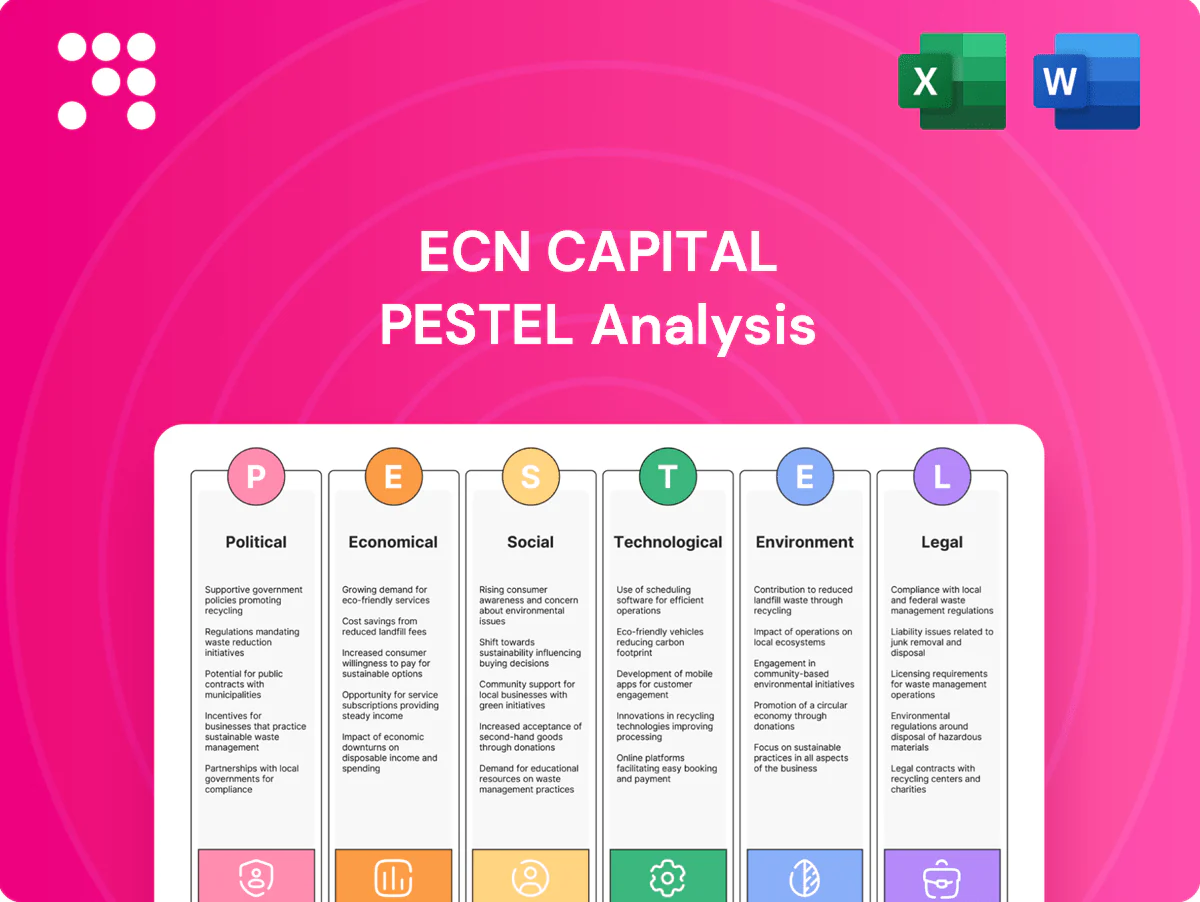
The ECN Capital PESTLE Analysis provides a concise, actionable assessment of political, economic, social, technological, legal, and environmental factors affecting the company. The preview shown here is the exact document you’ll receive after purchase—fully formatted and ready to use. No placeholders; the file is downloadable immediately upon purchase.

Original: $10.00
-65%$10.00
$3.50Product Information
Product Information
Shipping & Returns
Shipping & Returns
Description
Your Competitive Advantage Starts with This Report
Unlock strategic clarity with our PESTLE analysis of ECN Capital—three-plus years of macro trends distilled into actionable intelligence that highlights regulatory, economic, and technological forces shaping growth. Ideal for investors and strategists, this concise brief reveals risks and opportunities you can act on immediately. Purchase the full report to get the complete, editable breakdown and forecasting tools.
Political factors
US housing and consumer finance policy
Shifts in federal priorities on housing affordability, GSE support and manufactured housing can reshape demand and loan program structures; HUDs FY2024 appropriation (~71.6 billion) and FHA/VA insurance programs (combined portfolio >1.5 trillion) directly influence credit availability and dealer networks. Policy support for affordable housing boosts Triad origination volumes, while retrenchment could tighten capital and securitization flows. ECN must track agency directives and adapt origination criteria and underwriting quickly.
Energy-efficiency incentives and subsidies
Inflation Reduction Act home energy rebates, backed by a roughly $4.3 billion federal allocation, plus expanding state programs, are lifting demand for Service Finance’s home improvement loans. Political continuity influences funding cadence and contractor participation, affecting origination timing. Changes in rebate rules shift average ticket sizes and approval rates, so ECN should align loan terms and underwriting to evolving incentive eligibility.
State and provincial governance
US states (50) and Canadian provinces (10) plus 3 territories set licensing, rate caps and contractor consumer-protection rules that directly constrain ECN Capital’s lending and leasing products.
Fragmented regimes force tailored filings, disclosures and operational workflows for multi-state/province programs, increasing legal and operational complexity.
Frequent state-level elections and legislative cycles (every 2–4 years) can rapidly alter fee, cap and disclosure requirements.
Robust compliance programs and targeted state/provincial lobbying are essential to preempt adverse rulemaking and limit regulatory disruption.
Trade and cross-border capital flows
North American financial integration, reinforced by USMCA since 2020, lowers funding costs and broadens securitization investor pools; bilateral goods trade reached about US$1.1 trillion in 2023, supporting cross-border capital activity. Political tensions or tariff disputes can quickly dent capital markets sentiment, while cross-border data-transfer rules (privacy and localization) directly affect ECN Capital’s servicing operations; ECN benefits from stable US-Canada relations and diversified funding channels.
- USMCA: policy backbone
- US-Canada trade ~US$1.1T (2023)
- Data rules shape servicing
- Tariffs can shift investor sentiment
- ECN gains from diversified funding
Public infrastructure and disaster recovery spending
Federal and state resilience funding from the 2021 Infrastructure Investment and Jobs Act (IIJA, $1.2 trillion) and growing FEMA BRIC grants (now exceeding $1B annually) can boost home-improvement and weatherization financing, with post-storm political will accelerating grant and contractor activity. Program timing creates origination volatility; ECN can capture funded projects by partnering on approved contractor networks.
- IIJA: $1.2 trillion
- FEMA BRIC: >$1B/yr
- Post-storm political spikes in grants/contracting
- Origination volatility from program timing
- Strategy: partner with approved contractor networks
HUD, FHA/VA scale plus IRA/IIJA and trade reshape mortgage origination and securitization
Federal housing priorities, HUD FY2024 ~71.6B and FHA/VA portfolios >1.5T, shape ECN origination and securitization; IRA energy rebates (~4.3B) and IIJA (1.2T) drive home-improvement loan demand and timing; state/provincial licensing and rate caps fragment operations; US-Canada trade ~1.1T (2023) and BRIC >1B/yr affect funding and post-storm origination spikes.
| Policy | Key Figure |
|---|---|
| HUD FY2024 | ~71.6B |
| FHA/VA | >1.5T |
| IRA rebates | ~4.3B |
| IIJA | 1.2T |
| US-Canada trade (2023) | ~1.1T |
| FEMA BRIC | >1B/yr |
What is included in the product
Detailed Word Document
Explores how macro-environmental factors uniquely affect ECN Capital across Political, Economic, Social, Technological, Environmental and Legal dimensions, with data-backed insights and forward-looking implications to support executives, investors and strategists in identifying risks, opportunities and actionable scenarios for planning and fundraising.
Customizable Excel Spreadsheet
A concise, visually segmented ECN Capital PESTLE summary that fits into presentations or strategy packs, lets teams add region- or business‑specific notes, and clarifies external risks for fast alignment in planning and client reports.
Economic factors
Interest rate cycle and funding costs
Interest rate levels directly affect borrower affordability, approval rates and securitization spreads; with major central banks’ peak policy rates near 5.25–5.50% in 2024–25, origination tightened and spreads widened, pressuring yields. Rising rates compress margins unless pricing and loss expectations adjust; falling rates lift volumes but raise prepayment risk. Active hedging and dynamic pricing are essential to protect returns.
Housing affordability and demand
Manufactured housing demand strengthens when site-built homes are unaffordable: 30-year mortgage rates near 7% in 2024 pushed buyers toward lower-cost units, supporting Triad as manufactured home shipments rose about 15% year-over-year in 2024. Homeowner equity—roughly $28 trillion nationally—shapes appetite for financed improvements. Regional housing cycles drive dealer volume and credit performance, so ECN should tailor loan terms to local affordability metrics and vacancy trends.
Labor market and consumer credit health
Employment and wage growth—US unemployment ~3.7% and average hourly earnings +4.1% y/y (June 2025 BLS)—support repayment on home‑improvement and manufactured‑housing loans; deterioration lifts delinquencies and charge‑offs (bank credit card charge‑off ~3.8% Q1 2025), reducing investor appetite. Credit‑card servicing volumes track bank marketing spend and macro confidence. Stress testing portfolios to unemployment shocks (±1–3ppt) is essential.
Securitization and warehouse liquidity
Securitization access remains central to ECN Capital’s scale and cost of capital, with global ABS markets recovering to roughly USD 1.1 trillion in issuance in 2024 (SIFMA), supporting lower funding spreads. Volatile spreads in 2024 compressed deal windows and pushed variable coupons and tighter execution timing. Warehouse capacity and advance rates limited peak-season originations, while diversified lenders, staggered maturities and forward-flow commitments stabilized liquidity.
- ABS issuance ~USD 1.1T (2024)
- Spread volatility → timing/coupon shifts
- Warehouse limits constrain origination peaks
- Diversified funding + forward-flows = liquidity buffer
Inflation and contractor input costs
Inflation—US CPI 3.4% in 2024 per BLS—has pushed contractor input prices higher, expanding average project sizes and straining borrower DTI; BEA/PPI data showed construction input costs up about 5% in 2024, prompting more contractors to offer financing to close sales, raising loan volume and credit risk while increasing servicing and collections expenses.
- Higher project sizes: borrower DTI pressure
- Contractor-financing up: volume + risk
- Servicing/collections costs rise with inflation
- Mitigants: transparent pricing, contingency buffers
HUD, FHA/VA scale plus IRA/IIJA and trade reshape mortgage origination and securitization
Higher policy rates (~5.25–5.50% peak 2024–25) and 30‑yr mortgage ~7% (2024) compressed origination and widened spreads, raising margin pressure and hedging needs. Strong labor (unemployment ~3.7% June 2025) supports repayments but shocks raise delinquencies. ABS market recovery (USD 1.1T 2024) restored funding but spread volatility and warehouse limits constrain scale; CPI 3.4% (2024) lifted project costs.
| Metric | Value |
|---|---|
| Policy rate peak | 5.25–5.50% |
| 30‑yr mortgage | ~7% (2024) |
| Unemployment | ~3.7% (Jun 2025) |
| ABS issuance | USD 1.1T (2024) |
| CPI | 3.4% (2024) |
Full Version Awaits
ECN Capital PESTLE Analysis
The ECN Capital PESTLE Analysis provides a concise, actionable assessment of political, economic, social, technological, legal, and environmental factors affecting the company. The preview shown here is the exact document you’ll receive after purchase—fully formatted and ready to use. No placeholders; the file is downloadable immediately upon purchase.